Google Discover Search Console Reporting Bug
Google posted that there was a data logging issue with Google Discover traffic and Google Search Console. Because of that, Google performance reports for Discover traffic starting on May 12th and ongoing might be off. Google said “you might see a signi…
Google Hotel Ads: Commissions (Per Stay) & Free Cancellation Filters
Google announced for hotel ads they are now opening the commission (per stay) program for global participation for all Google Ads hotel advertisers. In addition, Google Hotel Ads can now be filtered by free cancellations or not.
Google Search Tests Topic Related To Jobs Box
SEMRush shared a screen shot of a new Google search user interface test that comes up with the Google Job Search feature. If you search for job related queries and Google jobs comes up in search, Google may show you “topic related to jobs” on the top r…
Google: Ask Yourself If Your Site Is The Best Result For The Query
A site owner said that after getting hit by a core update in March 2019, he is going to have to shut down his site. John Mueller of Google responded to that saying “I recommend taking a look at the top queries & top pages from before & after a change, and asking yourself if your site is really the best result for those.”
New SEO Tool: Was There A Google Update Search Site
I am proud to say this site has the most comprehensive and largest database of tracking both confirmed and unconfirmed Google search updates of all sites. But sometimes finding these updates by browsing through the archives section can be tedious. So…
Google Search Console Adds Guided Recipes Support & Reports
Google Search Console has added support for guided recipes. Guided recipes are step by step instructions on how to complete a recipe in Google Search and on Google Assistant. There is a new enhancement report for guided recipes in Google Search Consol…
Bing Webmaster Tools Adds More Features To New Version
In February, Bing announced the new version of Bing Webmaster Tools. Yesterday at SMX London, Fabrice Canel of Microsoft announced three new features that migrated over to the tool. The three features that were migrated from the old to the new version…
Google Is Working On Something Related To Nofollow Link Change
We know that Google made a change to the nofollow link policy, that starting on March 1, 2020, Google can look at a nofollow link attribute as a hint and not as a directive. But since then, it seems Google did not make any real change to search since…
Bing Yes Or No Questions & Expands Intelligent Answers Globally
Bing can now answer some yes or no questions – which is incredibly cool. Bing announced that it deployed large neural network models that allows it to answer yes or no questions, expand its intelligent answers globally and better understand complex an…
4 Reasons Your New Page Isn’t Getting Traffic
Picture this: you’ve done the heavy lifting to get a new page live and you’re ready to share it with the world! A few days go by and you check performance, but you’re not getting any sessions. Or maybe the amount of traffic you’re getting isn’t exactly up to par with what you were expecting.…
The post 4 Reasons Your New Page Isn’t Getting Traffic appeared first on Seer Interactive.
Rethink Link Building in 2020
On the heels of a NoFollow announcement from Google in late 2019, a core algorithm update in January, a major SERP change, and of course, the search landscape changing due to COVID-19, what’s next for link building? Changing our perspective on how we build links should start to shift from creating context to generating revenue.…
The post Rethink Link Building in 2020 appeared first on Seer Interactive.
Free resources to grow your business during lockdown
Adapting to change is the way forward. Free online resources add value, promote business growth and improve marketing strategies during and after the pandemic.
The post Free resources to grow your business during lockdown appeared first on Search Engine Watch.
Preparing for Post-Lockdown Traffic: Sports Betting, Fast Fashion and Staycations
The world has been hit by a pandemic. Highstreets are closed down and every business in the world has had to quickly adapt to remote working and online trading to avoid becoming a sinking ship. Jack Cornwall looks into the businesses that will bounce back after the lockdown ends.
Throughout the 6 months (or so) of lockdown, there have been a myriad of lucky businesses that have found great success online due to their offering being a form of commodity that benefits those at home (with lots of free time on their hands) or an essential product/service needed for those settling into working from home.
Post from Blueclaw
Empathetic content marketing falls flat without authenticity [Video]
During COVID, marketers can still cut through the noise and reach audiences by rethinking what it means to be empathetic.
Please visit Search Engine Land for the full article.
When Will Google Try Your 410 Page? It Depends.
John Mueller of Google said there is no fixed timeframe or duration for when Google will try to crawl and index a page that was returning a 410 status code. He said on Twitter “there’s no fixed duration” for that.
Google May 2020 Core Update 100% Rolled Out
Google has finished rolling out the Google May 2020 core update yesterday. Google posted about this yesterday, May 18, 2020 at 12:37pm ET. That makes for a full-two week roll out, which began on May 4, 2020 in the afternoon.
10 Ways to Evaluate a Company’s Commitment to their Employees
Which Companies Care for Employees?
When entering the job market, even during difficult times, it’s important to vet prospective employers. This habit is second nature to many of us–we hit a company’s Glassdoor page when we see they’re hiring, browse their site for a bit, and fire off an application.…
The post 10 Ways to Evaluate a Company’s Commitment to their Employees appeared first on Seer Interactive.
11 Tactics To Build a Strong Narrative in SEO Reports
Building Narratives In SEO Reports
As SEOs, reporting is a big part of our day-to-day responsibilities. At Seer, we talk a lot about data storytelling (using psychology to improve data visualizations) but it’s important to remember that visuals are only half of a report.…
The post 11 Tactics To Build a Strong Narrative in SEO Reports appeared first on Seer Interactive.
Google Translate’s Website Translator – available for non-commercial use
In this time of a global pandemic, webmasters across the world—from government officials to health organizations—are frequently updating their websites with the latest information meant to help fight the spread of COVID-19 and provide access to resources. However, they often lack the time or funding to translate this content into multiple languages, which can prevent valuable information from reaching a diverse set of readers. Additionally, some content may only be available via a file, e.g. a .pdf or .doc, which requires additional steps to translate.
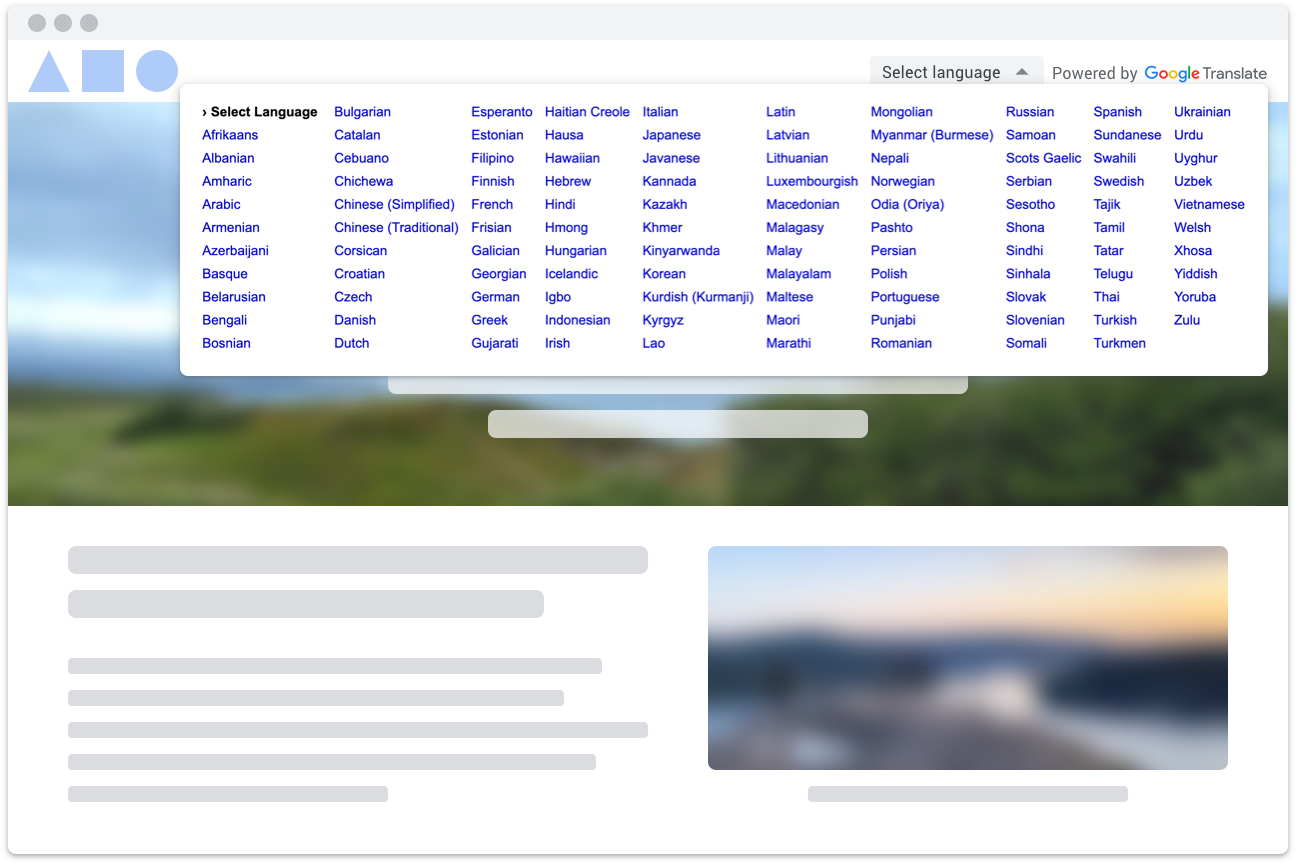
To help these webmasters reach more users, we’re reopening access to the Google Translate Website Translator—a widget that translates web page content into 100+ different languages. It uses our latest machine translation technology, is easy to integrate, and is free of charge. To start using the Website Translator widget, sign up here.
Please note that usage will be restricted to government, non-profit, and/or non-commercial websites (e.g. academic institutions) that focus on COVID-19 response. For all other websites, we recommend using the Google Cloud Translation API.
Google Translate also offers both webmasters and their readers a way to translate documents hosted on a website. For example, if you need to translate this PDF file into Spanish, go to translate.google.com and enter the file’s URL into the left-hand textbox , then choose “Spanish” as the target language on the right. The link shown in the right-hand textbox will take you to the translated version of the PDF file. The following file formats are supported: .doc, .docx, .odf, .pdf, .ppt, .pptx, .ps, .rtf, .txt, .xls, or .xlsx.
Finally, it’s very important to note that while we continuously look for ways to improve the quality of our translations, they may not be perfect – so please use your best judgement when reading any content translated via Google Translate.
Posted by Xinxing Gu, Product Manager/Mountain View, CA, and Michal Lahav, User Experience Research/ Seattle, WA


18 Resources to Help You Level Up Your SEO Skills
One thing about SEO that’s really exciting but also challenging is how quickly things change. When I took three months off for maternity leave in 2014, I returned to Seer to learn that Google launched the Pigeon update to improve local search results.…
The post 18 Resources to Help You Level Up Your SEO Skills appeared first on Seer Interactive.