Frequently asked questions about JavaScript and links
We get lots of questions every day – in our Webmaster office hours, at conferences, in the webmaster forum and on Twitter. One of the more frequent themes among these questions are links and especially those generated through JavaScript.
In our Webmaster Conference Lightning Talks video series, we recently addressed the most frequently asked questions on Links and JavaScript:
Note: This video has subtitles in many languages available, too.
During the live premiere, we also had a Q&A session with a few additional questions from the community and decided to publish those questions and our answers along with some other frequently asked questions around the topic of links and JavaScript.
What kinds of links can Googlebot discover?
Googlebot parses the HTML of a page, looking for links to discover the URLs of related pages to crawl. To discover these pages, you need to make your links actual HTML links, as described in the webmaster guidelines on links.
What kind of URLs are okay for Googlebot?
Googlebot extracts the URLs from the href attribute of your links and then enqueues them for crawling. This means that the URL needs to be resolvable or simply put: The URL should work when put into the address bar of a browser. See the webmaster guidelines on links for more information.
Is it okay to use JavaScript to create and inject links?
As long as these links fulfill the criteria as per our webmaster guidelines and outlined above, yes.
When Googlebot renders a page, it executes JavaScript and then discovers the links generated from JavaScript, too. It’s worth mentioning that link discovery can happen twice: Before and after JavaScript executed, so having your links in the initial server response allows Googlebot to discover your links a bit faster.
Does Googlebot understand fragment URLs?
Fragment URLs, also known as “hash URLs”, are technically fine, but might not work the way you expect with Googlebot.
Fragments are supposed to be used to address a piece of content within the page and when used for this purpose, fragments are absolutely fine.
Sometimes developers decide to use fragments with JavaScript to load different content than what is on the page without the fragment. That is not what fragments are meant for and won’t work with Googlebot. See the JavaScript SEO guide on how the History API can be used instead.
Does Googlebot still use the AJAX crawling scheme?
The AJAX crawling scheme has long been deprecated. Do not rely on it for your pages.
The recommendation for this is to use the History API and migrate your web apps to URLs that do not rely on fragments to load different content.
Stay tuned for more Webmaster Conference Lightning Talks
This post was inspired by the first installment of the Webmaster Conference Lightning Talks, but make sure to subscribe to our YouTube channel for more videos to come! We definitely recommend joining the premieres on YouTube to participate in the live chat and Q&A session for each episode!
If you are interested to see more Webmaster Conference Lightning Talks, check out the video Google Monetized Policies and subscribe to our channel to stay tuned for the next one!
Join the webmaster community in the upcoming video premieres and in the YouTube comments!
Posted by Martin Splitt, Googlebot whisperer at the Google Search Relations team


Celebrating 10 years of Yoast: 20% off everything!
Woohoo! Yoast’s 10th birthday is coming up on the 28th of May 2020! You might have seen our celebration calendar over the last month, where we’ve taken a trip down memory lane. And we’re so happy that you’re along for the ride. As a thank you, we’d love to give you a gift: for the […]
The post Celebrating 10 years of Yoast: 20% off everything! appeared first on Yoast.
Yoast SEO 14.2: Russian word forms in beta
Our linguists are busy bees lately. Over the last couple of releases, we’ve launched word form support for Yoast SEO Premium users writing in Spanish and French. These languages follow the languages that already had word form support: English, German and Dutch. In Yoast SEO 14.2, we’re adding yet another language: Russian! And, once again, […]
The post Yoast SEO 14.2: Russian word forms in beta appeared first on Yoast.
Google Alerts for Link Building: A Quick and Easy Guide
Posted by David_Farkas
If you’re a link builder, you know how tough it can be to persuade other site owners to link to your site with “out-of-the-blue” pitches. This is true even if you have great content or have been building links for years.
That’s why the mantra “link building is relationship building” exists. Often, before you build a link, you have to build a relationship with the site owner first. This means anything from following them on Twitter, commenting mindfully on their posts, writing emails to them to discuss their content without pitching links, etc. It’s a productive strategy, but also a time-intensive one.
However, there’s another — relatively quick — link building strategy.
Is your ear itching? If you’re the superstitious type, this means that someone is talking about you.
Sometimes a webmaster will publish your brand name, products, or target keywords on their site without actually linking to your site. In SEO, these are known as “fresh mention” opportunities. These are typically some of the easiest link building opportunities available, since you don’t really have to explain yourself to the site owner. Mostly, you just have to ask them to put an <a href> tag in the code.
But how do you find these fresh mentions? There are multiple methods and tools, but today I’m going to highlight the one I use most often: Google Alerts.
Google Alerts is beneficial in a myriad of ways beyond the world of link building and SEO, but there’s no doubt that it’s the best way to stay on top of your fresh mention opportunities. Allow me to explain how you can use it!
Setting up Google Alerts
First off, the obvious: you need the correct link. To start using Google Alerts, head over to Google Alerts. You can technically set up alerts without a Gmail account, but I would recommend having one. If you don’t have one, click here to find out how to set one up.
When you have an account set up and land on Google Alerts, you will see a page that looks like this:

No, there’s not much to see. Not yet anyway.
Let’s take a basic example. Say you want to create an alert for mentions of link building. Simply type the phrase into the bar at the top.

You will see something similar to the image above, even before you click on anything else. The first box asks for which email address you want to receive the alerts (I’ve erased mine for the purpose of this article, but trust me, it’s there). Below that will be examples of recent alerts for your query.
Click the “Create Alert” button, and alerts will be sent to your selected inbox going forward. However, you can customize a few settings before you do so. Click the “Show options” dropdown next to the button to see a list of settings you can adjust:

Each item is auto-filled with the default setting. You can adjust the settings so that you only get alerts from specific regions, for certain types of content, and more. In general, I have found the default settings to suffice, but there are valid reasons you might want to change them (if you’re only interested in video content, for example).
When you’re done with the settings, you can create the alert!
Google Alert tips
Quotation Marks
From that point on, assuming you stuck with the default option of once-a-day emails, you’ll get an email every 24 hours that looks like this:

Notice the returns in this example include pages that talk about each individual word from your query (in this example the word “link” and the word “building”). Obviously, this isn’t helpful, and it’s a waste of time to sift through these results.
So, how can you make sure that you only get results for an exact phrase? Quotation marks!
I (intentionally) made this mistake when setting up this alert. Notice in the image from the first section that “link building” didn’t include quotation marks around it. Without them, Google Alerts will return results like the ones in the image above.
The quotation marks indicate that you’re looking for an exact match of that phrase, so when you set up an alert using them you will get something that looks like this:

Much better, right?
Note that you can combine terms with and without quotation marks in one alert. Say for example I was looking for content related to link building around images. Instead of “link building images,” a phrase not likely to occur too often, I could use:

This will return results that include both the exact phrase “link building” AND the term “images”.
Set up multiple alerts
If you’re using Google Alerts for link building, I recommend setting up more than one alert. Consider some of the following:
- Your brand name
- Your products or services
- Your focus keywords
- Personalities associated with your brand
If you’re concerned about all the emails flooding your inbox, adjust the settings to decrease the frequency or stagger delivery days. You can also set up a separate Gmail account that only serves to receive these emails. I personally find the former to be the better option, but I know people who do the latter.
Consider setting up alerts for your competitors as well. Doing so may give you a window into their link building and publicity strategies that you can learn from. Along with that, you might find new potential target sites that aren’t mentioning you. If they mention your competitor, it’s likely they are relevant to your niche.
Also include common misspellings of any of the list items above. While Google’s algorithm is typically smart enough to correct such misspellings in its search, a few valuable results may seep through even still.
Conclusion
Google Alerts can be helpful for other purposes other than link building. Certainly, if you’re engaged in an online reputation management campaign, they’re a necessity. Some use Alerts to track the kind of publicity their competitors are getting as well.
There are other excellent link building tools out there that can complement your “fresh mention” strategy if you are a link builder, but Google Alerts is an essential. I hope you find Google Alerts as helpful for link building as I have. If you have other tools or suggestions, please mention them in the comments below.
Sign up for The Moz Top 10, a semimonthly mailer updating you on the top ten hottest pieces of SEO news, tips, and rad links uncovered by the Moz team. Think of it as your exclusive digest of stuff you don’t have time to hunt down but want to read!
Facebook Shops: Up next on Live with Search Engine Land
Facebook CEO Mark Zuckerberg calls Facebook Shops “the biggest step” the company has taken to unify e-commerce across its family of apps. Let’s talk about that.
Please visit Search Engine Land for the full article.
Memorial Day Day Logos From Google, Yahoo & Bing
Today is Memorial Day in the United States and the search engines; including Google, Yahoo and Bing have dressed up for the day. Google has historically done nothing for the day, but last year they went with a grayed out logo and flag theme. They did …
Vlog #68: Hillel Fuld On Helping Others Win In Business
Hillel Fuld (@HilzFuld) is someone I’ve known for a long time. He isn’t an SEO but he is super well connected with everyone I know in Israel and has a speciality in helping Israel start ups succeed. He also has helped me with SMX Israel in terms of f…
Three Steps to a Better-Performing About Page
Posted by AnnSmarty
Somehow, many businesses I’ve come across online have one glaring problem in common: a very weak and unconvincing About Us page.
This doesn’t make any sense in my mind, as the About page is one of the most important brand assets, and unlike link building and social media marketing, it doesn’t require any ongoing effort or investment.
An About page is often part of a buying journey. It can drive people to your site and help convince them to deal with you. And, in these uncertain times, you can use it to help build trust in you and your business.
Creating a solid About page is a one-time task, but it will boost both brand loyalty and conversions for many months to come.
Why is your About page so important?
It is often an entry page
Whether you’re a business owner or blogger, your About page tends to rank incredibly well for brand-driven search queries (those that contain your name or your brand name). If nothing else, it shows up in your sitelinks:

Or your mini-sitelinks:

This means your customers will often enter your site through your About page. Is it making a good first impression to convince them to browse your site further (or engage)?
Let’s not forget that branded queries have high intent, because people typing your brand name in the search box already know you or have heard about your products. Failing to meet their needs equals a missed opportunity.
It is often a conversion trigger (and more)
How often have you checked a business’s About page before buying anything from them? I always do, especially if it’s a new brand I haven’t heard of before.
Or maybe it’s not even about buying.
Anytime someone approaches me with a quote or an interview request, I always check their About page. I refuse to deal with bloggers who don’t take themselves seriously.
Likewise, I often look to the About page when trying to find a press contact to feature a tool in my article.
On a personal level, I always open an About page to find a brand’s social media profiles when I want to follow them.
A lack of a detailed, well-structured About page often means leaked conversions as well as missed backlinks or follows.
It is an important entity optimization asset
We don’t know exactly how Google decides whether a site can be considered a brand, but we have well-educated theories so we can help Google in making this decision. The About page is a perfect entity optimization asset.
First, what we know: An About page is mentioned in Google’s human rating guidelines as one of the ways to determine the “expertise, authoritativeness and trustworthiness”, or E-A-T, of any page.
Human raters don’t have a direct impact on search results, but their assessments are used to teach Google’s algorithm to better rank pages. So if the About page comes up in their guidelines, it’s likely they use it as a ranking signal.
Second, Google is using information you choose to put on your About page to put your business inside their knowledge base, so it’s important to include as much detail as you can.
With all of this in mind, how should you put together a great About page?
1. Start strong
This step is not unique to this particular page, but that doesn’t make it any less important.
Treat your About page as a business card: People should be willing to learn more as soon as they see it. Your page should be eye-catching and memorable, and grab attention at first sight without the need to scroll down.
For example, Cisco starts with a powerful picture and message:

Nextiva starts with their main tagline:

Slack tells us exactly what they are doing and sums up its most impressive stats:

Telling your brand’s story is a great way to make your About page more memorable and relatable. Terminus does a very good job at starting their page with some history about the company that leaves you wanting to know more:

And Zoom starts with a video and a list of the company’s values:

Starting your page with a quick, attention-grabbing video is probably the best idea because video has been proven to convince visitors to linger a little bit longer and start engaging with the page.
You can create a short and professional video within minutes using web-based video editors like InVideo (in fact, InVideo is probably the most affordable solution I’m aware of).
To create a video intro using InVideo:
- Pick a template
- Upload your images and videos (or use the ones inside the platform)
- Edit subtitles to tell your brand’s story
- Add music or a voiceover
It’ll take you just 30 minutes to create a captivating video to put on your landing page:

2. Link your brand to other entities
With all that Google-fueled nonsense going around about nofollowing external links, or even linking out in general, marketers and bloggers tend to forget about one important thing: A link is the only way for Google to crawl the web.
More than that, Google needs links to:
- Understand how well-cited (and hence authoritative) any page is
- Create a map of sites, entities behind them, and concepts they represent
This is where linking out to other “entities” (e.g. brands, organizations, places, etc.) is so important: it helps Google identify your place within their own knowledge base.
To give you some ideas, make sure to link to:
- Your company’s professional awards
- Your featured mentions
- Conferences you were/are speaking at
For personal blogs, feel free to include references to your education, past companies you worked for, etc.
To give you a quick example of how useful this may turn out to be, here’s my own Google Knowledge Graph:

How did I get it?
To start, “Shorty Awards” is Google’s recognized entity. When I was nominated, I linked to that announcement from my blog, so Google connected me to the entity and generated a branded Knowledge Graph.
This nomination is hardly my only — or even most notable — accomplishment, but that’s all Google needed to put me on the map.
Google may know you exist, but without making a connection to a known entity, you can’t become one yourself. So start by making those associations using your About page.
To help Google even more, use semantic analysis to create copy containing related concepts and entities:
- Register at Text Optimizer and type in your core keyword (something that describes your business model/niche in the best possible way)
- Choose Google and then “New Text”
Text Optimizer will run your query in Google, grab search snippets, and apply semantic analysis to generate the list of related concepts and entities you should try and include in your content. This will make it easier for Google to understand what your business is about and what kinds of associations it should be building:

Using some structured markup is also a good idea to help Google connect all the dots. You can point Google to your organization’s details (date it was founded, founder’s name, type of company, etc.) as well as some more details including official social media channels, awards, associated books, and more.
Here are a few useful Schema generators to create your code:

For Wordpress users, here are a few plugins to help with Schema integration.
3. Include your CTA
Most About pages I’ve had to deal with so far have one issue in common: It’s unclear what users are supposed to do once they land there.
Given the page role in the buying journey (customers may be entering your site through it or using it as a final research touchpoint), it is very important to help them proceed down your conversion channel.
Depending on the nature of your business, include a CTA to:
- Request a personal demo
- Contact you
- Check out your catalogue
- Talk to your chatbot
- Opt-in to receive your downloadable brochure or newsletter
Apart from your CTAs, there are helpful ways to make your About page easier to navigate from. These include:
- Breadcrumb navigation
- “Skip” navigation links (which are essential for accessibility, too)
Whatever you do, start treating your About page as a commercial landing page, not just a resource for information about your business. Turn it into a conversion funnel, and this includes monitoring that funnel.
On Wordpress, you can set up each link or button on your About page as an event to track using Finteza’s plugin. This way, you’ll be able to tell which of those CTAs bring in more customers and which are leaking conversions.
Finteza allows you to keep a close eye on your conversion funnel and analyze its performance based on traffic source, user location, and more.
For example, here’s us tracking all kinds of “Free Download” buttons. It’s obvious that the home page has many more entries, but the About page seems to do a better job at getting its visitors to convert:

[I am using arrows to show “leaked” clicks. The home page us obviously losing more clicks than the “About” page]
You can absolutely use Google Analytics to analyze your conversion funnel and user journeys once they land on your About page, but it will require some setup. For help, read about Google Analytics Attribution and Google Analytics Custom Dimensions — both resources are helpful in uncovering more insights with Google Analytics, beyond what you would normally monitor.
Like any other top- and middle-of-the-funnel pages, you’re welcome to reinforce your CTA by using social proof (recent reviews, testimonials, featured case studies, etc.). Here are a few ideas for placing testimonials.
Takeaways
Creating and optimizing your About page is a fairly low-effort initiative, especially if you compare it with other marketing tasks. Yet it can bring about several positive changes, like more trust in your brand and better conversion rates.
You should treat this page as a business card: It needs to create a very good impression in an instant. Put something attention-grabbing and engaging in the above-the-fold area — for example, a quick video intro, a tagline, or a photo.
Consider using links, semantic analysis, and structured markups to help Google associate your brand with other niche entities, and put it into its knowledge base.
Add CTAs (and experiment with different kinds of CTAs) to prompt your page visitors to follow your conversion funnel. An About page is often an underestimated, yet a very important part of your customers’ buying journeys, so make sure it’s clear where you want them to proceed.
Thanks for reading, hope it was helpful, let me know your thoughts/questions in the comments. Let’s discuss!
Sign up for The Moz Top 10, a semimonthly mailer updating you on the top ten hottest pieces of SEO news, tips, and rad links uncovered by the Moz team. Think of it as your exclusive digest of stuff you don’t have time to hunt down but want to read!
Replay: Experts discuss Google Shopping on Live with Search Engine Land
We’ll talk about what we’re seeing in the market, customer challenges and successes and what retailers and brand marketers should focus on now.
Please visit Search Engine Land for the full article.
How to Read Google Algorithm Updates
Links = Rank
Old Google (pre-Panda) was to some degree largely the following: links = rank.
Once you had enough links to a site you could literally pour content into a site like water and have the domain’s aggregate link authority help anything on that site rank well quickly.
As much as PageRank was hyped & important, having a diverse range of linking domains and keyword-focused anchor text were important.
Brand = Rank
After Vince then Panda a site’s brand awareness (or, rather, ranking signals that might best simulate it) were folded into the ability to rank well.
Panda considered factors beyond links & when it first rolled out it would clip anything on a particular domain or subdomain. Some sites like HubPages shifted their content into subdomains by users. And some aggressive spammers would rotate their entire site onto different subdomains repeatedly each time a Panda update happened. That allowed those sites to immediately recover from the first couple Panda updates, but eventually Google closed off that loophole.
Any signal which gets relied on eventually gets abused intentionally or unintentionally. And over time it leads to a “sameness” of the result set unless other signals are used:
Google is absolute garbage for searching anything related to a product. If I’m trying to learn something invariably I am required to search another source like Reddit through Google. For example, I became introduced to the concept of weighted blankets and was intrigued. So I Google “why use a weighted blanket” and “weighted blanket benefits”. Just by virtue of the word “weighted blanket” being in the search I got pages and pages of nothing but ads trying to sell them, and zero meaningful discourse on why I would use one
Getting More Granular
Over time as Google got more refined with Panda broad-based sites outside of the news vertical often fell on tough times unless they were dedicated to some specific media format or had a lot of user engagement metrics like a strong social network site. That is a big part of why the New York Times sold About.com for less than they paid for it & after IAC bought it they broke it down into a variety of sites like: Verywell (health), the Spruce (home decor), the Balance (personal finance), Lifewire (technology), Tripsavvy (travel) and ThoughtCo (education & self-improvement).
Penguin further clipped aggressive anchor text built on low quality links. When the Penguin update rolled out Google also rolled out an on-page spam classifier to further obfuscate the update. And the Penguin update was sandwiched by Panda updates on either side, making it hard for people to reverse engineer any signal out of weekly winners and losers lists from services that aggregate massive amounts of keyword rank tracking data.
So much of the link graph has been decimated that Google reversed their stance on nofollow to where in March 1st of this year they started treating it as a hint versus a directive for ranking purposes. Many mainstream media websites were overusing nofollow or not citing sources at all, so this additional layer of obfuscation on Google’s part will allow them to find more signal in that noise.
May 4, 2020 Algo Update
On May 4th Google rolled out another major core update.
Later today, we are releasing a broad core algorithm update, as we do several times per year. It is called the May 2020 Core Update. Our guidance about such updates remains as we’ve covered before. Please see this blog post for more about that:https://t.co/e5ZQUAlt0G— Google SearchLiaison (@searchliaison) May 4, 2020
I saw some sites which had their rankings suppressed for years see a big jump. But many things changed at once.
Wedge Issues
On some political search queries which were primarily classified as being news related Google is trying to limit political blowback by showing official sites and data scraped from official sites instead of putting news front & center.
“Google’s pretty much made it explicit that they’re not going to propagate news sites when it comes to election related queries and you scroll and you get a giant election widget in your phone and it shows you all the different data on the primary results and then you go down, you find Wikipedia, you find other like historical references, and before you even get to a single news article, it’s pretty crazy how Google’s changed the way that the SERP is intended.”
That change reflects the permanent change to the news media ecosystem brought on by the web.
The Internet commoditized the distribution of facts. The “news” media responded by pivoting wholesale into opinions and entertainment.— Naval (@naval) May 26, 2016
YMYL
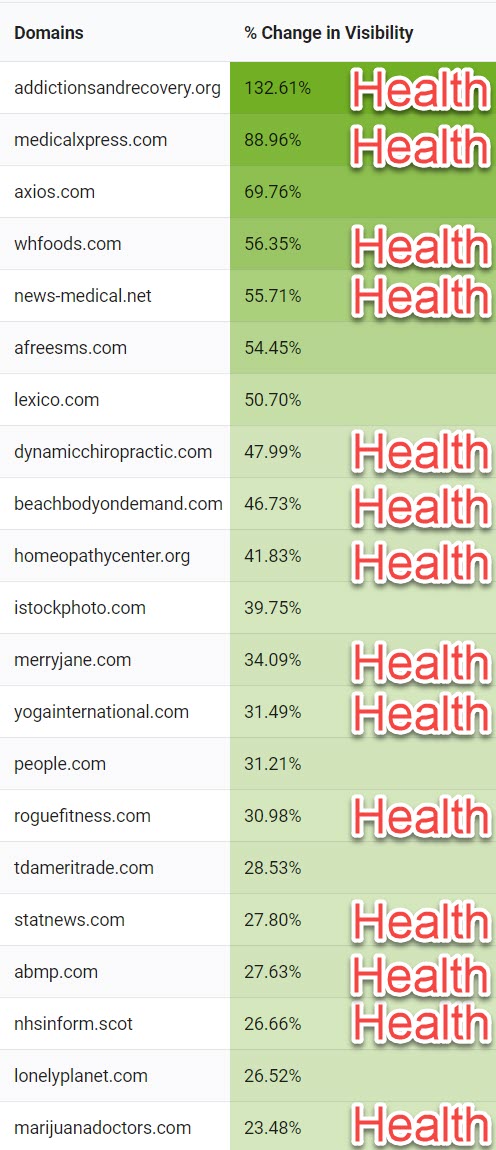
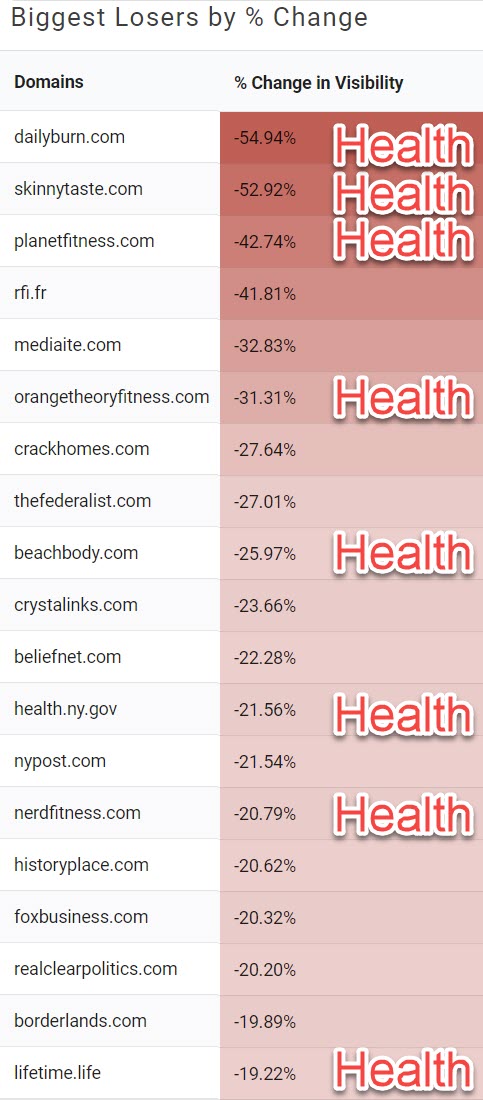
A blog post by Lily Ray from Path Interactive used Sistrix data to show many of the sites which saw high volatility were in the healthcare vertical & other your money, your life (YMYL) categories.
Aggressive Monetization
One of the more interesting pieces of feedback on the update was from Rank Ranger, where they looked at particular pages that jumped or fell hard on the update. They noticed sites that put ads or ad-like content front and center may have seen sharp falls on some of those big money pages which were aggressively monetized:
Seeing this all but cements the notion (in my mind at least) that Google did not want content unrelated to the main purpose of the page to appear above the fold to the exclusion of the page’s main content! Now for the second wrinkle in my theory…. A lot of the pages being swapped out for new ones did not use the above-indicated format where a series of “navigation boxes” dominated the page above the fold.
The above shift had a big impact on some sites which are worth serious money. Intuit paid over $7 billion to acquire Credit Karma, but their credit card affiliate pages recently slid hard.
Credit Karma lost 40% traffic from May core update. That’s insane, they do major TV ads and likely pay millions in SEO expenses. Think about that folks. Your site isn’t safe. Google changes what they want radically with every update, while telling us nothing!— SEOwner (@tehseowner) May 14, 2020
The above sort of shift reflects Google getting more granular with their algorithms. Early Panda was all or nothing. Then it started to have different levels of impact throughout different portions of a site.
Brand was sort of a band aid or a rising tide that lifted all (branded) boats. Now we are seeing Google get more granular with their algorithms where a strong brand might not be enough if they view the monetization as being excessive. That same focus on page layout can have a more adverse impact on small niche websites.
One of my old legacy clients had a site which was primarily monetized by the Amazon affiliate program. About a month ago Amazon chopped affiliate commissions in half & then the aggressive ad placement caused search traffic to the site to get chopped in half when rankings slid on this update.
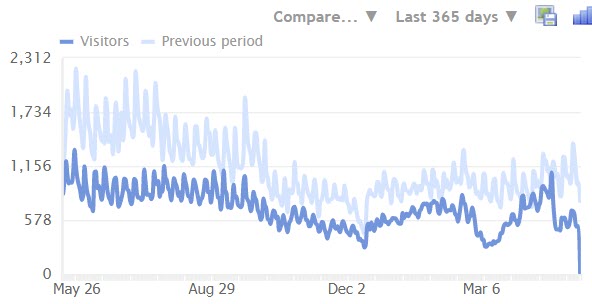
Their site has been trending down over the past couple years largely due to neglect as it was always a small side project. They recently improved some of the content about a month or so ago and that ended up leading to a bit of a boost, but then this update came. As long as that ad placement doesn’t change the declines are likely to continue.
They just recently removed that ad unit, but that meant another drop in income as until there is another big algo update they’re likely to stay at around half search traffic. So now they have a half of a half of a half. Good thing the site did not have any full time employees or they’d be among the millions of newly unemployed. That experience though really reflects how websites can be almost like debt levered companies in terms of going under virtually overnight. Who can have revenue slide around 88% and then take increase investment in the property using the remaining 12% while they wait for the site to be rescored for a quarter year or more?
“If you have been negatively impacted by a core update, you (mostly) cannot see recovery from that until another core update. In addition, you will only see recovery if you significantly improve the site over the long-term. If you haven’t done enough to improve the site overall, you might have to wait several updates to see an increase as you keep improving the site. And since core updates are typically separated by 3-4 months, that means you might need to wait a while.”
Almost nobody can afford to do that unless the site is just a side project.
Google could choose to run major updates more frequently, allowing sites to recover more quickly, but they gain economic benefit in defunding SEO investments & adding opportunity cost to aggressive SEO strategies by ensuring ranking declines on major updates last a season or more.
Choosing a Strategy vs Letting Things Come at You
They probably should have lowered their ad density when they did those other upgrades. If they had they likely would have seen rankings at worst flat or likely up as some other competing sites fell. Instead they are rolling with a half of a half of a half on the revenue front. Glenn Gabe preaches the importance of fixing all the problems you can find rather than just fixing one or two things and hoping it is enough. If you have a site which is on the edge you sort of have to consider the trade offs between various approaches to monetization.
- monetize it lightly and hope the site does well for many years
- monetize it slightly aggressively while using the extra income to further improve the site elsewhere and ensure you have enough to get by any lean months
- aggressively monetize the shortly after a major ranking update if it was previously lightly monetized & then hope to sell it off a month or two later before the next major algorithm update clips it again
Outcomes will depend partly on timing and luck, but consciously choosing a strategy is likely to yield better returns than doing a bit of mix-n-match while having your head buried in the sand.
Reading the Algo Updates
You can spend 50 or 100 hours reading blog posts about the update and learn precisely nothing in the process if you do not know which authors are bullshitting and which authors are writing about the correct signals.
But how do you know who knows what they are talking about?
It is more than a bit tricky as the people who know the most often do not have any economic advantage in writing specifics about the update. If you primarily monetize your own websites, then the ignorance of the broader market is a big part of your competitive advantage.
Making things even trickier, the less you know the more likely Google would be to trust you with sending official messaging through you. If you syndicate their messaging without questioning it, you get a treat – more exclusives. If you question their messaging in a way that undermines their goals, you’d quickly become persona non grata – something cNet learned many years ago when they published Eric Schmidt’s address.
It would be unlikely you’d see the following sort of Tweet from say Blue Hat SEO or Fantomaster or such.
I asked Gary about E-A-T. He said it’s largely based on links and mentions on authoritative sites. i.e. if the Washington post mentions you, that’s good.
He recommended reading the sections in the QRG on E-A-T as it outlines things well.@methode #Pubcon— Marie Haynes (@Marie_Haynes) February 21, 2018
To be able to read the algorithms well you have to have some market sectors and keyword groups you know well. Passively collecting an archive of historical data makes the big changes stand out quickly.
Everyone who depends on SEO to make a living should subscribe to an online rank tracking service or run something like Serposcope locally to track at least a dozen or two dozen keywords. If you track rankings locally it makes sense to use a set of web proxies and run the queries slowly through each so you don’t get blocked.
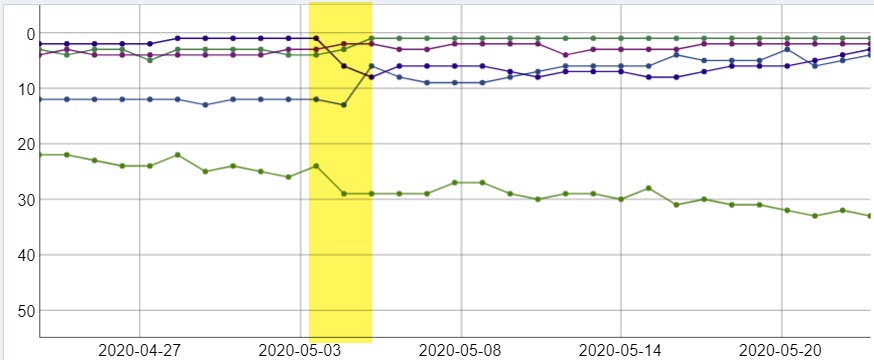
You should track at least a diverse range to get a true sense of the algorithmic changes.
- a couple different industries
- a couple different geographic markets (or at least some local-intent vs national-intent terms within a country)
- some head, midtail and longtail keywords
- sites of different size, age & brand awareness within a particular market
Some tools make it easy to quickly add or remove graphing of anything which moved big and is in the top 50 or 100 results, which can help you quickly find outliers. And some tools also make it easy to compare their rankings over time. As updates develop you’ll often see multiple sites making big moves at the same time & if you know a lot about the keyword, the market & the sites you can get a good idea of what might have been likely to change to cause those shifts.
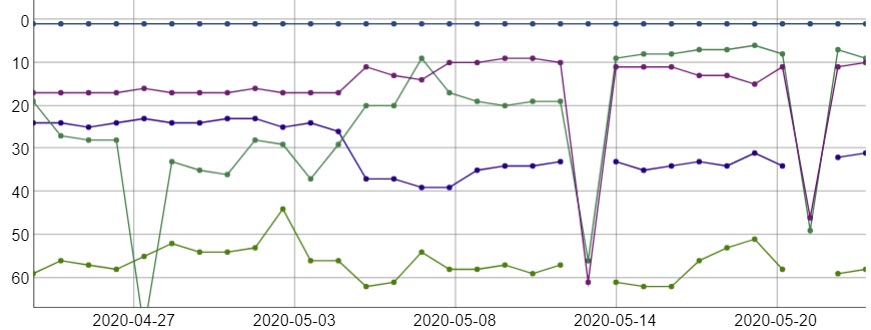
Once you see someone mention outliers most people miss that align with what you see in a data set, your level of confidence increases and you can spend more time trying to unravel what signals changed.
I’ve read influential industry writers mention that links were heavily discounted on this update. I have also read Tweets like this one which could potentially indicate the opposite.
Check out https://t.co/1GhD2U01ch . Up even more than Pinterest and ranking for some real freaky shit.— Paul Macnamara (@TheRealpmac) May 12, 2020
If I had little to no data, I wouldn’t be able to get any signal out of that range of opinions. I’d sort of be stuck at “who knows.”
By having my own data I track I can quickly figure out which message is more inline with what I saw in my subset of data & form a more solid hypothesis.
No Single Smoking Gun
As Glenn Gabe is fond of saying, sites that tank usually have multiple major issues.
Google rolls out major updates infrequently enough that they can sandwich a couple different aspects into major updates at the same time in order to make it harder to reverse engineer updates. So it does help to read widely with an open mind and imagine what signal shifts could cause the sorts of ranking shifts you are seeing.
Sometimes site level data is more than enough to figure out what changed, but as the above Credit Karma example showed sometimes you need to get far more granular and look at page-level data to form a solid hypothesis.
As the World Changes, the Web Also Changes
About 15 years ago online dating was seen as a weird niche for recluses who perhaps typically repulsed real people in person. Now there are all sorts of niche specialty dating sites including a variety of DTF type apps. What was once weird & absurd had over time become normal.
The COVID-19 scare is going to cause lasting shifts in consumer behavior that accelerate the movement of commerce online. A decade of change will happen in a year or two across many markets.
Telemedicine will grow quickly. Facebook is adding commerce featured directly onto their platform through partnering with Shopify. Spotify is spending big money to buy exclusives rights to distribute widely followed podcasters like Joe Rogan. Uber recently offered to acquire GrubHub. Google and Apple will continue adding financing features to their mobile devices. Movie theaters have lost much of their appeal.
Tons of offline “value” businesses ended up having no value after months of revenue disappearing while large outstanding debts accumulated interest. There is a belief that some of those brands will have strong latent brand value that carries over online, but if they were weak even when the offline stores acting like interactive billboards subsidized consumer awareness of their brands then as those stores close the consumer awareness & loyalty from in-person interactions will also dry up. A shell of a company rebuilt around the Toys R’ Us brand is unlikely to beat out Amazon’s parallel offering or a company which still runs stores offline.
Big box retailers like Target & Walmart are growing their online sales at hundreds of percent year over year.
There will be waves of bankruptcies, dramatic shifts in commercial real estate prices (already reflected in plunging REIT prices), and more people working remotely (shifting residential real estate demand from the urban core back out into suburbs).
People who work remote are easier to hire and easier to fire. Those who keep leveling up their skills will eventually get rewarded while those who don’t will rotate jobs every year or two. The lack of stability will increase demand for education, though much of that incremental demand will be around new technologies and specific sectors – certificates or informal training programs instead of degrees.
More and more activities will become normal online activities.
The University of California has about a half-million students & in the fall semester they are going to try to have most of those classes happen online. How much usage data does Google gain as thousands of institutions put more and more of their infrastructure and service online?
Colleges have to convince students for the next year that a remote education is worth every bit as much as an in-person one, and then pivot back before students actually start believing it.
It’s like only being able to sell your competitor’s product for a year.— Naval (@naval) May 6, 2020
A lot of B & C level schools are going to go under as the like-vs-like comparison gets easier. Back when I ran a membership site here a college paid us to have students gain access to our membership area of the site. As online education gets normalized many unofficial trade-related sites will look more economically attractive on a relative basis.
If core institutions of the state deliver most of their services online, then other companies can be expected to follow. When big cities publish lists of crimes they will not respond to during economic downturns they are effectively subsidizing more crime. That in turn makes moving to somewhere a bit more rural & cheaper make sense, particularly when you no longer need to live near your employer.
The most important implication of this permanent WFH movement are state income taxes.
The warm, sunny states with affordable housing and zero taxes will see an influx of educated, rich workers. States will need to cut taxes to keep up.
The biggest loser in this is CA.— Chamath Palihapitiya (@chamath) May 21, 2020
Categories:
How to Read Google Algorithm Updates
Links = Rank
Old Google (pre-Panda) was to some degree largely the following: links = rank.
Once you had enough links to a site you could literally pour content into a site like water and have the domain’s aggregate link authority help anything on that site rank well quickly.
As much as PageRank was hyped & important, having a diverse range of linking domains and keyword-focused anchor text were important.
Brand = Rank
After Vince then Panda a site’s brand awareness (or, rather, ranking signals that might best simulate it) were folded into the ability to rank well.
Panda considered factors beyond links & when it first rolled out it would clip anything on a particular domain or subdomain. Some sites like HubPages shifted their content into subdomains by users. And some aggressive spammers would rotate their entire site onto different subdomains repeatedly each time a Panda update happened. That allowed those sites to immediately recover from the first couple Panda updates, but eventually Google closed off that loophole.
Any signal which gets relied on eventually gets abused intentionally or unintentionally. And over time it leads to a “sameness” of the result set unless other signals are used:
Google is absolute garbage for searching anything related to a product. If I’m trying to learn something invariably I am required to search another source like Reddit through Google. For example, I became introduced to the concept of weighted blankets and was intrigued. So I Google “why use a weighted blanket” and “weighted blanket benefits”. Just by virtue of the word “weighted blanket” being in the search I got pages and pages of nothing but ads trying to sell them, and zero meaningful discourse on why I would use one
Getting More Granular
Over time as Google got more refined with Panda broad-based sites outside of the news vertical often fell on tough times unless they were dedicated to some specific media format or had a lot of user engagement metrics like a strong social network site. That is a big part of why the New York Times sold About.com for less than they paid for it & after IAC bought it they broke it down into a variety of sites like: Verywell (health), the Spruce (home decor), the Balance (personal finance), Lifewire (technology), Tripsavvy (travel) and ThoughtCo (education & self-improvement).
Penguin further clipped aggressive anchor text built on low quality links. When the Penguin update rolled out Google also rolled out an on-page spam classifier to further obfuscate the update. And the Penguin update was sandwiched by Panda updates on either side, making it hard for people to reverse engineer any signal out of weekly winners and losers lists from services that aggregate massive amounts of keyword rank tracking data.
So much of the link graph has been decimated that Google reversed their stance on nofollow to where in March 1st of this year they started treating it as a hint versus a directive for ranking purposes. Many mainstream media websites were overusing nofollow or not citing sources at all, so this additional layer of obfuscation on Google’s part will allow them to find more signal in that noise.
May 4, 2020 Algo Update
On May 4th Google rolled out another major core update.
Later today, we are releasing a broad core algorithm update, as we do several times per year. It is called the May 2020 Core Update. Our guidance about such updates remains as we’ve covered before. Please see this blog post for more about that:https://t.co/e5ZQUAlt0G— Google SearchLiaison (@searchliaison) May 4, 2020
I saw some sites which had their rankings suppressed for years see a big jump. But many things changed at once.
Wedge Issues
On some political search queries which were primarily classified as being news related Google is trying to limit political blowback by showing official sites and data scraped from official sites instead of putting news front & center.
“Google’s pretty much made it explicit that they’re not going to propagate news sites when it comes to election related queries and you scroll and you get a giant election widget in your phone and it shows you all the different data on the primary results and then you go down, you find Wikipedia, you find other like historical references, and before you even get to a single news article, it’s pretty crazy how Google’s changed the way that the SERP is intended.”
That change reflects the permanent change to the news media ecosystem brought on by the web.
The Internet commoditized the distribution of facts. The “news” media responded by pivoting wholesale into opinions and entertainment.— Naval (@naval) May 26, 2016
YMYL
A blog post by Lily Ray from Path Interactive used Sistrix data to show many of the sites which saw high volatility were in the healthcare vertical & other your money, your life (YMYL) categories.
Aggressive Monetization
One of the more interesting pieces of feedback on the update was from Rank Ranger, where they looked at particular pages that jumped or fell hard on the update. They noticed sites that put ads or ad-like content front and center may have seen sharp falls on some of those big money pages which were aggressively monetized:
Seeing this all but cements the notion (in my mind at least) that Google did not want content unrelated to the main purpose of the page to appear above the fold to the exclusion of the page’s main content! Now for the second wrinkle in my theory…. A lot of the pages being swapped out for new ones did not use the above-indicated format where a series of “navigation boxes” dominated the page above the fold.
The above shift had a big impact on some sites which are worth serious money. Intuit paid over $7 billion to acquire Credit Karma, but their credit card affiliate pages recently slid hard.
Credit Karma lost 40% traffic from May core update. That’s insane, they do major TV ads and likely pay millions in SEO expenses. Think about that folks. Your site isn’t safe. Google changes what they want radically with every update, while telling us nothing!— SEOwner (@tehseowner) May 14, 2020
The above sort of shift reflects Google getting more granular with their algorithms. Early Panda was all or nothing. Then it started to have different levels of impact throughout different portions of a site.
Brand was sort of a band aid or a rising tide that lifted all (branded) boats. Now we are seeing Google get more granular with their algorithms where a strong brand might not be enough if they view the monetization as being excessive. That same focus on page layout can have a more adverse impact on small niche websites.
One of my old legacy clients had a site which was primarily monetized by the Amazon affiliate program. About a month ago Amazon chopped affiliate commissions in half & then the aggressive ad placement caused search traffic to the site to get chopped in half when rankings slid on this update.
Their site has been trending down over the past couple years largely due to neglect as it was always a small side project. They recently improved some of the content about a month or so ago and that ended up leading to a bit of a boost, but then this update came. As long as that ad placement doesn’t change the declines are likely to continue.
They just recently removed that ad unit, but that meant another drop in income as until there is another big algo update they’re likely to stay at around half search traffic. So now they have a half of a half of a half. Good thing the site did not have any full time employees or they’d be among the millions of newly unemployed. That experience though really reflects how websites can be almost like debt levered companies in terms of going under virtually overnight. Who can have revenue slide around 88% and then take increase investment in the property using the remaining 12% while they wait for the site to be rescored for a quarter year or more?
“If you have been negatively impacted by a core update, you (mostly) cannot see recovery from that until another core update. In addition, you will only see recovery if you significantly improve the site over the long-term. If you haven’t done enough to improve the site overall, you might have to wait several updates to see an increase as you keep improving the site. And since core updates are typically separated by 3-4 months, that means you might need to wait a while.”
Almost nobody can afford to do that unless the site is just a side project.
Google could choose to run major updates more frequently, allowing sites to recover more quickly, but they gain economic benefit in defunding SEO investments & adding opportunity cost to aggressive SEO strategies by ensuring ranking declines on major updates last a season or more.
Choosing a Strategy vs Letting Things Come at You
They probably should have lowered their ad density when they did those other upgrades. If they had they likely would have seen rankings at worst flat or likely up as some other competing sites fell. Instead they are rolling with a half of a half of a half on the revenue front. Glenn Gabe preaches the importance of fixing all the problems you can find rather than just fixing one or two things and hoping it is enough. If you have a site which is on the edge you sort of have to consider the trade offs between various approaches to monetization.
- monetize it lightly and hope the site does well for many years
- monetize it slightly aggressively while using the extra income to further improve the site elsewhere and ensure you have enough to get by any lean months
- aggressively monetize the shortly after a major ranking update if it was previously lightly monetized & then hope to sell it off a month or two later before the next major algorithm update clips it again
Outcomes will depend partly on timing and luck, but consciously choosing a strategy is likely to yield better returns than doing a bit of mix-n-match while having your head buried in the sand.
Reading the Algo Updates
You can spend 50 or 100 hours reading blog posts about the update and learn precisely nothing in the process if you do not know which authors are bullshitting and which authors are writing about the correct signals.
But how do you know who knows what they are talking about?
It is more than a bit tricky as the people who know the most often do not have any economic advantage in writing specifics about the update. If you primarily monetize your own websites, then the ignorance of the broader market is a big part of your competitive advantage.
Making things even trickier, the less you know the more likely Google would be to trust you with sending official messaging through you. If you syndicate their messaging without questioning it, you get a treat – more exclusives. If you question their messaging in a way that undermines their goals, you’d quickly become persona non grata – something cNet learned many years ago when they published Eric Schmidt’s address.
It would be unlikely you’d see the following sort of Tweet from say Blue Hat SEO or Fantomaster or such.
I asked Gary about E-A-T. He said it’s largely based on links and mentions on authoritative sites. i.e. if the Washington post mentions you, that’s good.
He recommended reading the sections in the QRG on E-A-T as it outlines things well.@methode #Pubcon— Marie Haynes (@Marie_Haynes) February 21, 2018
To be able to read the algorithms well you have to have some market sectors and keyword groups you know well. Passively collecting an archive of historical data makes the big changes stand out quickly.
Everyone who depends on SEO to make a living should subscribe to an online rank tracking service or run something like Serposcope locally to track at least a dozen or two dozen keywords. If you track rankings locally it makes sense to use a set of web proxies and run the queries slowly through each so you don’t get blocked.
You should track at least a diverse range to get a true sense of the algorithmic changes.
- a couple different industries
- a couple different geographic markets (or at least some local-intent vs national-intent terms within a country)
- some head, midtail and longtail keywords
- sites of different size, age & brand awareness within a particular market
Some tools make it easy to quickly add or remove graphing of anything which moved big and is in the top 50 or 100 results, which can help you quickly find outliers. And some tools also make it easy to compare their rankings over time. As updates develop you’ll often see multiple sites making big moves at the same time & if you know a lot about the keyword, the market & the sites you can get a good idea of what might have been likely to change to cause those shifts.
Once you see someone mention outliers most people miss that align with what you see in a data set, your level of confidence increases and you can spend more time trying to unravel what signals changed.
I’ve read influential industry writers mention that links were heavily discounted on this update. I have also read Tweets like this one which could potentially indicate the opposite.
Check out https://t.co/1GhD2U01ch . Up even more than Pinterest and ranking for some real freaky shit.— Paul Macnamara (@TheRealpmac) May 12, 2020
If I had little to no data, I wouldn’t be able to get any signal out of that range of opinions. I’d sort of be stuck at “who knows.”
By having my own data I track I can quickly figure out which message is more inline with what I saw in my subset of data & form a more solid hypothesis.
No Single Smoking Gun
As Glenn Gabe is fond of saying, sites that tank usually have multiple major issues.
Google rolls out major updates infrequently enough that they can sandwich a couple different aspects into major updates at the same time in order to make it harder to reverse engineer updates. So it does help to read widely with an open mind and imagine what signal shifts could cause the sorts of ranking shifts you are seeing.
Sometimes site level data is more than enough to figure out what changed, but as the above Credit Karma example showed sometimes you need to get far more granular and look at page-level data to form a solid hypothesis.
As the World Changes, the Web Also Changes
About 15 years ago online dating was seen as a weird niche for recluses who perhaps typically repulsed real people in person. Now there are all sorts of niche specialty dating sites including a variety of DTF type apps. What was once weird & absurd had over time become normal.
The COVID-19 scare is going to cause lasting shifts in consumer behavior that accelerate the movement of commerce online. A decade of change will happen in a year or two across many markets.
Telemedicine will grow quickly. Facebook is adding commerce featured directly onto their platform through partnering with Shopify. Spotify is spending big money to buy exclusives rights to distribute widely followed podcasters like Joe Rogan. Uber recently offered to acquire GrubHub. Google and Apple will continue adding financing features to their mobile devices. Movie theaters have lost much of their appeal.
Tons of offline “value” businesses ended up having no value after months of revenue disappearing while large outstanding debts accumulated interest. There is a belief that some of those brands will have strong latent brand value that carries over online, but if they were weak even when the offline stores acting like interactive billboards subsidized consumer awareness of their brands then as those stores close the consumer awareness & loyalty from in-person interactions will also dry up. A shell of a company rebuilt around the Toys R’ Us brand is unlikely to beat out Amazon’s parallel offering or a company which still runs stores offline.
Big box retailers like Target & Walmart are growing their online sales at hundreds of percent year over year.
There will be waves of bankruptcies, shifts in commercial real estate prices, more people working remotely (shifting residential real estate demand from the urban core back out into suburbs).
More and more activities will become normal online activities.
The University of California has about a half-million students & in the fall semester they are going to try to have most of those classes happen online. How much usage data does Google gain as thousands of institutions put more and more of their infrastructure and service online?
Colleges have to convince students for the next year that a remote education is worth every bit as much as an in-person one, and then pivot back before students actually start believing it.
It’s like only being able to sell your competitor’s product for a year.— Naval (@naval) May 6, 2020
A lot of B & C level schools are going to go under as the like-vs-like comparison gets easier. Back when I ran a membership site here a college paid us to have students gain access to our membership area of the site. As online education gets normalized many unofficial trade-related sites will look more economically attractive on a relative basis.
Categories:
Tearing Up Your 2020 Plan – Part VI: Using Search to Improve Customer Experiences
This is a strategy from Tearing Up Your 2020 Plan: How To Get Through The Coming Recession:
- Part I: Opportunities to Change with the Times
- Part II: How to Find Out What’s Changing, for Whom, and How
- Part III: Estimating Demand for Your Business During COVID-19
- Part IV: What Google Knows vs What the Marketer Shows
- Part V: How is Your Customers’ Language Changing?
…
The post Tearing Up Your 2020 Plan – Part VI: Using Search to Improve Customer Experiences appeared first on Seer Interactive.
Tearing Up Your 2020 Plan – Part V: How is Your Customers’ Language Changing?
This is a strategy from Tearing Up Your 2020 Plan: How To Get Through The Coming Recession:
- Part I: Opportunities to Change with the Times
- Part II: How to Find Out What’s Changing, for Whom, and How
- Part III: Estimating Demand for Your Business During COVID-19
- Part IV: What Google Knows vs What the Marketer Shows
- Part V: How is Your Customers’ Language Changing?
…
The post Tearing Up Your 2020 Plan – Part V: How is Your Customers’ Language Changing? appeared first on Seer Interactive.
Tearing Up Your 2020 Plan – Part IV: What Google Knows vs What the Marketer Shows
This is a strategy from Tearing Up Your 2020 Plan: How To Get Through The Coming Recession:
- Part I: Opportunities to Change with the Times
- Part II: How to Find Out What’s Changing, for Whom, and How
- Part III: Estimating Demand for Your Business During COVID-19
- Part IV: What Google Knows vs What the Marketer Shows
- Part V: How is Your Customers’ Language Changing?
…
The post Tearing Up Your 2020 Plan – Part IV: What Google Knows vs What the Marketer Shows appeared first on Seer Interactive.
Tearing Up Your 2020 Plan – Part III: Estimating Demand for Your Business During COVID-19
This is a strategy from Tearing Up Your 2020 Plan: How To Get Through The Coming Recession:
- Part I: Opportunities to Change with the Times
- Part II: How to Find Out What’s Changing, for Whom, and How
- Part III: Estimating Demand for Your Business During COVID-19
- Part IV: What Google Knows vs What the Marketer Shows
- Part V: How is Your Customers’ Language Changing?
…
The post Tearing Up Your 2020 Plan – Part III: Estimating Demand for Your Business During COVID-19 appeared first on Seer Interactive.
Tearing Up Your 2020 Plan – Part II: How to Find What’s Changing, for Whom, and How
This is a strategy from Tearing Up Your 2020 Plan: How To Get Through The Coming Recession:
- Part I: Opportunities to Change with the Times
- Part II: How to Find Out What’s Changing, for Whom, and How
- Part III: Estimating Demand for Your Business During COVID-19
- Part IV: What Google Knows vs What the Marketer Shows
- Part V: How is Your Customers’ Language Changing?
…
The post Tearing Up Your 2020 Plan – Part II: How to Find What’s Changing, for Whom, and How appeared first on Seer Interactive.
Tearing Up Your 2020 Plan – Part I: Opportunities to Change with the Times
This is a strategy from Tearing Up Your 2020 Plan: How To Get Through The Coming Recession:
- Part I: Opportunities to Change with the Times
- Part II: How to Find Out What’s Changing, for Whom, and How
- Part III: Estimating Demand for Your Business During COVID-19
- Part IV: What Google Knows vs.
…
The post Tearing Up Your 2020 Plan – Part I: Opportunities to Change with the Times appeared first on Seer Interactive.
Tearing Up Your 2020 Plan, Full Recap: How To Get Through The Coming Recession

SOLD OUT! | Over 600 Attendees | $1,000 Donated to GiveDirectly
Full Recap

Rand Fishkin: “How to Gain a Competitive Edge & Grow your Business During Times of Great Stress, Strife, and Turmoil”
Learn the best ways to approach your marketing strategy based on where your business falls: Directly Harmed, Directly Benefiting, and Indirectly Affected. …
The post Tearing Up Your 2020 Plan, Full Recap: How To Get Through The Coming Recession appeared first on Seer Interactive.
Google Webmaster Podcast: “Search Off The Record” Sounds Fun
It sounds like the Google Search Relations team, aka John Mueller, Gary Illyes, Martin Splitt and others have started a podcast, in addition to the YouTube channel. The podcast was probably Gary’s idea, since he is camera shy.
Matt Cutts Predicts How Search Works In 2020 Ten Years Ago
April 2010, Matt Cutts who was working at Google on search, was asked how does he see search working in a decade from now. It is always fun to look at predictions from the past and see how they came out.