Google Square Promoted Map Pins
Google has launched new square-shaped map pins named promoted pins. It is aimed to help you make your listing stand out from the normal shaped pin like pins in Google Maps.
Google Search Fireworks Show Is Back
If you go to Google Search and search for [fireworks] you will see the search results explode with a fireworks show. This is exactly the same thing Google did last year a few weeks before July fourth but now, it is live a bit earlier.
Google Search Suggestions On Scroll
Here is an interesting test from Google Search. You type in a query, go to the search results and as you scroll through the search results, the search box shows search suggestions. As you can see from the example by Yvo Schaap on Twitter, Google shows…
Here’s how to use the new Microsoft Ads Audience Network Planner
You can expand your reach beyond your Audience Ads campaigns by uncovering more data with the new audience planner.
Please visit Search Engine Land for the full article.
Google: One Million Sites Using Rel=Sponsored
An interesting tidbit from the podcast from the Google folks was that Gary Illyes from Google said a heck of a lot of sites are already using the rel=sponsored link attribute. He said one million sites are already using the rel=sponsored link attribute…
Google Online Care Icon Added To Local Pack
We have seen Google add the “get online care” details to a local panel, when you click on a medical and health related local result in Google. But now Google has added the “online care” icons to the higher level, local pack.
Google Fixing Bug Where Dealership Service Shops Show Over Main Dealership Local Panel
In early March, Google added a feature to Google My Business that allow car dealerships to have multiple Google My Business listings within Google Local and Google Maps. But now it seems that for some dealerships, the service listing is showing above t…
Google Images Tests Query Expander Drop Down On Image Previews
Brian Freiesleben spotted a new feature Google is testing in Google Image search. When you click on an image preview on mobile, he saw Google showing related or query expander drop downs under the image. When you click on it, it shows more information…
The Google Page Experience Scores Will Use AMP Version
I already said this when I wrote about the Google Page Experience Update but it is important to say again. If you have an AMP version and your site is on mobile-first indexing, which all sites should be by the end of this year, then Google’s Page Expe…
Should You Break Up Your CSS & JavaScript Files Into Smaller Chunks? Here Is What Google Said.
Bartosz Goralewicz asked Martin Splitt of Google an interesting question. He asked if we should break out CSS and JavaScript files into smaller chunks of files or not. The answer from Martin is a long one but in short, it depends. :-)
Preparing E-Commerce for the Post-COVID Bounce Back
Posted by MrLukeCarthy
COVID-19 has switched up life as we know it, and it’s unlikely to stop doing so for some time.
E-commerce shopping is a perfect example of how things have changed, and in a number of ways.
If you feel like Shopify has been dropping huge, disruptive news bombs practically each week now, you’re right!
And who’d have guessed that in the UK, the exclusively online supermarket, Ocado, is now worth more than brick-and-mortar grocers Morrisons, Sainsbury’s, and Marks and Spencer combined.
The speed of transformation in e-commerce since the COVID-19 outbreak (an already fast-paced industry) has been savage.
Supply chains are under strain for many brands selling online (especially where demand is high and supplies are low). How do you best manage expectations and maximize every opportunity to sell to your target audience?
With your consumers now relying on the world of online shopping more than ever, how can you be sure you’re getting your fair share of that online retail pie?
Well, this post is designed to help you answer precisely these questions. Whether your sales have taken a hit or you have “off the wall” levels of demand, here are some ideas to help you navigate that bounce back and to help customers stay in love with your brand.
Pay close attention to changing on site search behavior
Your site search is a goldmine of insight, especially right now. Seriously.
Frequently checking in to understand how and what your customers are looking for once they get to your store can reveal a bunch of opportunities.
It’s possible that before COVID-19 took a stronghold on everyday life, customers had different contexts in mind when searching for your products.
For example, searches for “gloves” today vs. in January are likely to be visitors searching for two separate products entirely. It’s important to ensure that you’re serving today’s customer sufficiently and addressing their context correctly to remain relevant and to improve conversion.
Here’s an extreme example, but it’s a poignant one nonetheless. For context, Holland and Barrett are a popular, high street healthcare retailer with a strong web presence here in the UK.

When searches for “coronavirus” had skyrocketed and demand for hand sanitizer and Paracetamol (another brand of acetaminophen, like Tylenol) were painfully high, what I found incredible was that searching for “coronavirus” on their website yielded no results.
This seemed particularly jarring for a retailer that, first, sells items that have been scientifically proven to kill and help prevent the spread of the virus and, second, is a dedicated healthcare business.
Not only does this throw a huge wrench in the works when it comes to CX and customer perception, this tiny yet costly oversight is likely to have cost them sales and customers too.
Customers are also searching for products that aren’t typically associated with a certain brand or online store due to exhausted stocks elsewhere.
For example, the top three search terms for one of my e-commerce clients are now “Mask”, “mask”, and “PPE”. The search terms “mask”, “PPE”, and close variants were practically non-existent prior to mid-May.

Kit and Ace, a clothing retailer, has responded to precisely this changing behavior. After seeing a huge spike in the number of site searches for masks, they’re now introducing a new, premium, scientifically-derived mask that also fits their brand. They’re donating 100% of profits from the masks, but this tactic will likely to drive more sales in their other categories too.
This is a great move, especially since apparel sales have shrunk during this time. It’s important to find emerging opportunities when typical product lines are no longer in demand.
The point I’m trying to make here is that, in order to succeed coming out of the other side of this pandemic, you need to ensure you’re fully in tune with the wants and needs of today’s customer — whatever that looks like for you. Using site search can absolutely give you a huge window into their demands and interests.
If products are out of stock, offer excellent alternatives (where possible)
As touched on earlier, supply chain management is going to be increasingly challenging — especially in areas where demand is outstripping supply — yet so many retailers miss out here.
For some products, it doesn’t matter how hard you try, every retailer has them listed as “out of stock.”
For branded items that have stock issues globally, being the retailer that offers a perfectly good alternative could be enough to win over that visitor and win the sale that other retailers have lost.
To use a specific example, FTX is a manufacturer of radio-controlled cars, and is a brand sold on Europe e-commerce site Wheelspin. There’s an FTX item that you cannot get before the end of June (for love nor money) on any website due to COVID-19. The pandemic has forced factories to close and that disrupts production for many goods.

Specifically, in this example, it’s the FTX brushed motor that’s become victim to supply chain issues. However, there’s a brand that has a perfectly suitable alternative item that’s identical in specification, and it’s in stock:

Proactively offering solid alternatives with as few compromises as possible can be a great way of winning sales and delighting customers in a way that your competitors likely won’t be.
Add an “in stock only” filter
Continuing on the topic of store stock and managing a turbulent supply chain, a simple but welcome feature is to add an “items in stock” filter.
It goes without saying that allowing customers to browse items they’re able to get their hands on quickly will go down well and could help improve conversion on your website.
Another benefit of adding such a filter is the ability to bring light to other lines that are typically overshadowed by more popular (but now out of stock) items.
Taking this a step further, you could also help your customers experience by adding a filter for products expected to arrive within a certain timeframe, or filter out those that can be backordered.
Add an “email me when back in stock” CTA
If you’re a retailer struggling to get stock of popular lines, there’s a good chance you’re not the only retailer with that problem. Although it may not be possible to get stock any quicker than your competitors, you can absolutely ensure that you’re the first to let potential customers know that it’s back in stock.
Sweeten the deal by personalizing the back-in-stock email
Letting a potential customer know that the item’s back in stock is great, but why not suprise and delight your customers by taking the opportunity to personalize this email too?
Offering personalized cross-sells of the item that’s now back in stock can be a great way to not only give them the good news, but give them additional reasons to visit your shop and potentially increase basket value simultaneously. It’s certainly a win, win here.
Remarket to people when items are back in stock
People are spending more time online — fact. So it makes sense to reach your audience where they’re most likely to be spending time for the foreseeable future.
Depending on the popularity of an item (and how much traffic is going to it whilst it’s remained unavailable), you could create a retargeting list based on visitors that expressed an interest in it now that it’s back in stock.
This can prove to be a great way to reach people, say on social media, that aren’t particularly responsive to email but are spending increased amounts of time on their favorite social platforms.
Although this may not be scalable, or at least I haven’t found a way to make it so, doing this across your top-selling lines or lines with greater margins could prove to be a successful way of pulling engaged and semi-invested visitors back to your site.
Don’t be afraid to increase prices where necessary
Let’s not forget the basic principles of commerce, right? High demand (coupled with low supply) increases prices.
Businesses shouldn’t feel guilty for increasing prices, but of course, there’s a difference between a justifiable increase and straight ripping people off (as demonstrated below):

For context, four tins of 400g Heinz Spaghetti Plus Sausage would retail at around £4 in UK supermarkets (that’s about $5 at current exchange rates).
Think about this scenario for a second: You and your staff are potentially working in environments that could pose serious health risks. Plus there’s additional costs to consider in order to keep people safe. PPE, cleaning products, masks, sick pay for unwell staff, etc., all these factors will push up the cost per sale and erode your margins.
Equally, there are no guarantees right now. Those all-time high levels of sales could come slamming to a fierce halt at any time. Whether that’s caused by a change in demand, decrease in stock, or your business is no longer able to fulfil orders due to an internal COVID-19 outbreak.
Increasing prices fairly to better protect your business against these mostly uncontrollable factors is not a bad thing. In my opinion, it’s just good business sense.
You’ve got to ensure your business is as robust as it can be when faced with these potential eventualities. Increasing your prices fairly can help to better protect it.
Discover creative ways to connect with your audience
As the saying goes, “when life gives you lemons, make lemonade”. It’s a huge cliché, but it absolutely rings true and remains a powerful statement today.
Finding ways to be creative, cut through the noise, and engage with your audience is essential to staying relevant. Especially if your customer’s cash is heading elsewhere right now.
Here’s an example of a potentially powerful idea that I’ve been working on for a client in the world of apparel — one of the more fiercely affected industries during the pandemic.
People are spending less on fashion, and even less at the luxury end of the scale. So, why not let your audience build themselves a virtual dream wardrobe? Something they’d consider buying for a night out, things they’d have in their suitcase for a summer vacation, etc. It’s a fairly simple idea, but let’s think about the impact this could have for both customer and business:
You’re throwing down a few slices of “feel good”So many people miss going out, right? Heading to bars, clubs, celebrating a milestone, going on a vacation, or even just getting back to the office, so many of us associate buying new outfits as part of those moments.
Allowing your loyal fans and customers to pick out their money’s-no-object dream outfits based on some predetermined wardrobes (office attire, night out, summer holiday) is naturally going to invoke some positive emotions and memories — especially if you inject a social element into it by allowing people to share their collections.
But other wins can be extracted from such an idea too:
You’re collecting valuable user data: You’re getting some valuable insight into the sort of clothing people may buy when lockdown policies begin to wind back. This could help to get a better understanding of demand so you can work on reinvigorating your supply chain successfully.
Plus, you’re getting an idea of what items visitors would put together to help educate new fashion trends and inform “recommended for you” personalization.
You’re helping to alleviate boredom: In some ways, this kind of activity is adding an element of gamification to apparel. With so many people stuck indoors experiencing high levels of procrastination and boredom, it can help to cut through and detach from the realities of lockdown.
You’re creating an opportunity to welcome sales when things pick back up:
Offering an incentive (say 15% off your dream collections) once we’re on the cusp of restoring “normality” could be a really powerful way of encouraging and helping to re-energize apparel and fashion spend online. It’s also a great way to celebrate the comeback.
Last but not least, you’re building brand affinity: I’ve said it before, but it’s extremely important, so I’ll say it again: remaining relevant and keeping marketing efforts up is essential to ensure you remain in good shape when society heads towards the new normal.
Having your audience resonate with your brand and remember your positive actions whilst they’re away will be a major influence on your ability to maintain and deepen those customer relationships post-pandemic.
Final thoughts: the rise of big brands diving into D2C eCommerce
What’s amazing to see is a huge move by big household names and brands. They’re now setting up their own direct-to-consumer (D2C) e-commerce outfits, and on the surface, appear to be going head-to-head with supermarkets.
To highlight a few of my favorite examples, there’s snacks.com — created by Frito-Lay — shipping their brand’s snacking staples across North America.

Then there’s Heinz to Home, delivering popular Heinz products to households in the UK.

How these new D2C e-commerce brands fare in the long term will be interesting to see, but what’s certain is the pandemic is accelerating and evolving e-commerce in a way that’s not been seen before.
As a final note, to those of you hit hard by COVID-19, may I wish you a speedy recovery — personally and professionally.
Sign up for The Moz Top 10, a semimonthly mailer updating you on the top ten hottest pieces of SEO news, tips, and rad links uncovered by the Moz team. Think of it as your exclusive digest of stuff you don’t have time to hunt down but want to read!
The data problem in Google Smart Shopping campaigns [Video]
Smarter Ecommerce’s Mike Ryan discusses why ROAS isn’t a performance metric and why Google limits data insights for Smart Shopping campaigns.
Please visit Search Engine Land for the full article.
Button UX: designing a clear call-to-action
Half of the buttons that are used as the main call-to-action on a web page don’t invite me to click. You could and should test button design but, sometimes, it just starts with common sense. Button UX design has changed a lot over the past decade. A long-standing trend seems to be to blend a […]
The post Button UX: designing a clear call-to-action appeared first on Yoast.
Wasteful Wednesday with Wil Reynolds #3 – Keyword of the Week: “Names”
Watch the Video:
Read the Transcript:
Hi, my name is, Wil, your name is Joe.
There are times where people search for “joe” and some company and you show up because that company is either your company or you’re bidding on that company’s brand name when somebody is looking for an employee. …
The post Wasteful Wednesday with Wil Reynolds #3 – Keyword of the Week: “Names” appeared first on Seer Interactive.
How pitching to journalists has changed during Covid
Covid has changed news agenda, but what does that mean for your PR campaign? Find out the best ways to keep getting results while being mindful of the current pandemic.
Post from Rebecca Lee
Five SEO content types to power and grow your business through 2020
Search friendly content that is targeted, optimized, and engaging differentiates front-runner brands from the rest of the crowd. Jim Yu shares five content types that add value.
The post Five SEO content types to power and grow your business through 2020 appeared first on Search Engine Watch.
Google’s shocking ad ban [It’s clickbait]
We’ll save you a click. Google’s banning click bait ads.
Please visit Search Engine Land for the full article.
Google adding local store details to Shopping, free Promoted Pins for Smart campaigns, more
New features and updates are aimed at local businesses and services in the “reopening phase.”
Please visit Search Engine Land for the full article.
The State of Local SEO Industry Report 2020, Announced
Posted by MiriamEllis
Moz’s very warmest thanks to the 1,453 respondents who volunteered time to contribute to this second installation of our industry survey. It’s rewarding to have such a large survey group; as this report details in high relief, the work of marketing a single business location can pass through a dozen hands.
Owners, staff, in-house SEOs, agencies, creative directors, webmasters, project managers, and consultants may all be contributing to promoting just one local company. By capturing their hands-on experience, we get the big picture of local SEO as an effort not confined to experts, but rather, requiring all hands on deck.
In this report, you’ll find insights to share with coworkers and clients on:
- Company infrastructure
- Local ranking factors
- Tool & software usage
- Gaps in the marketplace
- High ROI strategies and tactics
A window in time on local business marketing
The data in our survey depicts the local SEO industry both before and during the public health emergency. As such, it’s an eagle’s eye view of both the status of marketing priorities up to the present and a gauge of preparedness for change. Change has always been the only constant in local SEO — our industry is accustomed to an environment that can turn on a dime, literally overnight. This challenging setting toughens businesses for tough times.
No one knows yet how COVID-19 may ultimately alter consumer behavior, but in the short term, one good sign which has emerged from the State of the Local SEO industry report is that local businesses were strongly embracing organic assets prior to the pandemic. Not long ago, you might have encountered narratives about websites being “dead” due to the dominance of local packs, zero click SERPs, and other Google features. Fortunately, our report indicates that many marketers have wisely ignored such schools of thought and have continued to promote the vital role local business websites play in connecting with communities.
For now, if connection is curbside or delivery instead of foot traffic, local businesses which have been thoughtfully maintaining their websites own a strong platform for next moves — perhaps implementing local e-commerce, or taking orders via form submissions, or hosting gated video consultations.
Access to the State of the Local SEO Industry’s data will enable you to do your own analysis of the sum total of marketing knowledge up to the present with an eye to future strategy. Here’s a preview of 3 emergent narratives that particularly caught my eye.
Proximity falls to third as a local ranking factor

Our 2019 report cited user-to-business proximity as the dominant influence on Google’s local pack rankings. So has every Local Search Ranking Factors survey since 2017. This is a surprising departure. Download the report for further analysis and view the numbers in the light of how Google might adjust proximity based on new factors like curbside pickup and local delivery.
YOY, 19% more respondents are involved with offline marketing
94% (up from 75%) of our survey group are consulting with clients at least some of the time on topics like real-world customer service and consumer policies.This statistic professionally delights me, because of my years of advocacy here on the Moz blog for local search marketers to care deeply about what happens in real time between consumers and brands. Some enterprising agency should consider doing a webinar or eBook on the history of brick-and-mortar marketing so our industry can engage in deeper levels of learning and make informed decisions about future offline marketing strategy.
COVID-era customer fulfillment strategies are here to stay
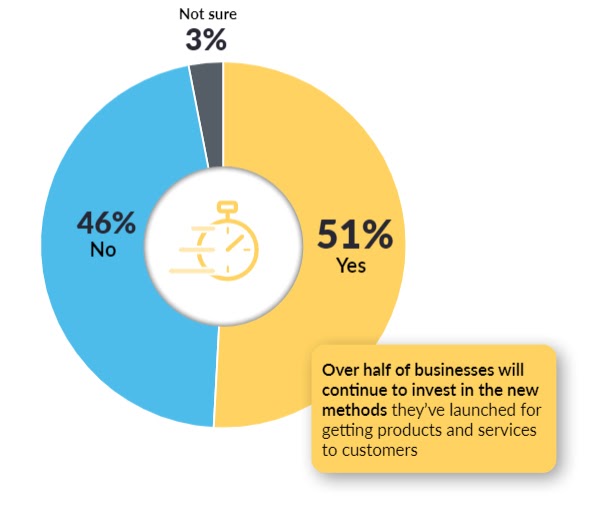
51% of respondents intend to permanently offer amenities like home delivery, curbside pickup, and video conferencing. Now is the time for innovative marketing agencies to put in the work researching the best possible solutions for clients for the long haul. Will it be in-house delivery fleets, or outsourcing to third parties like Instacart and Doordash? Which e-commerce platform is the best, not just for UX but for SEO? Many brands swiftly cobbled together new services to meet the state of emergency, but as time goes by, consumer feedback and marketing analysis will point the way to thoughtfully choosing the best transactional methodologies and platforms. All of these technologies predate the pandemic, but the year ahead is going to see them much more fully tested.
Please accept our invitation to download the free State of the Local SEO Industry Report 2020, with 30+ timely questions on topics that impact how you work, what to offer, and how to improve your strategy for the year ahead whether you own a local business or are in the business of marketing local brands!
Sign up for The Moz Top 10, a semimonthly mailer updating you on the top ten hottest pieces of SEO news, tips, and rad links uncovered by the Moz team. Think of it as your exclusive digest of stuff you don’t have time to hunt down but want to read!
How to manage a high-performing content marketing team
Kevin Payne shows you the exact steps and tips to build and manage your own high-performing content marketing team.
The post How to manage a high-performing content marketing team appeared first on Search Engine Watch.