How to evaluate content quality with BERT
Using a code-free deep learning toolkit model to review grammar in your posts and could be used as one of several proxies for content quality.
Please visit Search Engine Land for the full article.
Parent and child pages: Linking hierarchical post types for SEO
When we talk about site structure on WordPress we often focus on blogs post: “Use taxonomies and link to related posts!” But you probably have hierarchical post types on your site too. An example of a hierarchical post type is the Page post type; a page can have parent, child, and sibling pages. Inherently, these […]
The post Parent and child pages: Linking hierarchical post types for SEO appeared first on Yoast.
How to create new Google Shopping insight reports in Data Studio
Identify under-performing products faster, see what’s popular in your industry and get more out of PPC reporting.
Please visit Search Engine Land for the full article.
Yoast SEO 14.5: New internal linking blocks for Premium
Yoast SEO 14.5 is out today! In this release, we fixed a number of bugs, disabled the XML sitemaps that will arrive in WordPress 5.5 and added two new block editor blocks for our Premium users. These blocks help you with internal linking for hierarchical pages. Let’s find out more! Meet the new internal linking […]
The post Yoast SEO 14.5: New internal linking blocks for Premium appeared first on Yoast.
Google: Scoring 100 In SEO In Lighthouse Doesn’t Make You A Good SEO
Gary Illyes of Google said on Twitter “achieving a SEO score 100 in Lighthouse just means that you can follow a handful of directions, not that you’re great at SEO.” He did say “but good job!” Those that do score 100 he said are good at following dir…
The Google Indexing Issue From A Month Ago Was A Crawling Issue
On June 2, 2020, Google yet again confirmed it was having issues displaying new content in its search results. Google said it was an “indexing issue.” Well, it was actually a crawling issue that led to Google not being able to show the new pages in th…
Google Tests Video List View
Google is testing replacing the carousel interface in the Google search results for videos with a list view. Here is a screen shot from Mordy Oberstein where he spotted this when he was looking for new jeans :).
Web Stories Image Thumbnails In Google Mobile Search Results
In 2018, Google launched AMP Stories and then they got more visual, with visual stories in 2019. Now, Google renamed them from AMP Stories to Web Stories. Did you know that if you publish a web story, Google’s mobile search results will show you a fa…
Bing Advice On Optimizing For Intelligent Answers & Questions?
I will be honest, the blog post Bing posted yesterday confused me. The title is “How to Optimize Your Content for Search Questions using Deep Learning.” The author of the blog post, which is unknown, said “I think one approach to do this is to evaluat…
10 Ways to Give Back & Gain Experience with Skills-Based Volunteering
Maybe you’re unexpectedly unemployed, so you’re struggling to find time to volunteer amidst all the interviews and job applications. Perhaps, you’re yearning to make a positive contribution, but it feels like there aren’t enough hours in the day to juggle work and philanthropy.…
The post 10 Ways to Give Back & Gain Experience with Skills-Based Volunteering appeared first on Seer Interactive.
Cooler Screens is trying to solve digital advertising’s ‘last-mile’ problem
The company offers unique in-store digital merchandising at the point of sale.
Please visit Search Engine Land for the full article.
Declining Visitor Values
Late Funnel SEO Profits
Before the Panda update SEOs could easily focus almost all their energies on late funnel high-intent searches which were easy to monetize without needing to put a ton of effort into brand building or earlier funnel informational searches. This meant that SEOs could focus on phrases like [student credit cards] or [buy earbuds] or [best computer gaming headphones] or [vertical computer mouse] without needing to worry much about anything else. Make a good enough page on those topics, segment demand across options, and profit.
Due to the ability to focus content & efforts on those tiny subset high-intent commercial terms the absolute returns and CPMs from SEO investments were astronomical. Publishers could insert themselves arbitrarily just before the end of the value chain (just like Google AdWords) and extract a toll.
The Panda Shift / Eating the Info Supply Chain
Then Panda happened and sites needed to have stronger brands and/or more full funnel user experience and/or more differentiated content to be able to rank sustainably.
One over-simplified way to think of Panda and related algorithms would be: brand = rank.
Another way to look at it would be to consider the value chain of having many layers or pieces to it & Google wanting to remove as many unneeded or extra pieces from the chain as possible so that they themselves are capturing more of the value chain.
- That thin eHow article about a topic without any useful info? Not needed.
- The thin affiliate review which was buying Google AdSense ad impressions on that eHow article? Also not needed.
- All that is really needed is the consumer intent, Google & then either Google as the retailer (pay with your credentials stored in your phone) or another trusted retailer.
In some cases there may be value in mid-market in-depth reviews, but increasingly the aggregate value offered by many of them is captured inside the search snippets along with reviews directly incorporated into the knowledge graph & aggregate review scores.
The ability to remove the extra layers is driven largely by:
- the quality of the top players in the market
- the number of quality publishers in a market (as long as there are 2 or more, whoever is not winning will be willing to give a lot of value to Google to try to play catch up against their stronger competitor)
- the amount of usage data available in the market
- the ad depth of the market
If your competitor is strong and they keep updating in-depth content pieces you can’t set and forget your content and stay competitive. Across time searcher intent changes. Those who change with the markets should eventually have better engagement metrics and keep winning marketshare.
Benchmarking Your Competition
You only have to be better than whatever you are competing against to win.
If you have run out of ideas from your direct competitors in an emerging market you can typically find many more layers of optimization from looking at some of the largest and most successful players inside either the United States or China.
To give an example of how user data can be clean or a messy signal consider size 13 4E New Balance shoes. If you shop for these inside the United States a site like Amazon will have shoe size filters so you can see which shoes from that brand are available in that specific size.
In some smaller emerging markets ecommerce sites largely suck. They might allow you to filter shoes by the color blue but wanting to see the shoes available in your size is a choose your own adventure game as they do not offer those sorts of size filters, so you have to click into the shoe level, find out they do not have your size, and then try again. You do that about 100 times then eventually you get frustrated and buy off eBay or Amazon from someone who ships internationally.
In the first case it is very easy for Google to see the end user flow of users typically making their purchase at one of a few places like Amazon.com, the official New Balance store, or somewhere else like that which is likely to have the end product in stock. That second experience set is much harder to structure because the user signal is much more random with a lot more pogos back to Google.
Bigger, Better Ads
Over the past couple decades Google has grown much more aggressive at monetizing their search results. A website which sees its rank fall 1 position on mobile devices can see their mobile search traffic cut in half overnight. And desktop search results are also quite ad heavy to where sometimes a user can not see a single full organic result above the fold unless they have a huge monitor.
We tend to look at the present as being somewhat static. It is a part of human nature to think things are as they always were. But the general trend of the slow bleed squeeze is a function of math and time: “The relentless pressure to maintain Google’s growth, he said, had come at a heavy cost to the company’s users. Useful search results were pushed down the page to squeeze in more advertisements, and privacy was sacrificed for online tracking tools to keep tabs on what ads people were seeing.”
Some critics have captured the broad shift in ad labeling practices, but to get a grasp of how big the shift has been look at early Google search results.

Look at how bright those ad units from 2001 are.
Since then ad labeling has grown less intuitive while ad size has increased dramatically.
Traffic Mix Shift
As publishers have been crowded out on commercial searches via larger ads & Google’s vertical search properties a greater share of their overall search traffic is lower value visitors including people who have little to no commercial intent, people from emerging markets with lower disposable income and
Falling Ad Rates
Since 2010 online display ad rates have fallen about 40%.
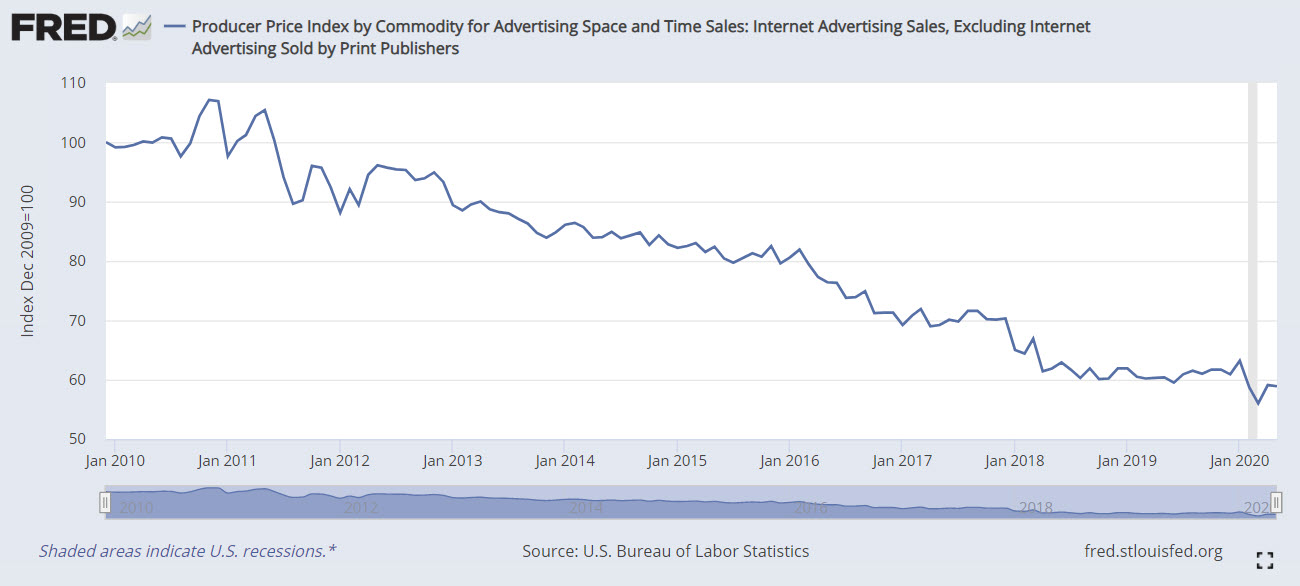
Any individual publisher will experience those declines in a series of non-linear step function shifts. Any of the following could happen:
- Google Panda or another algorithm update from a different attention merchant hits your distribution hard
- a Softbank-backed competitor jumps into your market and gains a ton of press coverage using flammable money
- a roll-up player buys out a series of sites in the supply chain & then tries to make the numbers back out by cramming down on ad syndication partners (sometimes you have to gain enough scale to create your own network or keep rotating through ad networks to keep them honest)
- regulatory costs hit any part of the supply chain (the California parallel to GDPR just went live this month)
- consumer interest shifts to other markets or solutions (the mobile phone has replaced many gadgets)
- a recession causes broad-based advertiser pullbacks
Margin Eaters
In addition to lowering ad rates for peripheral websites, there are a couple other bonus margin eaters.
Junk Sunk Costs
Monopoly platforms push publishers to adopt proprietary closed code bases in order to maintain distribution: “the trade group says Google’s Accelerated Mobile Pages (AMP) format was foisted on news publishers with an implied threat — their websites wouldn’t show up in search results.”
Decreased Supply Chain Visibility
Technical overhead leading to programmatic middlemen eating a huge piece of the pie: “From every £1 spent by an advertiser, about half goes to a publisher, roughly 16p to advertising platforms, 11p to other technology companies and 7 per cent to agencies. Adtech companies that took part in the study included Google’s dv360 and Ad Manager, Amazon Advertising and the Rubicon Project.”
Selection Effect
Large attention merchants control conversion tracking systems and displace organic distribution for brands by re-routing demand through a layer of ads which allows the central network to claim responsibility for conversions which would have already happened had they not existed.
Internal employees in the marketing department and external internet marketing consultants have an incentive to play along with this game because:
- it requires low effort to arbitrage your own brand
- at first glance it looks wildly profitable so long as you do not realize what is going on
- those who get a percent of spend can use the phantom profits from arbitraging their own brand equity to spend more money elsewhere
- those who get performance based bonuses get a bonus without having to perform
Both eBay and Microsoft published studies which showed how perverse selection effect is.
The selection effect bias is the inverse of customer acquisition cost. The more well known your brand is the more incentive ad networks have to arbitrage it & the more ad networks will try to take credit for any conversion which happens.
2) Why does CAC (mostly) only go up?
When you think about, CAC is “lowest” in the beginning, because you have no customers. You can get the low-hanging fruit cost effectively.
Think ad spend. Outbound sales spend. etc. First movers are ready to buy quickly.— Elizabeth Yin (@dunkhippo33) July 6, 2020
These margin eaters are a big part of the reason so many publishers are trying to desperately shift away from ad-based business models toward subscription revenues.
Hitting Every Layer
The commodification of content hits every layer from photography….
Networking is an art and a skill… but if the gold you hold are your images, don’t trade them for the passive networking value.
Simple lesson that is difficult to accept.— Send it. (@johnondotcom) July 4, 2020
…on through to writing
When you think about it, even $1000 is really inexpensive for a single piece of content that generates 20,000+ visits from search in the 1-3 years it’s alive and ranks well. That’s only about 1,000 visits a month. Yet companies only want to pay writers only $200 an article — Dan Shure (@dan_shure) July 6, 2020
…and every other layer of the editorial chain.
Profiting from content creation at scale is harder than most appreciate.
The idea that a $200 piece of content is particularly cheap comes across as ill-informed as there are many headwinds and many variables. The ability to monetize content depends on a ton of factors including: how commercial is it, how hard is it to monetize, what revshare do you go, how hard is it to rank or get distribution in front of other high intent audience sets?
If an article costs $200 it would be hard to make that back if it monetizes at anything under a $10 RPM. 20,000 visits equates to 20 units of RPM.
Some articles will not spread in spite of being high quality. Other articles take significant marketing spend to help them spread. Suddenly that $200 “successful” piece is closer to $500 when one averages in nonperformers that don’t spread & marketing expenses on ones that do. So then they either need the RPM to double or triple from there or the successful article needs to get at least 50,000 visits in order to break even.
A $10 RPM is quite high for many topics unless the ads are quite aggressively integrated into the content. The flip side of that is aggressive ad integration inhibits content spread & can cause algorithmic issues which prevent sustained rankings. Recall that in the most recent algorithm update Credit Karma saw some of their “money” credit card pages slide down the rankings due to aggressive monetization. And that happened to a big site which was purchased for over $7 billion. Smaller sites see greater levels of volatility. And nobody is investing $100,000s trying to break even many years down the road. If they were only trying to break even they’d buy bonds and ignore the concept of actively running a business of any sort.
Back in 2018 AdStage analyzed the Google display network and found the following: “In Q1 2018, advertisers spent, on average, $2.80 per thousand impressions (CPM), and $0.75 per click (CPC). The average click-through rate (CTR) on the GDN was 0.35%.”
A web page which garnered 20,000 pageviews and had 3 ad units on each page would get a total of 210 ad clicks given a 0.35% ad CTR. At 75 cents per click that would generate $157.50.
Suddenly a “cheap” $200 article doesn’t look so cheap. What’s more is said business would also have other costs beyond the writing. They have to pay for project management, editorial review, hosting, ad partnerships & biz dev, etc. etc. etc.
After all those other layers of overhead a $200 article would likely need to get about 50,000 pageviews to back out. And a $1,000 piece of content might need to get a quarter million or more pageviews to back out.
Categories:
Declining Visitor Values
Late Funnel SEO Profits
Before the Panda update SEOs could easily focus almost all their energies on late funnel high-intent searches which were easy to monetize without needing to put a ton of effort into brand building or earlier funnel informational searches. This meant that SEOs could focus on phrases like [student credit cards] or [buy earbuds] or [best computer gaming headphones] or [vertical computer mouse] without needing to worry much about anything else. Make a good enough page on those topics, segment demand across options, and profit.
Due to the ability to focus content & efforts on those tiny subset high-intent commercial terms the absolute returns and CPMs from SEO investments were astronomical. Publishers could insert themselves arbitrarily just before the end of the value chain (just like Google AdWords) and extract a toll.
The Panda Shift / Eating the Info Supply Chain
Then Panda happened and sites needed to have stronger brands and/or more full funnel user experience and/or more differentiated content to be able to rank sustainably.
One over-simplified way to think of Panda and related algorithms would be: brand = rank.
Another way to look at it would be to consider the value chain of having many layers or pieces to it & Google wanting to remove as many unneeded or extra pieces from the chain as possible so that they themselves are capturing more of the value chain.
- That thin eHow article about a topic without any useful info? Not needed.
- The thin affiliate review which was buying Google AdSense ad impressions on that eHow article? Also not needed.
- All that is really needed is the consumer intent, Google & then either Google as the retailer (pay with your credentials stored in your phone) or another trusted retailer.
In some cases there may be value in mid-market in-depth reviews, but increasingly the aggregate value offered by many of them is captured inside the search snippets along with reviews directly incorporated into the knowledge graph & aggregate review scores.
The ability to remove the extra layers is driven largely by:
- the quality of the top players in the market
- the number of quality publishers in a market (as long as there are 2 or more, whoever is not winning will be willing to give a lot of value to Google to try to play catch up against their stronger competitor)
- the amount of usage data available in the market
- the ad depth of the market
If your competitor is strong and they keep updating in-depth content pieces you can’t set and forget your content and stay competitive. Across time searcher intent changes. Those who change with the markets should eventually have better engagement metrics and keep winning marketshare.
Benchmarking Your Competition
You only have to be better than whatever you are competing against to win.
If you have run out of ideas from your direct competitors in an emerging market you can typically find many more layers of optimization from looking at some of the largest and most successful players inside either the United States or China.
To give an example of how user data can be clean or a messy signal consider size 13 4E New Balance shoes. If you shop for these inside the United States a site like Amazon will have shoe size filters so you can see which shoes from that brand are available in that specific size.
In some smaller emerging markets ecommerce sites largely suck. They might allow you to filter shoes by the color blue but wanting to see the shoes available in your size is a choose your own adventure game as they do not offer those sorts of size filters, so you have to click into the shoe level, find out they do not have your size, and then try again. You do that about 100 times then eventually you get frustrated and buy off eBay or Amazon from someone who ships internationally.
In the first case it is very easy for Google to see the end user flow of users typically making their purchase at one of a few places like Amazon.com, the official New Balance store, or somewhere else like that which is likely to have the end product in stock. That second experience set is much harder to structure because the user signal is much more random with a lot more pogos back to Google.
Bigger, Better Ads
Over the past couple decades Google has grown much more aggressive at monetizing their search results. A website which sees its rank fall 1 position on mobile devices can see their mobile search traffic cut in half overnight. And desktop search results are also quite ad heavy to where sometimes a user can not see a single full organic result above the fold unless they have a huge monitor.
We tend to look at the present as being somewhat static. It is a part of human nature to think things are as they always were. But the general trend of the slow bleed squeeze is a function of math and time: “The relentless pressure to maintain Google’s growth, he said, had come at a heavy cost to the company’s users. Useful search results were pushed down the page to squeeze in more advertisements, and privacy was sacrificed for online tracking tools to keep tabs on what ads people were seeing.”
Some critics have captured the broad shift in ad labeling practices, but to get a grasp of how big the shift has been look at early Google search results.
Look at how bright those ad units from 2001 are.
Since then ad labeling has grown less intuitive while ad size has increased dramatically.
Traffic Mix Shift
As publishers have been crowded out on commercial searches via larger ads & Google’s vertical search properties a greater share of their overall search traffic is lower value visitors including people who have little to no commercial intent, people from emerging markets with lower disposable income and
Falling Ad Rates
Since 2010 online display ad rates have fallen about 40%.
Any individual publisher will experience those declines in a series of non-linear step function shifts. Any of the following could happen:
- Google Panda or another algorithm update from a different attention merchant hits your distribution hard
- a Softbank-backed competitor jumps into your market and gains a ton of press coverage using flammable money
- a roll-up player buys out a series of sites in the supply chain & then tries to make the numbers back out by cramming down on ad syndication partners (sometimes you have to gain enough scale to create your own network or keep rotating through ad networks to keep them honest)
- regulatory costs hit any part of the supply chain (the California parallel to GDPR just went live this month)
- consumer interest shifts to other markets or solutions (the mobile phone has replaced many gadgets)
- a recession causes broad-based advertiser pullbacks
Margin Eaters
In addition to lowering ad rates for peripheral websites, there are a couple other bonus margin eaters.
Junk Sunk Costs
Monopoly platforms push publishers to adopt proprietary closed code bases in order to maintain distribution: “the trade group says Google’s Accelerated Mobile Pages (AMP) format was foisted on news publishers with an implied threat — their websites wouldn’t show up in search results.”
Decreased Supply Chain Visibility
Technical overhead leading to programmatic middlemen eating a huge piece of the pie: “From every £1 spent by an advertiser, about half goes to a publisher, roughly 16p to advertising platforms, 11p to other technology companies and 7 per cent to agencies. Adtech companies that took part in the study included Google’s dv360 and Ad Manager, Amazon Advertising and the Rubicon Project.”
Selection Effect
Large attention merchants control conversion tracking systems and displace organic distribution for brands by re-routing demand through a layer of ads which allows the central network to claim responsibility for conversions which would have already happened had they not existed.
Internal employees in the marketing department and external internet marketing consultants have an incentive to play along with this game because:
- it requires low effort to arbitrage your own brand
- at first glance it looks wildly profitable so long as you do not realize what is going on
- those who get a percent of spend can use the phantom profits from arbitraging their own brand equity to spend more money elsewhere
- those who get performance based bonuses get a bonus without having to perform
Both eBay and Microsoft published studies which showed how perverse selection effect is.
The selection effect bias is the inverse of customer acquisition cost. The more well known your brand is the more incentive ad networks have to arbitrage it & the more ad networks will try to take credit for any conversion which happens.
2) Why does CAC (mostly) only go up?
When you think about, CAC is “lowest” in the beginning, because you have no customers. You can get the low-hanging fruit cost effectively.
Think ad spend. Outbound sales spend. etc. First movers are ready to buy quickly.— Elizabeth Yin (@dunkhippo33) July 6, 2020
These margin eaters are a big part of the reason so many publishers are trying to desperately shift away from ad-based business models toward subscription revenues.
Hitting Every Layer
The commodification of content hits every layer from photography….
Networking is an art and a skill… but if the gold you hold are your images, don’t trade them for the passive networking value.
Simple lesson that is difficult to accept.— Send it. (@johnondotcom) July 4, 2020
…on through to writing
When you think about it, even $1000 is really inexpensive for a single piece of content that generates 20,000+ visits from search in the 1-3 years it’s alive and ranks well. That’s only about 1,000 visits a month. Yet companies only want to pay writers only $200 an article — Dan Shure (@dan_shure) July 6, 2020
…and every other layer of the editorial chain.
Profiting from content creation at scale is harder than most appreciate.
The idea that a $200 piece of content is particularly cheap comes across as ill-informed as there are many headwinds and many variables. The ability to monetize content depends on a ton of factors including: how commercial is it, how hard is it to monetize, what revshare do you go, how hard is it to rank or get distribution in front of other high intent audience sets?
If an article costs $200 it would be hard to make that back if it monetizes at anything under a $10 RPM. 20,000 visits equates to 20 units of RPM.
Some articles will not spread in spite of being high quality. Other articles take significant marketing spend to help them spread. Suddenly that $200 “successful” piece is closer to $500 when one averages in nonperformers that don’t spread & marketing expenses on ones that do. So then they either need the RPM to double or triple from there or the successful article needs to get at least 50,000 visits in order to break even.
A $10 RPM is quite high for many topics unless the ads are quite aggressively integrated into the content. The flip side of that is aggressive ad integration inhibits content spread & can cause algorithmic issues which prevent sustained rankings. Recall that in the most recent algorithm update Credit Karma saw some of their “money” credit card pages slide down the rankings due to aggressive monetization. And that happened to a big site which was purchased for over $7 billion. Smaller sites see greater levels of volatility. And nobody is investing $100,000s trying to break even many years down the road. If they were only trying to break even they’d buy bonds and ignore the concept of actively running a business of any sort.
Back in 2018 AdStage analyzed the Google display network and found the following: “In Q1 2018, advertisers spent, on average, $2.80 per thousand impressions (CPM), and $0.75 per click (CPC). The average click-through rate (CTR) on the GDN was 0.35%.”
A web page which garnered 20,000 pageviews and had 3 ad units on each page would get a total of 210 ad clicks given a 0.35% ad CTR. At 75 cents per click that would generate $157.50.
Suddenly a “cheap” $200 article doesn’t look so cheap. What’s more is said business would also have other costs beyond the writing. They have to pay for project management, editorial review, hosting, ad partnerships & biz dev, etc. etc. etc.
After all those other layers of overhead a $200 article would likely need to get about 50,000 pageviews to back out. And a $1,000 piece of content might need to get a quarter million or more pageviews to back out.
Categories:
If you think you’re link building, you’re doing it wrong
Founder and CEO of Organic Growth, Kevin Carney discovered many link building golden nuggets after interviewing 39 people with titles from Marketing Specialist, Outreach Team Lead, Head of Content, to VP of SEO & Analytics, about their link building practices.
The post If you think you’re link building, you’re doing it wrong appeared first on Search Engine Watch.
Is it time for Google Scotland?
Google has search results specific to 179 countries but some improvements are needed to be regionally relevant.
Please visit Search Engine Land for the full article.
How to get more leads on Instagram: 10 Highly effective tactics
Bhavik Soni shares the top 10 media tactics to generate more leads on Instagram which can help accelerate your sales in no time.
The post How to get more leads on Instagram: 10 Highly effective tactics appeared first on Search Engine Watch.
How to set up a simple Google Ads testing framework for continual campaign optimization
Regular PPC ad testing is easier than you may think — and can come with big rewards and set you apart from your competitors
Please visit Search Engine Land for the full article.
Google Rich Results Test tool now out of beta
Google is deprecating the old Structured Data Testing Tool.
Please visit Search Engine Land for the full article.
How to Bring Your Best Self to the Online Conference Season
Posted by cheryldraper
Conference season is here! Of course, this year it looks a bit different. Instead of signing in at the front table and snagging seats next to some new pals, you’ll be setting up your computer as the main stage.
For some, this is going to be a major learning curve. Virtual events can be tougher to follow and engage with. To help you out, we’ve compiled a list of best practices to show up ready and take on any online event you choose to attend this year.
Don’t forget, if you haven’t yet, there is still time to purchase your MozCon Virtual ticket!
Set your intention
To get the most out of your online event, you need to go in with an intention. That way you’ll be more likely to gain something from the experience.
Ask yourself, what are you hoping to achieve? Some examples could be:
- Gain a business opportunity
- Learn more about how to recover from the latest algorithm update
- Find ways to increase efficiency within your SEO processes
- Feel more confident selling your services
Schedule accordingly
Many events will provide you with schedules ahead of time — look at them! (Pssst…if you haven’t yet, now is the perfect time to check out the agenda for MozCon Virtual.)
These schedules can help you go into the conference with a clear idea of how you’re going to spend your time. Going in with a plan will allow you to focus on the content of the event and your intentions each day, as opposed to wasting time frantically trying to decide what sessions you’re going to attend.
Choosing your sessions
Once you know what your intentions are and you have the event schedule, determine what will be the most beneficial content for you. This can be especially helpful when the event has multiple tracks, very few break times, etc.
Choosing your sessions may come down to a process of elimination, and it’s much easier to eliminate sessions when you have some sort of goal in mind.
Things to consider when choosing your sessions are:
- The topic
- The speaker
- The time
- The availability of on-demand videos post-conference
Your intention may be to broaden your horizons this year, so instead of opting to see presentations with the same topics or speakers that you saw last year, you may see someone new discussing something you find interesting but haven’t had time to explore. You may have a tight schedule and not be able to make anything past 3pm. If some of the sessions will be available after the conference, it may be worth checking out topics you wouldn’t have otherwise.
Know when to take a break
When you’re planning out your schedule, you need to make sure you build in time for breaks. This means time to eat, time to decompress, time to refill your coffee cup, and time to do work or home stuff.
Conferences usually have a lot of breaks and that’s for good reason. Ideally, you’re going to be learning a lot. But if you try to learn it all at once without giving your brain a break, very little of it will stick.
So, be sure to listen to your body. If you start to feel foggy or overwhelmed, take a break, grab some water, and move around a bit.
Build in networking time
Something else you want to account for when planning your virtual event agenda is when you’re going to network. Some conferences will have time to network built in, but others won’t.
You’ll want to dedicate time to get to know the other attendees by joining conversations and adding people on social media. This will look a bit different in the virtual space, as you won’t be meeting for coffee or chatting in the lobby, but try to stay creative! Zoom chats and video calls are a great way to connect with new or old friends.
Check out our recent blog on networking online like a champ for more tips.
Recap at the end of the day
At the end of each day, take some time to reflect. Think back to what your intention was, what you did throughout the day to fulfill that intention, and what you can put into action moving forward.
This is a great exercise to ensure you’re making the most out of the event. Far too often, we take in all of the information and do nothing with it! That’s why we like to suggest creating at least three action items at the end of each day.
Gather the essentials
Okay, it’s the first day of the conference and you’re about to jump in front of the computer. BUT! Before you do that, you need to make sure you have everything you need to be successful.
Get a clean notebook or start a fresh doc
Having a clean slate for notes will help you stay focused while attending any conference (virtual or otherwise). So grab a new, crisp notebook or create a new document file on your computer before you get started.
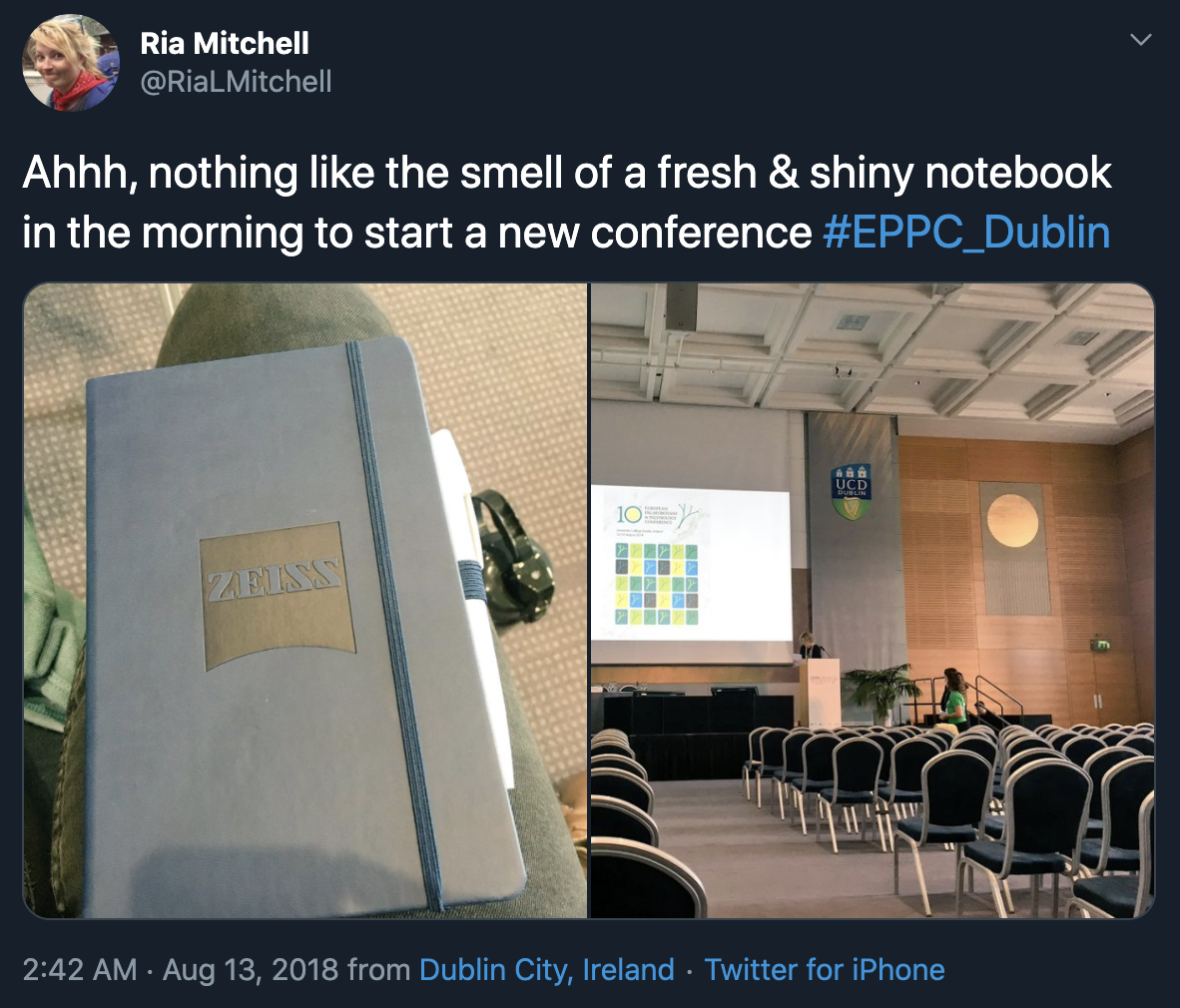
If you decide to go the computer route, be sure you close all other tabs and turn off notifications! You want to be sure that your attention stays on the conference.
Taking notes during a virtual conference
With that new notebook or document of yours, you’ll want to take the most effective notes possible. With that in mind, here are a few things to take note of:
- What you learned
- How can you apply it
- What can you share with your team
To ensure that you’re on track to capture each of these things, when you go into each session, write your intention for the session at the top of your notes page. Then, divide your pages by “what I learned,” “how to apply,” and “what to share.” This will keep your notes nice and organized and give you a visual cue on whether or not you’re getting what you expected out of the session. It will also make your end-of-day recap much easier.
When it comes to virtual events, one of the biggest benefits is that you often get the slide decks and video bundles afterward. We suggest finding out whether the event you’re attending offers those things before you start taking notes, as it may lighten your note-taking burden a bit.
Have some snacks, water, and coffee (or tea)
Perhaps the most important things to have during a virtual conference are the snacks and drinks! As you know, at MozCon, we take this part very seriously, so we expect nothing less if you attend our virtual event.
Brain food can help you stay focused. Some of our favorite snacks are granola bars, nuts, veggies, and of course, donuts. However, you have full control over the spread this year.
Be sure to also have plenty of water and your favorite caffeinated beverage as well!
Show up
You’re ready to go! All that’s left is showing up. With virtual events, this can be hard to do. Especially if you know that the content is going to be available after the event is over. But there is so much to be gained by being a part of the live event and the conversations happening around it.
So show up, and show out!
PS: If you’re looking for a virtual event to attend this year, Roger is still hoping to give you a virtual hug at MozCon Virtual 2020.
Sign up for The Moz Top 10, a semimonthly mailer updating you on the top ten hottest pieces of SEO news, tips, and rad links uncovered by the Moz team. Think of it as your exclusive digest of stuff you don’t have time to hunt down but want to read!
Regular Expression Filter Coming To Google Search Console Performance Report
People either love or hate regular expressions, so if you love them – you are going to love what is coming to Google Search Console’s Performance report. Google is adding the ability to use regular expressions in that report according to an updated hel…