Report: Google Will Label Search Results to End EU Antitrust Probe
The three-year Google antitrust investigation might be over. An agreement means that Google must clearly label search results for its own services such as Google News or Google+, but it won’t involve any changes to Google’s search algorithm.
Study: Google Image Search Referrer Traffic Drops 63% Since Upgrade
Define Media Group released statistics from 87 different websites on the images the new Google Image Search design features have impacted on publishers websites. Overall, sites in the study saw an average decline of 63% of their traffic from Google Ima…
Streetmap Lawsuit Accuses Google of ‘Cynical Manipulation of Search Results’
Google is the subject of yet another anti-competitiveness complaint, this one from UK Internet company Streetmap. The mapping alternative has had enough of Google giving its Maps preferential treatment, so they have put their lawyers on the case.
Study: Top Reason A User Would Block A Site From A Search? Too Many Ads
An online survey examining SEO assumptions by SurveyMonkey found that the No. 1 reason users would block a website from their search results was if the website contained too many ads. If given an option to remove a website from future search results, 6…
Top Video Trends & Opportunities: Mobile, Social, Ads & TV Everywhere [Report]
Video is a powerful way to reach audiences both for publishers and advertisers. Marketers already know people are watching online video more than ever. A new Adobe Digital benchmark report reveals what, when, and how people are watching.
Study: Many Searchers Choose Google Over Bing Even When Google’s Name Is On Bing’s Results
In a recent study by SurveyMonkey examining SEO assumptions, respondents were given two search result pages, one with a page header labeled “Google” and the other with a page header labeled “Bing,” and asked which page of results they preferred. Even when the page header…
Please visit Search Engine Land for the full article.
Infographic: 26 Ideas For Split Testing Your Search Ads
If you want to always be closing, then you need to always be testing, a long-standing mantra (and title of a popular book) in the search marketing space. When it comes to search ads, always be testing means trying out variations of ad copy to see which works best. Feeling like you’re out of…
Please visit Search Engine Land for the full article.
Enable Tape Mode: Watch YouTube Become a Really Bad VCR Player
Ever been watching a HD YouTube video and wondered what it would look like in crappy VHS quality? Me neither. But someone at YouTube did, and now we have a new YouTube Easter egg. Enable tape mode has been added to honor the first VCR’s birthday.
Social Ad Revenue Forecast to Hit $11 Billion by 2017 [Report]
Annual U.S. social ad revenue is expected to reach $11 billion by 2017, according to BIA/Kelsey. The jump would represent a growth rate of over 18 percent over the next five years. Video and mobile social ads will be the prime growth motivators.
14 Ways Facebook Homes In On Local Search
With the announcement of Facebook Home, Facebook has pushed the accelerator on its local mobile strategy, which was already in high gear, thanks to Facebook Local Search and its big brother, Facebook Graph Search. By the end of 2013, I expect the socia…
10 Killer SEO Landing Page Tips
User experience, site usability, and onsite engagement have become more important for major search engines in their assessment of a site’s “rankability,” Use this checklist of tips to ensure your landing pages are sending all the right signals.
Search Triggers: A Secret to More Powerful PPC Ads
Most people don’t search for a solution to their problem until something triggers them to do something about whatever pain or longing they’ve been suffering. By understanding these common search triggers, you can make your paid search ads stand out.
How to Be a Marketing Leader: Make Everyone Around You Better
A good commander is tested in his absence. Whether you are managing a marketing team, a company, or an agency, the only way to truly succeed (and scale) is to make sure you empower your team enough to do the job – even when you aren’t there.
How Will Google Glass Change Internet Marketing?
Google Glass is going to be here in just a few months. Don’t expect a tsunami of change all at once. Instead, wait, watch, and get ready. Somehow, some way, Google Glass and Internet marketing are going to meet up for a magical connection.
Weekly Rundown: Google & Spam, Search Malware, GM Back to Facebook & More
Google’s Matt Cutts and former ex-Googlers talk spam, rankings, and SEO tips. Google has safer results than Bing, Yandex, and Blekko. GM likes Facebook ads again. Here’s a quick recap of search and social marketing news and tips from the past week.
4 Steps to Take After a Google Manual Penalty is Removed
The same activities that were responsible for ascending to number one in the SERPs were also responsible for your manual penalty. So now what? It’s time to acquire high value editorial links. Here are some of the best methods for doing so.
Google Launches Inactive Account Manager, a Digital Last Will & Testament
Google now lets users opt to delete their data upon their death. The Inactivity Account Manager allows users to have their data deleted following long periods of inactivity. Users can also send their Google data to designated third-parties.
Will Google’s Proposed Search Fixes End EU Antitrust Case?
Google has presented a list of concessions in a bid to address the European Union’s concerns and put an end to a two-year long antitrust probe into its search business. Google wants to avoid paying out a massive fine and facing more legal action.
Free Rank Checker
This is a simple and fairly accurate online free rank checker – and you can check up to 100 keywords per url for free. I’ve been playing about with it and it is very simple to use. Using this rank checker is very easy and you can track up to 100 words per domain and up […]
DOWNLOAD YOUR FREE EBOOK – HOBO SEO GUIDE FOR BEGINNERS 2013
Download Free PDF
Introducing "x-default hreflang" for international landing pages
Webmaster Level: All
The homepages of multinational and multilingual websites are sometimes configured to point visitors to localized pages, either via redirects or by changing the content to reflect the user’s language. Today we’ll introduce a new rel-alternate-hreflang annotation that the webmaster can use to specify such homepages that is supported by both Google and Yandex.
To see this in action, let’s look at an example. The website example.com has content that targets users around the world as follows:
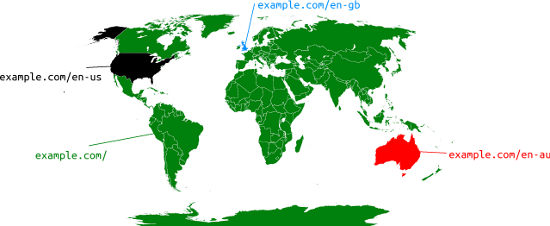
- http://example.com/en-gb: For English-speaking users in the UK
- http://example.com/en-us: For English-speaking users in the USA
- http://example.com/en-au: For English-speaking users in Australia
- http://example.com/: The homepage shows users a country selector and is the default page for users worldwide
In this case, the webmaster can annotate this cluster of pages using rel-alternate-hreflang using Sitemaps or using HTML link tags like this:
<link rel="alternate" href="http://example.com/en-gb" hreflang="en-gb" />
<link rel="alternate" href="http://example.com/en-us" hreflang="en-us" />
<link rel="alternate" href="http://example.com/en-au" hreflang="en-au" />
<link rel="alternate" href="http://example.com/" hreflang="x-default" />
The new x-default hreflang attribute value signals to our algorithms that this page doesn’t target any specific language or locale and is the default page when no other page is better suited. For example, it would be the page our algorithms try to show French-speaking searchers worldwide or English-speaking searchers on google.ca.
The same annotation applies for homepages that dynamically alter their contents based on a user’s perceived geolocation or the Accept-Language headers. The x-default hreflang value signals to our algorithms that such a page doesn’t target a specific language or locale.
As always, if you have any questions or feedback, please tell us in the Internationalization Webmaster Help Forum.
Posted by Pierre Far, Webmaster Trends Analyst

