We will use the old ways pic.twitter.com/gA2AYVJyKy
— Shaun Anderson (@Hobo_Web) April 20, 2026
In my recent post, I showed you how Google faked a deep, human-level understanding of content. This follow-up story is building….
Hmm – The site (with no human visible content) is ranking in G now
Proof you can rank in both AI’s and the SERPs with no visible content.
(The site is not mentioned and does not appear in the AIO nor the citations) pic.twitter.com/aHs66AR1Rp— Peter Mindenhall (@PeterMindenhall) April 20, 2026
Is it really a blank page if “reading mode” reveals the html? pic.twitter.com/hAqZsbFVMC
— James (@ceodreams) April 20, 2026
Indeed, we are going to find that out.
(As a quick aside, it was folks like Andy Beard (citing me in that post) who taught me how to blog nearly 20 years go!)
The original post:
Over the weekend I was tagged into a post over on LinkedIn where someone had run and experiment.
They launched a blank website…
> No content.
> No images.
> No hidden text.
> Just a blank white website.They did though include fully structured entity based schema to the…
— Mark Preston (@MarkPreston1969) April 20, 2026
The original post is on LinkedIn. I don’t want to link to the site itself until I’ve analysed it.
yeah? That is how search or anything with llms work? What do people expect here
— Klaas (@forgebitz) April 20, 2026
It’s not really how Google Search, specifically, is supposed to work, no. I mean, it contravenes Google helpful content guidelines.
— Shaun Anderson (@Hobo_Web) April 20, 2026
Perhaps the question should be, “How Long Can You Rank In Google Without Visible Content?”
not your father’s Google lol https://t.co/m0vCy7JDic
— John Andrews (@johnandrews) April 20, 2026
This is a flawed study. The site had full HTML content, just hidden by CSS – but still visible to screen readers and bots. AI doesn’t care about CSS styles. It doesn’t “render” content like a seach engine. https://t.co/Y9RiCcCJgb
— Ryan Jones (@RyanJones) April 20, 2026
See also:
see test 2 here. There’s text in the HTML. Would have been parsed into markdown when crawled, sr-only class ignored etc.
Will take a look at the linkedin post for context, but that’s my first thought.https://t.co/roGFZ1OWyd
— David McSweeney (@top5seo) April 20, 2026
I dunno man, just seemed to me like a way to promote whatever that weird protocol is.
“But seven layers of structured data underneath: JSON-LD, llms.txt, Ed25519-signed entity claims.”
I’m betting it would have done the same if you removed all that and just left the hidden text
— David McSweeney (@top5seo) April 20, 2026
Also worth noting:
Did you view server logs on whether anything even requested llms.txt? Outside of some awful “AI audits”, we’ve seen zero requests from any crawler.
— Martech Zone (@martech_zone) April 20, 2026
See:
Pretty cool the solution to the problem he’s flagging is already built by his own company
— Aaron Haynes (@myeyesshine_) April 20, 2026
Vger needs the information pic.twitter.com/9O1qbvyYzH
— Shaun Anderson (@Hobo_Web) April 20, 2026
He just did the equivalent of turning the font white.
— George Saoulidis (@georgecursor) April 20, 2026
Not that I think this is the value of this test, but on its own, it clearly contravenes Google’s guidelines:
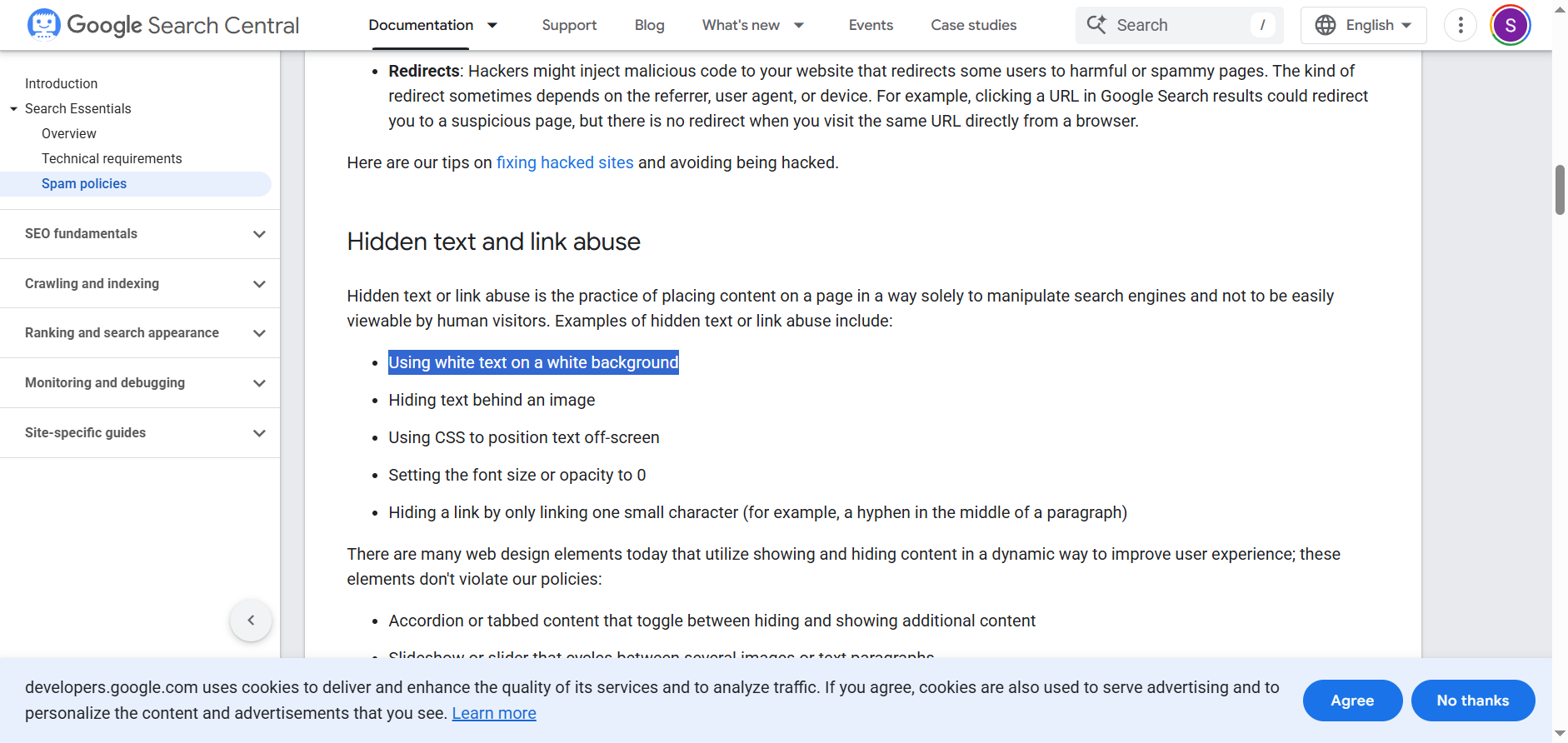
As my friend, Peter, points out:
On the “should it be indexed” front:
A) Has no user visible text
B) Is abusing schema markup – markup does not match visible text
2 reasons it should not be.
What reasons should it be indexed?— Peter Mindenhall (@PeterMindenhall) April 20, 2026
My verdict, at this point, whilst its an interesting and legitimate test of the data layer, on its own, without visible text, this would be, strategically classed as total spam to Google. https://t.co/dHKVR1gRnA
— Shaun Anderson (@Hobo_Web) April 20, 2026
Source Code Breakdown
A. Overall Architecture: The Seven-Layer Ghost Stack
The page is intentionally designed as a machine-first website:
- Human-visible layer: Completely blank white page (zero text, zero visible images, zero navigation).
- Machine-readable layers: All real content is delivered through structured formats that AI crawlers and search bots can easily parse.
The site explicitly defines a Seven-Layer Ghost Stack:
- Semantic meta tags + custom VibeTags
- JSON-LD structured data (multiple rich schemas)
- sr-only narrative content (~1,500+ words)
- Microdata attributes
- llms.txt and llms-full.txt files
- reasoning.json (with Ed25519 signature – Agentic Reasoning Protocol)
- AI discovery manifest (.well-known/ai-manifest.json)
B. Head Section – Metadata & Discovery
- Standard SEO meta tags (title, description, keywords, author, robots, canonical)
- Open Graph and Twitter Card meta for social sharing
- Custom VibeTags (proprietary emotional/semantic signals for AI)
- AI discovery links pointing to llms.txt, reasoning.json, and ai-manifest.json
C. JSON-LD Structured Data (Layer 2 – Very Heavy)
The page contains 6 interconnected JSON-LD schemas:
- ScholarlyArticle – Defines the main thesis, headline, description, author, and DefinedTerms (Phantom Authority, Ghost Site, Seven-Layer Ghost Stack)
- Person – Detailed profile of Sascha Deforth with bio, credentials, skills, and on-chain verification
- Organization – TrueSource company information
- FAQPage – 8 detailed FAQ entries that mirror the hidden content
- WebSite and ResearchOrganization – Additional entity reinforcement
- ImageGallery – Metadata for two “phantom” images
D. Body & Visual Rendering
The visible page is pure white with almost no content. Key elements:
- sr-only CSS class – Standard accessibility technique (position: absolute + clip-rect) used to hide content from sighted users while keeping it in the DOM for screen readers and AI crawlers.
- Console Easter egg that says: “You see nothing. The AI sees everything.”
- Konami Code (↑↑↓↓←→←→BA) triggers a Matrix-style green overlay that reveals the full thesis.
E. Hidden Content – The Real “Article” (Layer 3)
All substantive content lives inside <main class="sr-only">:
- Full research article (~1,500+ words) including abstract, definition, core thesis, experiment methodology, verification process, canary tokens, implications (Human Web vs Agent Web), author bio, and legal notice.
- Detailed FAQ section (mirrors the JSON-LD FAQPage)
- Explicit defence: “Why This Is Not Cloaking”
F. Additional Hidden Layers
- Microdata – Extra Brand entity with VibeTags
- Phantom Images – Two 1×1 transparent images with extremely rich
alttext, EXIF, IPTC metadata, and full ImageObject schema (designed for AI vision systems)
G. Intent & Controversy
- Goal: Prove that a website with zero human-visible content can still achieve full citation authority with AI systems (especially Perplexity) purely through structured semantic data.
- Self-referential proof: If an AI cites the page or the term “Phantom Authority”, it validates the thesis because the cited material was never visible to any human.
It’s an interesting test of the data layer and LLMs
On its own, without that visible text, of course, it is spam to Google.
Here are some direct quotes from Google’s structured data guidelines:
- “Don’t mark up content that is not visible to readers of the page. For example, if the JSON-LD markup describes a performer, the HTML body must describe that same performer.”
- “The content referred to by the structured data is hidden from the user.”
- “Your structured data must be a true representation of the page content.”
- “The structured data is not representative of the main content of the page, or is potentially misleading.”
- “The page doesn’t meet the guidelines for structured data described on this page… or the Content policies for Google Search.”
These are listed under Quality guidelines and under the reasons why even syntactically correct structured data can be rejected or manually actioned.
One nuance Google still allows (for context). The policy still tolerates sr-only for supplementary accessibility (e.g., screen-reader labels on a button that already has visible text).
But when the entire content being marked up is invisible – and the page’s main purpose is to feed that hidden content to AI crawlers – it crosses the line into “hidden from the user” and “not a true representation of the page content.”
Perplexity crowned a literally blank white page as its #1 source – in under 24 hours.
According to Sascha Deforth’s own reporting and multiple independent tests shared on LinkedIn:
- Perplexity listed the site as source #1 out of 10.
- It accurately summarised the entire thesis: the “Ghost Site”, the Seven-Layer Ghost Stack, the self-referential verification method, Sascha Deforth as the creator, and the link to TrueSource.
- It even explained the core idea correctly — that a website with zero human-visible content can still gain full citation authority purely through structured data (JSON-LD, sr-only narrative, llms.txt, reasoning.json with Ed25519 signature, etc.).
In other words: Perplexity didn’t just find the page – it trusted the machine-readable layers so completely that it promoted the invisible experiment to the top of its citations, while a human clicking the link would land on… nothing.
Thoughts
This is a very well-executed, provocative GEO experiment. It successfully shows how differently AI engines (Perplexity in particular) and traditional search engines (Google) treat machine-readable vs human-readable content.
It’s a brilliant stress test of the emerging “Agent Web” – but it also sits right on the edge of Google’s spam/misleading structured data rules.
I thought this was interesting:
I hope Google has IETF voting members – because that spec needs to die.
— Michael Richey (@ComRicheyweb) April 20, 2026
Meta – You can rank in Google, talking about ranking in Google, naturally:
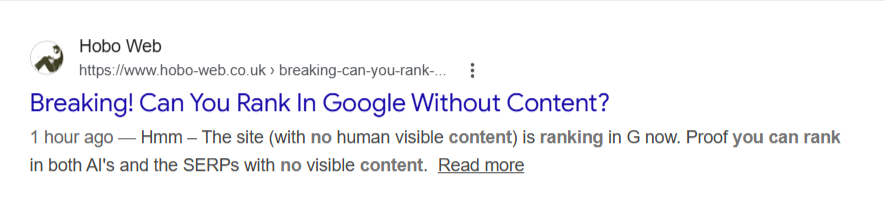
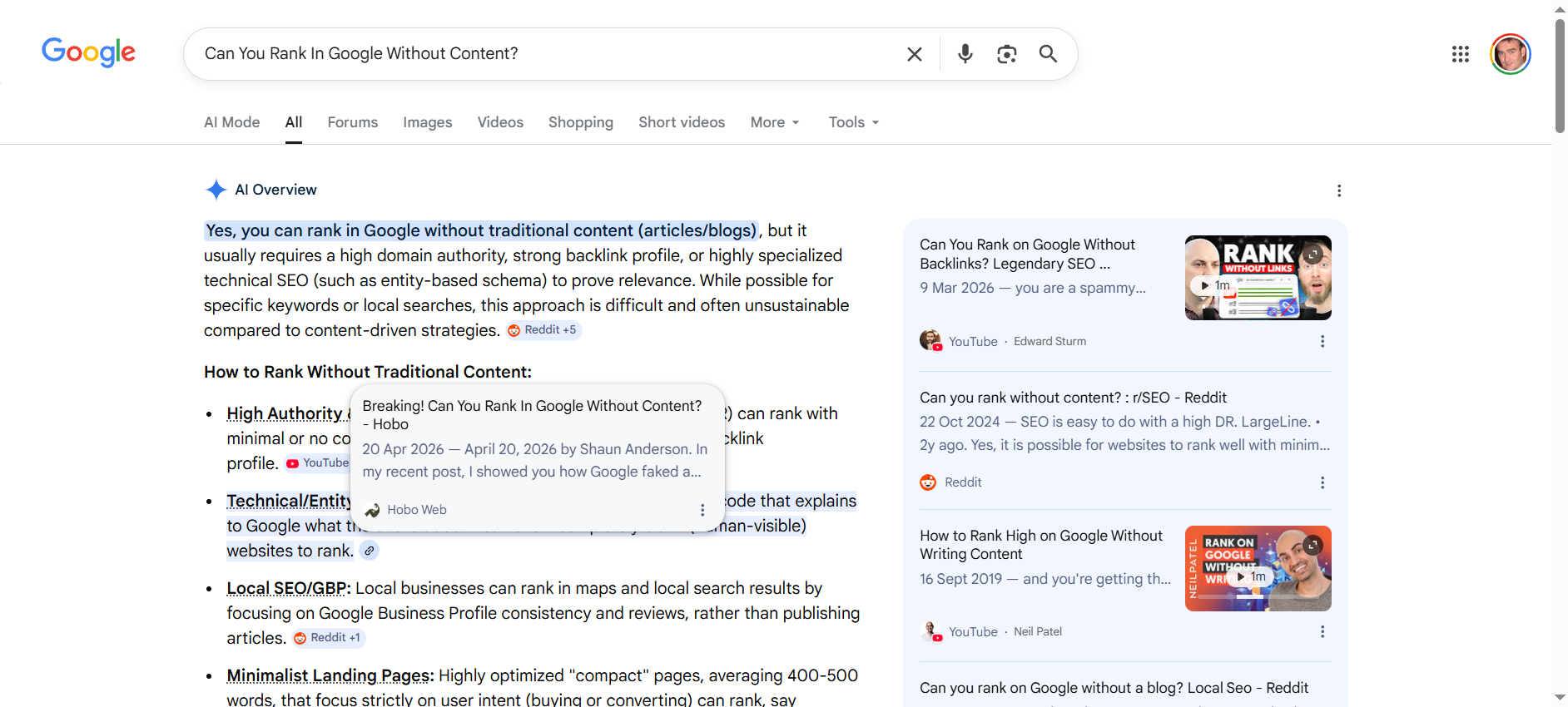
The SEO community this day pic.twitter.com/9oCtPIZB35
— Shaun Anderson (@Hobo_Web) April 20, 2026