The Inbounder: What does the DNA of a Modern Day Marketer look like?
What is the DNA of a modern day marketer? Rand Fishkin, Bas van den Beld, Lisa Myers, Aleyda Solis, Gianluca Fiorelli and Fernando Maciá Domene tell you what they think.
Post from Bas van den Beld
3 Keys To Understanding Your SEO Needs
Many businesses know they need search engine optimization, but they don’t know much more beyond that. Columnist Casie Gillette has tips for determining the specifics.
The post 3 Keys To Understanding Your SEO Needs appeared first on Search Engine Land…
Yelp – The Story that Won’t Die
The Bold Italic is reporting on a film maker that is attempting to tell the Yelp is a bully story via a documentary. Yelp gets zero stars in an upcoming documentary by local filmmaker Kaylie Milliken. Her film, Billion Dollar Bully (which is halfway done, according to the International Business Times) focuses on complaints from restaurant owners about Yelp’s … Continue reading Yelp – The Story that Won’t Die →
Answers and Apps: Trends at SMX West
SMX West 2015 was held in San Jose at the beginning of March. Kate Morris attended and shares the key lessons and trends she picked up from the event.
Post from Kate Morris
How Large Is Google’s Mobile-Friendly Algorithm? Larger Than Panda Or Penguin.
Google’s Zineb Ait Bahajji is quoted as saying at SMX Munich the upcoming mobile-friendly algorithm will impact more sites than their Panda or Penguin algorithms.
The post How Large Is Google’s Mobile-Friendly Algorithm? Larger Than Panda Or Penguin. appeared first on Search Engine Land.
Please visit Search Engine Land for the full article.
Dancing Three Leaf Shamrocks For Google’s St. Patrick’s Day Logo
Today on the Google home page is an annual Google Doodle for St. Patrick’s Day.
This year, Google has an animated version of the Doodle. The Google logo has Three Leaf Shamrocks dancing…
Google Change Of Address Tool May Support Subdomains
In a Google+ hangout, one of the questions asked to John Mueller of Google was about the change of address tool.
Currently it does not support
Google Knowledge Graph With Seductive Images For Gift Ideas
It is one thing to search explicitly for seductive images or specific type of photos or even gift ideas but to be shown them for search queries that can go either way in the knowledge graph seems like a mistake…
Google: Autocomplete On Mobile Forms Very Important But Not For Rankings
Google announced this morning that it is “very important” to make your mobile web sites user friendly and devoted a whole blog post about the importance of autocomplete on mobile web sites.
Google said:
Making websites friendly and easy to browse fo…
Google Doorway Pages Algorithm & Guidelines Updated
Google announced they have updated their ranking algorithm to detect a larger and better set of doorway pages and thus wipe them out of the search results, as to improve search quality within Google’s search results…
Google: The Mobile-Friendly Algorithm Will Be Larger Than Panda Or Penguin
If you had any doubt how big and “significant” the upcoming mobile-friendly ranking algorithm will be for Google’s mobile results, you should remove those doubts now…
Google Strongly Encouraging Webmasters To Adopt Autocomplete On Forms For Mobile
Google says webmasters should implement autocomplete markup to improve mobile user conversions but does not go as far to say it will be a ranking factor.
The post Google Strongly Encouraging Webmasters To Adopt Autocomplete On Forms For Mobile appeare…
In-App Social & Contact Data – New in Open Site Explorer
Posted by randfish
Today I’m excited to announce the launch of a new feature inside
Open Site Explorer—In-App Social & Contact Data. With this launch, you’ll be able to see the social or email accounts we’ve discovered associated with a given website, and have one-click access to those pages.

Initially, the feature offers:
- Availability today on the inbound links tab and in Link Intersect on the “pages -> subdomains” view. In the future, if y’all find it useful, we hope to expand its presence to other areas of the tool as well.
- Email accounts will only be shown if they match the domain name (e.g. rand@moz.com would be shown next to moz.com, randfishkin@yahoo.com would not) and if they appear in standard format on the page (we don’t try to grab emails in JavaScript or that use alternate formats to obsfucate).
- We show Facebook, Twitter, Google+, and email addresses we’ve found on multiple pages of the site (we take a small random set and analyze whether these social/contact data pieces are uniform). If we find multiple accounts, you’ll see this:

Use cases
There are three major use cases for this feature (at least for me; you might have more!):
1) Link/Outreach prospecting
It can be a pain to visit sites, find social accounts/emails, and copy them into a spreadsheet or send messages (and recall which ones you have/haven’t done yet). By including social/contact data in the same interface where you’re doing link analysis, we hope to save you time and clicks.
2) Link/site trust and audience reach analysis
We’re actually using this data on the back end at Moz for our upcoming Spam Score feature (coming very soon), but you can use it manually to help with a quick mental filter for trustworthy/authoritative/non-spammy sites, and to get a sense for the size and reach of a site’s social audience.
3) At-a-glance analysis of social networks among a group
If you’re in a given space (e.g. travel blogs), it’s a process to determine which social networks are/aren’t being used by industry participants and influencers. Social/contact data in OSE can help with that by showing which social networks various sites are using and linking to from their pages:

We need your feedback
This first implementation is relatively light in the app—we haven’t yet placed this data anywhere/everywhere it might be useful. Before we do, we want to hear what you think: Is this useful and valuable to your work? Does it help save you time? Would you want to see the feature expanded and if so, in what sections would it provide the greatest value to you? Please let us know in the comments, and by getting back in touch with us after you’ve had a chance to try it out for yourself.
Thanks for giving social/contact data a spin, and look for more upgrades to Open Site Explorer in the very near future!
Sign up for The Moz Top 10, a semimonthly mailer updating you on the top ten hottest pieces of SEO news, tips, and rad links uncovered by the Moz team. Think of it as your exclusive digest of stuff you don’t have time to hunt down but want to read!
St. Patrick’s Day Google Logo Brings Dancing Clovers To The Homepage
The holiday Doodle is accompanied by link that leads to Google Maps results for ‘Ireland Highlights’ search.
The post St. Patrick’s Day Google Logo Brings Dancing Clovers To The Homepage appeared first on Search Engine Land.
Please visit Search Engine Land for the full article.
Play The Google Feud Game & I Bet You’ll Lose
Google Feud adapts the popular game show, Family Feud, by using Google Auto Complete Suggestions.
The post Play The Google Feud Game & I Bet You’ll Lose appeared first on Search Engine Land.
Please visit Search Engine Land for the full article.
Landing Page Conversion: Organic & Content Optimization
Here’s a look at some of the ways search marketers can move to the next step of converting traffic by understanding options, page-level metrics, and the importance of testing.
From Travel to Training via Some Dodgy Links
The lines between good PR and paid link inclusions are often blurred. Claire Thompson explores the issue and provides some insights for journalists, PR and SEO professionals to keep in mind when paying for link inclusions in high profile publications.
Post from Claire Thompson
Helping users fill out online forms
A lot of websites rely on forms for important goals completion, such as completing a transaction on a shopping site or registering on a news site. For many users, online forms mean repeatedly typing common information like their names, emails, phone numbers or addresses, on different sites across the web. In addition to being tedious, this task is also error-prone, which can lead many users to abandon the flow entirely. In a world where users browse the internet using their mobile devices more than their laptops or desktops, having forms that are easy and quick to fill out is crucial! Three years ago, we announced the support for a new “autocomplete” attribute in Chrome, to make form-filling faster, easier and smarter. Now, Chrome fully supports the “autocomplete” attribute for form fields according to the current WHATWG HTML Standard. This allows webmasters and web developers to label input element fields with common data types, such as ‘name’ or ‘street-address’, without changing the user interface or the backend. Numerous webmasters have increased the rate of form completions on their sites by marking up their forms for auto-completion.
For example, marking up an email address field on a form to allow auto-completion would look like this (with a full sample form available):
<input type="text" name="customerEmail" autocomplete="email"/>
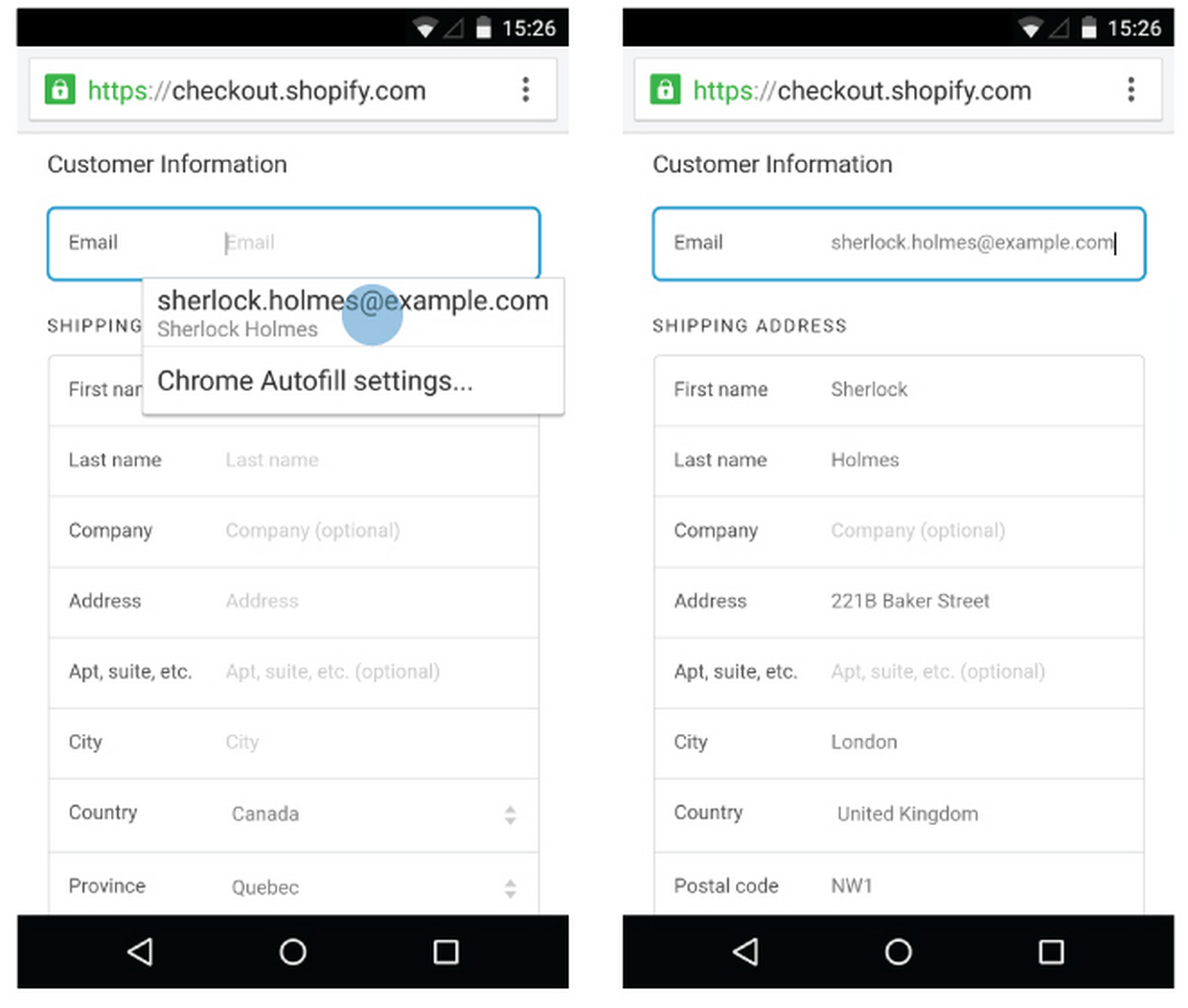
Making websites friendly and easy to browse for users on mobile devices is very important. We hope to see many forms marked up with the “autocomplete” attribute in the future. For more information, you can check out our specifications about Label and name inputs in Web Fundamentals. And as usual, if you have any questions, please post in our Webmasters Help Forums.
Posted by Mathieu Perreault, Chrome Software Engineer, and Zineb Ait Bahajji, Webmaster Trends Analyst


SEO-friendly exit intent pop-up plugin for WordPress
If you are a WordPress site owner, designer, or developer looking to maximize the number of leads from your website using pop-ups, this plugin is for you.
Read the full article here SEO-friendly exit intent pop-up plugin for WordPress © Copyright 2006-2021 Shaun Anderson
The Art of Concision: How to Effectively Make Your Point in Fewer Words
Posted by Isla_McKetta

You and your readers are being bombarded with information. Too often that’s in the shape of long-winded emails, blog posts, and reports that say very little or assume that because digital space is (virtually) free and unlimited, so is your time.
But time and attention
are valuable. If you learn to practice concision in all your writing (from emails and reports to blog posts, whitepapers, and product copy), you’ll not only get your point across, you might also earn your readers’ trust, gratitude, and repeat traffic. Plus, concise copy converts better.
Quick advice on writing concisely
The best advice I ever received about writing concisely came from former newspaperman (and current Moz associate)
Ronell Smith. He said that in order to clearly get your point across in the fewest possible words it’s essential to:
- Write a one-sentence description of the post you wish to write (this is basically the headline)
- Think of the number one thing you’d like readers to take away from the post
- Highlight at least three facts (authoritative, supportive evidence) that support this main point
- Jot down notes that help you tell the story using these facts
- Spend a few days letting the elements “breathe”
Now if I were writing the most concise blog post ever, I’d stop right there, because Ronell already said the most important things. But sometimes it’s helpful to see how someone else puts advice into action. So here’s how I’m putting Ronell’s advice to work to write a post about concision.
Write a one-sentence description of the post
Learning how to make your point in as few words as possible will help you capture your audience’s attention.
I could (and should) stop there. But I want to make a couple of points about
why this is important:
- Your brain does a lot of work as it’s trying to condense that amazing idea in your head down into one sentence—as much work as creating a whole first draft.
- Once you have a one-sentence description of where you’re going, it’s easy to toss aside all those other exciting ideas that try to plant themselves on the page and focus on what you wanted to say in the first place.
Think of the number one thing you’d like readers to take away from the post
Fewer words often makes for clearer, more impactful communication.
Once I know exactly what it is that I want you to take away from this post, I can make a promise that everything will contribute to that number one goal. This is good because:
- It helps you focus on one audience. When you’re writing amazing tips on keyword research, it can be really easy to want to also remind readers why keyword research is important. That’s the moment when you lose the interest of people who get the whys of keyword research. They are now bored and done with you (even though you were just about to blow their minds with really revolutionary information).
- You know what to lead with. Even if you’re writing a crucial email, you can bet not everyone will read every word (or paragraph). By leading with the most important part, your message is more likely to be understood.
Highlight at least three facts that support this main point
Technically, I’ve been cheating so far and adding in facts along the way. This step will help you:
- Build an outline of what you want to say. It’s easier to write to outlines and you’ll be sure to include all the points you wanted to see.
- Preview the quality of your argument. If you’re writing an article about how content is king and your first fact is “because everyone says so” and the second is “readers share stuff” and you’re struggling for a third fact, go back and find a stronger argument.
- Stay on topic.
Jot down notes that help you tell the story using those three facts
Hooray! You finally get to elaborate. I’ll start my elaboration by telling you that I’ve deleted about 500 words from this post already just because I was thinking so hard about concision. Do I miss a little of my standard whimsy and storytelling style? Yes (although I’m making up for it in this paragraph).
Because you’ve already honed in tight on your subject, you can let your creative self a little loose now. Enjoy embellishing your evidence with relevant examples and case studies. Relish the chance to make your points more memorable and engage your audience by sharing pertinent stories.
Spend a few days letting the elements “breathe”
Once you’ve pulled together your main point with supporting facts and illustrated those with stories, you need to step away from your writing. If you’re writing an email, you might not have a few days, but at least go to lunch or grab a coffee. Giving your writing room to breathe allows you to:
- Spot gaps. Everything makes perfect sense in your head, but a breath of fresh air might help you see where you forgot to actually write down a crucial piece of your argument.
- See redundancies. Sometimes you’re so passionate about something you say it twice (although usually in slightly different ways). A second, later read can show you where you’re repeating yourself.
- Be rational. Speaking of passion, sometimes we write things we’d never actually want to see out in the world. Allowing your writing to rest can help you make your point without saying anything you wouldn’t want repeated. This makes you easier to listen to as well.
The rest of the story
Now that we’ve seen Ronell’s points in action, there are a few more things I want to add.
Concision usually happens in editing
If you’ve been following Ronell’s advice, your writing is going to be a lot clearer, shorter, and more impactful. But don’t count on your first draft to be the best draft. You can usually clean up a lot of extra words (and random errors) with a second draft.
Why concision?
You’re busy. Your boss is busy. Your reader is busy. We’re all reading less and less of the information presented to us. But reading is still a critical way that we share information. By learning to say more with fewer words, you’ll get your point across and come out on top.
Concision ain’t easy
In fact, you might spend more time crafting your message. Making your point makes that time and effort worth the extra work. Take the
Moz Top 10 for example: over the last six editions, the ones with the fewest number of words have had the highest click-through rates.

Shortening the Moz Top 10 often takes me an extra draft, but that kind of increase in CTR is worth one more pass.
How this works at Moz
I was
shocked when Trevor and I found that the most popular Moz blog posts (usually) come in at 1,200-1,800 words. That seemed long to me (especially for the Internet), but then I realized how much advice and education are usually packed into one post.
Compare that with what we sometimes see in YouMoz, which are initial drafts of 4,000-8,000 words. I am certain that a few of those authors have that much valuable information to share about one topic. But my guess is that most of those articles are trying to do too much in one post or are repeating themselves unnecessarily. I’d also be really surprised if most readers manage to reach the end of a post that long.
That’s the real tragedy of overly wordy writing: No matter how brilliant you are, unless you are the most engaging writer ever, no one is reading what you’re writing. And according to one study, visitors only read 18% of content beyond the 1,250 word mark.
Do you have tips for stripping the bloat from your writing? Or do you truly love (and actually read) long-form writing on the web? Write me a novel in the comments ☺
Sign up for The Moz Top 10, a semimonthly mailer updating you on the top ten hottest pieces of SEO news, tips, and rad links uncovered by the Moz team. Think of it as your exclusive digest of stuff you don’t have time to hunt down but want to read!