Google: Don’t Use Hover Menus On Mobile Friendly Sites
As you may remember, Google is laying hints that mobile UX is coming as a ranking factor. That being the case, Googlers are now talking a lot about mobile UX (user experience) issues they see often…
Google Currently Won’t Accept HTTPS Sites Into Google Trusted Store Program
Google launched the Trusted Store program back in 2011, their way of vouching for online merchants.
But if those merchants are fully HTTPS…
The Importance of Initial Research Prior to Link Development
Even if you can take just a day or so to really do some research before you start trying to generate links, it’s incredibly beneficial.
Seasonal pages and SEO strategy: what works best?
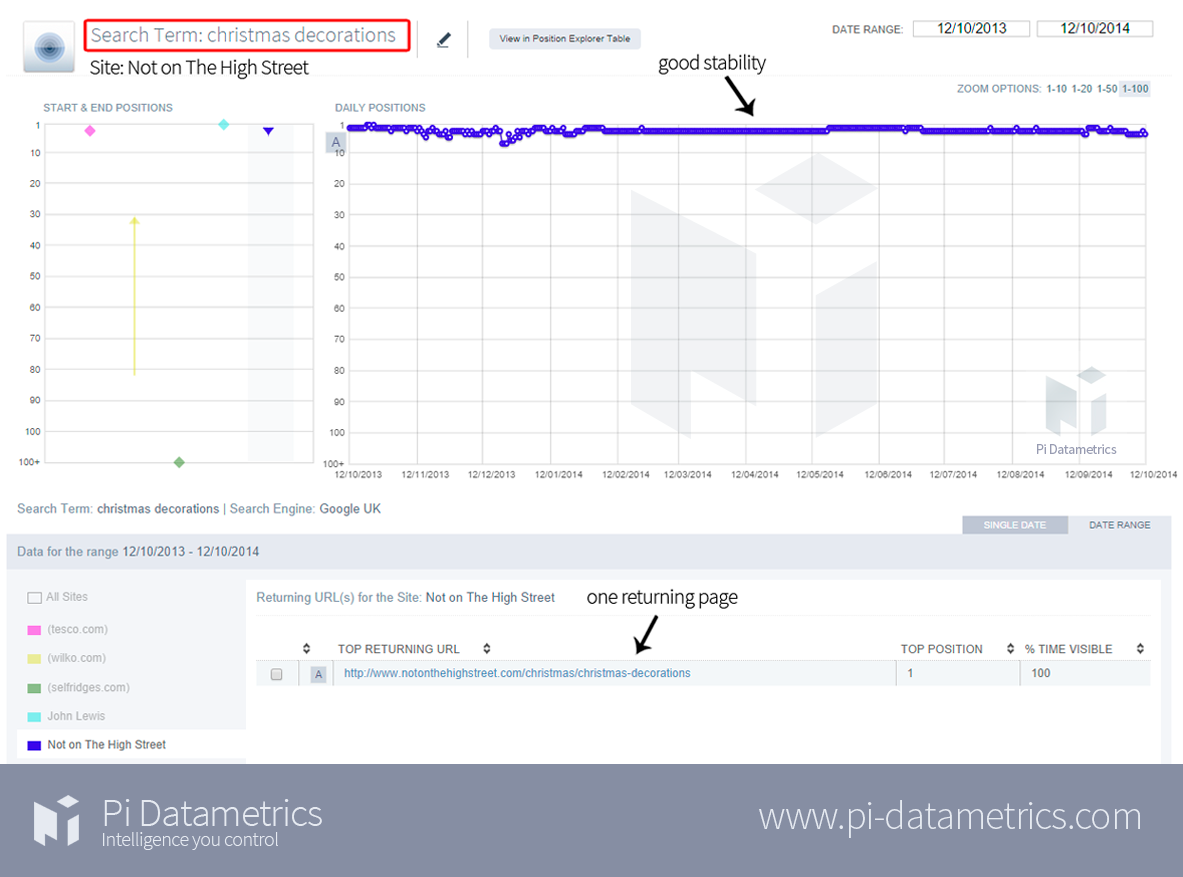
The following chart, supplied by PI Datametrics, shows how different brands are ranking for ‘christmas decorations’ over the last 12 months.
While three of the retailers here are ranking consistently on page one of Google, the other two (Selfridges and Wilko) are all over the place.
So what’s the difference?
(Click image for a larger version)

For obvious reasons, this is a seasonal term, with big spikes in the run up to Christmas and little or no interest in between, as this Google Trends chart shows.

John Lewis has a dedicated page for Christmas decorations which it doesn’t change too much. It also has no other pages competing for the term.

NotOnTheHighStreet.com has a similar strategy, which produces the same results.
In contrast, Selfridges doesn’t seem to have a strategy for this particular term, and has been publishing a number of pages which compete against each other for the term.
As I mentioned in a previous post, more content doesn’t always help, and in this case the competing pages are harming the overall rankings for the term.

We see the same pattern from Wilko, with five pages ranking for the term at various times of the year.
This means that Wilko’s search ranking has fluctuated between 11 and 82 over the course of 12 months.

We see similar patterns in searches for ‘Christmas Toys’. Amazon has barely touched this page, and therefore ranks steadlily throughout the year.

Argos, since just before last Christmas, has ranked steadily, but seems to have muddied the waters by adding more pages lately.
We can see this in the rankings for the past few months:

John Lewis had the right strategy for decorations, but is cannibalising its own search rankings on this term with five competing pages.

Toys R Us has no stability at all, with 11 pages ranking for this term at various times of the year.
This means that, when the Christmas traffic spike arrives, it has no control over which page will rank for the term and where it will sit on Google.

So what’s the best strategy for seasonal pages?
There are a number of factors:
- Publish well in advance of the target event. Longevity is a factor here, and those brands, like Amazon, that have published the pages more than 12 months ago are still ranking highly.
- Don’t mess with the pages. Come January, these pages may no longer be relevant or attract any traffic but that doesn’t mean they should be unpublished. Just leave them be.
-
Decide which page you want to rank. Set a landing page for your target term and make sure all other pages on the topic link to it.
This sends a clear signal to Google of which page is more important, and can prevent unneccesary competition between pages on the same site.
- More content isn’t always the answer. Just publishing more pages on the topic won’t help you rank unless the underlying strategy is there.
Google: My Business Dashboard May Have Few Day Delay
Jade Wang from Google said in a Google Business Help thread that updates submitted via the old Google Places dashboard may be delayed by a few days.
I don’t think this is new information for most local SEOs but it is nice to have on record…
How can marketers benefit from mobile search?
On one hand, this is due to the expanding number of smartphones and the greater time spent by users on these devices. On the other hand, given the small screen size and keyboards of phones, it is a lot simpler to search (either by text or voice), rather than type a long, complex URL into the address bar when you are on the go.
The rise of mobile is consequently changing the search landscape, with an estimated 26.7% of Google’s ad revenues expected to come from mobile search in 2014.
The results that search engines deliver on phones and computers vary dramatically. Our own data found that 36% of web pages (URLs) shown in mobile Google search results are different to those that appear for the same searches carried out on a desktop or laptop.
Nearly a quarter (23%) were from completely different websites (domains). This reflects Google’s increasing focus on the context and intent behind queries, which vary dramatically from device to device and are also strongly related to local aspects.
Given these factors, how should marketers approach their overall search strategy? Do they look to keep content the same or vary it, according to device?
Based on our experience, here are six key considerations to keep in mind.
And for more on this topic, download the Econsultancy Mobile and Local SEO Best Practice Guide or read our post on 30+ compelling mobile search statistics.
1. Focus on the context
As I’ve said the intent behind a search query is often radically different between devices. If you search for pizza on your laptop, you are more likely to be at home looking to order a delivery.
On mobile you are probably on the move, and hence searching for a restaurant nearby (which is why the factor ‘local’ is much more important when performing mobile searches).


This is also why mobile search is particularly strong in specific sectors. For example, Google reports that 30% of all restaurant searches and 25% of all film searches are performed on a mobile device.
Additionally a mobile search can be more time-critical and less speculative – typing ‘petrol station’ could well mean that your car is running low and you need one now, rather than just researching a future purchase.
2. Speed is a factor
People read less,and want information faster when accessing content on their mobile devices. Screens are smaller, and searchers are usually on the move, so they don’t have the time or inclination to read long-form content.
Attention spans are shorter on smartphones, meaning bounce rates are higher. Essentially people want information quickly and immediately, rather than having to scroll through pages of results. Answers have to be briefer, relevant and easily understandable, otherwise they simply will not be read.
3. Search engines treat mobile differently
As our results show, mobile results vary from other devices when it comes to Google searches. This is due to better understanding of the context, particularly as Google has additional information about the mobile searcher, such as exact location, to help it provide more relevant results.
With the form factor, particularly screen size, being different on a mobile device, Google displays results in a simpler way, using features such as Knowledge Graph to deliver answers in a straightforward, easily readable manner.
Knowledge Graph results


Hence, organic results are sometimes not visible without scrolling because the Knowledge Graph is delivered above them due to space constraints.
4. Content type is important
Figures from comScore reveal that the time spent consuming rich media (such as video) on mobile devices is actually higher than on the desktop. This could well be down to the fact that it is easier to listen or watch rich media than pure text while on the move.
Consequently marketers needs to factor this into their planning, ensuring that they offer a range of content types, optimised for different devices.
5. Mobile ranking factors are different
The factors that correlate with high rankings for mobile search are different to those on other devices.
A Searchmetrics study indicates that mobile search results on Google.com tend to include pages with fewer backlinks from other sites than comparable results for the same searches on desktop and laptop.
This makes sense because mobile content contains fewer ad hoc links, as mobile users are much less likely to link to pages, preferring to share/like through social media.
Additionally, mobile results often feature shorter content and also tend to display pages with a smaller file size on average than those delivered on desktop or laptop.
This could be because smaller pages will be quicker to download on a mobile and use less of a phone subscriber’s data allowance.
Marketers need to be aware of these differences and optimise content accordingly.
6. From responsive design to responsive content
Through techniques such as responsive design and HTML5, many organisations are creating web pages that change to fit different screen sizes and device interfaces.
The next step in this process is going to be responsive content. Take the example of a retailer – its traditional website should be optimised for desktop and laptop searches, with long-form, text-based content that covers all potential areas of interest to searchers.
For smartphone searchers, content should be condensed to what is relevant to them, perhaps using video rather than text, with the option to click to access the fuller desktop style article.
We now live in a mobile-first world, which has a significant impact on how brands engage with consumers when it comes to search.
Marketers therefore need to understand how ranking factors vary between smartphone, tablet and desktop/laptop computer and put in place a strategy that delivers optimised content, whatever device the search is carried out on.
Penguin 3.0: what’s it all about?
What is Penguin 3.0?
Automated punishment for companies that do automated link building.
Penguin has caught quite a few sites that have backlinks from poor quality blogs and link networks too, and it seems like Penguin 3.0 has much more of a focus on blogs.
We’re getting better at algorithmically identifying sites that aren’t genuine, so it’s fair to assume that Google is too.
What is Google aiming to achieve with this update?
Most search results have at least one or two sites on the first two pages that really don’t deserve to be there; often fraudulent businesses using quick and dirty tactics to get search traffic.
The aim of Penguin is to take out those sites, and because the effects of Penguin are transferred through redirects, those spam sites can’t come back under another guise (or at least they can’t stay there).
Where are you seeing the biggest changes so far?
The biggest changes have definitely been in the travel sector, with several major travel sites seeing a fall in visibility.
The reason for this is the travel industry’s insistence on ‘relevant blogs’ – the problem is that there are very few relevant travel blogs, and there’s no good reason for a backpacker to write about package holidays, so it looks unnatural.
Based on what you have seen so far, has it achieved what Google wanted?
It has, because I think Google wanted to give sites the chance to recover and not wipe out innocent sites.
Penguin 3.0 is long overdue because the way that the algorithm works means sites are susceptible to negative SEO.
The chatter in forums like Blackhat World makes it seem like there have been a lot of hits, but SEOs on Twitter are struggling to spot big drops, which is probably the way it should be.
What is your advice for sites hit by penguin 3.0?
Stop link building. After the last couple of Penguin updates it was fairly easy to blame legacy links, but businesses have had a whole year to organise a disavow file, which implies that toxic links might still be being added.
The question you need to be asking before you place a link is not ‘is this blog relevant?’ but ‘will this link drive traffic to my website?’
Google Penguin 3.0 Is A Slow Worldwide Rollout – Weeks Not Days
A new post from www.davidnaylor.co.uk. BAZINGA!
The post Google Penguin 3.0 Is A Slow Worldwide Rollout – Weeks Not Days appeared first on UK SEO Blog by Dave Naylor – SEO Tools, Tips & News.
Google AutoCorrects: Penguin 3.0 Still Rolling Out & 1% Impact
As you already know, Google launched Penguin 3.0 late Friday. But yesterday, Google’s John Mueller said he believed the roll out was complete but then hours later stepped back on that.
Today we learn from Google’s Pierre Far on Google+ that the roll out is far from complete, that it is still rolling out and will so for the “next few weeks.”
Pierre said, “itâs a slow worldwide rollout, so you may notice it settling down over the next few weeks.”
More than Keywords: 7 Concepts of Advanced On-Page SEO
Posted by Cyrus-Shepard
“What is this page about?”
As marketers, helping search engines answer that basic question is one of our most important tasks. Search engines can’t read pages like humans can, so we incorporate
structure and clues as to what our content means. This helps provide the relevance element of search engine optimization that matches queries to useful results.
Understanding the techniques used to capture this meaning helps to provide better signals as to what our content relates to, and ultimately helps it to rank higher in search results. This post explores a series of
on-page techniques that not only build upon one another, but can be combined in sophisticated ways.
While Google doesn’t reveal the exact details of its algorithm, over the years we’ve collected evidence from interviews, research papers, US patent filings and observations from hundreds of search marketers to be able to explore these processes. Special thanks to Bill Slawski, whose posts on
SEO By the Sea led to much of the research for this work.
As you read, keep in mind these are only
some of the ways in which Google could determine on-page relevancy, and they aren’t absolute law! Experimenting on your own is always the best policy.
We’ll start with the simple, and move to the more advanced.
1. Keyword Usage
In the beginning, there were keywords. All over the page.
The concept was this: If your page focused on a certain topic, search engines would discover keywords in important areas. These locations included the title tag, headlines, alt attributes of images, and throughout in the text. SEOs helped their pages rank by placing keywords in these areas.
Even today, we start with keywords, and it remains the most basic form of on-page optimization.

Most on-page SEO tools still rely on keyword placement to grade pages, and while it remains a good place to start, research shows its
influence has fallen.
While it’s important to ensure your page at a bare minimum contains the keywords you want to rank for, it is unlikely that keyword placement by itself will have much of an influence on your page’s ranking potential.
2. TF-IDF
It’s not keyword density, it’s
term frequency–inverse document frequency (TF-IDF).
Google researchers
recently described TF-IDF as “long used to index web pages” and variations of TF-IDF appear as a component in several well-known Google patents.
TF-IDF doesn’t measure how often a keyword appears, but offers a measurement of
importance by comparing how often a keyword appears compared to expectations gathered from a larger set of documents.
If we compare the phrases “basket” to “basketball player” in
Google’s Ngram viewer, we see that “basketball player” is a more rare, while “basket” is more common. Based on this frequency, we might conclude that “basketball player” is significant on a page that contains that term, while the threshold for “basket” remains much higher.

For SEO purposes, when we measure TF-IDF’s
correlation with higher rankings, it performs only moderately better than individual keyword usage. In other words, generating a high TF-IDF score by itself generally isn’t enough to expect much of an SEO boost. Instead, we should think of TF-IDF as an important component of other more advanced on-page concepts.
3. Synonyms and Close Variants
With over 6 billion searches per day, Google has a wealth of information to determine what searchers
actually mean when typing queries into a search box. Google’s own research shows that synonyms actually play a role in up to 70% of searches.
To solve this problem, search engines possess vast corpuses of
synonyms and close variants for billions of phrases, which allows them to match content to queries even when searchers use different words than your text. An example is the query dog pics, which can mean the same thing as:
• Dog Photos • Pictures of Dogs • Dog Pictures • Canine Photos • Dog Photographs
On the other hand, the query
Dog Motion Picture means something else entirely, and it’s important for search engines to know the difference.
From an SEO point of view, this means creating content using
natural language and variations, instead of employing the same strict keywords over and over again.

Using variations of your main topics can also add deeper semantic meaning and help solve the problem of
disambiguation, when the same keyword phrase can refer to more than one concept. Plant and factory together might refer to a manufacturing plant, whereas plant and shrub refer to vegetation.
Today, Google’s
Hummingbird algorithm also uses co-occurrence to identify
synonyms for query replacement.
Under Hummingbird, co-occurrence is used to identify words that may be
synonyms of each other in certain contexts while following certain rules
according to which, the selection of a certain page in response to a query
where such a substitution has taken place has a heightened probability.Bill Slawski –
SEO by the Sea

4. Page Segmentation
Where you place your words on a page is often as important as the words themselves.
Each web page is made up of different parts—headers, footers, sidebars, and more. Search engines have long worked to determine the most important part of a given page. Both Microsoft and Google hold
several patents suggesting content in the more relevant sections of HTML carry more weight.
Content located in the main body text likely holds more importance than text placed in sidebars or alternative positions. Repeating text placed in boilerplate locations, or chrome, runs the risk of being discounted even more.

Page segmentation becomes significantly more important as we move toward
mobile devices, which often hide portions of the page. Search engines want to serve users the portion of your pages that are visible and important, so text in these areas deserves the most focus.
To take it a step further,
HTML5 offers addition semantic elements such as <article>, <aside>, and <nav>, which can clearly define sections of your webpage.
5. Semantic Distance and Term Relationships
When talking about on-page optimization,
semantic distance refers to the relationships between different words and phrases in the text. This differs from the physical distance between phrases, and focuses on how terms connect within sentences, paragraphs, and other HTML elements.
How do search engines know that “Labrador” relates to “dog breeds” when the two phrases aren’t in the same sentence?
Search engines solve this problem by measuring the
distance between different words and phrases within different HTML elements. The closer the concepts are semantically, the closer the concepts may be related. Phrases located in the same paragraph are closer semantically than phrases separated by several blocks of text.

Additionally, HTML elements may shorten the semantic distance between concepts, pulling them closer together. For example,
list items can be considered equally distant to one another, and “the title of a document may be considered to be close to every other term in document“.
Now is a good time to mention Schema.org. Schema markup provides a way to semantically structure portions of your text in a manner that explicitly define relationship between terms.
The great advantage schema offers is that it leaves no guesswork for the search engines. Relationships are clearly defined. The challenge is it requires webmasters to employ special markup. So far, studies show
low adoption. The rest of the concepts listed here can work on any page containing text.
6. Co-occurrence and Phrase-Based Indexing
Up to this point, we’ve discussed individual keywords and relationships between them. Search engines also employ methods of indexing pages based on
complete phrases, and also ranking pages on the relevance of those pages.
We know this process as
phrase-based indexing.
What’s most interesting about this process is not how Google determines the important phrases for a webpage, but how Google can use these phrases to
rank a webpage based on how relevant they are.
Using the concept of
co-occurrence, search engines know that certain phrases tend to predict other phrases. If your main topic targets “John Oliver,” this phrase often co-occurs with other phrases like “late night comedian,” “Daily Show,” and “HBO.” A page that contains these related terms is more likely to be about “John Oliver” than a page that doesn’t contain related terms.

Add to this
incoming links from pages with related, co-occurring phrases and you’ve given your page powerful contextual signals.
7. Entity Salience
Looking to the future, search engines are exploring ways of using relationships between entities, not just keywords, to determine topical relevance.
One technique, published as a Google research paper, describes assigning relevance through
entity salience.
Entity salience goes beyond traditional keyword techniques, like TF-IDF, for finding relevant terms in a document by leveraging
known relationships between entities. An entity is anything in the document that is distinct and well defined.
The stronger an entity’s relationship to other entities on the page, the more significant that entity becomes.

In the diagram above, an article contains the topics
Iron Man, Tony Stark, Pepper Potts and Science Fiction. The phrase “Marvel Comics” has a strong entity relationship to all these terms. Even it only appears once, it’s likely
significant in the document.
On the other hand, even though the phrase “Cinerama” appears multiple times (because the film showed there), this phrase has weaker entity relationships, and likely isn’t as significant.
Practical tips for better on-page optimization
As we transition from keyword placement to more advanced practices of topic targeting, it’s actually easy to incorporate these concepts into our content. While most of us don’t have the means available to calculate semantic relationships and entity occurrences, there are a number of simple steps we can take when crafting optimized content:
- Keyword research forms your base. Even though individual keywords themselves are no longer enough to form the foundation of your content, everything begins with good keyword research. You want to know what terms you are targeting, the relative competition around those keywords, and the popularity of those terms. Ultimately, your goal is to connect your content with the very keywords people type and speak into the search box.
- Research around topics and themes. Resist researching single keywords, and instead move towards exploring your keyword themes. Examine the secondary keywords related to each keyword. When people talk about your topic, what words do they use to describe it? What are the properties of your subject? Use these supporting keyword phrases as cast members to build content around your central theme.
- When crafting your content, answer as many questions as you can. Good content answers questions, and semantically relevant content reflects this. A top ranking for any search query means the search engine believes your content answers the question best. As you structure your content around topics and themes, make sure you deserve the top ranking by answering the questions and offering a user experience better than the competition.
- Use natural language and variations. During your keyword research process, it’s helpful to identify other common ways searchers refer to your topic, and include these in your content when appropriate. Semantic keyword research is often invaluable to this process.
- Place your important content in the most important sections. Avoid footers and sidebars for important content. Don’t try to fool search engines with fancy CSS or JavaScript tricks. Your most important content should go in the places where it is most visible and accessible to readers.
- Structure your content appropriately. Headers, paragraphs, lists, and tables all provide structure to content so that search engines understand your topic targeting. A clear webpage contains structure similar to a good university paper. Employ proper introductions, conclusions, topics organized into paragraphs, spelling and grammar, and cite your sources properly.
At the end of the day, we don’t need a super computer to make our content better, or easier to understand. If we write
like humans for humans, our content goes a long way in becoming optimized for search engines. What are your best tips for on-page SEO and topic targeting?
Special thanks to
Dawn Shepard, who provided the images for this post.
Sign up for The Moz Top 10, a semimonthly mailer updating you on the top ten hottest pieces of SEO news, tips, and rad links uncovered by the Moz team. Think of it as your exclusive digest of stuff you don’t have time to hunt down but want to read!
SearchCap: Google Penguin 3.0, Apple Spotlight & IAB Digital Advertiser Numbers
Below is what happened in search today, as reported on Search Engine Land and from other places across the web. From Search Engine Land: Google Releases Penguin 3.0 — First Penguin Update In Over A Year Google has confirmed to Search Engine Land that it updated its Penguin filter on Friday….
Please visit Search Engine Land for the full article.
Daily Search Forum Recap: October 20, 2014
Here is a recap of what happened in the search forums today, through the eyes of the Search Engine Roundtable and other search forums on the web.
Search Engine Roundtable Stories:
Google Penguin 3.0 Done Rolling Out
Late Friday night…
[#SESDENVER] Could Google+ Be the Future of SEO?
At SES Denver, Merry Morud and Cindy Krum explained that as Hummingbird places more importance on social signals for ranking, Google Plus could be the key to boosting SEO rankings.
Google to Fight Piracy by Modifying Search Algorithms
Google has updated its search engine algorithms in an attempt to restrict piracy websites appearing high in its search rankings.
Google’s Profits Decline as It Spends Heavily in Q3
The company’s earnings slip 5 percent as Google ups its spending.
First Half Ad Revenue: Search Dominates PC Ads But Not Mobile
The IAB has released its first half 2014 digital advertising revenue figures. Total US digital revenues grew 15 percent compared with a year ago to $23.1 billion. Total second-quarter revenues were roughly $11.7 billion. Paid search was the largest single category of online advertising, though its…
Please visit Search Engine Land for the full article.
Google Penguin 3.0 Done Rolling Out
Late Friday night, Google began rolling out Penguin 3.0.
Google’s John Mueller said in a video hangout minutes ago that the roll out is now complete and fully done. So the rankings should stick around Penguin until they run another Penguin refresh.
…
Google Enriched Results Patent
I’ve been exploring some of the different search results that we see at Google, including things such as rich snippets and question-answering results, and came across a couple of patent filings from Google that describe something called “Enriched Results.” You’ve seen enriched results before. As the first of the patent filings tells us, these results […]
The post Google Enriched Results Patent appeared first on SEO by the Sea.
Apple Capturing Spotlight Search Query Data, Sharing With Bing
An improved Spotlight Search is a central feature of Apple’s new Yosemite operating system for the Mac. As reported when Yosemite was announced in June, Spotlight searches your desktop but also provides web search suggestions from Bing. There are a number of structured data sources such as…
Please visit Search Engine Land for the full article.
Google: Best To Use Both XML Sitemaps & RSS/Atom Feeds With PubSubHubbub
Google announced that if you want to do content discovery right by Google, do not just use an XML sitemap file but also submit an RSS/Atom feeds.
Google’s Alkis Evlogimenos wrote, “for optimal crawling…