Google AdSense Aggressively Testing Arrow Designs
The publishers are WebmasterWorld are noticing Google AdSense testing lots of flavors of AdSense ad arrows.
Personally, I was able to see square boxed in arrows, rounded edged boxed in arrows…
Google Not Crawling “Click To Expand” Content Now?
A few months ago, Google acknowledged that render your full page as a normal user would and this is something webmasters picked up on…
Target App Now Features In-Store Product Search And Inventory Maps
Just in time for the frenzied holiday shopping season Target is introducing product inventory search into its mobile app. The functionality is powered by PointInside but doesn’t rely on beacons or other indoor location technologies. Following a 40-store trial earlier this year, PointInside…
Please visit Search Engine Land for the full article.
A Quick Start Guide to Schema – Your Competitive Edge
Rich snippets can make your search results stand out, improving click-through rate and traffic to your site.
A Quick Start Guide to Schema – Your Competitive Edge
Rich snippets can make your search results stand out, improving click-through rate and traffic to your site.
Custom campaigns and why you should use them
Google Analytics actually offers quite a lot of ways to customize your tracking. One of the ways to track things specifically to your liking is custom campaign tracking. In this post I’ll explain what custom campaigns are and how you can use them. Some of this post will go into custom campaigns pretty deeply. The main…
This post first appeared on Yoast. Whoopity Doo!
3 Basic Principles of Journalism to Consider When Writing Content for Google

Writing copy doesn’t always come naturally, but there are some basic principles of journalism we can apply to all the content we create to ensure that it’s adding as much value as possible to our users.
3 Basic Principles of Journalism to Consider When Writing Content for Google
Writing copy doesn’t always come naturally, but there are some basic principles of journalism we can apply to all the content we create to ensure that it’s adding as much value as possible to our users.
Locate Your Audience in Minutes with Google Fusion Tables
Reach your customers where they are by using accurate geographic location targeting. In this post Polly Pospelova shows how to visualise customers postcodes on a Google Map in minutes.
Post from Polly Pospelova
The Coming Integration of PR and SEO
Posted by SamuelScott
This post was originally in YouMoz, and was promoted to the main blog because it provides great value and interest to our community. The author’s views are entirely his or her own and may not reflect the views of Moz, Inc.
Earlier this year, I published a Moz post that aimed to introduce the
basic principles of public relations that SEOs and digital marketers, I argued, need to know. (Specifically, the post was on media relations and story-pitching as a means of getting coverage and “earning” good links.)
Following the positive response to the post, Moz invited me to host a recent Mozinar on the integration of PR and SEO. (
You can listen to it and download the slides here for free!) As a former print journalist who later became a digital marketer, I love to discuss this niche because I am very passionate about the topic.
In summary, the Mozinar discussed:
- Traditional marketing and communications theory
- Why both inbound and outbound marketing are needed
- An overview of the basic PR process
- How to use PR software
- Examples of messaging and positioning
- Where to research demographic data for audience profiles
- How to integrate SEO into each step of the workflow
- How SEO and PR teams can help each other
- Why the best links come as natural results of doing good PR and marketing
- “Don’t think about how to get links. Think about how to get coverage and publicity.”
At the end of the Mozinar, the community had some intriguing and insightful questions (no surprise there!), and Moz invited me to write a follow-up post to provide more answers and discuss the relationship between SEO and PR further.
Follow-ups to the PR Mozinar
Before I address the questions and ideas at the end of the Mozinar, I just wanted to give some more credit where the credit is certainly due.
People like me, who write for major publications or speak at large conferences, get a lot of attention. But, truth is, we are always helped immensely by so many of our talented colleagues behind the scenes. Since the beginning of my digital marketing career, I have known about SEO, but I have learned more about public relations from observing (albeit from a distance) The Cline Group’s front line PR team in Philadelphia over the years.
So, I just wanted to thank (in alphabetical order)
Kim Cox, Gabrielle Dratch, Caitlin Driscoll, Max Marine, and Ariel Shore as well as our senior PR executives Bill Robinson and DeeDee Rudenstein and CEO Josh Cline. What I hope the Moz community learned from the Mozinar is what I have learned from them.
Now, onto the three Mozinar Q&A questions that had been left unanswered.
- Why do you use Cision and not Vocus or Meltwater or others?
I do not want to focus on why The Cline Group specifically uses Cision. I would not want my agency (and indirectly Moz) to be seen as endorsing one type of PR software over another. What I can do is encourage people to read these writings from
RMP Media Analysis, LinkedIn, Alaniz Marketing and Ombud, then do further research into which platform may work best for them and their specific companies and needs.
(Cision and Vocus recently agreed to merge, with the combined company continuing under the Cision brand.)
- Do you have examples of good PR pitches?
I’ve anonymized and uploaded three successful client pitches to our website. You can download them here: a
mobile-advertising network, a high-end vaporizer for the ingestion of medicinal herbs and a mobile app that helps to protect personal privacy. As you will see, these pitches incorporated the various tactics that I had detailed in the Mozinar.
Important caveat: Do not fall into the trap of relying too much on templates. Every reporter and every outlet you pitch will be different. The ideas in these examples of pitches may help, but please do not use them verbatim.
- Are there other websites similar to HARO (Help a Reporter Out) that people can use to find reporters who are looking for stories? Are the other free, simpler tools?
Some commonly mentioned tools are
My Blog U, ProfNet, BuzzStream and My Local Reporter. Raven Tools also has a good-sized list. But I can only vouch for My Blog U because it’s the only one I have used personally. It’s also important to note that using a PR tool is not a magic bullet. You have to know how to use it in the context of the overall public relations process. Creating a media list is just one part of the puzzle.
An infographic of integration
And now, the promised infographic!
I told the Mozinar audience we would provide a detailed infographic as a quick guide to the step-by-step process of PR and SEO integration. Well, here it is:

A second credit to my awesome colleague
Thomas Kerr, who designs most of The Cline Group’s presentations and graphics while also being our social media and overall digital wizard.
Just a few notes on the infographic:
First, I have segmented the two pillars by “PR and Traditional Marketing” and “SEO & Digital Marketing.” I hate to sound stereotypical, but the use of this differentiation was the easiest way to explain the integration process. The “PR” side deals with
people and content (e.g., messaging, media relations, and materials, etc.), while the “SEO” side focuses on things (e.g., online data, analytics, and research, etc.). See the end of this post for an important prediction.
Second, I have put social media on the online side because that is where the practice seems to sit in most companies and agencies. However, social media is really just a set of PR and communications channels, so it will likely increasingly move to the “traditional marketing” side of things. Again, see the end.
Third, there is a CMO / VP of Marketing / Project Leader (based on the structure of a company and whether the context is an agency or an in-house department) column between SEO and PR. This position should be a person with enough experience in both disciplines to mediate between the two as well as make judgment calls and final decisions in the case of conflicts. “SEO,” for example, may want to use certain keyword-based language in messaging in an attempt to rank highly for certain search terms. “PR” might want to use different terms that may resonate more with media outlets and the public. Someone will need to make a decision.
Fourth, it is important to understand that companies with numerous brands, products or services, and/or a diverse set of target audiences will need to take additional steps:

The marketing work for each brand, product, or service will need its own specific goal and KPI(s) in step one. Separate audience research and persona development will need to be performed for each distinct audience in step two. So, for a larger company, such as the one described above, parts of steps 3-8 below will often need to be done, say, six times, once for each audience of each product.
However, the complexity does not end there.
Online and offline is the same thing

Essentially, as more and more human activity occurs online, we are rapidly approaching a point where the offline and online worlds are merging into the same space. “Traditional” and “online” marketing are all collectively becoming simply “marketing.”
Above is our modern version of traditional communications and marketing theory. A sender decides upon a message; the message is packaged into a piece of content; the content is transmitted via a desired channel; and the channel delivers the content to the receiver. Marketing is essentially sending a message that is packaged into a piece of content to a receiver via a channel. The rest is just details.
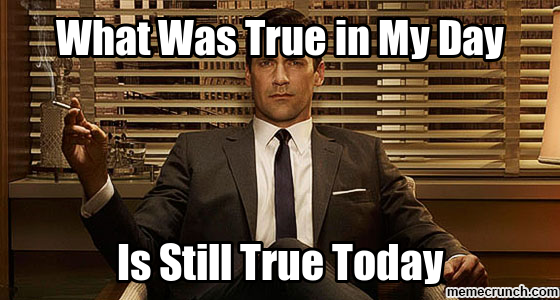
As Google becomes smarter and smarter, marketers will need to stop thinking only about SEO and think more like, well, marketers. Mad Men’s Don Draper, the subject of the meme at the top of the page, would best the performance of any link builder today because he understood how to gain mass publicity and coverage, both of which have always been more important than just building links here and there. The best and greatest numbers of links come naturally as a
result of good marketing and not as a result of any direct linkbuilding. In the 2014 Linkbuilding Survey published on Moz, most of the (good) tactics that were described in the post – such as “content plus outreach” – are PR by another name.
At SMX West 2014 (where I gave a talk on SEO and PR strategy), Rand Fishkin took to the main stage to discuss what the future holds for SEO. Starting at 6:30 in the video above, he argued that there will soon be a bias towards brands in organic search. (For an extensive discussion of this issue, I’ll refer you to Bryson Meunier’s essay at Search Engine Land.) I agree that it will soon become crucial to use PR, advertisingand publicity to build a brand, but that action is something the Don Drapers of the world had already known to do long before the Internet had ever existed.
But things are changing
The process that I have outlined above is a little vague on purpose. The lines between SEO and PR are increasingly blurring as online and offline marketing becomes more and more integrated. For example, take this very post: is it me doing SEO or PR for our agency (while
first and foremost aiming to help the readers)? The answer: Yes.
In a Moz post by Jason Acidre on
SEO and brand building, I commented with the following:
Say, 10 years ago, “SEOs” were focused on techie things: keyword research, sitemaps, site hierarchy, site speed, backlinks, and a lot more. Then, as Google became smarter and the industry become more and more mature, “SEOs” woke up one day and realized that online marketers need to think, you know, like marketers. Now, I get the sense that digital marketers are trying to learn all about traditional marketing as much as possible because, in the end, all marketing is about
people — not machines and algorithms. What the f&*# is a positioning statement? What is a pitch? I just wish “SEOs” had done this from the beginning.Of course, the same thing has been occurring in the inverse in the traditional marketing world. Traditional marketers have usually focused on these types of things: messaging documents, media lists, promotional campaigns, the 4 Ps, and SWOT analyses. Then, as more human activity moved to the Internet, they also woke up one day and saw an anarchic set of communications channels that operate under different sets of rules. Now, on the other end, I get the sense that traditional marketers are trying to learn as much as possible about SEO and digital marketing.
What the f&^% is a rel=canonical tag? What is Google+ authorship? I just wish traditional marketers had done this from the start.
In fact, such a separation between SEO and PR is quickly dying. Here is a simplified version of the marketing and communications process I outlined at the beginning:

Traditional marketers and communications professionals have used this process for decades, and almost everything that (the umbrella term of) SEO does can fit into one of these boxes. A message can appear in a newspaper article or in a blog post. Content can be a sales brochure or an e-book. A channel can be the television or Facebook. A lot of technical and on-page SEO is simply good web development. The most-effective type of off-page SEO is just PR and publicity. Public-relations executives, as I
have written elsewhere, can also learn to use analytics as yet another way to gauge results.
It all goes back to this tweet from Rand, which I cite in nearly every offline conversation with the marketing community:

SEO as an entity (sorry for the pun)
unto itself is quickly dying. The more SEO entails, the more the umbrella term becomes useless in any meaningful context. For this reason, it is crucial that digital marketers learn as much as possible about traditional marketing and PR.
So, in the end, how does one integrate public relations and SEO? By simply doing good
marketing.
Want more? Don’t forget to watch the Mozinar — I’d love to get your feedback in the comments below!
Sign up for The Moz Top 10, a semimonthly mailer updating you on the top ten hottest pieces of SEO news, tips, and rad links uncovered by the Moz team. Think of it as your exclusive digest of stuff you don’t have time to hunt down but want to read!
Peak Google? Not Even Close
Search vs Native Ads
Google owns search, but are they a one trick pony?
A couple weeks ago Ben Thompson published an interesting article suggesting Google may follow IBM and Microsoft in peaking, perhaps with native ads becoming more dominant than online search ads.
According to Forrester, in a couple years digital ad spend will overtake TV ad spend. In spite of the rise of sponsored content, native isn’t even broken out as a category.

Part of the issue with native advertising is it can be blurry to break out some of it. Some of it is obvious, but falls into multiple categories, like video ads on YouTube. Some of it is obvious, but relatively new & thus lacking in scale. Amazon is extending their payment services & Prime shipping deals to third party sites of brands like AllSaints & listing inventory from those sites on Amazon.com, selling them traffic on a CPC basis. Does that count as native advertising? What about a ticket broker or hotel booking site syndicating their inventory to a meta search site?
And while native is not broken out, Google already offers native ad management features in DoubleClick and has partnered with some of the more well known players like BuzzFeed.
The Penny Gap’s Impact on Search
Time intends to test paywalls on all of its major titles next year & they are working with third parties to integrate affiliate ads on sites like People.com.
The second link in the above sentence goes to an article which is behind a paywall. On Twitter I often link to WSJ articles which are behind a paywall. Any important information behind a paywall may quickly spread beyond it, but typically a competing free site which (re)reports on whatever is behind the paywall is shared more, spreads further on social, generates more additional coverage on forums and discussion sites like Hacker News, gets highlighted on aggregators like TechMeme, gets more links, ranks higher, and becomes the default/canonical source of the story.
Part of the rub of the penny gap is the cost of the friction vastly exceeds the financial cost. Those who can flow attention around the payment can typically make more by tracking and monetizing user behavior than they could by charging users incrementally a cent here and a nickel there.
Well known franchises are forced to offer a free version or they eventually cede their market position.
There are sites which do roll up subscriptions to a variety of sites at once, but some of them which had stub articles requiring payment to access like Highbeam Research got torched by Panda. If the barrier to entry to get to the content is too high the engagement metrics are likely to be terrible & a penalty ensues. Even a general registration wall is too high of a barrier to entry for some sites. Google demands whatever content is shown to them be visible to end users & if there is a miss match that is considered cloaking – unless the miss match is due to monetizing by using Google’s content locking consumer surveys.
Who gets to the scale needed to have enough consumer demand to be able to charge an ongoing subscription for access to a variety of third party content? There are a handful of players in music (Apple, Spotify, Pandora, etc) & a handful of players in video (Netflix, Hulu, Amazon Prime), but outside of those most paid subscription sites are about finance or niche topics with small scale. And whatever goes behind the paywalls gets seen by almost nobody when compared against to the broader public market at the free pricepoint.
Even if you are in a broad niche industry where a subscription-based model works, it still may be brutally tough to compete against Google. Google’s chief business officer joined the board of Spotify, which means Spotify should be safe from Google risk, except…
- In spite of billions of dollars of aggregate royalty payouts by Spotify, Taylor Swift pulled her catalog from Spotify
- shortly after Taylor Swift pulled her catalog from Spotify, YouTube announced their subscription service, which will include Taylor Swift’s catalog & will offer a free 6-month trial
Google’s Impact on Premium Content
I’ve long argued Google has leveraged piracy to secure favorable media deals (see the second bullet point at the bottom of this infographic). Some might have perceived my take as being cynical, but when Google mentioned their “continued progress on fighting piracy” the first thing they mentioned was more ad units.
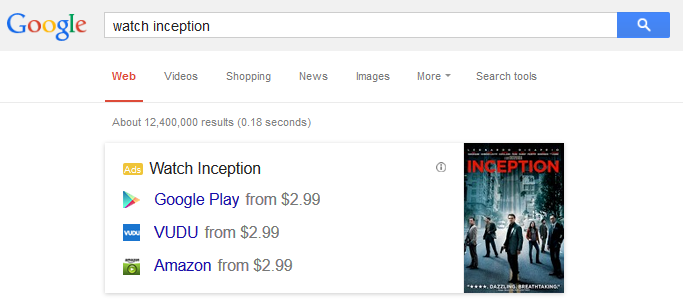
There are free options, paid options & the blurry lines in between which Google & YouTube ride while they experiment with business models and monetize the flow of traffic to the paid options.
“Tech companies don’t believe in the unique value of premium content over the long term.” – Jessica Lessin
There is a massive misalignment of values which causes many players to have to refine their strategy over and over again. The gray area is never static.
Many businesses only have a 10% or 15% profit margin. An online publishing company which sees 20% of its traffic disappear might thus go from sustainable to bleeding cash overnight. A company which can arbitrarily shift / redirect a large amount of traffic online might describe itself as a “kingmaker.”
In Germany some publishers wanted to be paid to be in the Google index. As a result Google stopped showing snippets near their listings. Google also refined their news search integration into the regular search results to include a broader selection of sources including social sites like Reddit. As a result Axel Springer quickly found itself begging for things to go back to the way they were before as their Google search traffic declined 40% and their Google News traffic declined 80%. Axel Springer got their descriptions back, but the “in the news” change remains.
Google’s Impact on Weaker Players
If Google could have that dramatic of an impact on Axel Springer, imagine what sort of influence they have on millions of other smaller and weaker online businesses.
One of the craziest examples is Demand Media.
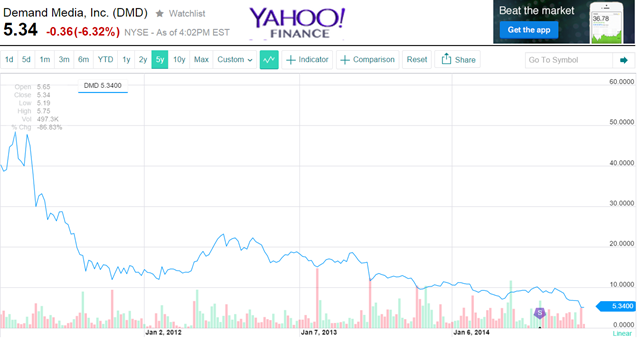
Demand Media’s market cap peaked above $1.9 billion. They spun out the domain name portion of the business into a company named Rightside Group, but the content portion of the business is valued at essentially nothing. They have about $40 million in cash & equivalents. Earlier this year they acquired Saatchi Art for $17 million & last year they acquired ecommerce marketplace Society6 for $94 million. After their last quarterly result their stock closed down 16.83% & Thursday they were down another 6.32%, given them a market capitalization of $102 million.
On their most recent conference call, here are some of the things Demand Media executives stated:
- By the end of 2014, we anticipate more than 50.000 articles will be substantially improved by rewrites made rich with great visuals.
- We are well underway with this push for quality and will remove $1.8 million underperforming articles in Q4
- as we strive to create the best experience we can we have removed two ad units with the third unit to be removed completely by January 1st
- (on the above 2 changes) These changes are expected to have a negative impact on revenues and adjusted EBITDA of approximately $15 million on an annualized basis.
- Through Q3 we have invested $1.1 million in content renovation costs and expect approximately another $1 million in Q4 and $2 million to $4 million in the first half of next year.
- if you look at visits or you know the mobile mix is growing which has lower CPM associated with it and then also on desktop we’re seeing compression on the pricing line as well.
- we know that sites that have ad density that’s too high, not only are they offending audiences in near term, you are penalized with respect to where you show up in search indexes as well.
Google torched eHow in April of 2011. In spite of over 3 years of pain, Demand Media is still letting Google drive their strategy, in some cases spending millions of dollars to undo past investments.
Yet when you look at Google’s search results page, they are doing the opposite of the above strategy: more scraping of third party content coupled with more & larger ad units.
“@CyrusShepard: Google’s got you covered: pic.twitter.com/ZU2AOl5EGn” Google copies entire web page?— john andrews (@searchsleuth999) October 30, 2014
Originally the source links in the scrape-n-displace program were light gray. They only turned blue after a journalist started working on a story about 10 blue links.
The Blend
The search results can be designed to have some aspects blend in while others stand out. Colors can change periodically to alter response rates in desirable ways.
The banner ad got a bad rap as publishers have fought declining CPMs by adding more advertisements to their pages. When it works, Google’s infrastructure still delivers (and tracks) billions of daily banner ads.
Search ads have never had the performance decline banner ads have.
The closest thing Google ever faced on that front was when AdBlock Plus became popular. Since it was blocking search ads, Google banned them & then restored them as they eventually negotiated a deal to pay them to display ads on Google while they continued to block ads on other third party sites.
Search itself *is* the ultimate native advertising platform.
Google is doing away with the local carousel in favor of a 3 pack local listing in categories like hotels. Once a person clicks on one of the hotel listings, Google then inserts an inline knowledge graph listing for that hotel with booking affiliate links inline in the search results, displacing the organic result set below the fold.
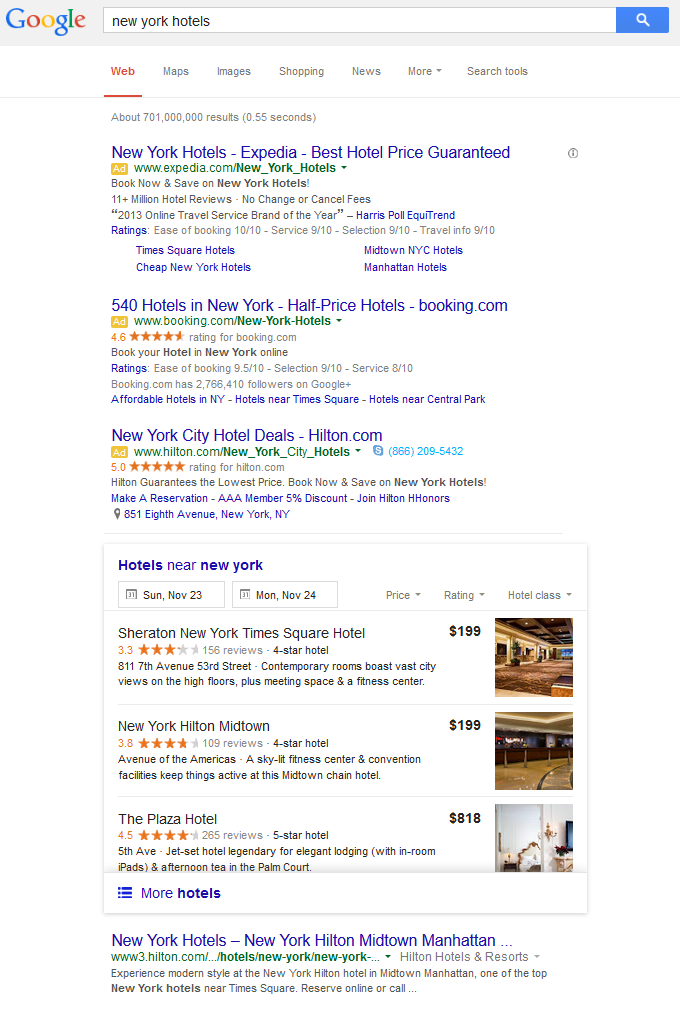
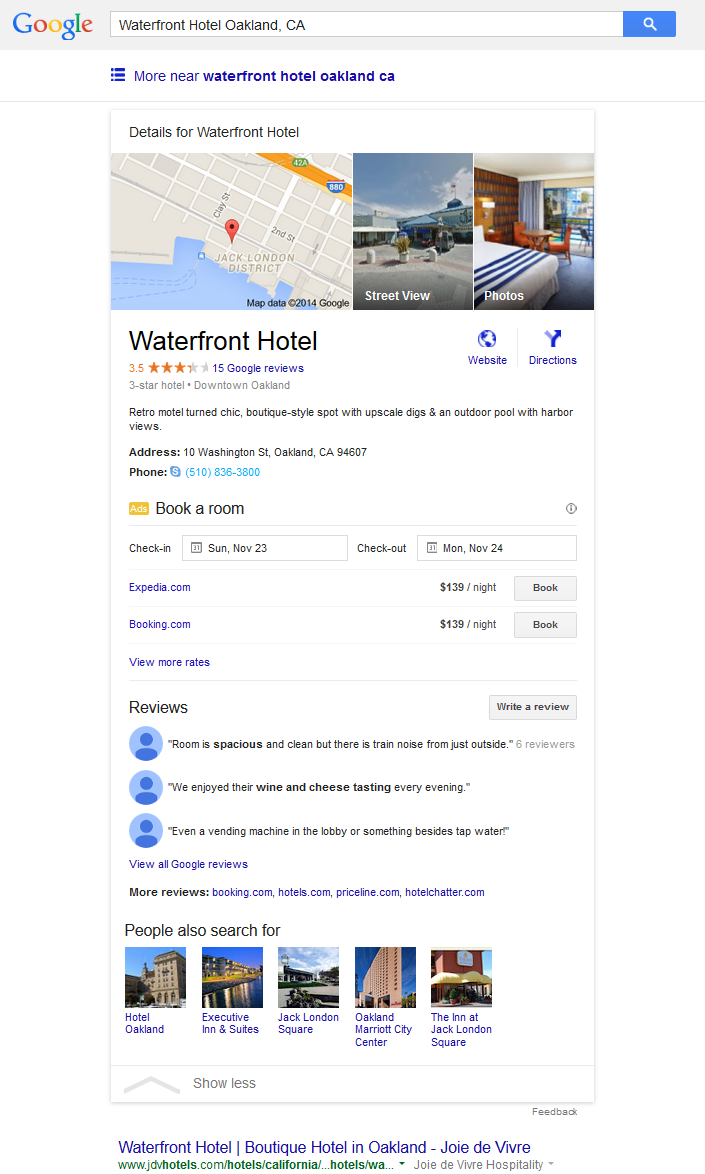
Notice in the above graphic how the “website” link uses generic text, is aligned toward the right, and is right next to an image so that it looks like an ad. It is engineered to feel like an ad and be ignored. The actual ads are left aligned and look like regular text links. They have an ad label, but that label is a couple lines up from them & there are multiple horizontal lines between the label and the actual ad units.
Not only does Google have the ability to shift the layout in such a drastic format, but then with whatever remains they also get to determine who they act against & who they don’t. While the SEO industry debates the “ethics” of various marketing techniques Google has their eye on the prize & is displacing the entire ecosystem wholesale.
Users were generally unable to distinguish between ads and organic listings *before* Google started mixing the two in their knowledge graph. That is a big part of the reason search ads have never seen the engagement declines banner ads have seen.
Mobile has been redesigned with the same thinking in mind. Google action items (which can eventually be monetized) up top & everything else pushed down the page.
The blurring of “knowledge” and ads allows Google to test entering category after category (like doctor calls from the search results) & forcing advertisers to pay for the various tests while Google collects data.
And as Google is scraping information from third party sites, they can choose to show less information on their own site if doing so creates additional monetization opportunities. As far back as 2009 Google stripped phone numbers off of non-sponsored map listings. And what happened with the recent 3 pack? While 100% of the above the fold results are monetized, …
“Go back to an original search that turns up the 3 PAC. Its completely devoid of logical information that a searcher would want:
- No phone number
- No address
- No map
- NO LINK to the restaurant website.
Anything that most users would want is deliberately hidden and/or requires more clicks.” – Dave Oremland
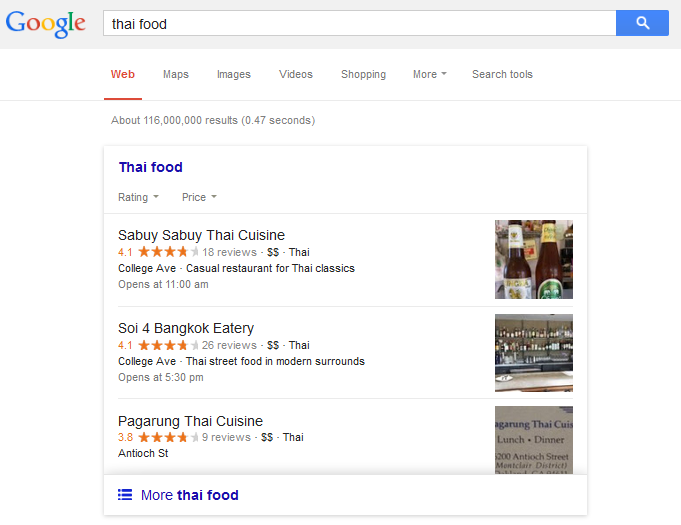
Google justifies their scrape-n-displace programs by claiming they are put users first. Then they hide some of the information to drive incremental monetization opportunities. Google may eventually re-add some of those basic features which are now hidden, but as part of sponsored local listings.
After all – ads are the solution to everything.
Do branded banner ads in the search results have a low response rate? Or are advertisers unwilling to pay a significant sum for them? If so, Google can end the test and instead shift to include a product carousel in the search results, driving traffic to Google Shopping.

“I see this as yet another money grab by Google. Our clients typically pay 400-500% more for PLA clicks than for clicks on their PPC Brand ads. We will implement exact match brand negatives in Shopping campaigns.” – Barb Young
That money grab stuff has virtually no limit.
The Click Casino
Off the start keywords defaulted to broad match. Then campaigns went “enhanced” so advertisers were forced to eat lower quality clicks on mobile devices.
Then there was the blurring exact match targeting into something else, forcing advertisers to buy lower quality variations of searches & making them add tons of negative keywords (and keep eating new garbage re-interpretations of words) in order to run a fine tuned campaign specifically targeted against a term.
In the past some PPC folks cheered obfuscation of organic search, thinking “this will never happen to me.”
Oops.
And of course Google not only wants to be the ad auction, but they want to be your SEM platform managing your spend & they are suggesting you can leverage the “power” of automated auction time biding.
Advertisers RAVE about the success of Google’s automatic bidding features: “It received one click. That click cost $362.63.”
The only thing better than that is banner ads in free mobile tap games targeted at children.
Adding Friction
Above I mentioned how Google arbitrarily banned the AdBlock Plus extension from the Play store. They also repeatedly banned Disconnect Mobile. If you depend on mobile phones for distribution it is hard to get around Google. What’s more they also collect performance data, internally launch competing apps, and invest in third party apps. And they control the prices various apps pay for advertising across their broad network.
So maybe you say “ok, I’ll skip search & mobile, I’ll try to leverage email” but this gets back to the same issue again. In Gmail social or promotional emails get quarantined into a ghetto where they are rarely seen:
“online stores, if they get big enough, can act as chokepoints. And so can Google. … Google unilaterally misfiled my daily blog into the promotions folder they created, and I have no recourse and no way (other than this post) to explain the error to them” – Seth Godin
Those friction adders have real world consequences. A year ago Groupon blamed Gmail’s tabs for causing them to have poor quarterly results. The filtering impact on a start up can be even more extreme. A small shift in exposure can lower the K factor to something below 1 & require the startups to buy exposure rather than generating it virally.
In addition to those other tabs, there are a host of other risks like being labeled as spam or having a security warning. Few sites promote Google’s view as often as people like Greg Sterling do on Search Engine Land, yet even their newsletter was showing a warning in Gmail.
Google can also add friction to
- websites using search rankings, vertical search result displacement, hiding local business information (as referenced above), search query suggestions, and/or leveraging their web browser to redirect consumer intent
- video on YouTube by counting ad views as organic views, changing the relevancy metrics, and investing in competing channels & giving them preferential exposure as part of the deal. YouTube gets over half their views on mobile devices with small screens, so any shift on Google’s rank preference is going to have a major shift in click distributions.
- mobile apps using default bundling agreements which require manufactures to set Google’s apps as defaults
- other business models by banning bundling-based business models too similar to their own (bundling is wrong UNLESS it is Google doing it)
- etc.
The launch of Keyword (not provided) which hid organic search keyword data was friction for the sake of it in organic search. When Google announced HTTPS as a ranking signal, Netmeg wrote: “It’s about ad targeting, and who gets to profile you, and who doesn’t. Mark my words.”
Facebook announced their relaunch of Atlas and Google immediately started cracking down on data access:
In the conversations this week, with companies like Krux, BlueKai and Lotame, Google told data management platform players that they could not use pixels in certain ads. The pixels—embedded within digital ads—help marketers target and understand how many times a given user has seen their messages online.
“Google is only allowing data management platforms to fire pixels on creative assets that they’re serving, on impressions they bought, through the Google Display Network,” said Mike Moreau, chief solutions officer at Krux. “So they’re starting with a very narrow scope.”
Around the same time Google was cracking down on data sharing, they began offering features targeting consumers across devices & announced custom affinity audiences which allow advertisers to target audiences who visit any particular website.
Google’s special role is not only as an organizer (and obfuscate) of information, but then they get to be the source measuromg how well marketing works via their analytics, which can regularly launch new reports which may causually over-represent their own contribution while under-representing some other channels, profiting from activity bias. The industry default of last click attribution driving search ad spending is one of the key issues which has driven down display ad values over the years.
Investing in Competition
Google not only ranks the ecosystem, but they actively invest in it.
Google tried to buy Yelp. When Facebook took off Google invested in Zynga to get access to data, in spite of a sketchy background. When Google’s $6 billion offer for Groupon didn’t close the deal, Google quickly partnered with over a dozen Groupon competitors & created new offer ad units in the search results.
Inside of the YouTube ecosystem Google also holds equity stakes in leading publishers like Machinima and Vevo.
There have been a few examples of investments getting special treatment, getting benefit of the doubt, or access to non-public information.
The scary scenario for publishers might sound something like this: “in Baidu Maps you can find a hotel, check room availability, and make a booking, all inside the app.” There’s no need to leave the search engine.
Take a closer look & that scary version might already be here. Google’s same day delivery boss moved to Uber and Google added Uber pickups and price estimates to their mobile Maps app.
Google, of course, also invested in Uber. It would be hard to argue that Uber is anything but successful. Though it is also worth mentioning winning at any cost often creates losses elsewhere:
- their insurance situation sounds fuzzy
- the founder doesn’t sound like a nice guy
- they’ve repeatedly engaged in shady endeavors like flooding a competing network with bogus requests & trying to screw with a competitor’s ability to raise funds
- as subprime auto loans have become widespread, Uber has pushed an extreme version of them onto their drivers while cutting their rates – an echo of the utopia of years gone by.
Google invests in disruption as though disruption is its own virtue & they leverage their internal data to drive the investments:
“If you can’t measure and quantify it, how can you hope to start working on a solution?” said Bill Maris, managing partner of Google Ventures. “We have access to the world’s largest data sets you can imagine, our cloud computer infrastructure is the biggest ever. It would be foolish to just go out and make gut investments.”
Combining usage data from their search engine, web browser, app store & mobile OS gives them unparalleled insights into almost any business.
Google is one of the few companies which can make multi-billion dollar investments in low margin areas, just for the data:
Google executives are prodding their engineers to make its public cloud as fast and powerful as the data centers that run its own apps. That push, along with other sales and technology initiatives, aren’t just about grabbing a share of growing cloud revenue. Executives increasingly believe such services could give Google insights about what to build next, what companies to buy and other consumer preferences
Google committed to spending as much as a half billion dollars promoting their shopping express delivery service.
Google’s fiber push now includes offering business internet services. Elon Musk is looking into offering satellite internet services – with an ex-Googler.
The End Game
Google now spends more than any other company on federal lobbying in the US. A steady stream of Google executives have filled US government rolls like deputy chief technology officer, chief technology officer, and head of the patent and trademark office. A Google software engineer went so far as suggesting President Obama
- Retire all government employees with full pensions.
- Transfer administrative authority to the tech industry.
- Appoint Eric Schmidt CEO of America.
That Googler may be crazy or a troll, but even if we don’t get their nightmare scenario, if the regulators come from a particular company, that company is unlikely to end up hurt by regulations.
President Obama has stated the importance of an open internet: “We cannot allow Internet service providers to restrict the best access or to pick winners and losers in the online marketplace for services and ideas.”
If there are relevant complaints about Google, who will hear them when Googlers head key government roles?
Larry Page was recently labeled businessperson of the year by Fortune:
It’s a powerful example of how Page pushes the world around him into his vision of the future. “The breadth of things that he is taking on is staggering,” says Ben Horowitz, of Andreessen Horowitz. “We have not seen that kind of business leader since Thomas Edison at GE or David Packard at HP.”
A recent interview of Larry Page in the Financial Times echos the theme of limitless ambition:
- “the world’s most powerful internet company is ready to trade the cash from its search engine monopoly for a slice of the next century’s technological bonanza.” … “As Page sees it, it all comes down to ambition – a commodity of which the world simply doesn’t have a large enough supply.”
- “I think people see the disruption but they don’t really see the positive,” says Page. “They don’t see it as a life-changing kind of thing . . . I think the problem has been people don’t feel they are participating in it.”
- “Even if there’s going to be a disruption on people’s jobs, in the short term that’s likely to be made up by the decreasing cost of things we need, which I think is really important and not being talked about.”
- “in a capitalist system, he suggests, the elimination of inefficiency through technology has to be pursued to its logical conclusion.”
There are some dark layers which are apparently “incidental side effects” of the techno-utopian desires.
Mental flaws could be reinforced & monetized by hooking people on prescription pharmaceuticals:
It takes very little imagination to foresee how the kitchen mood wall could lead to advertisements for antidepressants that follow you around the Web, or trigger an alert to your employer, or show up on your Facebook page because, according to Robert Scoble and Shel Israel in Age of Context: Mobile, Sensors, Data and the Future of Privacy, Facebook “wants to build a system that anticipates your needs.”
Or perhaps…
Those business savings are crucial to Rifkin’s vision of the Third Industrial Revolution, not simply because they have the potential to bring down the price of consumer goods, but because, for the first time, a central tenet of capitalism—that increased productivity requires increased human labor—will no longer hold. And once productivity is unmoored from labor, he argues, capitalism will not be able to support itself, either ideologically or practically.
That is not to say “all will fail” due to technology. Some will succeed wildly.
Michelle Phan has been able to leverage her popularity on YouTube to launch a makeup subscription service which is at an $84 million per year revenue run rate.
Those at the top of the hierarchy will get an additional boost. Such edge case success stories will be marketed offline to pull more people onto the platform.
Google is promoting Japanese Youtube creators’ personal brands in heavy TV, online, and print ads. Trying to recruit more maybe?— Patrick McKenzie (@patio11) November 1, 2014
While a “star based” compensation system makes a few people well off, most people publishing on those platforms won’t see any financial benefit from their efforts. Worse yet, a lot of the “viral” success stories are driven by a large ad budget.
Category after category gets commoditized, platform after platform gets funded by Google, and ultimately employees working on them will long for the days where their wages were held down by illegal collusion rather than the crowdsourcing fate they face:
Workers, in turn, have more mobility and a semblance of greater control over their working lives. But is any of it worth it when we can’t afford health insurance or don’t know how much the next gig might pay, or when it might come? When an app’s terms of service agreement is the closest thing we have to an employment contract? When work orders come through a smartphone and we know that if we don’t respond immediately, we might not get such an opportunity again? When we can’t even talk to another human being about the task at hand and we must work nonstop just to make minimum wage?
Just as people get commoditized, so do other layers of value:
- those who failed to see the value of & invest in domain names cheered as names lost value
- Google philosophically does not believe in customer service, but they feel they should grade others on their customer service and remove businesses which don’t respond well to culturally unaware outsourced third world labor.
- Google gets people to upload pirate content to YouTube & then uses the existence of the piracy to sell ads. They can also use YouTube to report on the quality of various ISPs, while also blocking competing search engines and apps from being able to access YouTube.
- PageRank extracts the value of editorial votes, allowing Google to leverage the work of editors to refine their search rankings without requiring people to visit the sites. Mix in the couple years Google spent fearmongering about links and it is not surprising to see the Yahoo Directory shut down.
- Remember the time a Google “contractor” did a manual scrape of Mocality in Kenya, then called up the businesses and lied to them to try to get them onto Google? I’d link to the original Mocality blog post, but Mocality Kenya has shut down.
- Google also scraped reviews (sometimes without attribution) & only failed at it when players large enough to be heard by Government regulators complained. This is why government scrutiny of Google is so important. It is one of the few things they actually respond to.
In SEO for a number of years many people have painted brand as the solution to everything. But consider the hotel search results which are 100% monetized above the fold – even if you have a brand, you still must pay to play. Or consider the Google Shopping ads which are now being tested on branded navigational searches.
Google even obtained a patent for targeting ads aimed at monetizing named entities.
You paid to build the brand. Then you pay Google again – “or else.”
One could choose to opt out of Google ad products so as not to pay to arbitrage themselves, but Google is willing to harm their own relevancy to extract revenues.
A search in the UK for the trademark term [cheapflights] is converted into the generic search [cheap flights]. The official site is ranking #2 organically and is the 20th clickable link in the left rail of the search results.
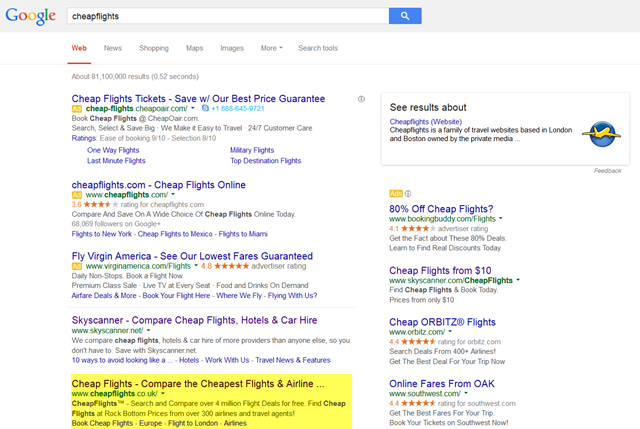
As much as brand is an asset, it also becomes a liability if you have to pay again for every time someone looks for your brand.
Mobile apps may be a way around Google, but again it is worth noting Google owns the operating system and guarantees themselves default placement across a wide array of verticals through bundling contracts with manufacturers. Another thing worth considering with mobile is new notification features tied to the operating systems are unbundling apps & Google has apps like Google Now which tie into many verticals.
As SEOs for a long time we had value in promoting the adoption of Google’s ecosystem. As Google attempts to capture more value than they create we may no longer gain by promoting the adoption of their ecosystem, but given their…
- cash hoard
- lobbyists
- ex-employees in key government rolls
- control over video, mobile, apps, maps, email, analytics (along with search)
- broad portfolio of investments
… it is hard to think they’ve come anywhere close to peaking.
Categories:
Some Thoughts On the New Pak Results from Google
Some thoughts & observations on the new [Hamburger] Pak from Google. 1-The local carousel is still in use and shows when you select a result delivered by “People also search for” in a 7-pack result. Will we soon see its demise as well? Currently Google shows five competitors, not three, below the brand Knowledge Graph. […]
Google Achieves 100% Monetization Above the Fold with New Pak
We knew that this day was coming. Like frogs in slowly warming water that ultimately reaches a boil we hardly noticed. On “average” screen sizes on the desktop, there is little else that can be seen besides ads and the new Pak. Thus in many search results that return a new Pak, only 3 listings […]
SearchCap: SEO Mistakes That Could Penalize Your Site, Bing Ads Offers Close Variants On Phrase Match & More
Below is what happened in search today, as reported on Search Engine Land and from other places across the web. From Search Engine Land: SEO & SSL: A Conversation With Jon Henshaw Of Raven Tools Google says it will boost rankings for HTTPS sites, but, in an interview by contributor Clark…
Please visit Search Engine Land for the full article.
SEO & SSL: A Conversation With Jon Henshaw Of Raven Tools
Google says it will boost rankings for HTTPS sites, but, in an interview by contributor Clark Buckner, Henshaw recommends SEOs hold off.
The post SEO & SSL: A Conversation With Jon Henshaw Of Raven Tools appeared first on Search Engine Land.
Please visit Search Engine Land for the full article.
4 Easy & Honest SEO Mistakes That Could Penalize Your Site
You did everything right when optimizing your site for search — or so you thought. Contributor Neil Patel explains where you may have gone wrong.
The post 4 Easy & Honest SEO Mistakes That Could Penalize Your Site appeared first on Search Engine Land.
Please visit Search Engine Land for the full article.
iOS App Install Analytics Via Google Analytics
Google announced you can now get iOS install sources via Google Analytics when you have AdMob installed on your app.
Now you can tell what lead people to download your app. Was it a banner ad? Organic search? Paid search ads…
Google In The News Box Showing Sponsored Posts
Google’s In The News box which launched over a month ago has been shown to have some weird content found within it but sponsored post and content is something I have not seen reported yet.
Chipper Nicodemus noticed one yesterday and shared a picture o…
Google Drops Carousel Interface For Local Results
After months and months of testing dating back to August, Google has finally and officially dropped the black carousel user interface for local listings…
Google Answers Now With “Show Me How” Links
Google Answers is pretty controversial amongst webmasters but Google has said time and time again, why they source certain places and it does not substitute the web page itself. In any event…