Engineering Search Outcomes
Kent Walker promotes public policies which advantage the Google monopoly.
His role doing that means he has to write some really bad hot takes that lack context or intentionally & dishonestly redirect attention away from core issues – that’s his jo…
Engineering Search Outcomes
Kent Walker promotes public policies which advantage the Google monopoly.
His role doing that means he has to write some really bad hot takes that lack context or intentionally & dishonestly redirect attention away from core issues – that’s his job.
With that in mind, his most recent blog post defending the Google monopoly was exceptional.
Force Ranking of Inferior Search Results
“When you have an urgent question — like “stroke symptoms” — Google Search could be barred from giving you immediate and clear information, and instead be required to direct you to a mix of low quality results.”
On some search queries users get a wall of Google ads, the forced ranked Google insert (or sometimes multiple of them with local & ecommerce) and then there can even be a “people also ask” box above the first organic result.
The idea that organic results must be low quality if not owned & operated indicates 1 of the following 3 must be true:
- they should not be in search
- their content scraping & various revenue shifting scams with their ad tech stack demonetized legit publishers
- their forced rank of their own content is stripping them of the signals needed to rank websites & pages
Whenever Google puts a “people also ask” box above the first organic result that is them saying they did not know what to rank, or they are just trying to create a visual block to push the organic result set down the page and user attention back up toward the ads.
The solution to Google’s claims is easy to solve. Either of the following would work.
- Have an API that allows user choice (to set rich snippet or vertical defaults in various categories), or
- If the vertical inserts remain Google-only then for Google to justify force ranking their own results above the organic result set Google should also be required to rank those same results above all of their ads, so that Google is demonetizing Google along with the rest of the ecosystem, rather than just demonetizing third parties.
If the thesis that this information needs to be front and center & that is a matter of life or death, then asking searchers to first scroll past a page or two of ads is not particularly legitimate.
Spam & Security
“when you use Google Search or Google Play, we might have to give equal prominence to a raft of spammy and low-quality services.”
Many of the worst versions of spam that have repeatedly made news headlines like fake tech support, fake government document providers, and fake locksmiths were buying distribution through Google Ads or were featured in the search results through Google force ranking their own local search offering even though they knew the results were vastly inferior to Yelp.
If Google did not force rank Google local results above the rest of the organic result set then the fake locksmiths would not have ranked.
I have lost count of how many articles I have read about hundreds or thousands of fake apps in the Google Play store which existed to defraud advertisers or commit identity theft, but there have been literally thousands of such articles. I see a similar headline at least once a month without eve looking for them. Here is one this week for scammers monetizing the popularity of Wordle with fake apps.
Making matters worse, some of the tech support scams showed the URL of a real business and rerouted the call through a Google number directly to a scammer. A searcher who trusted Google & sees Apple.com or Dell.com on Google Ads in the search results then got connected with a scammer who would commit identity theft or encrypt their computer then demand ransom cryptocurrency payments to decrypt it.
After making the ads harder to run for scammers Google decided the problem was too hard & expensive to sort out so they also blocked legitimate computer repair shops.
Sometimes Google considers something spam strictly due to financial considerations.
Their old remote rater documents stated *HELPFUL* hotel affiliate websites should be labeled as spam.
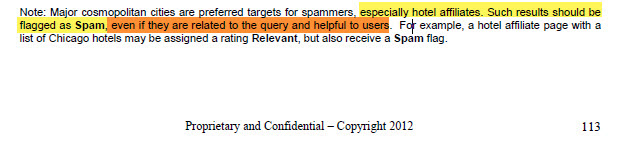
Years later the big OTAs are complaining about Google eating their lunch as well as Google is twice as big as the next player.
At one point Google got busted for helping an advertiser route around the automated safety features built into their ad network so that they could pay Google to run ads promoting illegal steroids.
With cartels, you can only buy illegal goods and services from the cartel if you don’t want to suffer ill consequences. The same appears to be true here.
The China Problem
“Handicapping America’s technology leaders would threaten our leading sources of research and development spending — just as bipartisan voices in Congress are recognizing the need to increase American R&D investment to stay competitive in the global race for AI, quantum, and other advanced technologies.”
We are patriotic, and, but China… is a favorite misdirection of a tech monopolist.
The problem with that is while Eric Schmidt warns it is a national emergency if China overtakes the US in AI tech, Google also operates an AI tech lab in China.
In other words, Eric Schmidt is trying to warn you about himself and his business interests at Google.
Duplicitous? Absolutely.
Patriotic? Less than Chamath!
Who the fuck did this? pic.twitter.com/BD4NKpila6— Girolamo Carlo Casio (Free Twatter) (@INArteCarloDoss) January 19, 2022
Inflation
“the online services targeted by these bills have reduced prices; these bills say nothing about sectors where prices have actually been rising and contributing to inflation.”
Technology is no doubt deflationary (moving bits on an optical line is cheaper than printing out a book and shipping it across the world) BUT some dominant channels have increased the cost of distribution by increasing the chunk size of information and withholding performance information.
Before Google Analytics was “free” there was a rich and vibrant set of competition in web analytics software with lots of innovation from players like ClickTracks.
Most competing solutions went away.
Google moved away from an installed licensing model to a hosted service where they can change the price upon contract renewal.
Search hid progressively more performance information over time, only sampled data from larger data sets, & now you can sign up for Google Analytics 360 starting at only $150,000 per year.
The hidden search performance data also has many layers to that onion. Not only does Google not show keyword referrers on organic search, but they often don’t show your paid search keywords either, and they keep extending out keyword targeting broader than advertisers intend.
Yesterday’s announcement on match type changes had me crawling through query data this morning. I’m staring at many 2-3 word exact match keywords that are matching to 8-word queries. G thinks ‘deck paint’ and ‘how do i put paint on my deck’ mean the exact same thing. CPA is 10x.— Brad Geddes (@bgtheory) February 5, 2021
Google used to pay Brad Geddes to run official Google AdWords ad training seminars for advertisers, so the idea that *he* has to express his frustrations on Twitter is an indication of how little effort Google is putting into having open communications channels or caring about what their advertisers think.
This is in accordance with the Google customer service philosophy:
he told her that the whole idea of customer support was ridiculous. Rather than assuming the unscalable task of answering users one by one, Page said, Google should enable users to answer one another’s questions.
Those who were paying for ads get the above “serve yourself” treatment, all the while Google regularly resets user default ad settings to extend out ad distribution, automatically ad keywords, shift to enhanced AdWords ad campaigns, etc.
Then there are other features which would be beneficial and offered in a competitive market that have been deprioritized. Many years ago eBay did a study which showed their branded Google AdWords ad buys were cannibalistic to eBay profits. Google maintained most advertisers could not conduct such a study because it would be too expensive and Google does not make the feature set available as part of their ad suite.
Missing Information
“When you search for local businesses, Google Search and Maps may be prohibited from highlighting information we gather about hours of operation, contact information, and reviews. That could hurt small businesses and local retailers, as well as their customers.”
Claiming reviews or an attempt to offer a comprehensive set of accurate review data as a strong point would be economical with the truth.
Back when I had a local business page my only review was from a locksmith spammer / scammer who praised his own two businesses, trashed a dozen other local locksmiths, crapped on a couple local SEO services, and joked about how a local mover smashed the guts out of his dog. Scammer fake reviewer’s name was rather sophisticated … it was … Loop Dee Loop

About a decade back when Google was clearly losing Google took Yelp reviews wholesale (sometimes without even attributing them to Yelp!) and told Yelp that if they did not want Google stealing their work and displacing them with a copy of it then they should block GoogleBot. Google offered the same sort of advice / threat to TripAdvisor.
A few years before that Google temporarily “forgot” to show phone numbers on local listings.
After Yelp turned down an acquisition offer by Google & Yelp did a great job making some people aware of how Google was stealing their reviews wholesale without attribution Google bought Zagat & Fromer’s to augment the Google local review data and then sold those businesses off.
This is sort of the same playbook Google has run in the past elsewhere. After Groupon said no to Google’s acquisition offer, Google quickly provided daily deal ads to over a dozen Groupon competitors to help commoditize the Groupon offering and market position.
Ultimately with the above sort of stuff Google is primarily a volume aggregator or has lower editorial costs than pure plays due to the ability to force bundle their own distribution. And they use the ability to rank themselves above a neutral algorithmic position as a core part of their biz dev strategy. When shopping search engines were popular Google kept rewording the question set they sent remote raters to justify rank demotion for shopping search engines & Google also came up with innovative ranking “signals” like concurrent ranking of their own vertical search offering whenever competitors x or y are shown in the result set & rolled out a “diversity” algorithm to limit how many comparison shopping sites could appear in the search results. The intent of the change was strictly anti-competitive:
“Although Google originally sought to demote all comparison shopping websites, after Google raters provided negative feedback to such a widespread demotion, Google implemented the current iteration of its so-called ‘diversity’ algorithm.”
As a matter of fact, part of one of many document dumps in recent years went further than the old concurrent ranking signal to a rank x above y feature which highlights how YouTube can be hard coded at a number 1 ranking position.
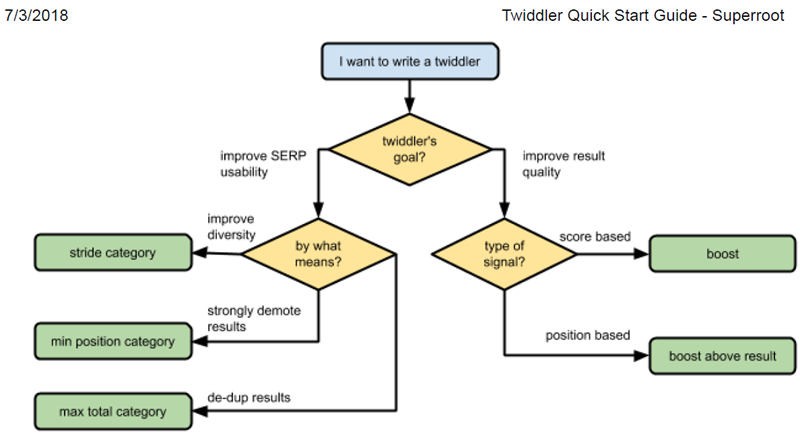
Part of that guide highlighted how to hardcode ranking YouTube #1.
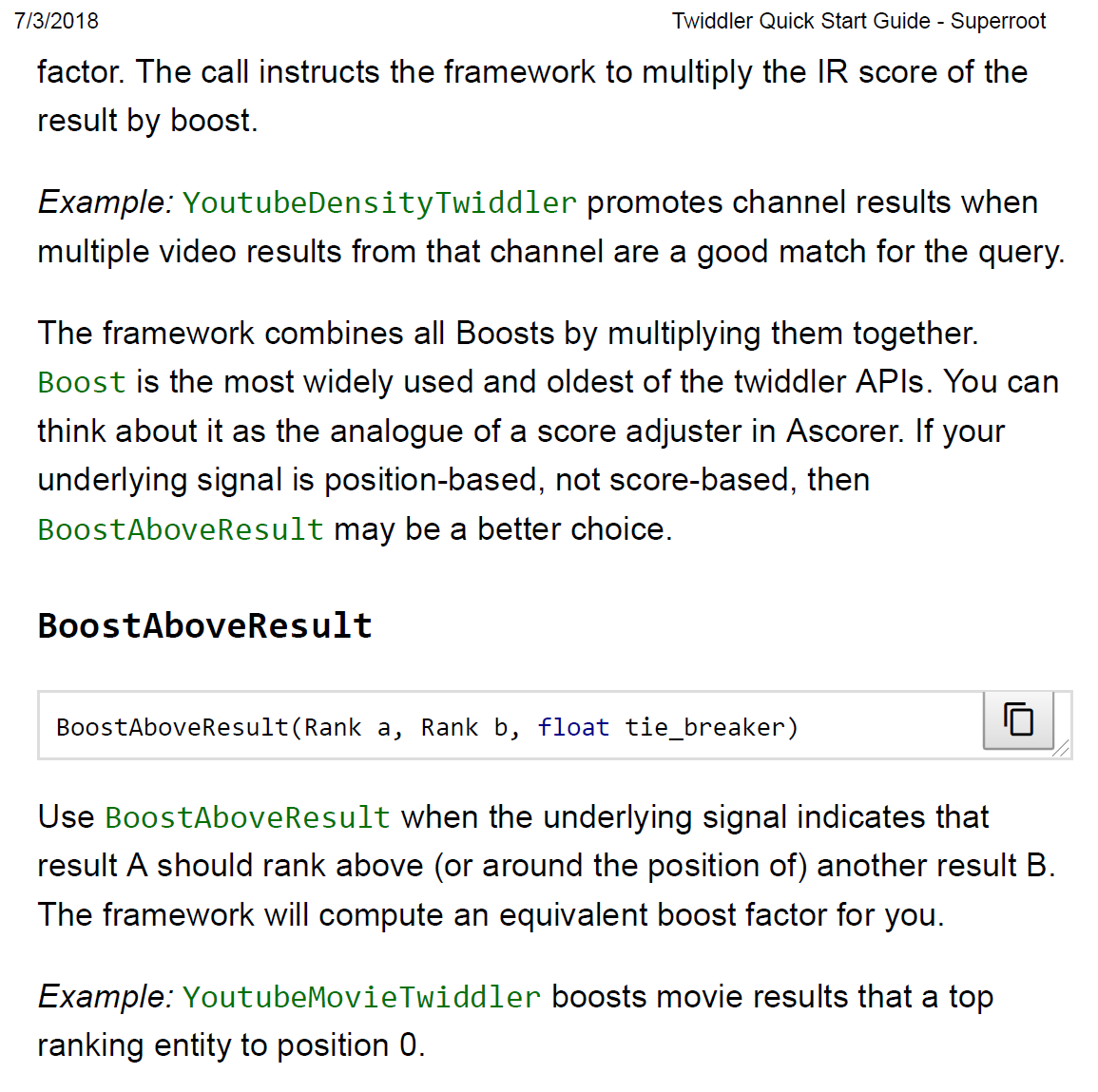
If you re-represent content & can force rank yourself #1 (with larger listings) that can be used to force other players onto your platform on your terms. Back when YouTube was must less of a sure thing Google suggested they could threaten to change copyright.
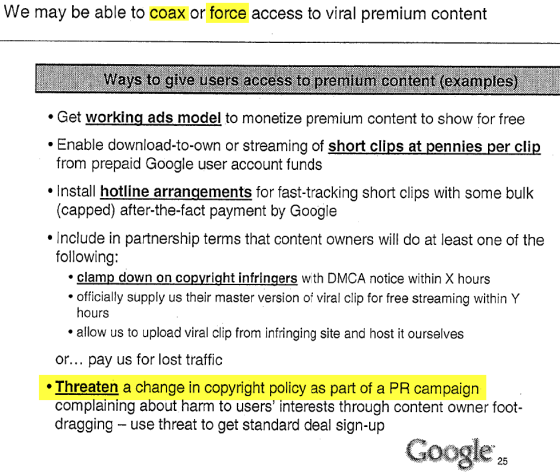
This same approach to “relevancy” is everywhere.
Did you watermark your images? Well shame on you, as that is good for a rank demotion
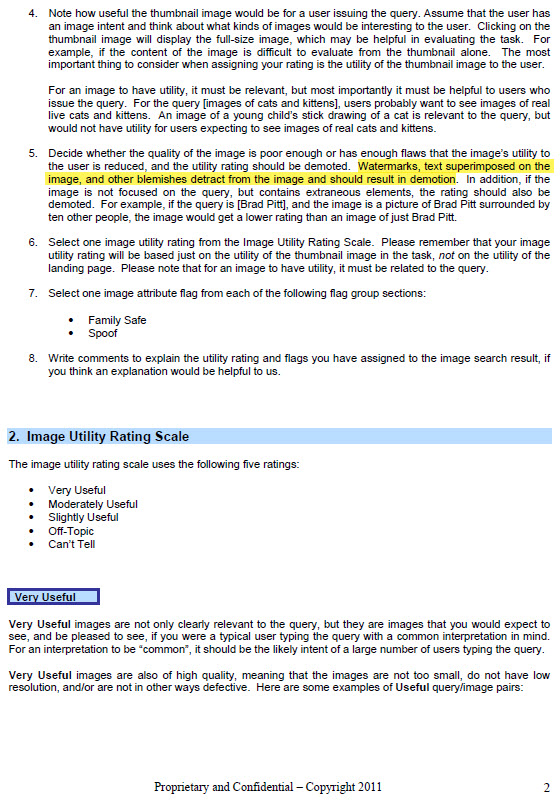
And if there are photos which are deemed illegal Google will make you file an endless series of DMCA removal requests even though they already had the image fingerprinted.
Now there are some issues where there is missing information. These areas involve original reporting on local politics & are called news deserts. As the ad pie has consolidated around Google & Facebook that has left many newspapers high and dry.
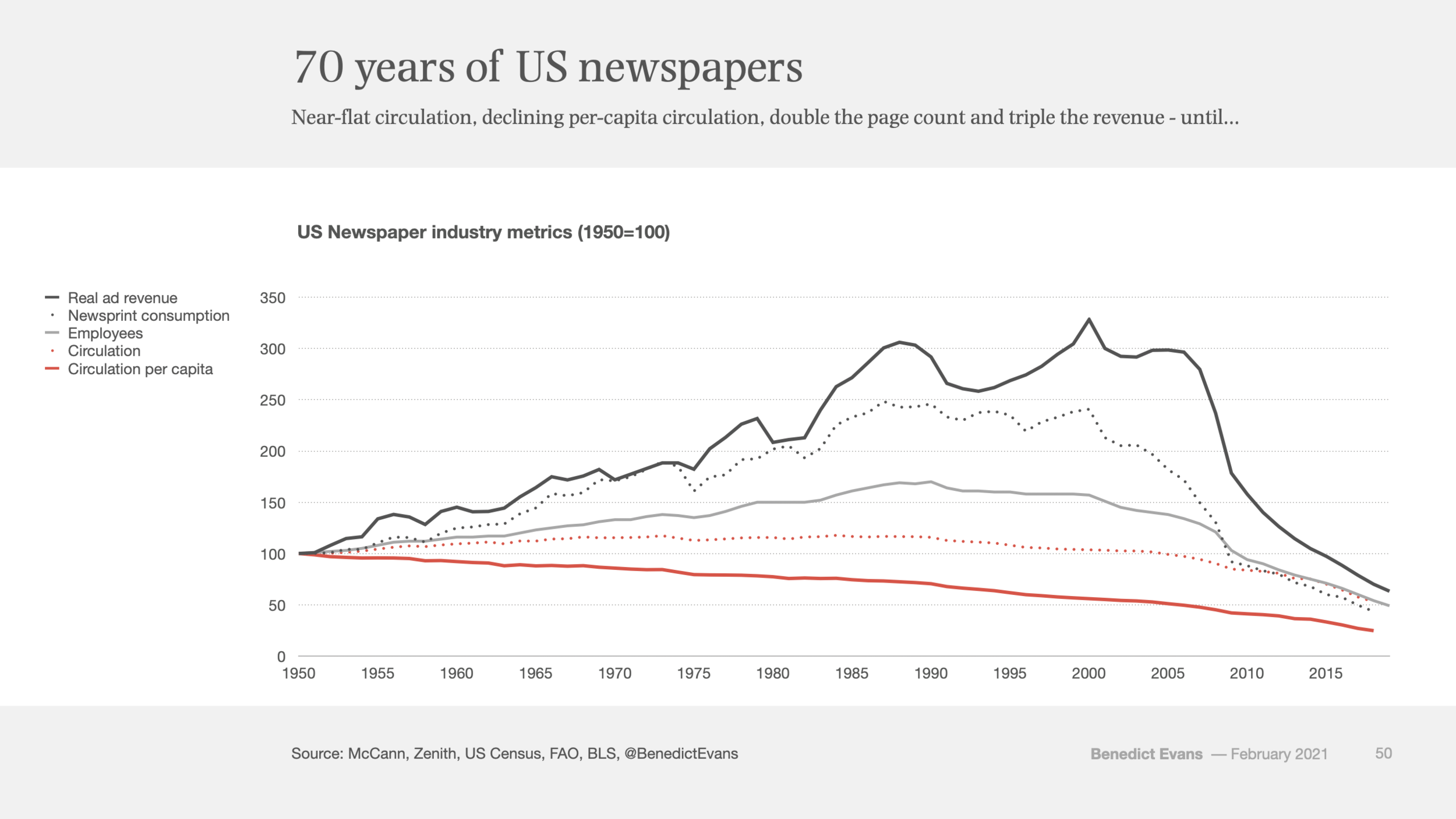
Private equity players like Alden Global Capital buy up newspapers, fire journalists, and monetize brand equity as they drive the papers into the ground.
If you are sub-scale maybe Google steals your money or hits you with a false positive algorithm flag that has you seeking professional mental health help.
Big players get a slower blood letting.
Google has maintained they do not make any money from news search, but the states lawsuit around ad tech made it clear Google promoted AMP for anti-competitive purposes to block header bidding, lied to news publishers to get them to adopt AMP and eat the tech costs of implementation, did a deal with their biggest competitor in online advertising Facebook to maintain the status quo, charge over double what their competitors do for ad tech, and had a variety of bid rigging auction manipulation algorithms they used to keep funneling more money to themselves.
Internally they had an OKR to make *most* search clicks land on AMP pages within a year of launch
“AMP launched as an open source project in October 2015, with 26 publishers and over 40 publications already publishing AMP files for our preview demo. Our team built g.co/ampdemo and is now racing towards launching it for all of our users. We’re responsible for the AMP @ Google integrations, particularly focusing on Search, our most visible product. We have a Google-wide 2016 OKR to deliver! By the end of 2016, our goal is that 50%+ of content consumed through Search is being consumed through AMP.”
You don’t get over half the web to shift to a proprietary version of HTML in under a year without a lot of manipulation.
So, when Google tells buyers an ad sold for one price and they tell sellers it sold for a lower price, isn’t that just plain old fraud? I mean, on top of the anti-competitive tying and all that, fraud is illegal, isn’t it?— Jerry Neumann (@ganeumann) January 14, 2022
Categories:
Conversion.ai Review
Background / Intro
One of my longtime friends who was Internet marketing long before I was hit me up on Skype about a week ago praising Conversion.ai. I have to think long and hard about any other time he has really pitched or recommended something like that & really I just can’t think of any other time where he did that. The following day my wife Giovanna mentioned something to me and I was like “oh you should check out this thing my buddy recommended yesterday” and then I looked and realized they were both talking about the same thing. :D
I have a general heuristic that if people I trust recommend things I put them near the top of the “to do” list and if multiple people I trust do that I pull out the credit card and run at it.
Unfortunately I have been a bit burned out recently and launched a new site which I have put a few hundred hours into, so I haven’t had the time to do too much testing, BUT I have a writer who works for me who has a master’s degree in writing, and figured she could do a solid review.
She is maybe even a bit more cynical than I am (is that even possible?) and a certified cat lady who loves writing, reading, poetry and is more into a soft sell versus aggressive sales.
Full disclosure…the above link and the one at the end of this post are affiliate links, but they had zero impact on the shape or format of the review. The reviewer was completely disconnected from the affiliate program and I pulled out my credit card to pay for the software for her to test it out.
With that tiny bit of a micro-introduction, the rest of the post from here on out is hers. I may have made a couple minor edits for clarity (and probably introduced a few errors she will choke me for. :D) but otherwise the rest of this post is all her …
An In-depth Review of the Conversion.ai Writing Software
Considering the possibilities of artificial intelligence (AI), we picture robots doing tasks autonomously like humans. With a computer’s brain power, productivity is accelerated significantly. We also expect AI programs to have the capability to evolve intelligently the longer they are used. These types of AI employ “machine learning,” or deep learning to solve problems.
AI technology can be leveraged by various industries, especially with writing. Recently, I learned about the Conversion.ai copywriting tool. It uses machine learning which claims to write “high converting copy” for websites, ads, landing pages, emails, etc. The software is geared towards writers, marketers, entrepreneurs, and agencies that benefit from creating engaging and effective copy. To date, companies such as Hubspot, Shopify, and Salesforce are known to use the software. Currently, it’s offering a 7-day free trial with 20,000-word credits.
To give you the lowdown on Conversion.ai, I wrote an in-depth review of how this software works. I’ll go through its various features and show examples of how I used them. I’ll include the advantages of using Conversion.ai’s Jarvis (that’s what it’s called) in writing scenarios. More importantly, I’ll discuss challenges and specific limitations this tool might present.
Assistance in Creating High Conversion Copy
As a writer doing web copy for 10 years, including the time I took a post-grad creative writing degree, I grabbed the opportunity to try this AI software. For starters, it struck me how Conversion.ai claims to provide “high converting copy” for increased conversion and higher ROI. Such claims are a tall order. If you’ve been in the marketing or sales industry, you’d know conversion depends on so many other factors, such as the quality of the actual product, customer support, price, etc. It’s not just how well copy is written, though it’s a vital part. But anyway, upon more research, I learned the app generates copy based on proven high conversion sales and marketing messages.
To be honest, I have mixed feelings about this conversion strategy. I believe it’s a double-edged sword. This is not to undermine facts or measurable data. Basing content creation on “proven content” means you’re likely using the same phrases, techniques, and styles already used by successful competitors. This serves as a jumping board for ideas of course, so you know what’s already there. However, it can be an echo chamber. Marketers must not forget that execution must still be fresh. Otherwise, you’ll sound like everyone else.
Next, while it seems sustainable, it also sounds pretty safe. If your product or service is not that distinct, you must put extra effort to create content that stands out. This applies to all aspects of the marketing strategy, not just in writing content. It’s a crucial principal I learned after reading Purple Cow by Seth Godin (thanks for the book suggestion, Aaron!).

Depending on your product or service, Conversion.ai will generate copy that most consumers keep going back to. Based on the samples it generated, I’d say it really does come up with engaging copy, though it needs editing. If your business must rewrite product descriptions for extensive inventories, Conversion.ai can cut the time in half. It can help automate description rewriting without hiring more writers. That saves money and time, so businesses need fewer writers and editors.
What did I learn? Conversion.ai can make writing and editing faster, yes, especially for low-level content focused on descriptions. It can also inform the strength of your ideas for more creative campaigns. However, it still takes solid direction and creativity to drive good marketing copy forward. That said, it’s only as good as the writer utilizing this app. As a content creator, you cannot rely on it solely for creativity. But as an enhancer, it will significantly help push ideas forward, organize campaigns, and structure engaging copy effectively.
When you use this app, it offers many different features that help create and organize content. It also customizes copy for various media platforms. Beyond rewriting , it even has special brainstorming tools designed to help writers consider various idea angles. This can add more flavor and uniqueness into a campaign.
At the end of the day, what will set your copy apart is the strength of your ideas and your communication strategy. How you customize content for a business is still entirely up to you. AI writing tools like Conversion.ai can only help enhance your content and the ideas behind it. It’s a far cry from creating truly unique concepts for your campaign, but it definitely helps.
Conversion.ai Writing Features & How They Work
This AI writing app comes with plenty of “writing templates” that are customized to help you write with a specific framework or media platform in mind. Currently, Conversion.ai offers 39 different writing templates or content building blocks that deliver results. We’ll provide details for how each one works.
For company or product descriptions, Conversion.ai has a Start Here step by step guide, which says users should alternate between the Product Description and the Content Improver template until they have found the right mix they’re looking for. But for this review, I just focused on how to use the templates for different writing projects. The app comes with video instructions as well as a live training call if you need further assistance on how to use it.
Each template asks you to input a description or what you want to write about. This is limited to 600 characters. Writing the description is the sole basis for how Jarvis will generate ways to write or expand your content. It also helps you brainstorm and structure ideas for an article or campaign.
But as an issue, I find the 600-character limit can hinder reposting the full content generated by the AI back into the template for improvement. Yes, it churns out marketing copy of more than 600 characters. If you want to post the improved copy again, you might have to do this in two batches. In any case, Jarvis can generate as many improved writing samples as you need.
To give you a better idea, here are different Conversion.ai templates and how they work. This is going to take a while, so have your coffee ready.
Long-form Assistant
This is for longer articles, emails, scripts, and stories. It’s also suggested for writing books. It has two modes, a blank document where you can start typing freely and an assistant workflow. The blank document also lets you access the rest of the other writing templates vertically. On the other hand, the long-form assistant workflow is where the app asks you to describe the content you want to create. Consider this carefully. The better you can articulate your topic, the higher quality content Jarvis can help generate.
For the example, suppose I want to write about what it took to finally release Zack Synder’s 2021 Justice League. I want to write this feature article for my film and culture website.
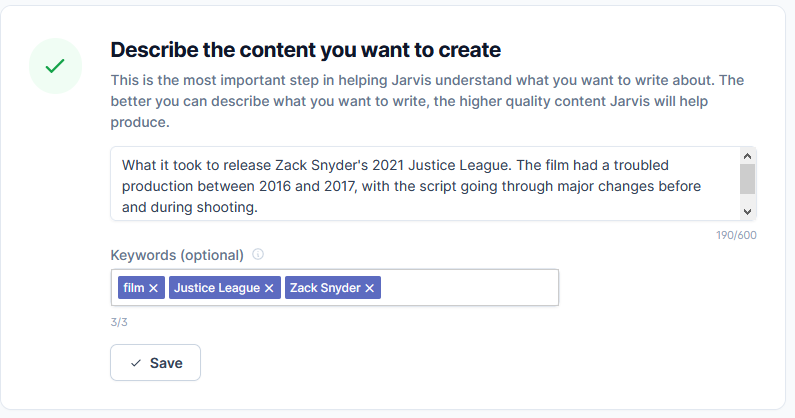
Jarvis asks for a maximum of three keywords. It’s optional, but I presume adding keywords will help Jarvis generate more relevant content. Next, it prompts you to write a working title and start an introductory paragraph. Once you write your initial title, it will generate other title ideas.
For the title, I wrote: The Challenges of Releasing Zach Snyder’s Justice League 2021
It generated the following suggestions:
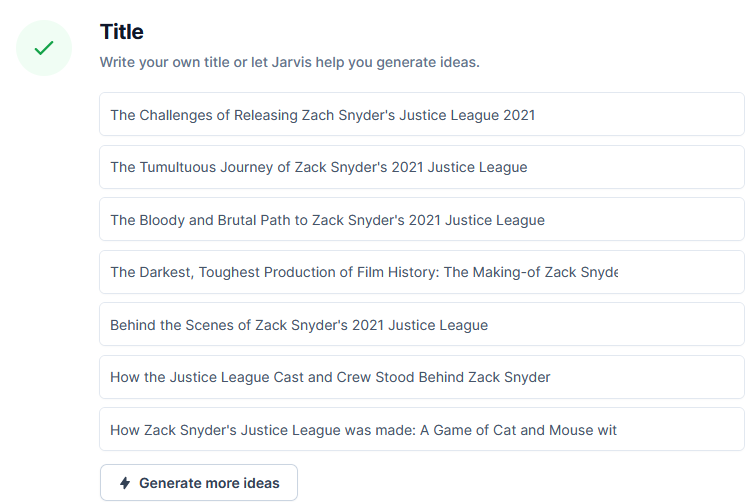
Jarvis generated a long list of appropriate and catchy titles. I personally liked “The Tumultuous Journey of Zack Snyder’s Justice League 2021,” though I’d shorten it a bit. I also liked “The Darkest, Toughest Production in Film History,” which basically tells audiences how hard it was to produce the version of the film. Though it’s an exaggeration, it can be qualified in the article. The other suggestions with “Behind the Scenes” and “Towards a Better Script” were more specific angles. I like that I could explore those topics too. Generally, I think it’s definitely a great tool to make title writing faster.
So far, so good, right? But when I got to content suggestions, it got a bit messy. It was mainly because the suggested content was too general. It also tended toward suggesting expansions that were incoherent to the main topic. This did not sound very promising. Moreover, the AI added bits of information such as dates and other related information. I had to check if these details were used accurately. In a previous test I did (and even for this example), it completely got a date wrong. So I advise writers to always double check the details suggested by Jarvis.
Take a look below. The top paragraph was the one I wrote, while the ones below are suggested by Jarvis.
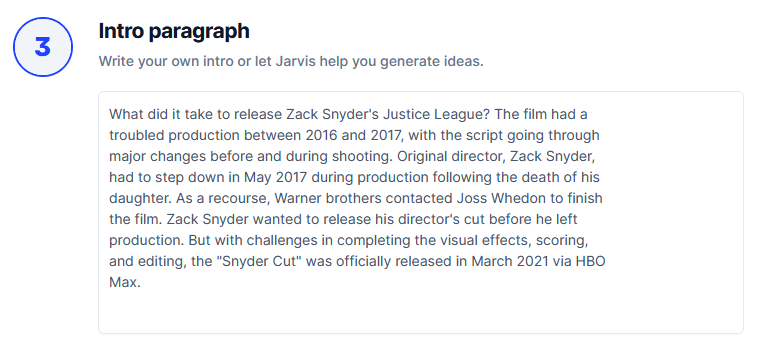
Content suggestions from Jarvis:
1) You might not be able to see Zack Snyder’s Justice League on the big screen, but you can catch it online in 2021. It was released digitally by Warner Bros. on November 27th 2020 and we’ve been watching it slowly climb the ranks of IMDB since then. The film had a troubled production between 2016 and 2017 with the script going through major changes before and during shooting. But now that all is said and done, what did people think? Let’s find out!
2) Justice League is a film that was released on November 17, 2017. The movie had been preceded by Batman v Superman: Dawn of Justice and Wonder Woman. It’s also the fifth installment in the DC Extended Universe (DCEU). Despite being generally well-received by critics, it was considered to be a disappointment at the box office. In this blog post, we’ll take you behind the scenes and show you what went wrong with Zack Snyder’s 2021 Justice League film production!
3) Director Zack Snyder’s Justice League film was one of the most anticipated films of 2017. Unfortunately, the film had a troubled production and was not released until 2021. That didn’t stop it from becoming one of the highest-grossing films of all time. What does this have to do with SEO? When you release content on your website, be sure to include keywords that are relevant to your business and industry!
At first glance, the introduction actually looks appealing to Justice League fans. Many people have been anticipating it on the big screen. But upon further reading, compared to the paragraph I wrote, the AI content had so many problems. Besides being too general, it had issues with imprecise details. Though you can argue these problems are small and editable, it adds time to your work. It can even derail you from focusing on your topic.
The first AI suggestion wrote that Snyder Cut was released digitally by Warner Bros. in November 27, 2020. Upon further research, I found no such confirmation of this. However, there was a YouTube video “speculating” it’s release in November 2020. But from the looks of it, this did not pan out. Officially, Zack Snyder’s Justice League was released in March 18, 2021 by HBO Max via streaming platform, according to Rotten Tomatoes. And yes, it has been climbing the ranks since its digital release.
If you’re not careful about fact-checking, you might end up with misleading information. And frankly, I feel as if some of the other suggestions may tend towards fluff. However, what you can do is choose the best suggestions and put them together into one coherent paragraph. The first suggestion ended the introduction with “But now that all is said and done, what did people think? Let’s find out!” While it’s something I want to touch on eventually, it is not the main focus of my introduction. The AI was not sensitive enough to sense this follow up was out of place. I’d rather get to the details of the challenging production. If I use this suggestion, I’ll have to edit it into “Let’s take a look at what it took to deliver the highly anticipated Snyder Cut,” or something to that effect.
The second example, on the other hand, was quite a miss. It started by talking about the 2017 Justice League film. While it’s good to expound on the history of the project started, it got lost in discussing the 2017 version. Worse, it did not transition the topic smoothly into the 2021 Snyder Cut. If I read this introduction, I’d be confused into thinking the article was about the 2017 Justice League. Finally, it awkwardly ended the paragraph with “we’ll take you behind the scenes and show you what went wrong with Zack Snyder’s 2021 Justice League film production!” Besides the wordy sentence, suddenly it’s talking about the 2021 Justice League out of nowhere. I would not phrase the production’s challenges as something that went wrong. That’s unnecessary hype. It’s confusing, and just an example of bad writing. Again, while it can be fixed with editing, I feel better off writing on my own.
Finally, the third example actually started okay. But then it started talking about SEO out of nowhere. I don’t know where that came from or why the AI did that, but I’ll count it as a totally unusable suggestion from the app. I reckon there might be more of those glitches if I generate more content suggestions from Jarvis.
SIDEBAR FROM AARON: COUGH. SEO IS EVERYTHING. HOW DO I REEEEECH DEZ KIDZ
I noticed these were nuances the AI was not able to catch. It’s probably even based on trending articles at the time, which had a tendency towards hype and dated showbiz information. And though the suggestions were interesting, they were mostly too general or against the direction I needed. If the usage of the information is not accurate, imagine what that would mean for health or political articles. But too be fair, it did generate other usable suggestions with less serious edits. It’s worth looking into those.
However, by this time, I felt I was better off writing the feature without the app, at least for this example. I guess it’s really a hit or miss. Even with so many content suggestions, I think you can still end up with inappropriate samples even if you find good ones. But at least you got a good title already. Personally, I’d rather go straight to researching on my own.
Framework Templates
Conversion.ai allows you to write copy based on marketing frameworks that have been used by professionals for years. It’s ideal for brands, products, and services you need to promote. This features includes the following templates:
- AIDA Framework: The AIDA template stands for Attention, Interest, Desire, and Action. This basically divides your copy into sections drawing attention from consumers and piquing their interest. The suggested copy also includes content that appeals to the consumer’s desire, then ends with a call to action.
- PAS Framework: The PAS template is structured by generating copy which highlights the consumer’s Problem, Agitate, and Solution. It’s focused on how a particular product will help solve a consumer’s problem.
- Bridge-After-Bridge Framework: Also known as BAB framework, this copywriting structure revolves around the idea of getting a consumer from a bad place to a better one. It shows the before and after scenario after benefitting from a product.
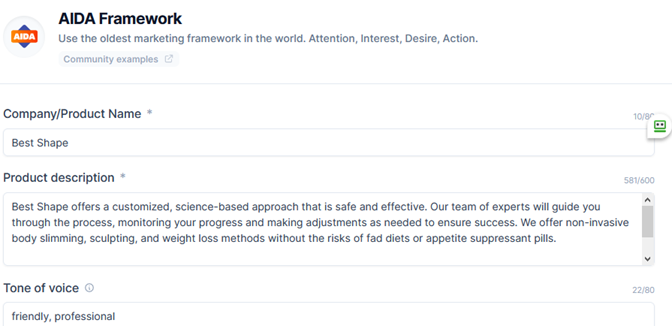
For this example, I used the AIDA template for an imagined non-invasive weight loss service company. The new company promotes fitness and advocates against fad diets. It performs non-surgical weight loss procedures, such as wraps and thermomagnetic massages.
Again, Jarvis asks for a description. It also requires you to specify the tone of the copy. I placed “friendly” and “professional” under the box. See my input below.
Here’s the first suggestion from Jarvis:
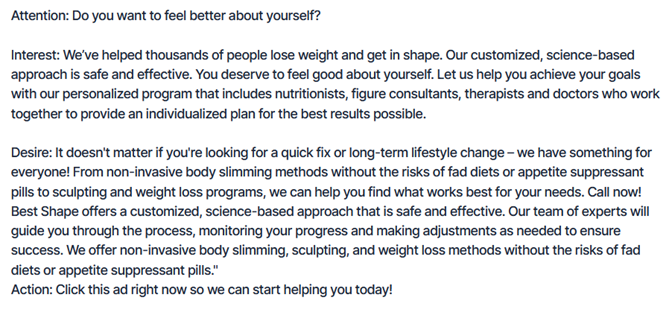
Based on this example, I’d say the AI-generated content is quite engaging. It tried to have a personal touch by letting the customer know they’re here to help. The writing empathizes with consumers who have a hard time losing weight. However, since this is for a new company, the introduction “We have helped thousands of people lose weight and get in shape,” does not apply. So as a writer, I simply have to remove it. This can be replaced with the intent to help more people lose weight and get in shape.
I actually pulled out at least 6 different content suggestions. From these, writers could get the best parts and edit them into one strong copy description. On it’s own, the content would still benefit from a lot of editing. Here are some issues you might encounter while generating copy suggestions:
- Hard Sell Copy. The sample content can be hard sell, even if you specify a professional tone of voice. It tends to use exclamation marks (!) per sample. I believe this depends on the product or service you are writing about. Certain products or services may sell more with the hard sell approach, so the AI suggests this strategy. It may also appear like the “proven” way to communicate to consumers. But if you’re going against this direction, it’s a nuance the AI tool might miss. If your business or client specifically avoids exclamation marks your copy, be ready to make the necessary edits.
- Can be Wordy, Long, Redundant. In terms of style, here’s where you can’t rely on Jarvis to write the entire thing. If you happen to input a long and detailed product description, the AI has a tendency to generate wordy variations of the copy. If you notice, some details are also redundant. In copywriting standards, this needs tightening. Conciseness can be an issue, most notably if you’re not used to brevity. Thus, I believe this tool will best benefit writers and editors who have considerable experience in crafting straightforward copy.
Product Description
The app comes with a special template for creating product descriptions. If you have a large inventory of product information for rewriting, this is the right tool to use. It even comes with an optional language output translation feature, which is available in other templates too.
However, the language feature is limited. I tried putting Thai, Italian, and Japanese and it generated few suggestions, some mixed with English. Same thing with Punjabi and Vietnamese. In other templates, they just keep making English suggestions. Filipino is also not recognized by the AI, which likely means it cannot translate a bunch of other languages. This feature obviously needs development. But it’s not the main feature, so I doubt they’ll do a lot of improvements.
For this example, I used an imagined tire center that offers products and services throughout the U.S. I specifically wrote that it’s the second most affordable tire center in the country. I asked for a professional and witty tone. I’m not at all fluent in Spanish, but I placed Spanish under the output language box.
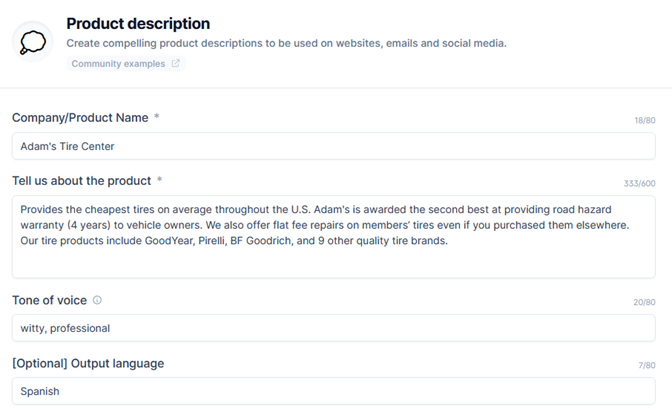
Below is the first suggested copy in Spanish:

When translated through Google, it reads:
“Don’t think twice, Adam’s Tire Center is your best option because it offers the largest range of products for cars and wagons. Join our satisfied customers and insure your tires with the Road Hazard Warranty service. Call or visit our sales center in Miami, FL, where we are honored to help you.”
Obviously, I can’t comment much on the accuracy of the translation. Though certainly, I have doubts for how writing in another language can capture certain styles and tones. But right now, what I’m more concerned with is the tendency to use superlative descriptions that might not accurately fit the brand. Things like “we offer the largest range of products” should probably be tweaked to “we offer a wide range of products…” If your tire center does not offer the largest inventory, you should not be writing that. It also assumed a specific location, which prompts the writer to include the actual business location (this is a good suggestion). Again, the AI copy would benefit from fine-tuning to make it specific to your product or service.
Now, back to English. Here are three other content samples generated by Jarvis: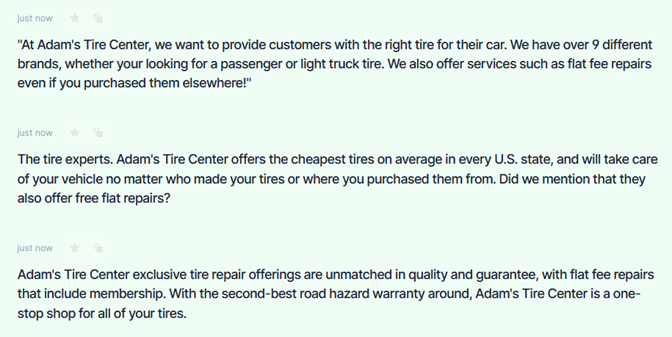
The English AI-generated samples are not so bad. But in the last sample, there is a tendency for hard sell terms like “unmatched in quality,” that you need to watch out for. You can get the best parts and put them into one solid brand description. But again, these tend to be wordy and long. It would help to use the Hemingway app or Grammarly to make the descriptions tight and concise.
Content Improver
Using the Content Improver template will help you tweak the product or service descriptions you came up with. To show you how it works, I placed the content I wrote based on the edited tire center descriptions Jarvis generated.
For this example, I placed professional and witty under tone of voice.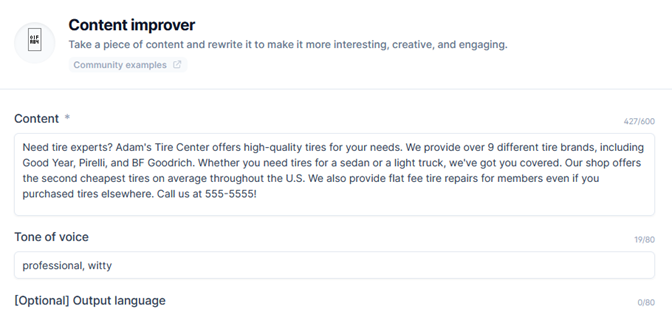
Suggested content from Jarvis: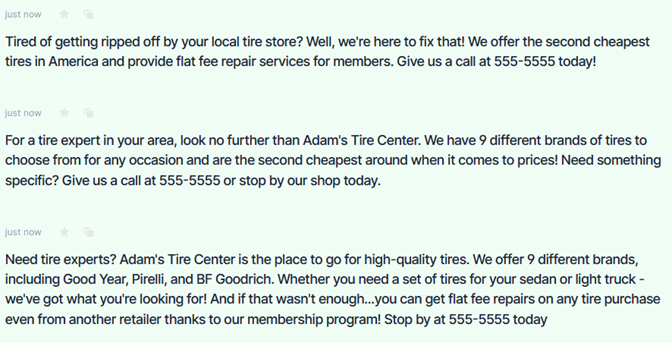
Based on the sample suggestion, I’d say the first two can pretty much stand on their own. These are straightforward copies that address consumer needs with a direct call to action. Though the first one may sound a bit informal, it might fit the type of consumer demographic you are targeting. Finally, the last example gets a bit wordy but can be fixed with a couple of edits. The major issue is the number (555-5555), which the AI mistook for an address.
Marketing Angles
Besides churning out copy suggestions, Conversion.ai has a brainstorming tool. This basically takes your product or service and comes up with various campaign ideas to promote it. If you’re running out of concepts for promotion, Jarvis leverages on your product’s features and strengths. I appreciate that it tried to come up with benefit-driven copy based on the example I put.
For this example, the product I used is a gym management software. It helps gym owners manage activities, schedules, and handle payments. The software aims to run gyms more efficiently.
I personally find the following suggestions helpful in pushing the strengths of a product. I would definitely use this tool for brainstorming ideas. Here’s what Jarvis generated: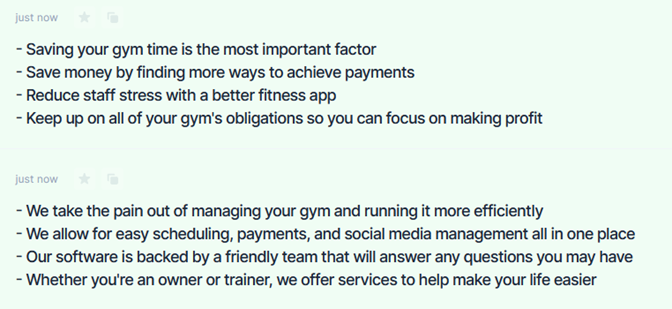
Unique Value Propositions
Another intriguing feature is the unique value propositions (UVP ) template. UVP is essentially a clear statement that describes the benefit your product offers. It also captures how you address your customer’s needs and what distinguishes you from the competition.
If you have a product or service, It claims to generate copy that describes your product’s unique advantage in a remarkable way. To test how this works, I used the previous example, which is the gym software. It came up with several statements that emphasized the product’s benefits. See Jarvis’ suggestions below. Personally, I like the idea of software that helps me make more money with less work.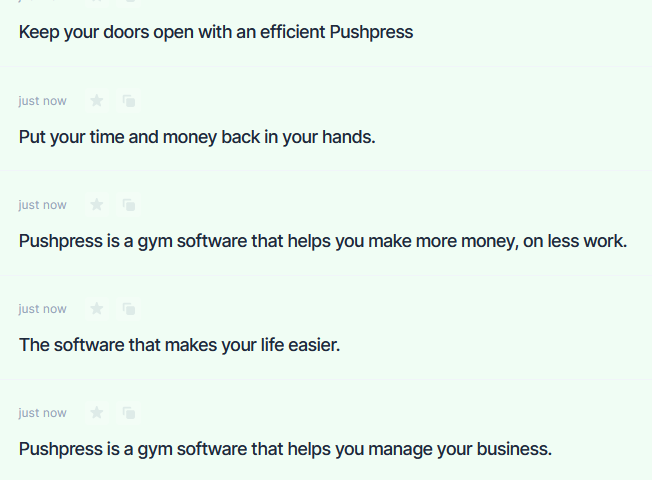
Feature Benefit
The feature benefit template comes up with a list of advantages offered by your product. For this example, the product is a camisole for plus size women. You’ll see how it took the paragraph details and made bulleted benefits based on those features. It’s a useful tool if you want to break down your product’s unique selling points so you can further emphasize them in your campaign.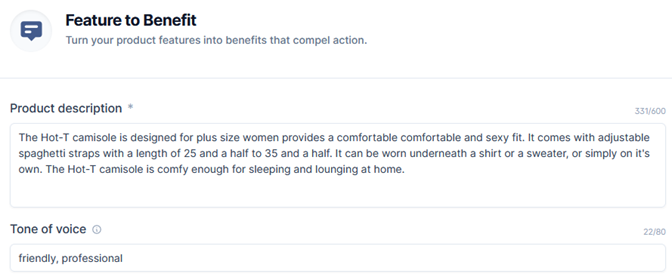

Persuasive Bullet Points
Another related function is the persuasive bullet points template. This is very similar to the feature benefit template. Personally, I think it’s either you use this or the feature benefit template if you want to highlight product advantages in bullet points. On the other hand, this template doesn’t categorize benefits as emotional or standard advantages.
Copy Headline and Sub-headline Templates
Conversioan.ai also comes with copy headline and sub-headline templates. They claim the AI is “trained with formulas from the world’s best copywriters.” It also guaranteed to create “high-converting headlines” for businesses. At this point, the only way to know if it does have high conversion is to see actual results. Right now, my review can’t prove any of that. But it would be interesting to know from companies who have been using this software for results.
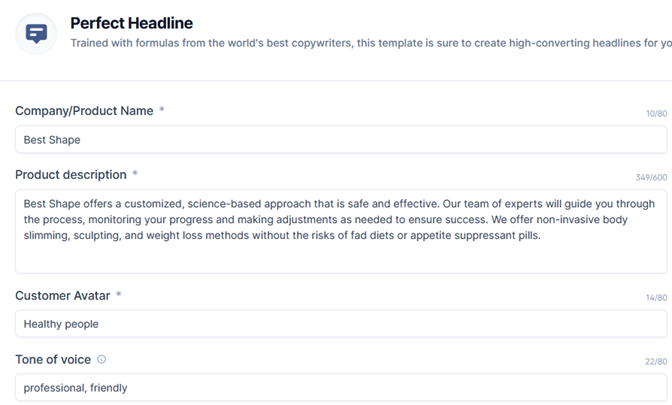
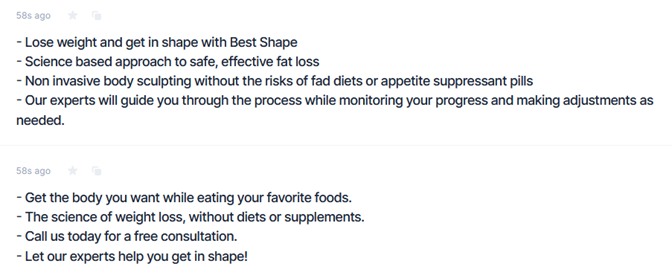
- Perfect Headline: For this template, I used an earlier example that provides non-invasive weight loss services. You’ll see the product description I used, followed by the suggestions made by Jarvis. I specifically liked the headline: Science-based approach to safe, effective fat loss. It’s right concept I was going for.
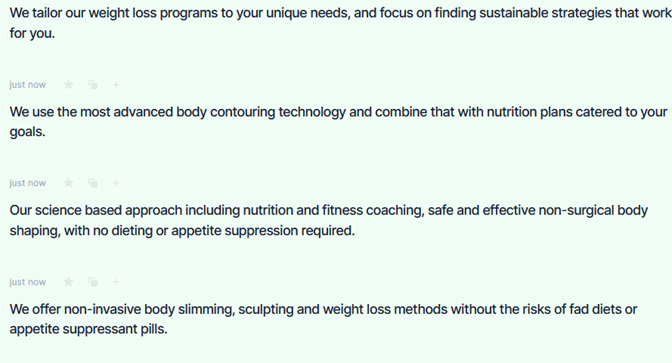
- Website Sub-headline: I used the same product description for the sub-headline. I also used the suggested headline generated by Jarvis, which is “Science-based approach to safe, effective fat loss.” Based on Jarvis’ suggestions, I liked the last one, which emphasizes non-invasive slimming. It also tells consumers the procedure is safe. Though it tends to be wordy, I appreciate it provides different ways you can get your message across.
Sentence Expander
Another interesting feature is the sentence expander. It claims to make your sentence longer and more creative. I guess it should help you get to another thought if you caught writer’s block. But I’m wary what kind of suggestions it might give. When I tried it, it’s just another way to rewrite your sentence in a longer, more detailed way.
In any case, see my sentence below.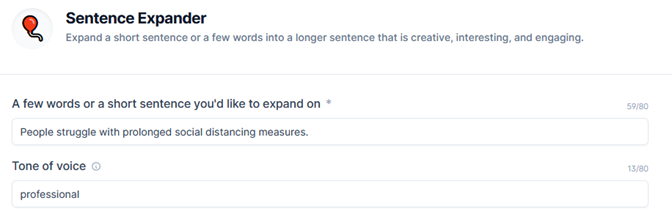
Here’s what Jarvis generated: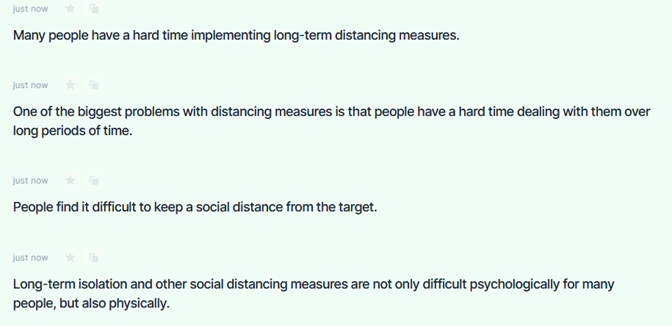
I’m actually not a fan of long-winded sentences. However, I do appreciate the extra details added by the AI. I can use these suggestions if I make further edits on them. But realistically, if I’m writing an article, I’d skip this and go directly to what I’m trying to say. That would save me time. If I want to talk about the negative psychological effects of social distancing, I’d write that point per point. My idea of expansion is moving an argument forward, not merely adding more details to what was already said.
Creative Story
Here’s an interesting template I was curious to try. I wonder how Jarvis would develop a two sentence plot. It’s fascinating to see how an AI that uses “proven high conversion data” would suggest story development.
For my example, I took a horror story plot inspired by the Bone Turner from a popular horror podcast called The Magnus Archives. See my plot description and the suggestions made by Jarvis.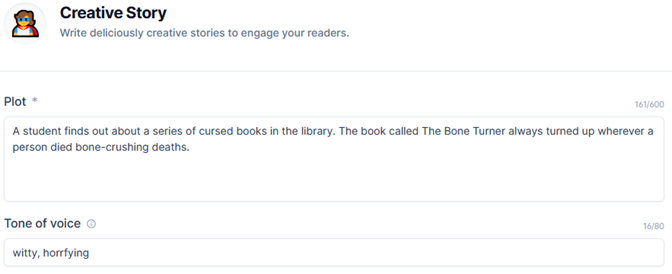
Story suggestions by Jarvis: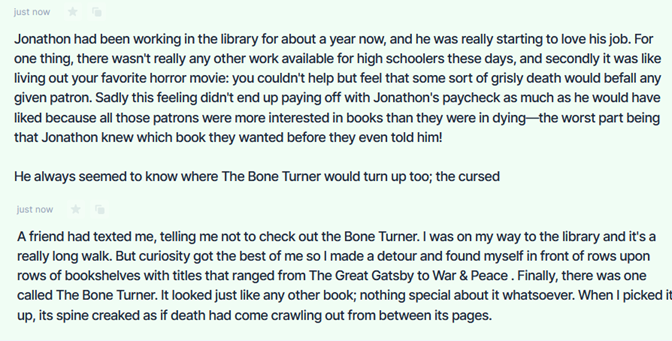
I have to say, these are very interesting ideas for an introduction. It’s also funny how it used the name “Jonathon,” because the actual name of main character in the Magnus Archives is “Jonathan.” I kind of think that was on purpose, since the AI probably knows the Bone Turner is from a popular online show.
In any case, I particularly liked the second suggestion. With some editing and fine-tuning, you could fix the details to fit the story in your head. On the other hand, I’m wary authors might rely too much on this to bridge plot gaps. While it’s amusing, it’s more compelling to read plot twists and resolutions that are not forced. At this stage, I’m still not convinced the AI can make a story without contrived plot twists.
Email Subject Lines
Besides creative writing tools, Coversion.ai also has templates for email marketing. This feature is made for businesses or individuals who want to promote products and services via email. The app claims to come up with catchy subject lines that draw consumers to open your email. In this example, I used an imaginary cake shop that delivers throughout LA. I thought Jarvis came up with a long list of creative subject lines. These were spot on for the example. Since I am a cake person, I’d likely read this kind of email.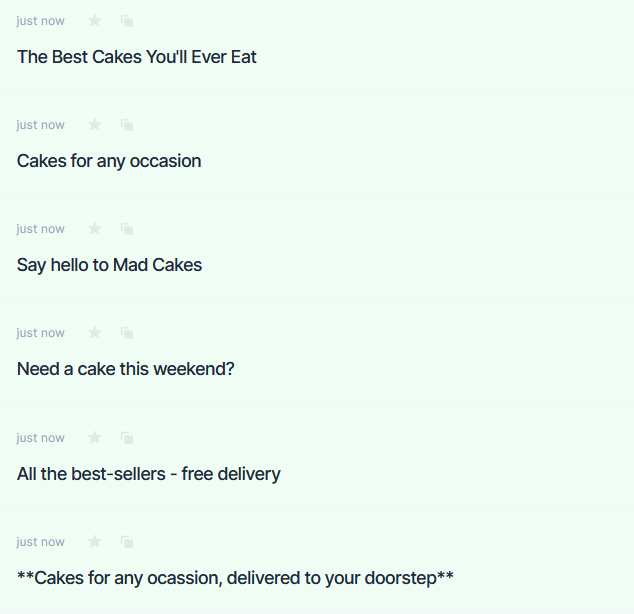
Personal and Company Bio
You can also generate creative personal and company bios through Jarvis. If you’re running a personal blog or website, Jarvis generates personal bios in first person or third person POV, whichever you are more comfortable with. I’m actually pleased with what the AI suggested. It’s a good start, because I find it hard writing about myself.
The example below is not me, of course. I made up Jessica Ackerman as the founder of Mad Cakes in LA.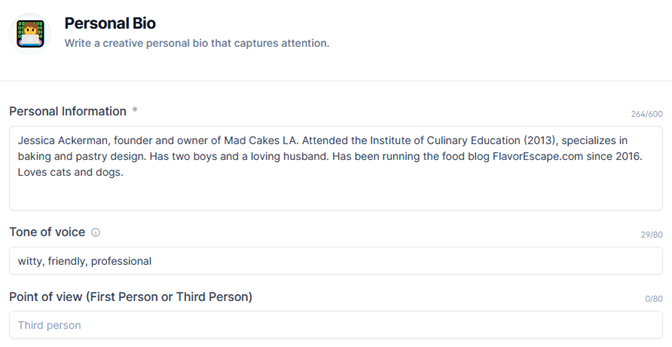
Here’s what Jarvis generated: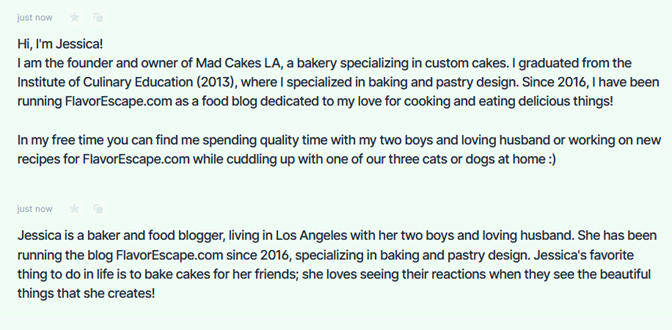
It does sound like a personalized bio. Especially with the detail about cuddling with cats and dogs. Again, I’d edit it to be more particular about details. Other than that, I think it’s a good tool to use.
Next, Jarvis also generates company bios that sound professional. I put a three-sentence info about a company that boosts website conversion for businesses. I was surprised how long the suggestions were. It also presumed the names of clients the company has serviced (TripAdvisor, Yelp, etc.). Again, for particular information like this, it’s important to edit or remove them. Otherwise, you might publish copy with misleading details.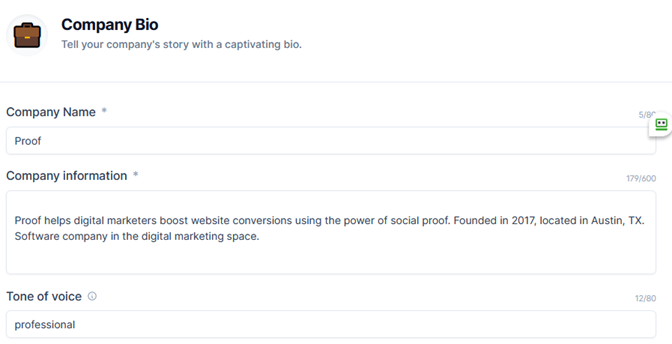
Suggestions from Jarvis: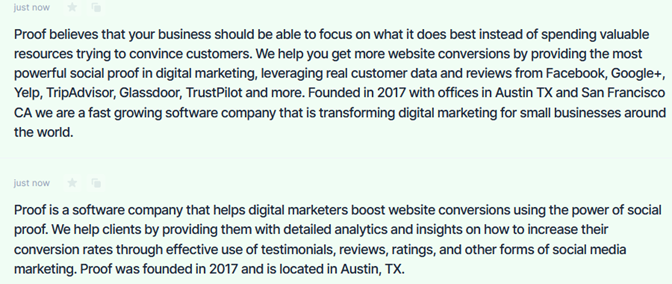
Real Estate Listing – Residential
You can utilize this template to create creative and descriptive residential listings. It’s helpful for real estate agents and people who are planning to sell their property. The following shows information about a house for sale, followed by listing suggestions by Jarvis.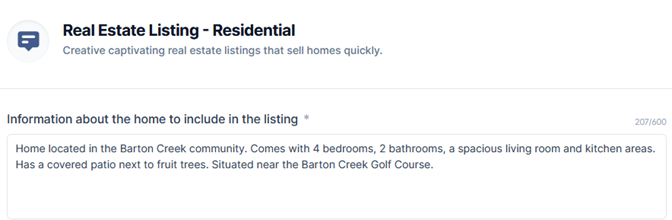
Suggestions from Jarvis:
It’s interesting how the suggested content appeals to the consumer’s idea of a perfect home. It tries to paint a picture of affluent living just based on the golf course description I supplied. But again, for accuracy, these added details should be edited by the writer.
Templates for Specific Online Platforms
Besides articles and product or brand descriptions, expect Conversion.ai to provide special writing features for online platforms. This includes Facebook, Instagram, YouTube, Google, and Amazon accounts. The AI’s content suggestions are based on posts and ads that have generated high traffic on these platforms. I think this a good tool to use if you want an edge over what already sells.
- Facebook Ad Headline: Makes catchy headlines for FB ads, claims to increase chances of clicks that lead to sales.
- Facebook Ad Primary Text: Claims to generate high converting copy for FB ad’s primary text section.
For the Facebook ad headline, my example is a cake shop that delivers a wide assortment of cakes in Los Angeles. It specifically mentions delivering cakes “within an hour or your money back.” Here’s the example and Jarvis’ suggested content.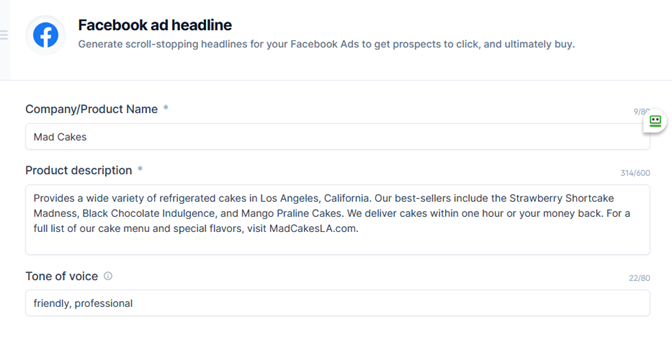
AI ad sample headlines: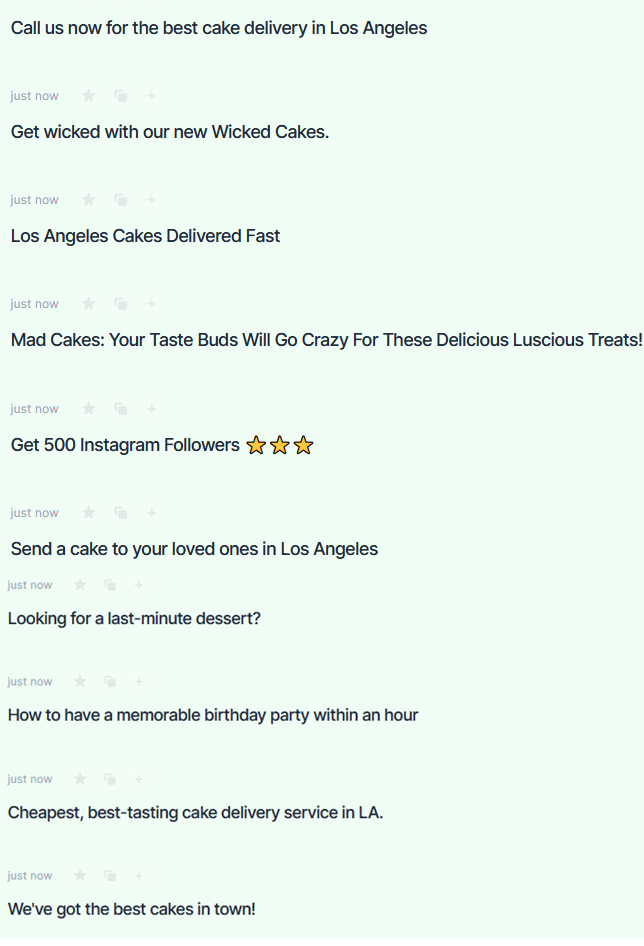
I must say these sound like fun and friendly FB headlines. I personally would like a last minute dessert. And if I don’t have time to pick up cake, I’d certainly like one delivered. Just not sure about “Get 500 Instagram Followers,” the suggestion is out-of-place. I’d use this tool for a fresh and exciting FB headline.
Here’s the AI sample for Facebook ad primary text: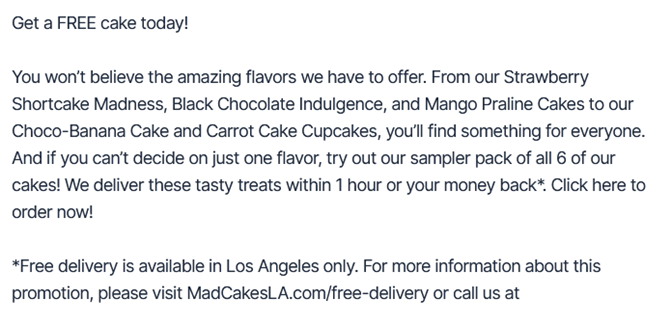
Based on the FB text sample, the AI instantly suggested to give away free cake. Most of the generated samples headed toward this direction. It didn’t just generate engaging copy, it likely showed you what other cake shops do to draw more customers. I think it’s a great marketing strategy to have promos and free cake. I also like that it suggested catchy hashtags. But again, I’d fix the wordy and adjective-ridden descriptions. With a little editing, the samples should read more smoothly. Other than that, it’s a fast way to come up with social media copy.
Photo Post Captions for Instagram
You can use the app for a company or store’s IG accounts. Here are some samples based on a Mad Cakes Black Chocolate Indulgence photo. If you need ideas for your IG post, this tool can suggest copy that’s simple and straightforward for IG. Depending on your product or service, it suggests content that typically targets your customers base.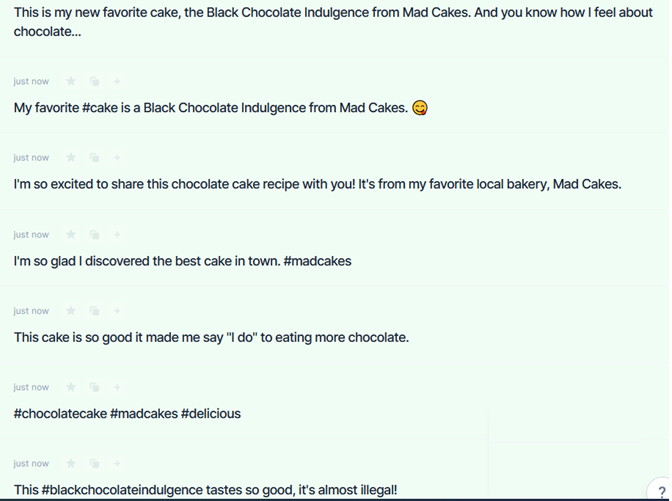
Video Writing Templates for YouTube
Next, Conversion.ai offers specialized templates for videos, specifically for platforms such as YouTube. But I also think you can use the content similarly if you’re posting on other video sites. However, the suggestions are based on content with high traffic on YouTube. It includes the following features:
Video Topic Ideas: For brainstorming video content concepts that rank well on YouTube. For example, your initial topic is baking homemade cake. It’s a useful tool for letting you know what people are actually interested in. It gives you an idea what to work on right off the batt. Here are the AI’s suggestions. It mentions concepts for cake baking videos many people look for: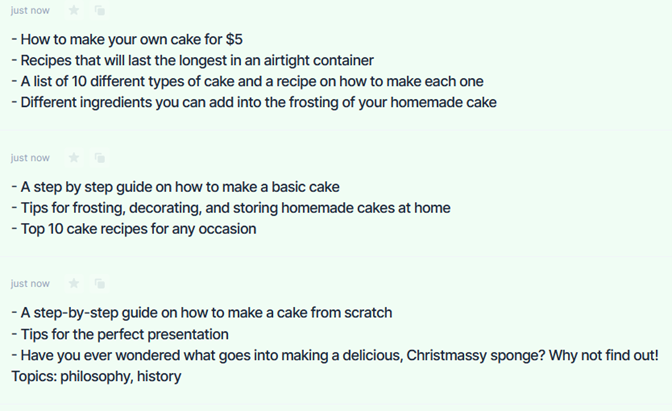
Video Script Outline: Helps make script outlines for any topic. However, this works more suitably for how-to and listicle type videos, not the ones with a narrative. The example below for how to spot aurora borealis or Northern lights. From the AI suggestions, you can choose the best strategies to come up with your own outline. I noticed many suggestions can be too general, besides the more specific ones I posted below. It’s still best to do your own research to make your video content more nuanced and unique. Otherwise, you may just parrot what other content creators have already done.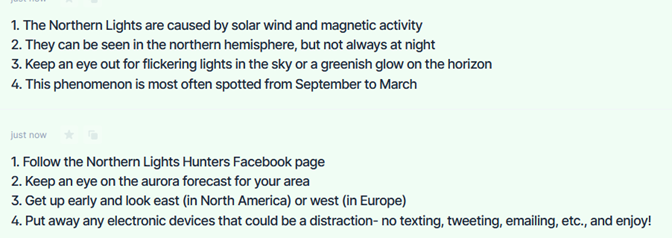
Video Titles: Like the other templates, there’s also a video title feature. As an example, many users on YouTube like to create content about shows or films. Suppose you want to write a feature about the anime Attack on Titan. For the suggestion, the AI actually came up with pretty awesome titles and topics you can start researching on. While this is based on high-traffic fan search, what you can do is watch what’s already there. This will help you come up with more unique insights about the show that has not been tackled. Again, try to focus on what would set your content apart from what’s already there.
Blog Post Templates
Conversion.ai provides templates that help you conceptual blog posts for your brands. It has tools to help you brainstorm topic ideas and outline your content. These suggestions are all based on high ranking topics on Google. It also comes with features that help compose blog post introductions and conclusions.
- Blog Post Topic Ideas
- Blog Post Outline
- Blog Post Intro Paragraph
- Blog Post Conclusion Paragraph
For the example, let’s focus on the topic template. I used the earlier example, Best Shape, which is an imaginary non-invasive weight loss service. See the AI’s suggestions below.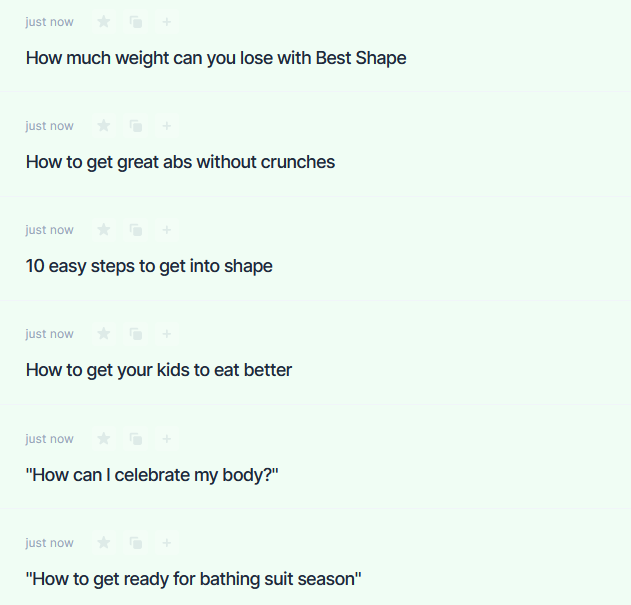
Jarvis’s results show topics that trend around non-invasive weight loss methods. Trending topics around your market is always good to know. For ideas on blog topics, I think Conversion.ai will really be a useful tool. If you need help structuring your outline, I think it’s worth using it especially if you’re having trouble with organization.
Personally, after getting different topics, you can start writing your post without the app. You won’t need it especially if you already have an idea what to write. It’s still better to do proper research than rely on the app to add information on your post. As you’ve noticed, it has a tendency to supply the incorrect information, which you must diligently edit.
Would I Recommend This Software?
After crash testing Conversion.ai, I would recommend this tool to agencies or individuals that deal with extensive online copywriting and product rewrites. They will benefit the most by eliminating the time-consuming process of doing product descriptions. I would also recommend it for businesses that run social media campaigns, including Google and Amazon ads. This will help generate and organize copy ideas faster, especially if you have a lot of products and services to promote. And because the AI suggestions are based on high-ranking topics, you have a better idea of what your client base is also looking for. It can also enhance messaging concepts and help brainstorm new campaign ideas for a product or brand. Just remember to always edit the content suggestions.
On the other hand, I would not recommend this app for long-form writing. I do not think it is ideal for any writing that requires a lot of research. Because the AI suggestions tend towards incorrect information, you’re better off researching current data on your own. It’s an interesting tool for wring stories, but I also worry authors might be too reliant on the app for plot ideas. There is a difference between carefully worded prose versus long-winded sentences composed by this app. Human writing is still more precise with expression, which the AI has yet to learn.
While it’s a good tool to have, the bottom line is, you still need to edit your content. It will help you structure your outline and compose your post. However, the impetus for writing and the direction it will take is still on you, the writer. My verdict? AI writing technology won’t fully replace humans anytime soon.
Categories:
Conversion.ai Review
Background / Intro
One of my longtime friends who was Internet marketing long before I was hit me up on Skype about a week ago praising Conversion.ai. I have to think long and hard about any other time he has really pitched or recommended something like that & really I just can’t think of any other time where he did that. The following day my wife Giovanna mentioned something to me and I was like “oh you should check out this thing my buddy recommended yesterday” and then I looked and realized they were both talking about the same thing. :D
I have a general heuristic that if people I trust recommend things I put them near the top of the “to do” list and if multiple people I trust do that I pull out the credit card and run at it.
Unfortunately I have been a bit burned out recently and launched a new site which I have put a few hundred hours into, so I haven’t had the time to do too much testing, BUT I have a writer who works for me who has a master’s degree in writing, and figured she could do a solid review. And she did. :D
She is maybe even a bit more cynical than I am (is that even possible?) and a certified cat lady who loves writing, reading, poetry and is more into a soft sell versus aggressive sales.
Full disclosure…the above link and the one at the end of this post are affiliate links, but they had zero impact on the shape or format of the review. The reviewer was completely disconnected from the affiliate program and I pulled out my credit card to pay for the software for her to test it out.
With that tiny bit of a micro-introduction, the rest of the post from here on out is hers. I may have made a couple minor edits for clarity (and probably introduced a few errors she will choke me for. :D) but otherwise the rest of this post is all her …
An In-depth Review of the Conversion.ai Writing Software
Considering the possibilities of artificial intelligence (AI), we picture robots doing tasks autonomously like humans. With a computer’s brain power, productivity is accelerated significantly. We also expect AI programs to have the capability to evolve intelligently the longer they are used. These types of AI employ “machine learning,” or deep learning to solve problems.
AI technology can be leveraged by various industries, especially with writing. Recently, I learned about the Conversion.ai copywriting tool. It uses machine learning which claims to write “high converting copy” for websites, ads, landing pages, emails, etc. The software is geared towards writers, marketers, entrepreneurs, and agencies that benefit from creating engaging and effective copy. To date, companies such as Hubspot, Shopify, and Salesforce are known to use the software. Currently, it’s offering a 7-day free trial with 20,000-word credits.
To give you the lowdown on Conversion.ai, I wrote an in-depth review of how this software works. I’ll go through its various features and show examples of how I used them. I’ll include the advantages of using Conversion.ai’s Jarvis (that’s what it’s called) in writing scenarios. More importantly, I’ll discuss challenges and specific limitations this tool might present.
Assistance in Creating High Conversion Copy
As a writer doing web copy for 10 years, including the time I took a post-grad creative writing degree, I grabbed the opportunity to try this AI software. For starters, it struck me how Conversion.ai claims to provide “high converting copy” for increased conversion and higher ROI. Such claims are a tall order. If you’ve been in the marketing or sales industry, you’d know conversion depends on so many other factors, such as the quality of the actual product, customer support, price, etc. It’s not just how well copy is written, though it’s a vital part. But anyway, upon more research, I learned the app generates copy based on proven high conversion sales and marketing messages.
To be honest, I have mixed feelings about this conversion strategy. I believe it’s a double-edged sword. This is not to undermine facts or measurable data. Basing content creation on “proven content” means you’re likely using the same phrases, techniques, and styles already used by successful competitors. This serves as a jumping board for ideas of course, so you know what’s already there. However, it can be an echo chamber. Marketers must not forget that execution must still be fresh. Otherwise, you’ll sound like everyone else.
Next, while it seems sustainable, it also sounds pretty safe. If your product or service is not that distinct, you must put extra effort to create content that stands out. This applies to all aspects of the marketing strategy, not just in writing content. It’s a crucial principal I learned after reading Purple Cow by Seth Godin (thanks for the book suggestion, Aaron!).
Depending on your product or service, Conversion.ai will generate copy that most consumers keep going back to. Based on the samples it generated, I’d say it really does come up with engaging copy, though it needs editing. If your business must rewrite product descriptions for extensive inventories, Conversion.ai can cut the time in half. It can help automate description rewriting without hiring more writers. That saves money and time, so businesses need fewer writers and editors.
What did I learn? Conversion.ai can make writing and editing faster, yes, especially for low-level content focused on descriptions. It can also inform the strength of your ideas for more creative campaigns. However, it still takes solid direction and creativity to drive good marketing copy forward. That said, it’s only as good as the writer utilizing this app. As a content creator, you cannot rely on it solely for creativity. But as an enhancer, it will significantly help push ideas forward, organize campaigns, and structure engaging copy effectively.
When you use this app, it offers many different features that help create and organize content. It also customizes copy for various media platforms. Beyond rewriting , it even has special brainstorming tools designed to help writers consider various idea angles. This can add more flavor and uniqueness into a campaign.
At the end of the day, what will set your copy apart is the strength of your ideas and your communication strategy. How you customize content for a business is still entirely up to you. AI writing tools like Conversion.ai can only help enhance your content and the ideas behind it. It’s a far cry from creating truly unique concepts for your campaign, but it definitely helps.
Conversion.ai Writing Features & How They Work
This AI writing app comes with plenty of “writing templates” that are customized to help you write with a specific framework or media platform in mind. Currently, Conversion.ai offers 39 different writing templates or content building blocks that deliver results. We’ll provide details for how each one works.
For company or product descriptions, Conversion.ai has a Start Here step by step guide, which says users should alternate between the Product Description and the Content Improver template until they have found the right mix they’re looking for. But for this review, I just focused on how to use the templates for different writing projects. The app comes with video instructions as well as a live training call if you need further assistance on how to use it.
Each template asks you to input a description or what you want to write about. This is limited to 600 characters. Writing the description is the sole basis for how Jarvis will generate ways to write or expand your content. It also helps you brainstorm and structure ideas for an article or campaign.
But as an issue, I find the 600-character limit can hinder reposting the full content generated by the AI back into the template for improvement. Yes, it churns out marketing copy of more than 600 characters. If you want to post the improved copy again, you might have to do this in two batches. In any case, Jarvis can generate as many improved writing samples as you need.
To give you a better idea, here are different Conversion.ai templates and how they work. This is going to take a while, so have your coffee ready.
Long-form Assistant
This is for longer articles, emails, scripts, and stories. It’s also suggested for writing books. It has two modes, a blank document where you can start typing freely and an assistant workflow. The blank document also lets you access the rest of the other writing templates vertically. On the other hand, the long-form assistant workflow is where the app asks you to describe the content you want to create. Consider this carefully. The better you can articulate your topic, the higher quality content Jarvis can help generate.
For the example, suppose I want to write about what it took to finally release Zack Synder’s 2021 Justice League. I want to write this feature article for my film and culture website.
Jarvis asks for a maximum of three keywords. It’s optional, but I presume adding keywords will help Jarvis generate more relevant content. Next, it prompts you to write a working title and start an introductory paragraph. Once you write your initial title, it will generate other title ideas.
For the title, I wrote: The Challenges of Releasing Zach Snyder’s Justice League 2021
It generated the following suggestions:
Jarvis generated a long list of appropriate and catchy titles. I personally liked “The Tumultuous Journey of Zack Snyder’s Justice League 2021,” though I’d shorten it a bit. I also liked “The Darkest, Toughest Production in Film History,” which basically tells audiences how hard it was to produce the version of the film. Though it’s an exaggeration, it can be qualified in the article. The other suggestions with “Behind the Scenes” and “Towards a Better Script” were more specific angles. I like that I could explore those topics too. Generally, I think it’s definitely a great tool to make title writing faster.
So far, so good, right? But when I got to content suggestions, it got a bit messy. It was mainly because the suggested content was too general. It also tended toward suggesting expansions that were incoherent to the main topic. This did not sound very promising. Moreover, the AI added bits of information such as dates and other related information. I had to check if these details were used accurately. In a previous test I did (and even for this example), it completely got a date wrong. So I advise writers to always double check the details suggested by Jarvis.
Take a look below. The top paragraph was the one I wrote, while the ones below are suggested by Jarvis.
Content suggestions from Jarvis:
1) You might not be able to see Zack Snyder’s Justice League on the big screen, but you can catch it online in 2021. It was released digitally by Warner Bros. on November 27th 2020 and we’ve been watching it slowly climb the ranks of IMDB since then. The film had a troubled production between 2016 and 2017 with the script going through major changes before and during shooting. But now that all is said and done, what did people think? Let’s find out!
2) Justice League is a film that was released on November 17, 2017. The movie had been preceded by Batman v Superman: Dawn of Justice and Wonder Woman. It’s also the fifth installment in the DC Extended Universe (DCEU). Despite being generally well-received by critics, it was considered to be a disappointment at the box office. In this blog post, we’ll take you behind the scenes and show you what went wrong with Zack Snyder’s 2021 Justice League film production!
3) Director Zack Snyder’s Justice League film was one of the most anticipated films of 2017. Unfortunately, the film had a troubled production and was not released until 2021. That didn’t stop it from becoming one of the highest-grossing films of all time. What does this have to do with SEO? When you release content on your website, be sure to include keywords that are relevant to your business and industry!
At first glance, the introduction actually looks appealing to Justice League fans. Many people have been anticipating it on the big screen. But upon further reading, compared to the paragraph I wrote, the AI content had so many problems. Besides being too general, it had issues with imprecise details. Though you can argue these problems are small and editable, it adds time to your work. It can even derail you from focusing on your topic.
The first AI suggestion wrote that Snyder Cut was released digitally by Warner Bros. in November 27, 2020. Upon further research, I found no such confirmation of this. However, there was a YouTube video “speculating” it’s release in November 2020. But from the looks of it, this did not pan out. Officially, Zack Snyder’s Justice League was released in March 18, 2021 by HBO Max via streaming platform, according to Rotten Tomatoes. And yes, it has been climbing the ranks since its digital release.
If you’re not careful about fact-checking, you might end up with misleading information. And frankly, I feel as if some of the other suggestions may tend towards fluff. However, what you can do is choose the best suggestions and put them together into one coherent paragraph. The first suggestion ended the introduction with “But now that all is said and done, what did people think? Let’s find out!” While it’s something I want to touch on eventually, it is not the main focus of my introduction. The AI was not sensitive enough to sense this follow up was out of place. I’d rather get to the details of the challenging production. If I use this suggestion, I’ll have to edit it into “Let’s take a look at what it took to deliver the highly anticipated Snyder Cut,” or something to that effect.
The second example, on the other hand, was quite a miss. It started by talking about the 2017 Justice League film. While it’s good to expound on the history of the project started, it got lost in discussing the 2017 version. Worse, it did not transition the topic smoothly into the 2021 Snyder Cut. If I read this introduction, I’d be confused into thinking the article was about the 2017 Justice League. Finally, it awkwardly ended the paragraph with “we’ll take you behind the scenes and show you what went wrong with Zack Snyder’s 2021 Justice League film production!” Besides the wordy sentence, suddenly it’s talking about the 2021 Justice League out of nowhere. I would not phrase the production’s challenges as something that went wrong. That’s unnecessary hype. It’s confusing, and just an example of bad writing. Again, while it can be fixed with editing, I feel better off writing on my own.
Finally, the third example actually started okay. But then it started talking about SEO out of nowhere. I don’t know where that came from or why the AI did that, but I’ll count it as a totally unusable suggestion from the app. I reckon there might be more of those glitches if I generate more content suggestions from Jarvis.
SIDEBAR FROM AARON: COUGH. SEO IS EVERYTHING. HOW DO I REEEEECH DEZ KIDZ
I noticed these were nuances the AI was not able to catch. It’s probably even based on trending articles at the time, which had a tendency towards hype and dated showbiz information. And though the suggestions were interesting, they were mostly too general or against the direction I needed. If the usage of the information is not accurate, imagine what that would mean for health or political articles. But too be fair, it did generate other usable suggestions with less serious edits. It’s worth looking into those.
However, by this time, I felt I was better off writing the feature without the app, at least for this example. I guess it’s really a hit or miss. Even with so many content suggestions, I think you can still end up with inappropriate samples even if you find good ones. But at least you got a good title already. Personally, I’d rather go straight to researching on my own.
Framework Templates
Conversion.ai allows you to write copy based on marketing frameworks that have been used by professionals for years. It’s ideal for brands, products, and services you need to promote. This features includes the following templates:
- AIDA Framework: The AIDA template stands for Attention, Interest, Desire, and Action. This basically divides your copy into sections drawing attention from consumers and piquing their interest. The suggested copy also includes content that appeals to the consumer’s desire, then ends with a call to action.
- PAS Framework: The PAS template is structured by generating copy which highlights the consumer’s Problem, Agitate, and Solution. It’s focused on how a particular product will help solve a consumer’s problem.
- Bridge-After-Bridge Framework: Also known as BAB framework, this copywriting structure revolves around the idea of getting a consumer from a bad place to a better one. It shows the before and after scenario after benefitting from a product.
For this example, I used the AIDA template for an imagined non-invasive weight loss service company. The new company promotes fitness and advocates against fad diets. It performs non-surgical weight loss procedures, such as wraps and thermomagnetic massages.
Again, Jarvis asks for a description. It also requires you to specify the tone of the copy. I placed “friendly” and “professional” under the box. See my input below.
Here’s the first suggestion from Jarvis:
Based on this example, I’d say the AI-generated content is quite engaging. It tried to have a personal touch by letting the customer know they’re here to help. The writing empathizes with consumers who have a hard time losing weight. However, since this is for a new company, the introduction “We have helped thousands of people lose weight and get in shape,” does not apply. So as a writer, I simply have to remove it. This can be replaced with the intent to help more people lose weight and get in shape.
I actually pulled out at least 6 different content suggestions. From these, writers could get the best parts and edit them into one strong copy description. On it’s own, the content would still benefit from a lot of editing. Here are some issues you might encounter while generating copy suggestions:
- Hard Sell Copy. The sample content can be hard sell, even if you specify a professional tone of voice. It tends to use exclamation marks (!) per sample. I believe this depends on the product or service you are writing about. Certain products or services may sell more with the hard sell approach, so the AI suggests this strategy. It may also appear like the “proven” way to communicate to consumers. But if you’re going against this direction, it’s a nuance the AI tool might miss. If your business or client specifically avoids exclamation marks your copy, be ready to make the necessary edits.
- Can be Wordy, Long, Redundant. In terms of style, here’s where you can’t rely on Jarvis to write the entire thing. If you happen to input a long and detailed product description, the AI has a tendency to generate wordy variations of the copy. If you notice, some details are also redundant. In copywriting standards, this needs tightening. Conciseness can be an issue, most notably if you’re not used to brevity. Thus, I believe this tool will best benefit writers and editors who have considerable experience in crafting straightforward copy.
Product Description
The app comes with a special template for creating product descriptions. If you have a large inventory of product information for rewriting, this is the right tool to use. It even comes with an optional language output translation feature, which is available in other templates too.
However, the language feature is limited. I tried putting Thai, Italian, and Japanese and it generated few suggestions, some mixed with English. Same thing with Punjabi and Vietnamese. In other templates, they just keep making English suggestions. Filipino is also not recognized by the AI, which likely means it cannot translate a bunch of other languages. This feature obviously needs development. But it’s not the main feature, so I doubt they’ll do a lot of improvements.
For this example, I used an imagined tire center that offers products and services throughout the U.S. I specifically wrote that it’s the second most affordable tire center in the country. I asked for a professional and witty tone. I’m not at all fluent in Spanish, but I placed Spanish under the output language box.
Below is the first suggested copy in Spanish:
When translated through Google, it reads:
“Don’t think twice, Adam’s Tire Center is your best option because it offers the largest range of products for cars and wagons. Join our satisfied customers and insure your tires with the Road Hazard Warranty service. Call or visit our sales center in Miami, FL, where we are honored to help you.”
Obviously, I can’t comment much on the accuracy of the translation. Though certainly, I have doubts for how writing in another language can capture certain styles and tones. But right now, what I’m more concerned with is the tendency to use superlative descriptions that might not accurately fit the brand. Things like “we offer the largest range of products” should probably be tweaked to “we offer a wide range of products…” If your tire center does not offer the largest inventory, you should not be writing that. It also assumed a specific location, which prompts the writer to include the actual business location (this is a good suggestion). Again, the AI copy would benefit from fine-tuning to make it specific to your product or service.
Now, back to English. Here are three other content samples generated by Jarvis:
The English AI-generated samples are not so bad. But in the last sample, there is a tendency for hard sell terms like “unmatched in quality,” that you need to watch out for. You can get the best parts and put them into one solid brand description. But again, these tend to be wordy and long. It would help to use the Hemingway app or Grammarly to make the descriptions tight and concise.
Content Improver
Using the Content Improver template will help you tweak the product or service descriptions you came up with. To show you how it works, I placed the content I wrote based on the edited tire center descriptions Jarvis generated.
For this example, I placed professional and witty under tone of voice.
Suggested content from Jarvis:
Based on the sample suggestion, I’d say the first two can pretty much stand on their own. These are straightforward copies that address consumer needs with a direct call to action. Though the first one may sound a bit informal, it might fit the type of consumer demographic you are targeting. Finally, the last example gets a bit wordy but can be fixed with a couple of edits. The major issue is the number (555-5555), which the AI mistook for an address.
Marketing Angles
Besides churning out copy suggestions, Conversion.ai has a brainstorming tool. This basically takes your product or service and comes up with various campaign ideas to promote it. If you’re running out of concepts for promotion, Jarvis leverages on your product’s features and strengths. I appreciate that it tried to come up with benefit-driven copy based on the example I put.
For this example, the product I used is a gym management software. It helps gym owners manage activities, schedules, and handle payments. The software aims to run gyms more efficiently.
I personally find the following suggestions helpful in pushing the strengths of a product. I would definitely use this tool for brainstorming ideas. Here’s what Jarvis generated:
Unique Value Propositions
Another intriguing feature is the unique value propositions (UVP ) template. UVP is essentially a clear statement that describes the benefit your product offers. It also captures how you address your customer’s needs and what distinguishes you from the competition.
If you have a product or service, It claims to generate copy that describes your product’s unique advantage in a remarkable way. To test how this works, I used the previous example, which is the gym software. It came up with several statements that emphasized the product’s benefits. See Jarvis’ suggestions below. Personally, I like the idea of software that helps me make more money with less work.
Feature Benefit
The feature benefit template comes up with a list of advantages offered by your product. For this example, the product is a camisole for plus size women. You’ll see how it took the paragraph details and made bulleted benefits based on those features. It’s a useful tool if you want to break down your product’s unique selling points so you can further emphasize them in your campaign.
Persuasive Bullet Points
Another related function is the persuasive bullet points template. This is very similar to the feature benefit template. Personally, I think it’s either you use this or the feature benefit template if you want to highlight product advantages in bullet points. On the other hand, this template doesn’t categorize benefits as emotional or standard advantages.
Copy Headline and Sub-headline Templates
Conversioan.ai also comes with copy headline and sub-headline templates. They claim the AI is “trained with formulas from the world’s best copywriters.” It also guaranteed to create “high-converting headlines” for businesses. At this point, the only way to know if it does have high conversion is to see actual results. Right now, my review can’t prove any of that. But it would be interesting to know from companies who have been using this software for results.
- Perfect Headline: For this template, I used an earlier example that provides non-invasive weight loss services. You’ll see the product description I used, followed by the suggestions made by Jarvis. I specifically liked the headline: Science-based approach to safe, effective fat loss. It’s right concept I was going for.
- Website Sub-headline: I used the same product description for the sub-headline. I also used the suggested headline generated by Jarvis, which is “Science-based approach to safe, effective fat loss.” Based on Jarvis’ suggestions, I liked the last one, which emphasizes non-invasive slimming. It also tells consumers the procedure is safe. Though it tends to be wordy, I appreciate it provides different ways you can get your message across.
Sentence Expander
Another interesting feature is the sentence expander. It claims to make your sentence longer and more creative. I guess it should help you get to another thought if you caught writer’s block. But I’m wary what kind of suggestions it might give. When I tried it, it’s just another way to rewrite your sentence in a longer, more detailed way.
In any case, see my sentence below.
Here’s what Jarvis generated:
I’m actually not a fan of long-winded sentences. However, I do appreciate the extra details added by the AI. I can use these suggestions if I make further edits on them. But realistically, if I’m writing an article, I’d skip this and go directly to what I’m trying to say. That would save me time. If I want to talk about the negative psychological effects of social distancing, I’d write that point per point. My idea of expansion is moving an argument forward, not merely adding more details to what was already said.
Creative Story
Here’s an interesting template I was curious to try. I wonder how Jarvis would develop a two sentence plot. It’s fascinating to see how an AI that uses “proven high conversion data” would suggest story development.
For my example, I took a horror story plot inspired by the Bone Turner from a popular horror podcast called The Magnus Archives. See my plot description and the suggestions made by Jarvis.
Story suggestions by Jarvis:
I have to say, these are very interesting ideas for an introduction. It’s also funny how it used the name “Jonathon,” because the actual name of main character in the Magnus Archives is “Jonathan.” I kind of think that was on purpose, since the AI probably knows the Bone Turner is from a popular online show.
In any case, I particularly liked the second suggestion. With some editing and fine-tuning, you could fix the details to fit the story in your head. On the other hand, I’m wary authors might rely too much on this to bridge plot gaps. While it’s amusing, it’s more compelling to read plot twists and resolutions that are not forced. At this stage, I’m still not convinced the AI can make a story without contrived plot twists.
Email Subject Lines
Besides creative writing tools, Coversion.ai also has templates for email marketing. This feature is made for businesses or individuals who want to promote products and services via email. The app claims to come up with catchy subject lines that draw consumers to open your email. In this example, I used an imaginary cake shop that delivers throughout LA. I thought Jarvis came up with a long list of creative subject lines. These were spot on for the example. Since I am a cake person, I’d likely read this kind of email.
Personal and Company Bio
You can also generate creative personal and company bios through Jarvis. If you’re running a personal blog or website, Jarvis generates personal bios in first person or third person POV, whichever you are more comfortable with. I’m actually pleased with what the AI suggested. It’s a good start, because I find it hard writing about myself.
The example below is not me, of course. I made up Jessica Ackerman as the founder of Mad Cakes in LA.
Here’s what Jarvis generated:
It does sound like a personalized bio. Especially with the detail about cuddling with cats and dogs. Again, I’d edit it to be more particular about details. Other than that, I think it’s a good tool to use.
Next, Jarvis also generates company bios that sound professional. I put a three-sentence info about a company that boosts website conversion for businesses. I was surprised how long the suggestions were. It also presumed the names of clients the company has serviced (TripAdvisor, Yelp, etc.). Again, for particular information like this, it’s important to edit or remove them. Otherwise, you might publish copy with misleading details.
Suggestions from Jarvis:
Real Estate Listing – Residential
You can utilize this template to create creative and descriptive residential listings. It’s helpful for real estate agents and people who are planning to sell their property. The following shows information about a house for sale, followed by listing suggestions by Jarvis.
Suggestions from Jarvis:
It’s interesting how the suggested content appeals to the consumer’s idea of a perfect home. It tries to paint a picture of affluent living just based on the golf course description I supplied. But again, for accuracy, these added details should be edited by the writer.
Templates for Specific Online Platforms
Besides articles and product or brand descriptions, expect Conversion.ai to provide special writing features for online platforms. This includes Facebook, Instagram, YouTube, Google, and Amazon accounts. The AI’s content suggestions are based on posts and ads that have generated high traffic on these platforms. I think this a good tool to use if you want an edge over what already sells.
- Facebook Ad Headline: Makes catchy headlines for FB ads, claims to increase chances of clicks that lead to sales.
- Facebook Ad Primary Text: Claims to generate high converting copy for FB ad’s primary text section.
For the Facebook ad headline, my example is a cake shop that delivers a wide assortment of cakes in Los Angeles. It specifically mentions delivering cakes “within an hour or your money back.” Here’s the example and Jarvis’ suggested content.
AI ad sample headlines:
I must say these sound like fun and friendly FB headlines. I personally would like a last minute dessert. And if I don’t have time to pick up cake, I’d certainly like one delivered. Just not sure about “Get 500 Instagram Followers,” the suggestion is out-of-place. I’d use this tool for a fresh and exciting FB headline.
Here’s the AI sample for Facebook ad primary text:
Based on the FB text sample, the AI instantly suggested to give away free cake. Most of the generated samples headed toward this direction. It didn’t just generate engaging copy, it likely showed you what other cake shops do to draw more customers. I think it’s a great marketing strategy to have promos and free cake. I also like that it suggested catchy hashtags. But again, I’d fix the wordy and adjective-ridden descriptions. With a little editing, the samples should read more smoothly. Other than that, it’s a fast way to come up with social media copy.
Photo Post Captions for Instagram
You can use the app for a company or store’s IG accounts. Here are some samples based on a Mad Cakes Black Chocolate Indulgence photo. If you need ideas for your IG post, this tool can suggest copy that’s simple and straightforward for IG. Depending on your product or service, it suggests content that typically targets your customers base.
Video Writing Templates for YouTube
Next, Conversion.ai offers specialized templates for videos, specifically for platforms such as YouTube. But I also think you can use the content similarly if you’re posting on other video sites. However, the suggestions are based on content with high traffic on YouTube. It includes the following features:
Video Topic Ideas: For brainstorming video content concepts that rank well on YouTube. For example, your initial topic is baking homemade cake. It’s a useful tool for letting you know what people are actually interested in. It gives you an idea what to work on right off the batt. Here are the AI’s suggestions. It mentions concepts for cake baking videos many people look for:
Video Script Outline: Helps make script outlines for any topic. However, this works more suitably for how-to and listicle type videos, not the ones with a narrative. The example below for how to spot aurora borealis or Northern lights. From the AI suggestions, you can choose the best strategies to come up with your own outline. I noticed many suggestions can be too general, besides the more specific ones I posted below. It’s still best to do your own research to make your video content more nuanced and unique. Otherwise, you may just parrot what other content creators have already done.
Video Titles: Like the other templates, there’s also a video title feature. As an example, many users on YouTube like to create content about shows or films. Suppose you want to write a feature about the anime Attack on Titan. For the suggestion, the AI actually came up with pretty awesome titles and topics you can start researching on. While this is based on high-traffic fan search, what you can do is watch what’s already there. This will help you come up with more unique insights about the show that has not been tackled. Again, try to focus on what would set your content apart from what’s already there.
Blog Post Templates
Conversion.ai provides templates that help you conceptual blog posts for your brands. It has tools to help you brainstorm topic ideas and outline your content. These suggestions are all based on high ranking topics on Google. It also comes with features that help compose blog post introductions and conclusions.
- Blog Post Topic Ideas
- Blog Post Outline
- Blog Post Intro Paragraph
- Blog Post Conclusion Paragraph
For the example, let’s focus on the topic template. I used the earlier example, Best Shape, which is an imaginary non-invasive weight loss service. See the AI’s suggestions below.
Jarvis’s results show topics that trend around non-invasive weight loss methods. Trending topics around your market is always good to know. For ideas on blog topics, I think Conversion.ai will really be a useful tool. If you need help structuring your outline, I think it’s worth using it especially if you’re having trouble with organization.
Personally, after getting different topics, you can start writing your post without the app. You won’t need it especially if you already have an idea what to write. It’s still better to do proper research than rely on the app to add information on your post. As you’ve noticed, it has a tendency to supply the incorrect information, which you must diligently edit.
Would I Recommend This Software?
After crash testing Conversion.ai, I would recommend this tool to agencies or individuals that deal with extensive online copywriting and product rewrites. They will benefit the most by eliminating the time-consuming process of doing product descriptions. I would also recommend it for businesses that run social media campaigns, including Google and Amazon ads. This will help generate and organize copy ideas faster, especially if you have a lot of products and services to promote. And because the AI suggestions are based on high-ranking topics, you have a better idea of what your client base is also looking for. It can also enhance messaging concepts and help brainstorm new campaign ideas for a product or brand. Just remember to always edit the content suggestions.
On the other hand, I would not recommend this app for long-form writing. I do not think it is ideal for any writing that requires a lot of research. Because the AI suggestions tend towards incorrect information, you’re better off researching current data on your own. It’s an interesting tool for wring stories, but I also worry authors might be too reliant on the app for plot ideas. There is a difference between carefully worded prose versus long-winded sentences composed by this app. Human writing is still more precise with expression, which the AI has yet to learn.
While it’s a good tool to have, the bottom line is, you still need to edit your content. It will help you structure your outline and compose your post. However, the impetus for writing and the direction it will take is still on you, the writer. My verdict? AI writing technology won’t fully replace humans anytime soon.
Categories:
SEMrush IPO (SEMR)
On Wednesday SEMrush priced their IPO at $14 a share & listed Thursday.
There have been many marketing and online advertising companies which are publicly traded, but few that were so focused specifically on SEO while having a sizeable market cap. According to this SeekingAlpha post at the IPO price SEMrush had a valuation of about $1.95 to $1.99 billion. For comparison sake, here are some other companies & valuations.
- Facebook acquired Instagram for $1 billion.
- Google acquired YouTube for $1.65 billion.
- Yelp trades at around a $2.9 billion market cap.
- Yahoo! was acquired by Verizon for $4.48 billion.
- Hubspot has a market cap of around $20.4 billion.
A couple years ago Gannett bought AdWords reseller WordStream. A few years before that they bought ReachLocal. The Hearst publishing empire also bought iCrossing long ago. Marin Software remains publicly traded, but they are only valued at about $20 million.
Newspapers reselling Google AdWords ads isn’t really SEO though. Beyond those sorts of deals, many of the publicly traded SEO stuff has been only tangentially relevant to SEO, or crap.
There are some quality category-leading publishers which use SEO as a means of distribution but are not necessarily an SEO service provider like TripAdvisor, BankRate, and WebMD. Over time many of these sorts of companies have been gobbled up by Red Ventures or various private equity firms. Zillow, Yelp and TripAdvisor are some of the few examples which still exist as independent companies.
So that puts most of the publicly traded SEO stuff in one of the following categories…
- small scale – does anyone other than Andy Beal & Mike Grehan still remember KeywordRanking / WebSourced / Think Interactive / MarketSmart Interactive?
- hope and nope – sites like Business.com were repeatedly acquired but never really gained lasting relevance.
- affiliate networks – which reliant on partners with SEO traffic like Quinstreet & Commission Junction. many affiliate networks were hit hard as the barrier to entry in SEO increased over the years. Quinstreet is doing well in some verticals but sold their education division to Education Dynamics for $20 million. CJ was part of the Publicis Groupe acquisition of Epsilon.
- pump and dump scams – Demand Media, owner of eHow, which later rebranded as Leaf Group & still trades at a small fraction of their IPO price.
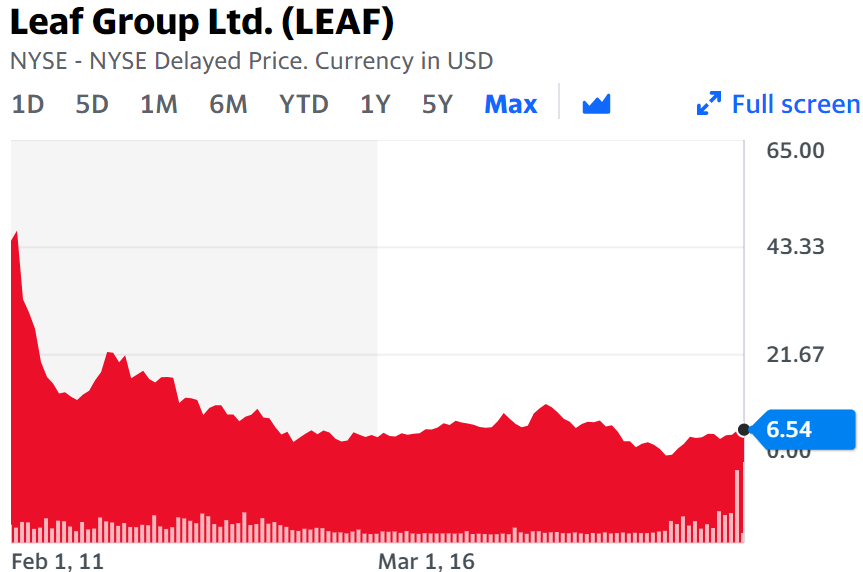
The one lasting counter-example to the above is Barry Diller’s IAC. His innovation ecosystem is surreal. Across time & across markets he is the best creator of vertical leading properties later spun off as their own companies. He’s owned Expedia, TripAdvisor, LendingTree, HomeAdvisor, Match.com, TicketMaster and so many other category leaders. His buying of Ask.com did not pan out as well as hoped as web browsers turned the address bar into a search box, his ability to differentiate the service went away after they shut down the engine in 2008, he was locked out of mobile search marketshare by default placement contracts & Google pushes back against extension bundling, but just about everything else he touched turned to gold. A lot of their current market cap is their ownership of Vimeo, which by itself is valued at $6 billion.
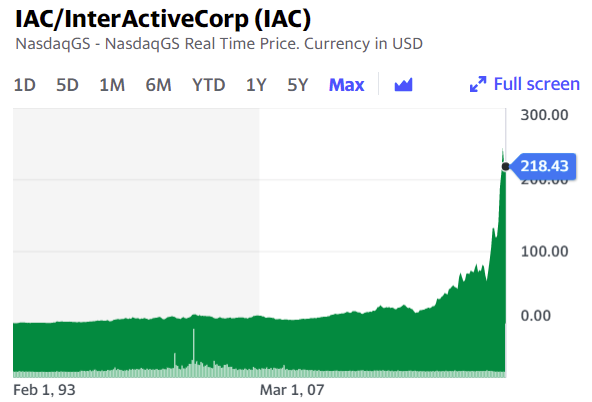
What is the most recent big bet for Barry Diller? MGM. Last August he bet $1 billion on the growth of online gambling. And he was willing to bet another billion to help them acquire Entain:
IAC has to date invested approximately US$1 billion in MGM with an initial investment thesis of accelerating MGM’s penetration of the $450 billion global gaming market. IAC notes in its letter of intent that IAC continues to strongly support this objective for MGM whether or not a transaction with Entain is consummated.
Barry Diller not accurately projects future trends, but he also has the ability to rehab broken companies past their due dates.
The New York Times bought About.com for $410 million in 2005 & did little with it as its relevance declined over time as its content got stale, Wikipedia grew and search engines kept putting more scraped content in the search results. The relentless growth of Wikipedia and Google launching “universal search” in 2007 diminished the value of About.com even as web usage was exploding.
IAC bought About.com from the New York Times for $300 million in August of 2012. They tried to grow it through improving usability, content depth and content quality but ultimately decided to blow it up.
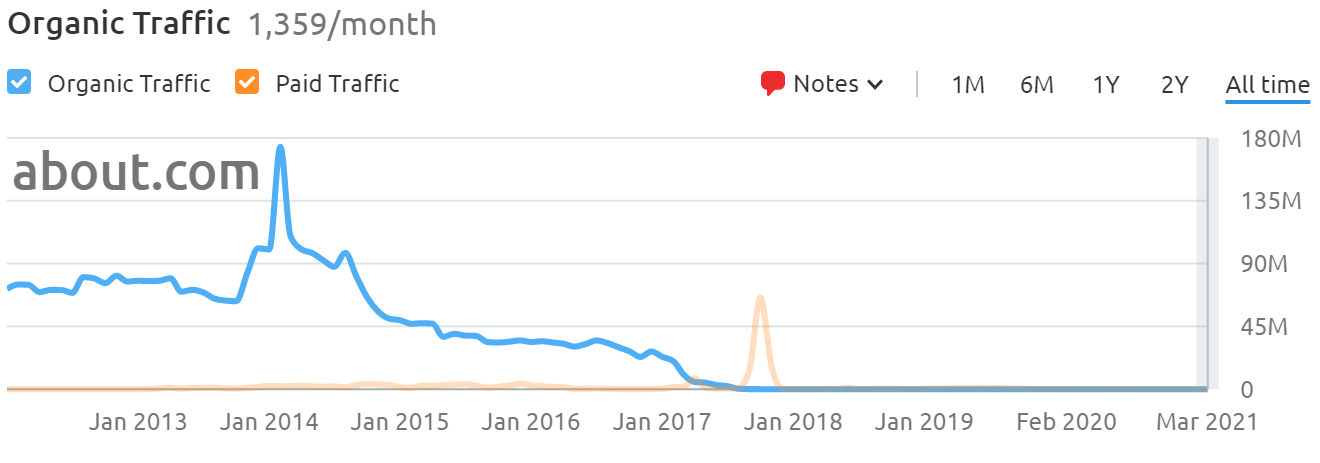
They were bold enough to break it into vertical category branded sites. They’ve done amazingly well with it and in many cases they rank 2, 3, 4 times in the SERPs with different properties like TheSpruce, TheBalance, Investopedia, etc. As newspapers chains keep consolidating or going under, IAC is one of the few constant “always wins” online publishers.
At its peak TheBalance was getting roughly 2/3 the traffic About.com generated.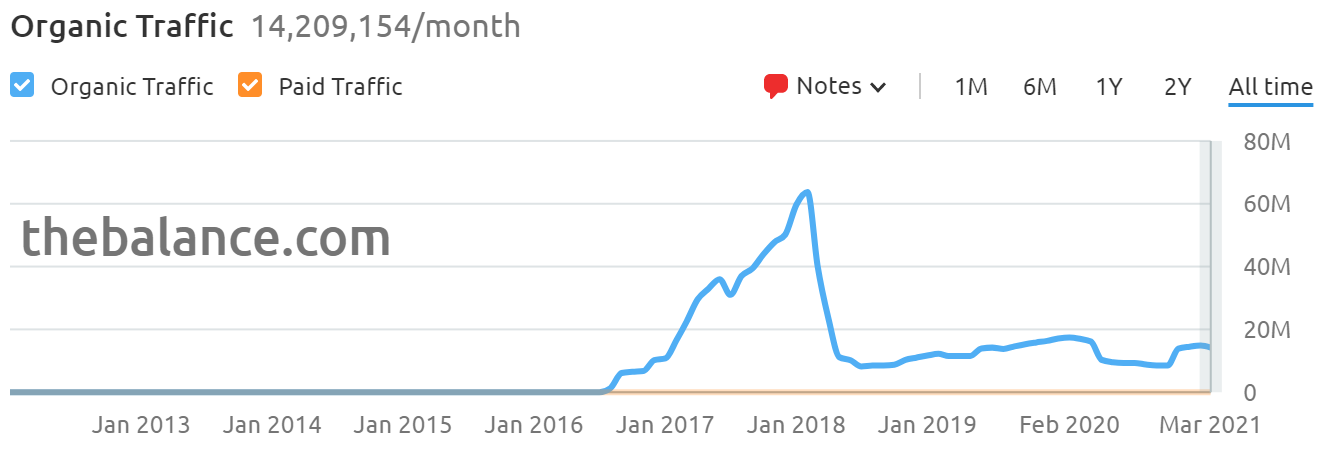
Part of the decline in the chart there was perhaps a Panda hit, but the reason traffic never fully recovered is they broke some of these category sites into niche sites using sub-brands.
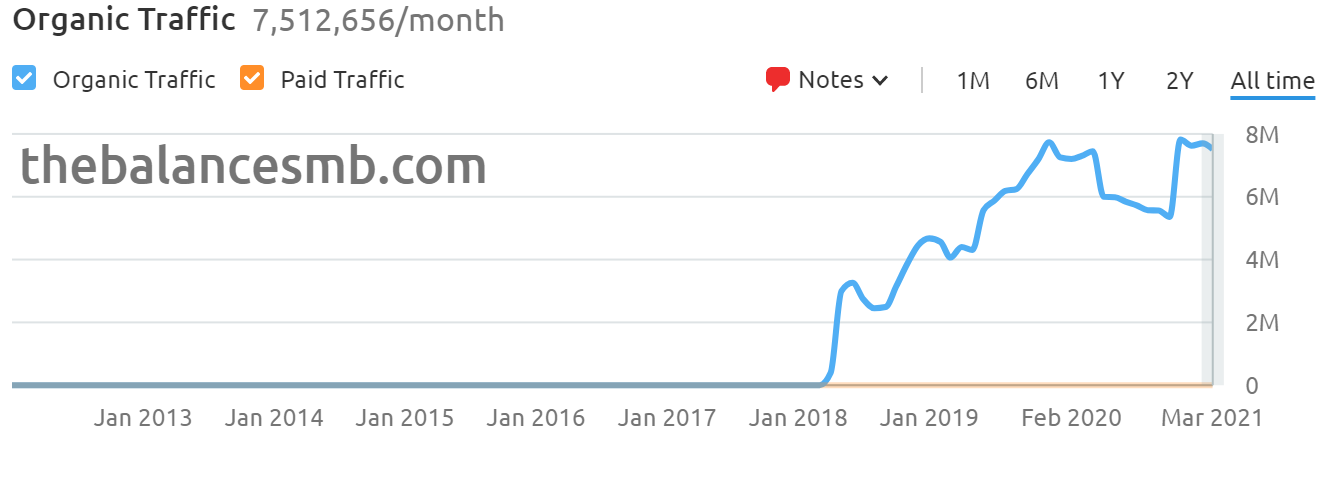
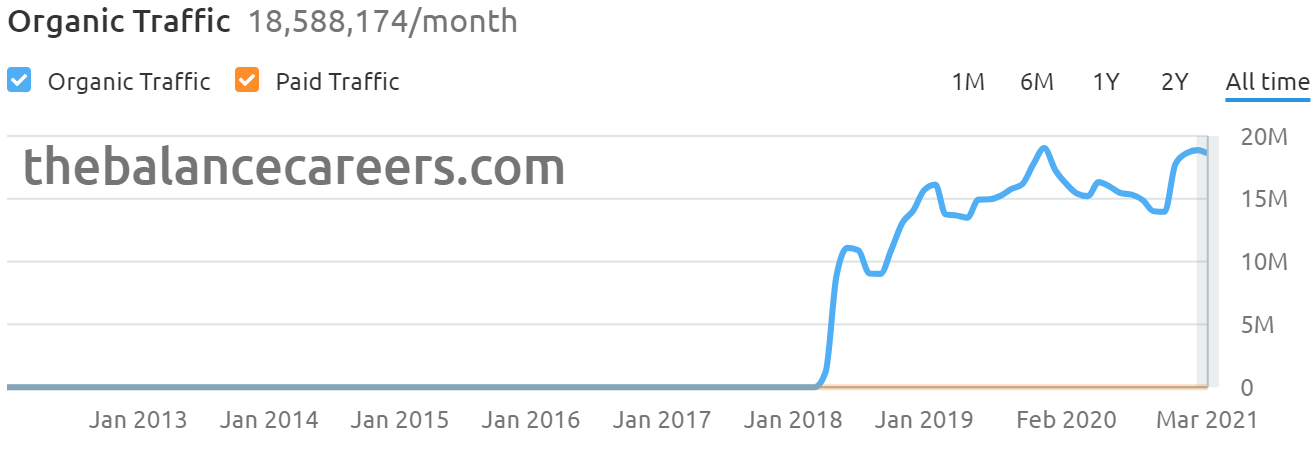
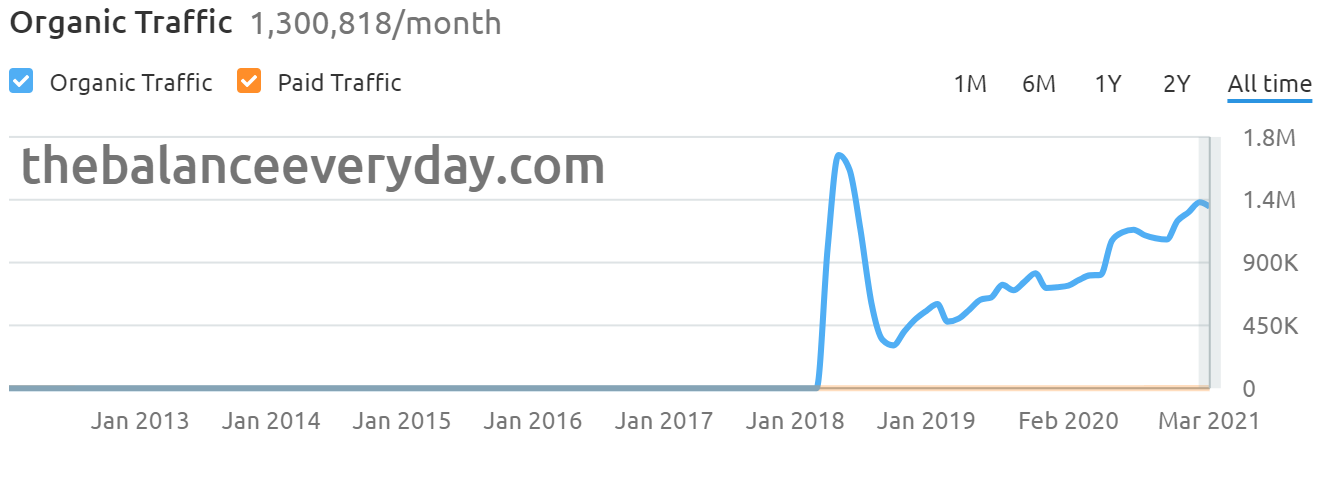
All the above search traffic estimate trend charts are from SEMrush. :)
I could do a blog post titled 1001 ways to use SEMrush if you would like me to, though I haven’t yet as I already have affiliate ads for them here and don’t want to come across as a shill by overpromoting a tool I love & use regularly.
I tend to sort of “not get” a lot of SaaS stocks in terms of prices and multiples, though they seem to go to infinity and beyond more often than not. I actually like SEMrush more than most though & think they’ll do well for years to come. I get the sense with both them and Ahrefs that they were started by programmers who learned marketing rather than started by marketers who cobbled together offerings which they though would sell. If you ever have feedback on ways to improve SEMrush they are fast at integrating it, or at least were in the past whenever I had feedback.
When SEMrush released their S-1 Dan Barker did a quick analysis on Twitter.
Some stats from the S-1: $144 million in annual recurring revenues @ 50% compound annual growth rate, 76% gross margins, nearly 1,000 employees and over 67,000 paying customers.
SEMrush, the SEO tool, has filed to go public. Here’s the S-1: https://t.co/i1meSHts4Y
They spent $54 million on marketing last year, for revenue of $125 million.
(gross profit $95m, net loss $7m) pic.twitter.com/iz5nybcwfA— dan barker (@danbarker) March 1, 2021
At some point a lot of tool suits tend to overlap because much of their data either comes from scraping Google or crawling the open web. If something is strong enough of a point of differentiation to where it is widely talked about or marketed then competitors will try to clone it. Thus spending a bit extra on marketing to ensure you have the brand awareness to be the first tool people try is wise. Years ago when I ran a membership site here I paid to license the ability to syndicate some SEMrush data for our members & I have promoted them as an affiliate for what seems like a decade now.
When Dan Baker did his analysis of the S-1 it made me think SEMrush likely has brighter prospects than many would consider. A few of the reasons I could think of off the top of my head:
- each day their archive of historical data is larger, especially when you consider they crawl many foreign markets which some other competitive research tools ignore
- increasing ad prices promote SEO by making it relatively cheaper
- keyword not provided on organic search means third party competitive analysis tools are valuable not only for measuring competitors but also measuring your own site
- Google Ads has recently started broadening ad targeting further and hiding some keyword data so advertisers are paying for clicks where they are not even aware what the keyword was
That last point speaks to Google’s dominance over the search ecosystem. But it is also so absurd that even people who ran AdWords training workshops point out the absurdity.
Yesterday’s announcement on match type changes had me crawling through query data this morning. I’m staring at many 2-3 word exact match keywords that are matching to 8-word queries. G thinks ‘deck paint’ and ‘how do i put paint on my deck’ mean the exact same thing. CPA is 10x.— Brad Geddes (@bgtheory) February 5, 2021
In Google maximizing their income some nuance is lost for the advertiser who must dig into N-Gram analysis or look at historical data to find patterns to adjust:
The account overall has a CPA in the $450 range. If the word ‘how’ is in the query, our CPA is over double. If someone searches for ‘quote,’ our CPA is under $300. If they ask a question about cost, the CPA is over $1000. Obviously, looking for quotes versus cost data is very different in the eyes of a user, but not in the matching search terms of Google.
Every ad network has incentive to overstate its contribution to awareness and conversions so that more ad budget is allocated to them.
- Facebook kept having to restate their ad stats around video impressions, user reach, etc.
- Facebook gave themselves a 28 day window for credit for some app installs.
- Google AMP accidentally double counted unique users on Google Analytics (drives adoption = good).
- Google Analytics came with last click attribution, which over-credits the search channel you use near the end of a conversion journey.
There are a lot of Google water carriers who suggest any and all of their actions are at worst benevolent, but when I hear about hiding keyword data I am reminded of the following quote from the Texas AG Google lawsuit.
“Google employees agreed that, in the future, they should not directly lie to publishers, but instead find ways to convince publishers to act against their interest and remove header bidding on their own.”
That lawsuit details the great lengths Google went to in order to leverage their search monopoly to keep monopoly profit margins on their display ad serving business.
AMP was created with the explicit intent to kill header bidding as header bidding shifted power and profit margins to publishers. Some publishers saw a 50% rise in ad revenues from header bidding.
Remember how Google made companywide bonuses depend on the performance of the Google Facebook clone named Google+? Google later literally partnered with Facebook on a secret ad deal to prevent Facebook from launching a header bidding solution. The partnership agreement with Facebook explicitly mentioned antitrust repeatedly.
Bid-rigging?! Is this bid-rigging? As in, one of the “supreme evils of antitrust”? As in, the thing that if RE investors do it at foreclosure auctions they go to prison? pic.twitter.com/w7ez6gwfZd— John Newman (@johnmarknewman) December 16, 2020
When a company partners with its biggest direct competitor on a bid rigging scheme you can count on it that the intent is to screw others.
So when you see Google talk about benevolence, remember that they promise to no longer lie in the future & only deceive others into working against themselves via other coercive measures.
We went from the observation that you can’t copyright facts to promoting opinion instead:
The Internet commoditized the distribution of facts. The “news” media responded by pivoting wholesale into opinions and entertainment.— Naval (@naval) May 26, 2016
to where after many thousands of journalists have been laid off now the “newspaper of record” is promoting ponzi scheme garbage as a performance art piece:
The NYT made a NFT!
My new column is about NFTs, and I also turned the column into a NFT and put it up for auction on @withFND, with proceeds going to charity.
Bid away, and you could own the first NFT in the paper’s 170-year history. https://t.co/9ItGZvID8B— Kevin Roose (@kevinroose) March 24, 2021
The decline of About.com was literally going to be terminal without the work of Barry Diller to revive it. That slide reflected how over time a greater share of searches never actually leave Google:
Of those 5.1T searches, 33.59% resulted in clicks on organic search results. 1.59% resulted in clicks on paid search results. The remaining 64.82% completed a search without a direct, follow-up click to another web property. Searches resulting in a click are much higher on desktop devices (50.75% organic CTR, 2.78% paid CTR). Zero-click searches are much higher on mobile devices (77.22%)
The data from the above study came from SimilarWeb, which is another online marketing competitive research tool planning on going public soon.
Google “debunked” Rand’s take by focusing on absolute numbers instead of relative numbers. But if you keep buying default placements in a monopoly ecosystem where everyday more people have access to a computer in their pocket you would expect your marketshare and absolute numbers to increase even if the section of pie other publishers becomes a smaller slice of a bigger pie.
Google’s take there is disingenuous at the core. It reminds me of the time when they put out a study claiming brand bidding was beneficial and that it was too complex and expensive for advertisers to set up a scientific study, without any mention of the fact the reason that would be complex and expensive is because Google chooses not to provide those features in their ad offering. That parallels the way they now decide to hide keyword data even from paying advertisers in much the same way they hide ad fees and lie to publishers to protect their ad income.
Google suggests they don’t make money from news searches, but if they control most of the display ads technology stack & used search to ram AMP down publishers throats as a technological forced sunk cost while screwing third party ad networks and news publishers, Google can both be technically true in their statement and lying in spirit.
“Google employees agreed that, in the future, they should not directly lie to publishers, but instead find ways to convince publishers to act against their interest and remove header bidding on their own.”
There are many more treats in store for publishers.
Google will stop supporting third party cookies in Chrome next year. They are also going to stop selling ads where targeting is based on tracking user data across websites:
“Google plans to stop selling ads based on individuals’ browsing across multiple websites, a change that could hasten upheaval in the digital advertising industry. The Alphabet Inc. company said Wednesday that it plans next year to stop using or investing in tracking technologies that uniquely identify web users as they move from site to site across the internet. … Google had already announced last year that it would remove the most widely used such tracking technology, called third-party cookies, in 2022. But now the company is saying it won’t build alternative tracking technologies, or use those being developed by other entities, to replace third-party cookies for its own ad-buying tools. … Google says its announcement on Wednesday doesn’t cover its ad tools and unique identifiers for mobile apps, just for websites.”
Google stated they would make no replacement for the equivalent of the third party cookie tracking of individual users:
“we continue to get questions about whether Google will join others in the ad tech industry who plan to replace third-party cookies with alternative user-level identifiers. Today, we’re making explicit that once third-party cookies are phased out, we will not build alternate identifiers to track individuals as they browse across the web, nor will we use them in our products. We realize this means other providers may offer a level of user identity for ad tracking across the web that we will not — like PII graphs based on people’s email addresses. We don’t believe these solutions will meet rising consumer expectations for privacy, nor will they stand up to rapidly evolving regulatory restrictions, and therefore aren’t a sustainable long term investment.”
On the above announcement, other ad networks tanked, with TheTradeDesk falling 20% in two days.
These are all Google’s competitors in advertising technology, collapsing after Google announced that it won’t let them do targeted advertising anymore, but that Google itself will continue to do it. https://t.co/S6Axcrw5a0— Matt Stoller (@matthewstoller) March 5, 2021
Competing ad networks wonder if Google will play by their own rules:
“One clarification I’d like to hear from them is whether or not it means there’ll be no login for DBM [a historic name for Google’s DSP], no login for YouTube and no login for Google properties. I’m looking for them to play by the same rules that they so generously foisted upon the rest of the industry,” Magnite CTO Tom Kershaw said.
Regulators are looking into antitrust implications:
“Google’s plan to block a popular web tracking tool called “cookies” is a source of concern for U.S. Justice Department investigators who have been asking advertising industry executives whether the move by the search giant will hobble its smaller rivals, people familiar with the situation said.”
The web will continue to grow more complicated, but it isn’t going to get any more transparent anytime soon.
“Google employees agreed that, in the future, they should not directly lie to publishers, but instead find ways to convince publishers to act against their interest and remove header bidding on their own.”
As the Attention Merchants blur the ecosystem while shifting free clicks over to paid and charging higher ad rates on their owned and operated properties it increases the value of neutral third party measurement services.
The trend is not too hard to notice if you are remotely awake.
While I was writing this post Google announced the launch of a “best things” scraper website featuring their scraped re-representations of hot selling items.
If I could give you one key takeaway here, it would be this:
“Google employees agreed that, in the future, they should not directly lie to publishers, but instead find ways to convince publishers to act against their interest and remove header bidding on their own.”
Categories:
SEMrush IPO (SEMR)
On Wednesday SEMrush priced their IPO at $14 a share & listed Thursday.
There have been many marketing and online advertising companies which are publicly traded, but few that were so focused specifically on SEO while having a sizeable market cap. According to this SeekingAlpha post at the IPO price SEMrush had a valuation of about $1.95 to $1.99 billion. For comparison sake, here are some other companies & valuations.
- Facebook acquired Instagram for $1 billion.
- Google acquired YouTube for $1.65 billion.
- Yelp trades at around a $2.9 billion market cap.
- Yahoo! was acquired by Verizon for $4.48 billion.
- Hubspot has a market cap of around $20.4 billion.
A couple years ago Gannett bought AdWords reseller WordStream. A few years before that they bought ReachLocal. The Hearst publishing empire also bought iCrossing long ago. Marin Software remains publicly traded, but they are only valued at about $20 million.
Newspapers reselling Google AdWords ads isn’t really SEO though. Beyond those sorts of deals, many of the publicly traded SEO stuff has been only tangentially relevant to SEO, or crap.
There are some quality category-leading publishers which use SEO as a means of distribution but are not necessarily an SEO service provider like TripAdvisor, BankRate, and WebMD. Over time many of these sorts of companies have been gobbled up by Red Ventures or various private equity firms. Zillow, Yelp and TripAdvisor are some of the few examples which still exist as independent companies.
So that puts most of the publicly traded SEO stuff in one of the following categories…
- small scale – does anyone other than Andy Beal & Mike Grehan still remember KeywordRanking / WebSourced / Think Interactive / MarketSmart Interactive?
- hope and nope – sites like Business.com were repeatedly acquired but never really gained lasting relevance.
- affiliate networks – which reliant on partners with SEO traffic like Quinstreet & Commission Junction. many affiliate networks were hit hard as the barrier to entry in SEO increased over the years. Quinstreet is doing well in some verticals but sold their education division to Education Dynamics for $20 million. CJ was part of the Publicis Groupe acquisition of Epsilon.
- pump and dump scams – Demand Media, owner of eHow, which later rebranded as Leaf Group & still trades at a small fraction of their IPO price.
[Editorial note: 8 days after writing this post LEAF announced a $304.3 million all cash buyout offer from Graham Holdings at 21% above current market prices and was trading at $8.63 a share. If you bought shares at $40 or $30 or $20 and hoped it would at some point come back – nope – the losses are crystalized on a take out. Graham Holdings formerly owned the Washington Post but sold it to Jeff Bezos 8 years ago for $250 million.]
The one lasting counter-example to the above is Barry Diller’s IAC. His innovation ecosystem is surreal. Across time & across markets he is the best creator of vertical leading properties later spun off as their own companies. He’s owned Expedia, TripAdvisor, LendingTree, HomeAdvisor, Match.com, TicketMaster and so many other category leaders. His buying of Ask.com did not pan out as well as hoped as web browsers turned the address bar into a search box, his ability to differentiate the service went away after they shut down the engine in 2008, he was locked out of mobile search marketshare by default placement contracts & Google pushes back against extension bundling, but just about everything else he touched turned to gold. A lot of their current market cap is their ownership of Vimeo, which by itself is valued at $6 billion.
What is the most recent big bet for Barry Diller? MGM. Last August he bet $1 billion on the growth of online gambling. And he was willing to bet another billion to help them acquire Entain:
IAC has to date invested approximately US$1 billion in MGM with an initial investment thesis of accelerating MGM’s penetration of the $450 billion global gaming market. IAC notes in its letter of intent that IAC continues to strongly support this objective for MGM whether or not a transaction with Entain is consummated.
Barry Diller not only accurately projects future trends, but he also has the ability to rehab broken companies past their due dates.
The New York Times bought About.com for $410 million in 2005 & did little with it as its relevance declined over time as its content got stale, Wikipedia grew and search engines kept putting more scraped content in the search results. The relentless growth of Wikipedia and Google launching “universal search” in 2007 diminished the value of About.com even as web usage was exploding.
IAC bought About.com from the New York Times for $300 million in August of 2012. They tried to grow it through improving usability, content depth and content quality but ultimately decided to blow it up.
They were bold enough to break it into vertical category branded sites. They’ve done amazingly well with it and in many cases they rank 2, 3, 4 times in the SERPs with different properties like TheSpruce, TheBalance, Investopedia, etc. As newspapers chains keep consolidating or going under, IAC is one of the few constant “always wins” online publishers.
At its peak TheBalance was getting roughly 2/3 the traffic About.com generated.
Part of the decline in the chart there was perhaps a Panda hit, but the reason traffic never fully recovered is they broke some of these category sites into niche sites using sub-brands.
All the above search traffic estimate trend charts are from SEMrush. :)
I could do a blog post titled 1001 ways to use SEMrush if you would like me to, though I haven’t yet as I already have affiliate ads for them here and don’t want to come across as a shill by overpromoting a tool I love & use regularly.
I tend to sort of “not get” a lot of SaaS stocks in terms of prices and multiples, though they seem to go to infinity and beyond more often than not. I actually like SEMrush more than most though & think they’ll do well for years to come. I get the sense with both them and Ahrefs that they were started by programmers who learned marketing rather than started by marketers who cobbled together offerings which they though would sell. If you ever have feedback on ways to improve SEMrush they are fast at integrating it, or at least were in the past whenever I had feedback.
When SEMrush released their S-1 Dan Barker did a quick analysis on Twitter.
Some stats from the S-1: $144 million in annual recurring revenues @ 50% compound annual growth rate, 76% gross margins, nearly 1,000 employees and over 67,000 paying customers.
SEMrush, the SEO tool, has filed to go public. Here’s the S-1: https://t.co/i1meSHts4Y
They spent $54 million on marketing last year, for revenue of $125 million.
(gross profit $95m, net loss $7m) pic.twitter.com/iz5nybcwfA— dan barker (@danbarker) March 1, 2021
At some point a lot of tool suits tend to overlap because much of their data either comes from scraping Google or crawling the open web. If something is strong enough of a point of differentiation to where it is widely talked about or marketed then competitors will try to clone it. Thus spending a bit extra on marketing to ensure you have the brand awareness to be the first tool people try is wise. Years ago when I ran a membership site here I paid to license the ability to syndicate some SEMrush data for our members & I have promoted them as an affiliate for what seems like a decade now.
When Dan Barker did his analysis of the S-1 it made me think SEMrush likely has brighter prospects than many would consider. A few of the reasons I could think of off the top of my head:
- each day their archive of historical data is larger, especially when you consider they crawl many foreign markets which some other competitive research tools ignore
- increasing ad prices promote SEO by making it relatively cheaper
- keyword not provided on organic search means third party competitive analysis tools are valuable not only for measuring competitors but also measuring your own site
- Google Ads has recently started broadening ad targeting further and hiding some keyword data so advertisers are paying for clicks where they are not even aware what the keyword was
That last point speaks to Google’s dominance over the search ecosystem. But it is also so absurd that even people who ran AdWords training workshops point out the absurdity.
Yesterday’s announcement on match type changes had me crawling through query data this morning. I’m staring at many 2-3 word exact match keywords that are matching to 8-word queries. G thinks ‘deck paint’ and ‘how do i put paint on my deck’ mean the exact same thing. CPA is 10x.— Brad Geddes (@bgtheory) February 5, 2021
In Google maximizing their income some nuance is lost for the advertiser who must dig into N-Gram analysis or look at historical data to find patterns to adjust:
The account overall has a CPA in the $450 range. If the word ‘how’ is in the query, our CPA is over double. If someone searches for ‘quote,’ our CPA is under $300. If they ask a question about cost, the CPA is over $1000. Obviously, looking for quotes versus cost data is very different in the eyes of a user, but not in the matching search terms of Google.
Every ad network has incentive to overstate its contribution to awareness and conversions so that more ad budget is allocated to them.
- Facebook kept having to restate their ad stats around video impressions, user reach, etc.
- Facebook gave themselves a 28 day window for credit for some app installs.
- Google AMP accidentally double counted unique users on Google Analytics (drives adoption = good).
- Google Analytics came with last click attribution, which over-credits the search channel you use near the end of a conversion journey.
There are a lot of Google water carriers who suggest any and all of their actions are at worst benevolent, but when I hear about hiding keyword data I am reminded of the following quote from the Texas AG Google lawsuit.
“Google employees agreed that, in the future, they should not directly lie to publishers, but instead find ways to convince publishers to act against their interest and remove header bidding on their own.”
That lawsuit details the great lengths Google went to in order to leverage their search monopoly to keep monopoly profit margins on their display ad serving business.
AMP was created with the explicit intent to kill header bidding as header bidding shifted power and profit margins to publishers. Some publishers saw a 50% rise in ad revenues from header bidding.
Remember how Google made companywide bonuses depend on the performance of the Google Facebook clone named Google+? Google later literally partnered with Facebook on a secret ad deal to prevent Facebook from launching a header bidding solution. The partnership agreement with Facebook explicitly mentioned antitrust repeatedly.
Bid-rigging?! Is this bid-rigging? As in, one of the “supreme evils of antitrust”? As in, the thing that if RE investors do it at foreclosure auctions they go to prison? pic.twitter.com/w7ez6gwfZd— John Newman (@johnmarknewman) December 16, 2020
When a company partners with its biggest direct competitor on a bid rigging scheme you can count on it that the intent is to screw others.
So when you see Google talk about benevolence, remember that they promise to no longer lie in the future & only deceive others into working against themselves via other coercive measures.
We went from the observation that you can’t copyright facts to promoting opinion instead:
The Internet commoditized the distribution of facts. The “news” media responded by pivoting wholesale into opinions and entertainment.— Naval (@naval) May 26, 2016
to where after many thousands of journalists have been laid off now the “newspaper of record” is promoting ponzi scheme garbage as a performance art piece:
The NYT made a NFT!
My new column is about NFTs, and I also turned the column into a NFT and put it up for auction on @withFND, with proceeds going to charity.
Bid away, and you could own the first NFT in the paper’s 170-year history. https://t.co/9ItGZvID8B— Kevin Roose (@kevinroose) March 24, 2021
Is it any wonder people have lost trust in institutions?
A one-hour @CBCNews special that examines the media’s role in the polarization of America and the unmaking of a citizen — Big News is now streaming. pic.twitter.com/tm5QB2P4Ro— CBC Gem (@cbcgem) March 26, 2021
The decline of About.com was literally going to be terminal without the work of Barry Diller to revive it. That slide reflected how over time a greater share of searches never actually leave Google:
Of those 5.1T searches, 33.59% resulted in clicks on organic search results. 1.59% resulted in clicks on paid search results. The remaining 64.82% completed a search without a direct, follow-up click to another web property. Searches resulting in a click are much higher on desktop devices (50.75% organic CTR, 2.78% paid CTR). Zero-click searches are much higher on mobile devices (77.22%)
The data from the above study came from SimilarWeb, which is another online marketing competitive research tool planning on going public soon.
Google “debunked” Rand’s take by focusing on absolute numbers instead of relative numbers. But if you keep buying default placements in a monopoly ecosystem where everyday more people have access to a computer in their pocket you would expect your marketshare and absolute numbers to increase even if the section of pie other publishers becomes a smaller slice of a bigger pie.
Google’s take there is disingenuous at the core. It reminds me of the time when they put out a study claiming brand bidding was beneficial and that it was too complex and expensive for advertisers to set up a scientific study, without any mention of the fact the reason that would be complex and expensive is because Google chooses not to provide those features in their ad offering. That parallels the way they now decide to hide keyword data even from paying advertisers in much the same way they hide ad fees and lie to publishers to protect their ad income.
Google suggests they don’t make money from news searches, but if they control most of the display ads technology stack & used search to ram AMP down publishers throats as a technological forced sunk cost while screwing third party ad networks and news publishers, Google can both be technically true in their statement and lying in spirit.
“Google employees agreed that, in the future, they should not directly lie to publishers, but instead find ways to convince publishers to act against their interest and remove header bidding on their own.”
There are many more treats in store for publishers.
Google Chrome stopped sending full referrals for most web site visitors late last year. Google will stop supporting third party cookies in Chrome next year. They’ve even floated the idea of hiding user IP addresses from websites (good luck to those who need to prevent fraud!).
Google claims they also going to stop selling ads where targeting is based on tracking user data across websites:
“Google plans to stop selling ads based on individuals’ browsing across multiple websites, a change that could hasten upheaval in the digital advertising industry. The Alphabet Inc. company said Wednesday that it plans next year to stop using or investing in tracking technologies that uniquely identify web users as they move from site to site across the internet. … Google had already announced last year that it would remove the most widely used such tracking technology, called third-party cookies, in 2022. But now the company is saying it won’t build alternative tracking technologies, or use those being developed by other entities, to replace third-party cookies for its own ad-buying tools. … Google says its announcement on Wednesday doesn’t cover its ad tools and unique identifiers for mobile apps, just for websites.”
Google stated they would make no replacement for the equivalent of the third party cookie tracking of individual users:
“we continue to get questions about whether Google will join others in the ad tech industry who plan to replace third-party cookies with alternative user-level identifiers. Today, we’re making explicit that once third-party cookies are phased out, we will not build alternate identifiers to track individuals as they browse across the web, nor will we use them in our products. We realize this means other providers may offer a level of user identity for ad tracking across the web that we will not — like PII graphs based on people’s email addresses. We don’t believe these solutions will meet rising consumer expectations for privacy, nor will they stand up to rapidly evolving regulatory restrictions, and therefore aren’t a sustainable long term investment.”
On the above announcement, other ad networks tanked, with TheTradeDesk falling 20% in two days.
These are all Google’s competitors in advertising technology, collapsing after Google announced that it won’t let them do targeted advertising anymore, but that Google itself will continue to do it. https://t.co/S6Axcrw5a0— Matt Stoller (@matthewstoller) March 5, 2021
Competing ad networks wonder if Google will play by their own rules:
“One clarification I’d like to hear from them is whether or not it means there’ll be no login for DBM [a historic name for Google’s DSP], no login for YouTube and no login for Google properties. I’m looking for them to play by the same rules that they so generously foisted upon the rest of the industry,” Magnite CTO Tom Kershaw said.
Regulators are looking into antitrust implications:
“Google’s plan to block a popular web tracking tool called “cookies” is a source of concern for U.S. Justice Department investigators who have been asking advertising industry executives whether the move by the search giant will hobble its smaller rivals, people familiar with the situation said.”
The web will continue to grow more complicated, but it isn’t going to get any more transparent anytime soon.
“Google employees agreed that, in the future, they should not directly lie to publishers, but instead find ways to convince publishers to act against their interest and remove header bidding on their own.”
As the Attention Merchants blur the ecosystem while shifting free clicks over to paid and charging higher ad rates on their owned and operated properties it increases the value of neutral third party measurement services.
The trend is not too hard to notice if you are remotely awake.
While I was writing this post Google announced the launch of a “best things” scraper website featuring their scraped re-representations of hot selling items. And they are cross-promoting competitors in “knowledge” panels to dilute brand values & force the brand ad buy.
Oh man. Check out this bullshit on our GMB Knowledge Panel. Are they going to list competitors on everyone’s listings now? pic.twitter.com/ITwiZGyRxs— Darren Shaw (@DarrenShaw_) March 26, 2021
Shortly after Google launched their thin affiliate scraper site full of product ads they announced an update to demote other product review sites.
Where Google can get away with it, they will rig things in their favor to rip off other players in the ecosystem:
Google for years operated a secret program that used data from past bids in the company’s digital advertising exchange to allegedly give its own ad-buying system an advantage over competitors, according to court documents filed in a Texas antitrust lawsuit. The program, known as “Project Bernanke,” wasn’t disclosed to publishers who sold ads through Google’s ad-buying systems.
If I could give you one key takeaway here, it would be this:
“Google employees agreed that, in the future, they should not directly lie to publishers, but instead find ways to convince publishers to act against their interest and remove header bidding on their own.”
Categories:
The Wrong People Won
My initial attraction toward SEO and the web was largely that it was like a new and parallel world that bypassed many traditional gatekeepers.
I wrote an ebook which originally had inconsistent formatting and it was riddled with spelling and grammar errors. I learned to write by writing poorly and often while reading great writers daily.
Ultimately it did not matter that my efforts were subpar on some fronts as few people read early copies, and I was receptive to feedback on how to improve it and rapidly did.
The above process … growing while few people see your ugly work … is actually one of the advantages of *NOT* taking venture capital. You get to learn at your own pace while risks are low and only really lean into something when you know it is working. You keep making small bets that won’t kill you and then when something works better than you expect you can *REALLY* lean into it.
I ultimately did that with SEO, blogging, and a couple other areas I can’t mention too much as I had partners on some projects.
This blog never even started as its own site. It was a section on a different site that was spun out to become its own site when it was obvious blogs were being algorithmically over-promoted due to the cross linking from other bloggers and the instant exposure RSS feeds offered.
Instead of begging a book publisher to publish a book I had a higher margin product and the book publishers were begging me. The market was inverted and an outcast won by bypassing traditional gatekeepers.
When SEO was easy it was the same sort of deal. As long as you tried to learn about what the algorithms valued & put effort behind it you could rank for almost anything.
Early on that meant begging, buying, or borrowing links any way you could. If a project was throwing off big money you’d try public relations and to get high quality links to help reinforce the position and increase its longevity. But even junky links worked fantastic back in the day. That’s part of why there was so much blog comment spam, referrer spam, expired domains, cheeseball web directories which actually had pagerank in the URL, article directories, private blog networks, all sorts of other paid links like Text-Link-Ads.com, etc. etc. etc.
New channels provide new opportunities. Small players prove the model, drive adoption, and then over time the affiliate or independent publisher is replaced by some big publisher or a scrape-n-displace offering from the central market operators.
If you take a broad enough view of the world the above sort of water cycle repeatedly happens across all media formats and channels.
- New channels emerge
- Smaller players and hobbyists are attracted to the new and shiny object
- Limited competition & regulation
- Channel grows wildly
- Channel locked down by regulation or a monopoly
When the channels are new they have the greatest chance of failure, but the biggest potential rewards for early adopters.
As channels are established and competition increases almost all the profit margins get handed over to the central market operator. Everything gets adjust on an “as needed” basis. Anything that hands too much of the profits over to a third party publisher gets cloned by the central network operator, becomes against the terms of service, or is algorithmically or manually neutralized by the central market operators.
- affiliates used to be able to sit at the end of the conversion funnel and extract profits from the most valuable keywords, but new algorithmic signals make it hard to stay competitive with limited value add, differentiation, or brand building
- commercial keywords are all ads in the search results above the fold & many brands feel the need to bid on their pre-existing brand equity for defensive purposes
- Google hid keyword data from organic search & later started to hide some from paid search campaigns as well.
- the Chrome browser by default only allows extensions to be downloaded from their official store & while Google got a lot of Chrome distribution through negative option bundling on Flash security updates, they prohibit app bundling in their app store
- Apple’s iOS and Google Android allow the central network operators to track third party app usage. The Apple Appstore and Google Play have mandatory 30% rakes and may disallow certain widely used apps after those features have been baked into the operating system or cloned and default bundled on new phones.
- YouTube takes a 45% revenue share rake & the ad inventory is sold exclusively through Google tools where Google takes up to another 20% rake off the top
- Amazon uses your sales data and product design to create what amounts to an effective clone job of it (going so far as to say there are fake safety issues to demand to see where it was manufactured) and then you are forced to bid on your own brand as Amazon gives itself free ads on your brand for their product clone job
- Google and Facebook try to suck content into their networks via Instant Articles and AMP. Google gives AMP priority placement in their search results (just like they did previously with Google+, Google Checkout, Google Base / Google Shopping / YouTube / etc etc etc).
- Rather than competing, Google and Facebook partnered to illegally bid rig auctions to destroy header bidding & preserve monopoly profit margins, keeping control over external publishers. Google also pushes “privacy” obfuscation which harms third party publishers and third party ad networks while bypassing those firewalls for its own ad network. They are also looking to use their web browser to do away with cookies, further kneecapping other ad networks.
- Early Pinterest Ads sent users offsite and often cost only a couple cents a visit while all the internal cross promotion & viral spread across Pinterest was effectively free. Then over time advertisers start getting charged for pins even being opened and getting a user to actually leave Pinterest and click through can cost $5 or $10 a click. Long after I saw Reddit threads about how I was a washed up hack who could not compete in the modern market I literally used Pinterest to seed the growth of a site which now gets about a million organic search visits a month. I recently tried further promoting that site on Pinterest in some new areas, but the economics no longer works for that particular site on that channel.
If you play by the rules suggested by private market participants you are betting that they won’t dramatically change their ecosystem at the drop of a hat and they won’t compete against you.
And that bet is a REALLY bad bet.
Networks do not stay on top & in control by stagnating. They change with society & if they are influential enough they also change the structure of society.
The Texas AG lawsuit of Google for manipulating the online display ad market lays bare how power works:
Google employees agreed that, in the future, they should not directly lie to publishers, but instead find ways to convince publishers to act against their interest and remove header bidding on their own.
I could easily write a 100 page blog post on that lawsuit while feeling guilty for leaving many things out.
For example, did you know Google stole AdSense earnings from publishers in the AdTrader ad network and lied about refunding that money to advertisers as AdTrader also managed some of the advertiser accounts which got a $0.00 rebate:
We confirmed through multiple sources, both within and outside of Google, through our Google invoices, and data collected from Google APIs that Google never actually refunded any of the confiscated publisher earnings to the advertisers. In fact, Google’s own support team admitted that they never had a system in place for such refunds.
Google is the network I have studied most and know the most about, though others certainly know Facebook equally well. All the large networks growth the predacious exploits.
Even with limited Facebook usage I know they have at various points in time promoted: games, hype headline fake news, lists and viral quiz junk from Buzzfeed, real actual news sites, the Instant Articles version of real actual news, live video, friend content, etc. Facebook also bought Onavo, a VPN network to track the growth of competing apps. That data was used to inform their WhatsApp purchase. And they could see which features from what external networks they should clone, like when Instagram copied much of SnapChat’s offering.
You can follow the Facebook terms of service in everything you do, but the odds of that delivering you real and sustainable profit streams is low.
“You can be unethical and still be legal that’s the way I live my life” – Mark Zuckerberg
Few publishers will be experts at both optimizing for the flaw or overpromotion in the current algorithm or network set up AND being good at reinventing themselves to appeal to the algorithms of tomorrow. You ultimately want to use some of any excess profits to build a destination people seek out so you are less dependent on the central network operators.
At the same time, if you ignore the algorithms and just hope for the best you are probably going to lose to a competitor who clones most of your strategy AND manipulates the result set.
You sort of have to figure out what is being over-promoted today AND then try to figure out what will matter tomorrow, while reinvesting profits to the point you are no longer really faking it until you make it.
Realizing that all success is temporary is vital to encourage yourself to take advantage of the opportunities in front of you, while also ensuring you have a plan B in place that acts as a bridge to tomorrow in case your primary channel bombs.
Almost all profit margins (particularly for newer players lacking access to connections, massive cashflows, strong legacy brands, etc.) come from operating somewhere in the gray area. Behave in a manner that is legal, but push the boundaries of terms from other players.
Google funded eHow. Demand Media was ultimately a pump and dump operation. Those who followed it late got their asses handed to them, but those who got in early had plenty of profits they could reinvest in other lower risk ventures. At one point Mahalo publicly listed their page-level earnings data. One of my buddies went through and put that keyword list through TextBroker and uploaded a few hundred articles to an old blog. After about a year that led to a free house for one of their family members. :D
Now Google has far more data to use so it is hard to be anywhere near as exploitative or lowbrow as an eHow or a Mahalo was and expect that stuff to back out.
When Matt Cutts was on TWIG in 2013 he stated:
If you want to stop spam, the most straight forward way to do it is to deny people money because they care about the money and that should be their end goal. But if you really want to stop spam, it is a little bit mean, but what you want to do, is break their spirits. There are parts of Google algorithms specifically designed to frustrate spammers. Some of the things we do is give people a hint their site will drop and then a week or two later, their site actually does drop. So they get a little bit more frustrated. So hopefully, and we’ve seen this happen, people step away from the dark side and say, you know what, that was so much pain and anguish and frustration, let’s just stay on the high road from now on.
…
Some of the stuff I like best is when people say “you know what, this SEO stuff is too unpredictable, I am just going to write some apps.”
This past year is the year when “writing some apps” was revealed to have the same core problems that SEO has. Central market operators grabbing their tithings (fight between Apple and entities like Spotify and Epic Games, Google Play pushing through similar 30% rake requirements) and then outright banning apps like Parler from their app stores.
The COVID-19 pandemic moved everyone and everything online.
The ad money follows the attention stream. If the central network operators pay creators nothing then those creators who have a following will find other ways to monetize. Cygnus was early to SEO and he was early to influencer marketing.
Selling a sliver of attention and then using that funds flow to improve website usability, website design, content quality, brand awareness, reach, etc. … is usually going to work out better for most people than trying to raise venture capital. Many small bets and incremental improvements yields much higher odds of success than a few really big bets.
Speaking of bets, I follow the stock market a bit because it teaches a lot about human psychology, markets and marketing.
Well before the COVID-19 crisis happened the repo market froze. In fact, the Federal Reserve was discussing alternative ways to fund the market’s liquidity without looking like they were directly subsidizing and bailing out hedge funds:
the new approach could also create political problems for policy makers, analysts said. The problem centers on the central bank lending directly to hedge funds, the little-regulated investment vehicles that tend to serve wealthy or institutional investors. … Though hedge funds are key participants in the market—where they both borrow and lend cash—lending to them directly through the FICC would raise questions about whether the government was backstopping their bets, analysts said.
When the COVID-19 crisis happened optics no longer mattered. Bailouts ensued. Without them levered hedge funds were screwed as many instruments became illiquid and spreads blew out even in bedrock stable markets:
Of particular concern: The hedge funds were using trading strategies similar to those employed by Long-Term Capital Management, a fund that collapsed in 1998 and nearly caused a financial meltdown. The bet that hedge funds were making earlier this year was simple enough. Called a basis trade, it involved exploiting a price difference in the Treasury market, generally by selling Treasury futures contracts — promises to deliver a bond or note at a set price on a set date — and buying the comparatively cheap underlying securities.
Toward the end of last year and early this year Bitcoin was a rocket ship on the thesis of mass money printing leading to currency debasement and revaluing finite alternatives to fiat cash upward.
And then regulators began dropping hints while banks started to put the breaks on it. And XRP got kicked hard by the SEC, leading to delisting.
Tether may be an absolute scam (it’s hard to short Patio11’s knowledge), but in spite of that there are a lot of retail traders bored at home chasing anything that moves. There are ETFs like GBTC sucking up a huge share of the Bitcoin float with no intent of ever liquidating any of the position.
If sports and society shut down and people are stuck in their homes gambling is an unsurprising source of entertainment. Barstool Sports founder David Portnoy got this and quickly became a day trader when he didn’t have any sports to talk about. :D
Above I mentioned a bit how the Federal Reserve was ultimately bailing out hedge funds. In an easy money market where central banks are printing tons of money what a lot of hedge funds do is buy higher beta growth names while shorting lower beta value stocks, particularly if they feel those companies are destined to go under.
In some cases the short bets believe ideas from a category apply to a specific company in a way they do not. And that can lead to a massive short squeeze, especially if the company announces a buyback and/or insiders buy.
In other cases, the shorts are so confident in their position, they go HOG WILD with low interest leverage and literally short the entire float of a company, trying to drive it into bankruptcy.
Recently Melvin Capital and some other well-connected hedge funds went short GameStop’s stock and a Subreddit named WallStreetBets took the other side of that position.
GME has a 52-week low of $2.57. After being pumped by the Subreddit the stock closed today at $347.51, leading to billions in losses for hedge funds which shorted over 100% of the stock.
According to @S3Partners, short sellers lost $14.3 billion on $GME stock today… just today.— Riley de León (@RileyCNBC) January 27, 2021
The hedge funds that shorted over 100% of a stock … were market manipulators aiming to manipulate a market.
When they win, that is capitalism.
When they lose, they get bailed out, contact regulators and have pressure applied to prevent THE WRONG PEOPLE from winning.
There are over 2.6 million Wall Street Bet users and only 10,000 hedge funds. The power of the proletariat is now!— Reddit Investors (@redditinvestors) January 27, 2021
The SEC published a statement on market volatility, the Biden administration mentioned it was watching GameStop, Nasdaq’s CEO suggested halting trading to allow hedge funds to steamroll Reddit users, the Discord group for WallStreetBets was shut down, and Reddit (at least temporarily) banned the WallStreetBets subreddit for hate speech.
That WallStreetBets was temporarily nuked will likely make the degenerate gamblers even more aggressive.
Emergency Press Conference – The Suits Shut Down @wallstreetbets @WSBChairman My prediction is tomorrow will be intergalactic for $amc $gme $nok
(Im not a financial adviser. Don’t listen to me) pic.twitter.com/oYrsPOz8Vx— Dave Portnoy (@stoolpresidente) January 28, 2021
You can see a lot of moves coming if you understand internet culture.
does one throw one, two, three, four, or five hundy at $TR on open? :)— uoɹɐɐ (@aaronwall) January 26, 2021
But in many ways we are now where the outcomes will be pre-determined in order to ensure THE RIGHT PEOPLE win.
Politicians will determine outcomes after the fact.
The more THE WRONG PEOPLE win, the more intervention there will be to correct the natural order.
Risk is much higher than most perceive because outcomes matter more than process & some multi-generational politically-connected wealth is losing badly to THE WRONG PEOPLE.
Gamestop:
Perhaps they got lucky.
Maybe just a flash in pan.
So dismiss them if u want.
But if read their messages u see its not just about money.
They’re discovering their voice.
& that they’re powerful.
IMO this is partly why wont be so easy for Fed to bailout Eurodollar Mkt…— Santiago Capital (@SantiagoAuFund) January 28, 2021
We are now at the point that the internet is no longer a spot for weirdo outcasts & instead it is reshaping the rest of society.
Part of a person as awful as Trump getting elected as president was micro-targeted South Park inspired videos sent to minorities reminding them of Hillary Clinton’s super predators speech.
And who could forget her laughing about having the head of Libya murdered, a former nation which fell apart to such an extreme degree they had open air slave auctions.
Another part of Trump getting elected was Obama promising “Hope and Change” but then standing between banks and pitchforks for the intentional and malicious fraud that led to the 2008 economic blowup.
As it turns out, a Citigroup insider had the Obama cabinet picked out before he was even elected.
Citigroup was the biggest TARP recipient.
Citicorp is the same company which illegally merged with Travelers, had that merger made legal after the fact by getting the Great Depression era Glass-Steagall Act regulation repealed:
”I think we will look back in 10 years’ time and say we should not have done this but we did because we forgot the lessons of the past, and that that which is true in the 1930’s is true in 2010,” said Senator Byron L. Dorgan, Democrat of North Dakota. ”I wasn’t around during the 1930’s or the debate over Glass-Steagall. But I was here in the early 1980’s when it was decided to allow the expansion of savings and loans. We have now decided in the name of modernization to forget the lessons of the past, of safety and of soundness.”
After the internet stock bubble popped the Federal Reserve lowered rates dramatically and left them there far too long, creating a massive hunt for yield. This led to a housing bubble and deteriorating loan standards with fog-a-mirror NINJA loans and similar dominating the market due to the insatiable demand for “risk free” yield. Entities like Citigroup created a ton of bogus mortgage paper they knew was garbage. Their entire board of advisors was repeatedly emailed by Richard M. Bowden about the fraud:
I started issuing warnings in June of 2006 and attempted to get management to address these critical risk issues. These warnings continued through 2007 and went to all levels of the Consumer Lending Group. We continued to purchase and sell to investors even larger volumes of mortgages through 2007. And defective mortgages increased during 2007 to over 80% of production.
If you control the government economic outcomes are determined by politics.
Citigroup was so confident in their control of the political outcomes they continued to dump bad loans on the FHA after Fannie Mae and Freddie Mac were forced into receivership.
THE RIGHT PEOPLE WON.
Any government which intentionally subsidizes and promotes massive fraud ultimately undermines their own legitimacy.
Obama was so rotten he made Trump look like a reasonable choice.
Who were the people hurt worst by Citigroup’s fraud?
So it should come as no surprise the Citigroup recently published “research” on how racism is holding back the U.S. economy.
If Obama the president matched Obama the candidate the Citigroup board would have been imprisoned, that bank would have been dismantled, and the above “research” would not have been published.
“I was in my early teens during the ’08 crisis. I vividly remember the enormous repercussions that the reckless actions by those on Wall Street had in my personal life, and the lives of those close to me. I was fortunate – my parents were prudent and a little paranoid, and they had some food storage saved up. When that crisis hit our family, we were able to keep our little house, but we lived off of pancake mix, and powdered milk, and beans and rice for a year. Ever since then, my parents have kept a food storage, and they keep it updated and fresh. Those close to me, my friends and extended family, were not nearly as fortunate.” – ssauronn
The reasons I liked Trump were:
- he was hated by the media, so they’d cover wrongdoings (even making some up)
- until the COVID-19 crisis hit, he was broadening the economy
- his administration pushed through an antitrust lawsuit against Google for their monopolistic bundling practices
The above being said, the January 6th siege was absolutely idiotic, and looked like it was something out of South Park.
Google’s Eric Schmidt played a vital role in the Obama elections & administration. Their relationship was so close it was called “The Android Administration.”
When the FTC investigated Google the Obama administration intervened to prevent justice. And now Schmidt’s shadowy “use AI everywhere in weaponry” startup is deeply embedded in the Biden administration.
We are back to an administration loved by the media. The controversy are hence reduced to casual magazine cover shoots.
Mainstream media: please serve your vital roll in society. Cover that casual photoshoot and not the Darth Vader aspects of Eric Schmidt.
Biden pushed against the “racist” attribution of the COVID-19 crisis to its source in China, though few have considered how “free trade” with a country with over a million slaves would impact living standards as it deindustrializes the country and destroys the middle class.
If a country has a live organ harvesting program for its own citizens, do we want to have close ties to it?
If a state-controlled economy dumps fentanyl into your country they deserve nothing but ire and disrespect, at least until that problem goes away.
While we are seeking out a just global society, does LeBron James say “technically the Chinese Uighur slaves who make my shoes are not black, so it is all good? #BLM”
Free capital flows plus structural trade deficits from “free trade” with slave states = declining domestic living standards.
If you have an average to below average IQ, did not come from wealth, have high living costs, and you must compete against literal slaves your life is probably going to suck.
Declining living standards can be masked temporarily through manipulating economic data, but fake data can’t restore hopes and dreams and aspiration for something better.
When I was inside the Fed, it was acknowledged internally that the core PCE was a broken metric that understated & misrepresented true inflation. The decision was made to continue using the broken gauge because Fed models would not work if true inflation was used.
QE is a lie. https://t.co/E3LlQhTPyv— Danielle DiMartino Booth (@DiMartinoBooth) January 4, 2021
That loss of hope will fuel deaths of despair, desperation, and a desire to believe in just about anything.
The race baiting “equality of outcomes” promoters only throw further fuel on the fire by telling people they are victims and pointing their ire in the wrong direction.
Burning down the local nail salon in a riot is not going to change the Federal Reserve bailing out hedge funds who are manipulating the stock market.
Instead of acting like an enraged victim, read Kurt Vonnegut’s Harrison Bergeron and then consider what skills you can lean into to make a positive change in the world.
The process and outcome of that “free trade” & papering it over with increasing debt leverage was well known in advance.
Look no further than this 1994 Charlie Rose video interview of Sir James Goldsmith.
Ultra-wealthy plutocrats were willing to partner with the CCP and sacrifice the US middle class in order to gain more wealth and political power.
THE RIGHT PEOPLE won.
For some people the web was a life raft, but a lot of the easy wins have already been had.
And the central network operators are getting more aggressive with scratch-your-back censorship for those in political power.
As more and more services happen online, more and more of business profit margins are flowing online, and the online networks are having a massive impact on the portions of the economy which remain offline.
The central network operators can choose to ban an outgoing president while ignoring politicians who call for genocide in other markets to curry favor to political leaders. As Zuck would say …
“You can be unethical and still be legal that’s the way I live my life”
Tim Berners-Lee will likely end up saving the web he created by promoting decentralization.
If that doesn’t work, we are stuck with Zuck and Eric Schmidt restructuring society as they see fit.
Categories:
Apple Search
Google, Google, Google
For well over a decade Google has dominated search to where most stories in the search sphere were about Google or something on the periphery.
In 2019 Google generated $134.81 billion in ad revenues.
When Verizon bought core Yahoo three years ago the final purchase price was $4.48 billion. That amount was to own their finance vertical, news vertical, web portal, homepage, email & web search. It also included a variety of other services like Tumblr.
Part of what keeps Google so dominant in search is their brand awareness. That is also augmented by distribution as defaults in Chrome and Android. Then when it comes to buying search distribution from other players like Mozilla Firefox, Opera or Apple’s Safari they can outbid everyone else as they are much better at monetizing tier 2 markets and emerging markets than other search companies are since they have such strong ad depth. Even if Bing gave a 100% revshare to Apple they still could not compete with Google in most markets in terms of search monetization.
Apple as a Huge Search Traffic Driver
In 2019 Google paid just under £1.2 billion in default payments for UK search traffic. Most of that went to Apple. Historically when Google broke out their search revenues by region typically the US was around 45% to 46% of search ad revenue & the UK was around 11% to 12%, so it is likely Google is spending north of $10 billion a year to be the default search provider on Apple devices:
Apple submitted that search engines do not pay Apple for the right to be set as the primary default search engine on its devices. However, our assessment is that Google does pay to be the primary default on Apple devices. The agreement between Google and Apple states that Google will be the default web search provider and the same agreement states that Google will pay Apple a specified share of search advertising revenues. We also note that Google does not pay compensation to any partners that set Google Search as a secondary option. This further suggests that Google’s payment to Apple is in return for Apple setting Google as the primary default.
Apple is glad to cash those checks & let Google handle the core algorithmic search function in the web browser, but Apple also auto-completes many searches from within the address bar via various features like website history, top hit, news, Siri suggested website, suggested sites, etc.
A Unique Voice in Search
The nice thing about Apple powering some of those search auto-complete results themselves is their results are not simply a re-hash of the Google search results so they can add a unique voice to the search marketplace where if your site isn’t doing as well in Google it could still be promoted by Apple based on other factors.
High-traffic Shortcuts
Apple users generally have plenty of disposable personal income and a tendency to dispose of much of it, so if you are an Android user it is probably worth having an Apple device to see what they are recommending for core terms in your client’s markets. If you want to see recommendations for a particular country you may need to have a specialized router targeted to that country or use a web proxy or VPN.
Most users likely conduct full search queries and click through to listings from the Google search result page, but over time the search autocomplete feature that recommends previously viewed websites and other sites likely picks up incremental share of voice.
A friend of mine from the UK runs a local site and the following shows how the Apple ecosystem drove nearly 2/3 of his website traffic.
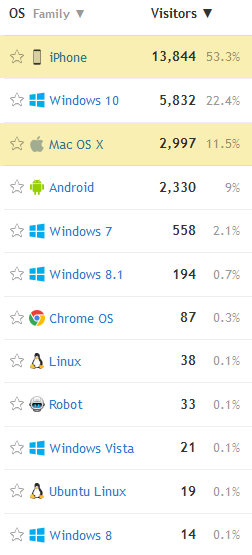
His website is only a couple years old, so it doesn’t get a ton of traffic from other sources yet. As of now his site does not have great Google rankings, but even if it did the boost by the Apple recommendations still provides a tailwind of free distribution and awareness (for however long it lasts).
For topics covered in news or repeat navigational searches Apple likely sends a lot of direct visits via their URL auto-completion features, but they do not use the feature broadly into the tail of search across other verticals, so it is a limited set of searches that ultimately benefit from the shortcuts.
Apple Search Ranking Factors
Apple recently updated their search page offering information about Applebot:
Apple Search may take the following into account when ranking web search results:
- Aggregated user engagement with search results
- Relevancy and matching of search terms to webpage topics and content
- Number and quality of links from other pages on the web
- User location based signals (approximate data)
- Webpage design characteristics
Search results may use the above factors with no (pre-determined) importance of ranking. Users of Search are subject to the privacy policy in Siri Suggestions, Search & Privacy.
I have seen some country-code TLDs do well in their local markets in spite of not necessarily being associated with large brands. Sites which do not rank well in Google can still end up in the mix provided the user experience is clean, the site is useful and it is easy for Apple to associate the site with a related keyword.
Panda-like Quality Updates
Markets like news change every day as the news changes, but I think Apple also does some Panda-like updates roughly quarterly where they do a broad refresh of what they recommend generally. As part of those updates sites which were once recommended can end up seeing the recommendation go away (especially if user experience declined since the initial recommendation via an ad heavy layout or similar) while other sites that have good engagement metrics get recommended on related searches.
A friend had a website they sort of forgot that was recommended by Apple. That site saw a big jump on July 9, 2018 then it slid back in early August that year, likely after the testing data showed it wasn’t as good as some other site Apple recommended. They noticed the spike in traffic & improved the site a bit. In early October it was widely recommended once again. That lasted until May of 2019 when it fell off a cliff once more. They had monetized the site with a somewhat spammy ad network & the recommendation mostly went away.
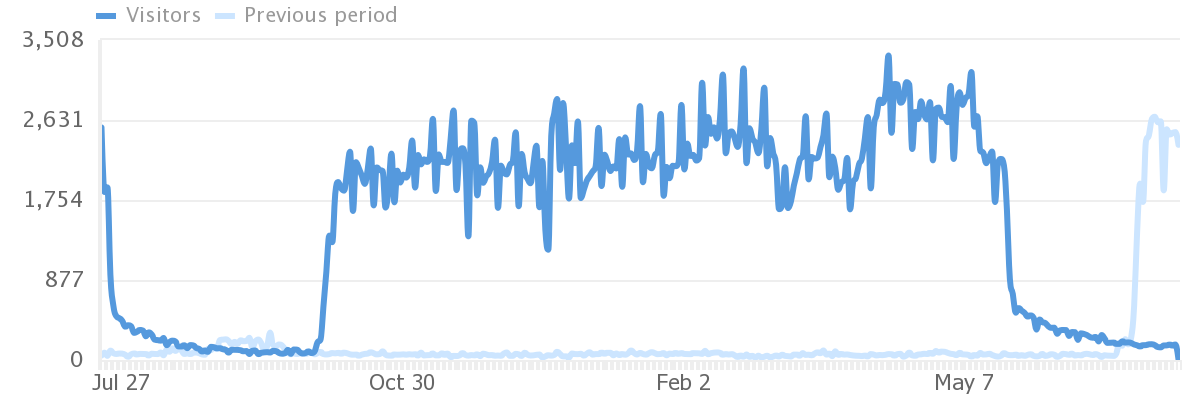
The recommendations happen as the person types and they may be different for searches where there is a space between keywords and the word is ran together. It is also worth noting Apple will typically recommend the www. version of a site over the m. version of a site for sites that offer both, so it makes sense to ensure if you used separate URLs that the www version also uses a responsive website design.
Indirect Impact on Google
While the Apple search shortcuts bypass Google search & thus do not create direct user signals to impact Google search, people who own an iPhone then search on a Windows computer at work or a Windows laptop at home might remember the site they liked from their iPhone and search for it once more, giving the site some awareness that could indirectly bleed over into impacting Google’s search rankings.
Apple could also eventually roll out their own fully featured search engine.
Categories:
Apple Search
Google, Google, Google
For well over a decade Google has dominated search to where most stories in the search sphere were about Google or something on the periphery.
In 2019 Google generated $134.81 billion in ad revenues.
When Verizon bought core Yahoo three years ago the final purchase price was $4.48 billion. That amount was to own their finance vertical, news vertical, web portal, homepage, email & web search. It also included a variety of other services like Tumblr.
Part of what keeps Google so dominant in search is their brand awareness. That is also augmented by distribution as defaults in Chrome and Android. Then when it comes to buying search distribution from other players like Mozilla Firefox, Opera or Apple’s Safari they can outbid everyone else as they are much better at monetizing tier 2 markets and emerging markets than other search companies are since they have such strong ad depth. Even if Bing gave a 100% revshare to Apple they still could not compete with Google in most markets in terms of search monetization.
Apple as a Huge Search Traffic Driver
In 2019 Google paid just under £1.2 billion in default payments for UK search traffic. Most of that went to Apple. Historically when Google broke out their search revenues by region typically the US was around 45% to 46% of search ad revenue & the UK was around 11% to 12%, so it is likely Google is spending north of $10 billion a year to be the default search provider on Apple devices:
Apple submitted that search engines do not pay Apple for the right to be set as the primary default search engine on its devices. However, our assessment is that Google does pay to be the primary default on Apple devices. The agreement between Google and Apple states that Google will be the default web search provider and the same agreement states that Google will pay Apple a specified share of search advertising revenues. We also note that Google does not pay compensation to any partners that set Google Search as a secondary option. This further suggests that Google’s payment to Apple is in return for Apple setting Google as the primary default.
Apple is glad to cash those checks & let Google handle the core algorithmic search function in the web browser, but Apple also auto-completes many searches from within the address bar via various features like website history, top hit, news, Siri suggested website, suggested sites, etc.
A Unique Voice in Search
The nice thing about Apple powering some of those search auto-complete results themselves is their results are not simply a re-hash of the Google search results so they can add a unique voice to the search marketplace where if your site isn’t doing as well in Google it could still be promoted by Apple based on other factors.
High-traffic Shortcuts
Apple users generally have plenty of disposable personal income and a tendency to dispose of much of it, so if you are an Android user it is probably worth having an Apple device to see what they are recommending for core terms in your client’s markets. If you want to see recommendations for a particular country you may need to have a specialized router targeted to that country or use a web proxy or VPN.
Most users likely conduct full search queries and click through to listings from the Google search result page, but over time the search autocomplete feature that recommends previously viewed websites and other sites likely picks up incremental share of voice.
A friend of mine from the UK runs a local site and the following shows how the Apple ecosystem drove nearly 2/3 of his website traffic.
His website is only a couple years old, so it doesn’t get a ton of traffic from other sources yet. As of now his site does not have great Google rankings, but even if it did the boost by the Apple recommendations still provides a tailwind of free distribution and awareness (for however long it lasts).
For topics covered in news or repeat navigational searches Apple likely sends a lot of direct visits via their URL auto-completion features, but they do not use the feature broadly into the tail of search across other verticals, so it is a limited set of searches that ultimately benefit from the shortcuts.
Apple Search Ranking Factors
Apple recently updated their search page offering information about Applebot:
Apple Search may take the following into account when ranking web search results:
- Aggregated user engagement with search results
- Relevancy and matching of search terms to webpage topics and content
- Number and quality of links from other pages on the web
- User location based signals (approximate data)
- Webpage design characteristics
Search results may use the above factors with no (pre-determined) importance of ranking. Users of Search are subject to the privacy policy in Siri Suggestions, Search & Privacy.
I have seen some country-code TLDs do well in their local markets in spite of not necessarily being associated with large brands. Sites which do not rank well in Google can still end up in the mix provided the user experience is clean, the site is useful and it is easy for Apple to associate the site with a related keyword.
Panda-like Quality Updates
Markets like news change every day as the news changes, but I think Apple also does some Panda-like updates roughly quarterly where they do a broad refresh of what they recommend generally. As part of those updates sites which were once recommended can end up seeing the recommendation go away (especially if user experience declined since the initial recommendation via an ad heavy layout or similar) while other sites that have good engagement metrics get recommended on related searches.
A friend had a website they sort of forgot that was recommended by Apple. That site saw a big jump on July 9, 2018 then it slid back in early August that year, likely after the testing data showed it wasn’t as good as some other site Apple recommended. They noticed the spike in traffic & improved the site a bit. In early October it was widely recommended once again. That lasted until May of 2019 when it fell off a cliff once more. They had monetized the site with a somewhat spammy ad network & the recommendation mostly went away.
The recommendations happen as the person types and they may be different for searches where there is a space between keywords and the word is ran together. It is also worth noting Apple will typically recommend the www. version of a site over the m. version of a site for sites that offer both, so it makes sense to ensure if you used separate URLs that the www version also uses a responsive website design.
Indirect Impact on Google
While the Apple search shortcuts bypass Google search & thus do not create direct user signals to impact Google search, people who own an iPhone then search on a Windows computer at work or a Windows laptop at home might remember the site they liked from their iPhone and search for it once more, giving the site some awareness that could indirectly bleed over into impacting Google’s search rankings.
Apple could also eventually roll out their own fully featured search engine.
Categories:
Overcoming Webmaster Depression
This year is a rather easy year to be depressed. ;)
COVID-19, fearmongering media, polarized hyper-charged social media, mass unemployment, lockdowns that killed exercise routines and social connections, loss of hope / purpose / meaning, a guy who stuck a gun in the belly area of a pregnant woman overdosing on fentanyl shortly after he passed counterfeit currency, that broader background being utterly ignored so outrage could fuel widespread rioting with a man in dreadlocks kicking a man sitting in the street unconscious & other bonus random drive by shootings where actual heroes are murdered at random, cities being burned down, communist anarchy, social “justice” movements founded on the idiotic idea of improving society by ripping apart the family unit, etc.
This post is not a suicide letter, but an ode to reality of accepting today for what it is. :D
pic.twitter.com/OWBHGa5eKR— Zero Gravity Media (@zerogravityhxp) August 12, 2020
Last year was the first year where I managed an office with a bunch of employees in it. When the office opened my email inbox had under 2,000 emails built up in it over a 16 year period of working on the web. Far from inbox zero, I am now above 20,000. I think in a Bill Gates interview about a half year ago I smiled after hearing his sort of EGT was how his email inbox was doing. I timed that office opening almost perfectly for COVID-19 so I could have all the stress and cost associated with training a team, setting up a ton of computers, creating workflow, … and then none of the benefits as the office would get shut down shortly after things began to operate smoothly. :D
By the end of last year a was a bit (err…lot) on the fat side from working too much, too much stress, and exercising too little. My weight and the length of my fuse are reciprocals.
In the past I used to harness negative energy into a form of rage to fuel drive, but now that I am over 40 I find it much harder to live that way. I’ve already had a number of near death experiences (including one when my wife was pregnant with our only child) and think at some point living that rage-drive way is just shitty. Just say no to endless rage.
So when it was obvious this year was largely going to be dog crap, I started to look internally instead of externally & figured it made more sense to improve health & mood than to fight the gravity of the global depression we are currently living through.
Exogenous Shocks
When things change out of nowhere they can end up dramatically changing the social and economic order.
Many such changes are utterly arbitrary and orthogonal to the concepts of fairness, justice, human decency, etc.
Some parties are politically connected & shielded from actual market forces.
As a self-employed person living overseas I am certainly not one of those protected parties. That said, my family and the people who work for me look to me and hope I can help shield them from some of the crap reality served up this year.
As a rule, when exogenous shocks happen those who are not politically connected get screwed hardest.
Smaller firms tend to under-perform larger firms: “As the earnings season draws to a close, companies within the Russell 2000 stock index — the small-cap benchmark — have reported an aggregate loss of $1.1bn, compared to profits of almost $18bn a year earlier, according to data provider FactSet. Meantime, the much bigger companies within the benchmark S&P 500 index have posted a 34 per cent aggregate drop in earnings, to $233bn.”
Poorer people are more likely to lose their jobs.
Emerging markets tend to get hit harder than developed markets. Which only adds to the powder keg of instability as the food price inflation tied to falling incomes makes many people rather desperate.
etc.
As people get desperate violence increases & many governments get overthrown.
Central banks printing cash to prop up the financial markets only increases the divide further.
Congratulations @federalreserve pic.twitter.com/8HxhLH9il5— Sven Henrich (@NorthmanTrader) August 17, 2020
That increased income & wealth inequality makes “the system” only feel that much more fraudulent, which in turn acts as a powder keg to fuel more arbitrary misdirected violence.
Tesla now has a $340 billion market capitalization. They remain unprofitable outside of harvesting tax credits.
Beyond fueling increased violence, the sky high numbers for FOMO stocks also lead some people to feel like they are failures for only slightly succeeding or just getting by.
Others pile in to trashy cryptocurrencies in an attempt to catch up where they only further compound their losses.
Waiting Things Out
It is worth noting many of the jobs that are gone are gone for good.
We may very well be facing a global depression:
“The pandemic has created a massive economic contraction that will be followed by a financial crisis in many parts of the globe, as nonperforming corporate loans accumulate alongside bankruptcies. Sovereign defaults in the developing world are also poised to spike. This crisis will follow a path similar to the one the last crisis took, except worse, commensurate with the scale and scope of the collapse in global economic activity. And the crisis will hit lower-income households and countries harder than their wealthier counterparts. … In all of the worst financial crises since the mid-nineteenth century, it took an average of eight years for per capita GDP to return to the pre-crisis level. (The median was seven years.) … The last time all engines failed was in the Great Depression; the collapse this time will be similarly abrupt and steep.”
If you can’t afford to feed your family of course you have to solve that problem first. But if you are not absolutely financially desperate then this can be a good year to win in ways other than finances & only worry about money after other things are in a better place.
This is a good year to find meaning through various types of self-improvement and doing lots of small & kind things for the people around you. Yesterday was a good day to buy your wife flowers. So is today. Tomorrow is a good day to buy a friend a surprise gift.
One of the best books you can read about developing positive personal habits is Charles Duhigg’s The Power of Habit. It is 8 years old now but it is still a great read.
Pushing for broad structural changes in a crisis through ideology which removes ordinary feedback loops often ends up creating only further injustice with the campaign “hero” looking like their polar opposite. Ideology pushed hard enough wraps around to the other side.
When things are absolutely screwed the world over it is better to focus on improving yourself and your family rather than promoting arbitrary extrajudicial justice and burning things down further.
Here are the steps I took to improve a good bit so far this year.
Coronavirus Lockdowns
When I saw a video of a guy walking down the street in Wuhan cough blood and fall over dead I immediately ordered facemasks for everyone in my extended family. I also bought facemasks and gloves into the office for workers. As it turns out gloves were largely a non-winner because using them is more likely to spread virus and bacteria, but the intent was good.
Cygnus recommended taking the supplement quercetin & so did Dr. Zev, so I do that.
Our government does not want us to treat covid early. If I get covid and no hcq access-I would take IMMEDIATELY quercetin 500mg three times a day for 7 days and elemental zinc 50mg one a day for 7 days, and z-pack. Every American home should have quercetin and zinc.— Dr. Zev Zelenko (@zev_dr) August 16, 2020
When lockdowns were announced I hoarded months worth of baby formula so I know my daughter would be ok & bought her a couple birthday presents in case the lockdowns were extended repeatedly. They were, so that worked out ok.
When lockdowns ended I bought a ton of different toys for my daughter so I could share them with her and make up for the limited outside contact for the time being. I also brought my lead graphic & web designer a dual monitor computer to his house to improve his efficiency.
Any day where there is not a lockdown I try to make the most of it knowing another couple months or quarter year can disappear arbitrarily.
Making the most out of the day for me often means doing something positive on the health front & meaning front right away. Things like getting food for my daughter or going for a walk are big wins early in the day as we tend to slow down and get tired as the day drags on.
Health / Fitness
Early in the year when I could use the gym I was walking at a brisk pace for about an hour a day while reading books and listening to podcasts.
After gyms were forced to be closed I started walking outside. Initially this was often to get groceries or various baby supplies, though I continued to walk daily even when there wasn’t a real direct need just to keep mood up with all the ridiculous crap going on in the world. I used to think the Philippines was way too hot when I had to drive everywhere, but even if it is hot as hell it isn’t bad to be out in the sun and heat so long as you are only walking especially if the walk has a purpose which helps your loved ones in some way.
Walking regularly with nothing else going on can be boring as hell, of course, so to offset the boredom I bring my iPhone and have some Airpod Pro earbuds with their killer noise canceling features. When nobody is near me I sometimes pull down my face mask and jog or sprint for a while to add variety to the day. I also sometimes make people’s ears bleed by singing along in an effort to share the joy of whatever I am listening to. :D
There are many awesome acoustic songs on YouTube. Revisiting unheard versions of songs you liked a long time ago can make the lyrics more powerful.
Some of the spoken-word song introductions are quite powerful: “everyone wants you to forget you are gonna die, because if they convince you your not gonna die you waste your time doing what they want you to do. Spend money on what they’re selling. … one day I’m gonna die, but before then I’m gonna live, live, live, the way I want to live and I hope you do too.”
Whenever I exercise I usually have caffeine as well. I view it a bit like a band aid or kick start, but I try to only use it either explicitly when walking or when intensely focusing on work.
If my back hurts from sitting at the chair too long that is a cue to get up and take a break even if it is a short one to go play with my daughter.
Sometimes I will walk two or three times throughout the day to break up the monotony.
Most my exercise is walking or jogging, but occasionally I will do a few push ups or sit ups.
In a world of gloom it is hard to look in the mirror and see a steaming pile of garbage which is not well maintained and feel good about yourself.
You know what sacrifices you have made and what the costs were, but it is easy to go down the path of resentment if outcomes are subpar and beyond your control in the short term.
If you don’t feel alive you aren’t. :D
It’s a lifeless life, with no fixed address to give
But you’re not mine to die for anymore
so I must live
Diet
I try to eat salad, Indian food, quiche, nuts, beef jerky, and all sorts of other foods where carbohydrates are sort of only incidental and are not core to the dish.
Anything that looks/smells/feels/sounds like sugar, rice, potatoes, bread, derivatives thereof, etc. I consider to be poison / systemic inflammation / weight gain and try to skip it.
I also consider drinking calories to be a disaster as the glycemic index on things like a soda are through the roof.
If you are fat and eat a lot of carbs you are repeatedly spiking your blood sugar, then it crashes, then you are hungry again. This habit & addictive cycle works on some of the same neural pathways that hardcore drugs do.
Sometimes I still do eat a bit of peanut butter or chocolate or frozen chocolate dipped in peanut butter, though I try not to use it meal replacement style very often & try not to be “full jar now empty” Aaron.
When I wake I often wait at least 4 or 5 hours before eating my first meal. In some cases I stretch that out to 6 or 8.
Communicating
I know a lot of people are in a bad state this year, so I try to offset that at least slightly by overcommunicating.
I send my mom pictures or videos of my daughter every day as she told me those help her sleep better at night and her watch even shows her blood pressure is lower and she feels much more well rested the next morning. I have bought my daughter a ton of extra clothes to wear just so my mom gets a bit more variety in the pictures and my daughter will have a ton of memories to sort through when she is older.
Our daughter has quite a bit of energy so sometimes she makes communicating with my wife hard. Sometimes we have better luck texting back and forth if something is urgent and then discuss it in more detail over email or when our daughter is taking a nap.
A lot of people around me have recently went through hardships beyond the financial uncertainties many are facing.
- Our web designer’s mom had a heart attack then got COVID-19 but I think she is ok now.
- Our lead writer had a friend younger than I who after going to the hospital with COVID-19.
- Our lead programmer’s parents recently had their house broken into with some of their sentimental jewelry stolen & he is the glue guy for the whole family.
- One of my buddies recently broke up with his long time girlfriend.
I am sure there are a lot more similar stories that I have not been told yet. So as a rule of thumb I sort of consider that if people have historically been good its ok to give them more leeway this year & be extra kind.
Mental Health
I generally am not a fan of taking prescription drugs to solve symptoms of real problems as in many cases those can cause additional bonus problems. I get that some people need various drugs to get by and survive, though outside of caffeine I typically try not to drink much or do much of anything else that can add more instability or create more bonus issues.
The above said, I think my baseline mood (especially if I am not in great health) tends to be a bit darker than average.
The early web was quite cool and you could do things like email Tim Berners-Lee and get a response, or someone would read your site and see you mentioned Carl Sagan and shoot you an email like this one:
I wrote the first modern book on depression in 1980. It was the first book to present depression as a biochemical disease, rather than a ‘mental’ illness (whatever that is). And, I was the one who introduced Carl Sagan to television as a local TV personality in L. A., Carl was a good family friend who came to watch a taping of my PBS show, he got really intense when he realized what a medium for communication TV was, and I introduced him to the GM of the station, that’s how he got to TV. He was more of a scientist than an actor, I coached him on TV persona. He was a very intense person, and did not have a big ego; he was always open to new information, whether it came from experiences or ideas. He would have loved living now.
To solve both depression and weight gain problems, try an over-the-counter nutrient called 5HTP. The Walmarts here sell the least expensive and best pills. Take about nine a day for about nine days, you will notice you haven’t felt the urge to eat all day and you don’t have as much depression symptoms; the griffonia seed from which 5HTP is made increases serotonin in the brain.
Then a follow up after I asked about the FDA ban of L-Tryptophan:
Now something gets clearer! When tryotophan was banned because of one supposedly contaminated batch, I used every tiny bit of influence I had as a journalist, talked to every politician I could get in touch with. It was like going up against a brick wall. I wrote articles, did everything, could not understand at all why the nutrient was being banned for one bad batch in Japan and why resistance to overturning the ban was so solid. I even tried to obtain the animal version, and was told it ‘wasn’t the same,’ yet according to a chemical analysis, it was. Now I understand….
My book is “Depression, How to Recognize It, Cure It and Grow From It, Prentice Hall hardback, Simon Schuster paperback.
She also mentioned
Depression research is such big business that I feel they don’t want to find a real cure. The way the research should have gone is to study the chemical makeup of depression, then match the medication effect to different brain hormones (as well as cortisol-though it’s not a biogenic amine, it’s a definite precursor), and find accurate ways of testing which hormone or combination thereof is/are out of balance, so the correct medication can be prescribed right off the bat. So, if it’s a seratonin imbalance, the doc gives one medication, if it’s monomaine oxadase, the patient gets another, and so on. Prosac is like a huge blanket device, rather than an accurate laser beam going to the exact place it is needed.
Depression research really hasn’t progressed that much in the last 20 years, imho.
I know a big part of my improved mood was from taking 5-HTP along with Vitamin B & Vitamin C just before bed. When I take those I can fall asleep a bit quicker, sleep about an hour less, wake up feeling more refreshed, and am less hungry the following morning. If I had to guess, I would say the 5-hydroxytryptophan contributed to my recent 40 pound weight loss more than anything else did.
Anyhow, I would not recommend 5-HTP for anyone who is on SSRIs, MAO inhibitors, or many other drug classes (talk to your doctor first, etc.). But I figured a lot of people feel like crap this year so I should mention it has worked well for me.
Before writing this blog post I also recommended it to a few other people.
Our lead content writer was down after her friend died & I recommended it to her. She said she felt a difference the very next day.
Our backend developer took some after I told him about it and said his personal doom loop he was going through was better within 2 days.
I do not think it is a magic cure-all or would work for everyone, but if you are a bit down combining a bit of 5-HTP with exercise, healthy diet, sleep, etc. can help you improve your worldview and outlook a bit to get through the challenging times we are going through.
My only complaint (glass is always at least half empty :D) would be that as I have discarded that sort of rage cycle I find it easier to be distracted and harder to focus on work. If you love what you do focus comes automatic, but if you don’t then you do sometimes have to trick yourself a bit into being productive if you literally could be retired for life. But I suppose most people would say that is an absurd “problem” to complain about.
My only solution to the above is watching MJ on MJ. :D
I’m going to tweet this & pin it to my page so I can watch it every single day
When MJ talks about winning & leadership has a price, he’s talking about sacrificing a part of who you are for all that your team can become.
A Championship Standard!! pic.twitter.com/IbK95jFTVY— Jaycob Ammerman (@Jammer2233) May 13, 2020
Ending on a Positive Note
Destruction leads to a very rough road but it also breeds creation
And earthquakes are to a girl’s guitar, they’re just another good vibration
And tidal waves couldn’t save the world from Californication
If you are reading this blog post you are almost certainly involved in some part of web development, content production, internet marketing and/or e-commerce.
Ultimately as the world is reshaped you will benefit as long as you get through the current period as literally *everything* is moving online.
This chart on e-commerce continues to amaze me. pic.twitter.com/zW4EwKHW1N— David Schawel (@DavidSchawel) August 17, 2020
Given that the big platform monopolies are now getting the PR black eyes they deserve for their locked down ecosystems there is a good chance the web will be a much better place in the next half-decade.
The number of people rushing to become their own bosses is at a record level. Many will fail, but many will innovate and create new markets as they have no choice but to succeed. As more things move online, attention merchant platforms keep breaking culture into smaller and smaller chunks to fuel increasingly distorted views of reality that cater toward confirmation bias and rage.
At some point people will tire of the feed-based never-ending stream and want things they can complete. The growth of Neflix and their streaming competitors reflects the desire for something longer and more in-depth.
Some of legacy print media brands with high cost structures are now recycled selling marked-up garbage in parallel markets.
The combination of these trends will drive an increased appreciation for authenticity & the desire for human connection.
Long ago my original SEO mentor stated:
This is what I think, SEO is all about emotions, all about human interaction. People, search engineers even, try and force it into a numbers box. Numbers, math and formulas are for people not smart enough to think in concepts.
I think the best brands, the best sites have a large portion of their founders personality in them. Never be afraid to be yourself, after all there are 1/2 billion people on the www, not all of them have to agree with you. Concentrate on the ones that share your views, concentrate on making their experience the very best it can be, the rest forget them.
Or to put it another way, the best sites say – this is what we do, this is how we do it, if you don’t like it go somewhere else.
Ultimately though I think it comes down to desire and the will to win.
He later sold his business for a life changing sum, so unlike his favorite football club, I guess he had the will to win. The question remains if he will purchase the football club and “fix” them. :D
Categories:
Overcoming Webmaster Depression
This year is a rather easy year to be depressed. ;)
COVID-19, fearmongering media, polarized hyper-charged social media, mass unemployment, lockdowns that killed exercise routines and social connections, loss of hope / purpose / meaning, a guy who stuck a gun in the belly area of a pregnant woman overdosing on fentanyl shortly after he passed counterfeit currency, that broader background being utterly ignored so outrage could fuel widespread rioting with a man in dreadlocks kicking a man sitting in the street unconscious & other bonus random drive by shootings where actual heroes are murdered at random, cities being burned down, communist anarchy, social “justice” movements founded on the idiotic idea of improving society by ripping apart the family unit, etc.
This post is not a suicide letter, but an ode to reality of accepting today for what it is. :D
pic.twitter.com/OWBHGa5eKR— Zero Gravity Media (@zerogravityhxp) August 12, 2020
Last year was the first year where I managed an office with a bunch of employees in it. When the office opened my email inbox had under 2,000 emails built up in it over a 16 year period of working on the web. Far from inbox zero, I am now above 20,000. I think in a Bill Gates interview about a half year ago I smiled after hearing his sort of EGT was how his email inbox was doing. I timed that office opening almost perfectly for COVID-19 so I could have all the stress and cost associated with training a team, setting up a ton of computers, creating workflow, … and then none of the benefits as the office would get shut down shortly after things began to operate smoothly. :D
By the end of last year a was a bit (err…lot) on the fat side from working too much, too much stress, and exercising too little. My weight and the length of my fuse are reciprocals.
In the past I used to harness negative energy into a form of rage to fuel drive, but now that I am over 40 I find it much harder to live that way. I’ve already had a number of near death experiences (including one when my wife was pregnant with our only child) and think at some point living that rage-drive way is just shitty. Just say no to endless rage.
So when it was obvious this year was largely going to be dog crap, I started to look internally instead of externally & figured it made more sense to improve health & mood than to fight the gravity of the global depression we are currently living through.
Exogenous Shocks
When things change out of nowhere they can end up dramatically changing the social and economic order.
Many such changes are utterly arbitrary and orthogonal to the concepts of fairness, justice, human decency, etc.
Some parties are politically connected & shielded from actual market forces.
As a self-employed person living overseas I am certainly not one of those protected parties. That said, my family and the people who work for me look to me and hope I can help shield them from some of the crap reality served up this year.
As a rule, when exogenous shocks happen those who are not politically connected get screwed hardest.
Smaller firms tend to under-perform larger firms: “As the earnings season draws to a close, companies within the Russell 2000 stock index — the small-cap benchmark — have reported an aggregate loss of $1.1bn, compared to profits of almost $18bn a year earlier, according to data provider FactSet. Meantime, the much bigger companies within the benchmark S&P 500 index have posted a 34 per cent aggregate drop in earnings, to $233bn.”
Poorer people are more likely to lose their jobs.
Emerging markets tend to get hit harder than developed markets. Which only adds to the powder keg of instability as the food price inflation tied to falling incomes makes many people rather desperate.
etc.
As people get desperate violence increases & many governments get overthrown.
Central banks printing cash to prop up the financial markets only increases the divide further.
Congratulations @federalreserve pic.twitter.com/8HxhLH9il5— Sven Henrich (@NorthmanTrader) August 17, 2020
That increased income & wealth inequality makes “the system” only feel that much more fraudulent, which in turn acts as a powder keg to fuel more arbitrary misdirected violence.
Tesla now has a $340 billion market capitalization. They remain unprofitable outside of harvesting tax credits.
Beyond fueling increased violence, the sky high numbers for FOMO stocks also lead some people to feel like they are failures for only slightly succeeding or just getting by.
Others pile in to trashy cryptocurrencies in an attempt to catch up where they only further compound their losses.
Waiting Things Out
It is worth noting many of the jobs that are gone are gone for good.
We may very well be facing a global depression:
“The pandemic has created a massive economic contraction that will be followed by a financial crisis in many parts of the globe, as nonperforming corporate loans accumulate alongside bankruptcies. Sovereign defaults in the developing world are also poised to spike. This crisis will follow a path similar to the one the last crisis took, except worse, commensurate with the scale and scope of the collapse in global economic activity. And the crisis will hit lower-income households and countries harder than their wealthier counterparts. … In all of the worst financial crises since the mid-nineteenth century, it took an average of eight years for per capita GDP to return to the pre-crisis level. (The median was seven years.) … The last time all engines failed was in the Great Depression; the collapse this time will be similarly abrupt and steep.”
If you can’t afford to feed your family of course you have to solve that problem first. But if you are not absolutely financially desperate then this can be a good year to win in ways other than finances & only worry about money after other things are in a better place.
This is a good year to find meaning through various types of self-improvement and doing lots of small & kind things for the people around you. Yesterday was a good day to buy your wife flowers. So is today. Tomorrow is a good day to buy a friend a surprise gift.
One of the best books you can read about developing positive personal habits is Charles Duhigg’s The Power of Habit. It is 8 years old now but it is still a great read.
Pushing for broad structural changes in a crisis through ideology which removes ordinary feedback loops often ends up creating only further injustice with the campaign “hero” looking like their polar opposite. Ideology pushed hard enough wraps around to the other side.
When things are absolutely screwed the world over it is better to focus on improving yourself and your family rather than promoting arbitrary extrajudicial justice and burning things down further.
Here are the steps I took to improve a good bit so far this year.
Coronavirus Lockdowns
When I saw a video of a guy walking down the street in Wuhan cough blood and fall over dead I immediately ordered facemasks for everyone in my extended family. I also bought facemasks and gloves into the office for workers. As it turns out gloves were largely a non-winner because using them is more likely to spread virus and bacteria, but the intent was good.
Cygnus recommended taking the supplement quercetin & so did Dr. Zev, so I do that.
Our government does not want us to treat covid early. If I get covid and no hcq access-I would take IMMEDIATELY quercetin 500mg three times a day for 7 days and elemental zinc 50mg one a day for 7 days, and z-pack. Every American home should have quercetin and zinc.— Dr. Zev Zelenko (@zev_dr) August 16, 2020
When lockdowns were announced I hoarded months worth of baby formula so I know my daughter would be ok & bought her a couple birthday presents in case the lockdowns were extended repeatedly. They were, so that worked out ok.
When lockdowns ended I bought a ton of different toys for my daughter so I could share them with her and make up for the limited outside contact for the time being. I also brought my lead graphic & web designer a dual monitor computer to his house to improve his efficiency.
Any day where there is not a lockdown I try to make the most of it knowing another couple months or quarter year can disappear arbitrarily.
Making the most out of the day for me often means doing something positive on the health front & meaning front right away. Things like getting food for my daughter or going for a walk are big wins early in the day as we tend to slow down and get tired as the day drags on.
Health / Fitness
Early in the year when I could use the gym I was walking at a brisk pace for about an hour a day while reading books and listening to podcasts.
After gyms were forced to be closed I started walking outside. Initially this was often to get groceries or various baby supplies, though I continued to walk daily even when there wasn’t a real direct need just to keep mood up with all the ridiculous crap going on in the world. I used to think the Philippines was way too hot when I had to drive everywhere, but even if it is hot as hell it isn’t bad to be out in the sun and heat so long as you are only walking especially if the walk has a purpose which helps your loved ones in some way.
Walking regularly with nothing else going on can be boring as hell, of course, so to offset the boredom I bring my iPhone and have some Airpod Pro earbuds with their killer noise canceling features. When nobody is near me I sometimes pull down my face mask and jog or sprint for a while to add variety to the day. I also sometimes make people’s ears bleed by singing along in an effort to share the joy of whatever I am listening to. :D
There are many awesome acoustic songs on YouTube. Revisiting unheard versions of songs you liked a long time ago can make the lyrics more powerful.
Some of the spoken-word song introductions are quite powerful: “everyone wants you to forget you are gonna die, because if they convince you your not gonna die you waste your time doing what they want you to do. Spend money on what they’re selling. … one day I’m gonna die, but before then I’m gonna live, live, live, the way I want to live and I hope you do too.”
Whenever I exercise I usually have caffeine as well. I view it a bit like a band aid or kick start, but I try to only use it either explicitly when walking or when intensely focusing on work.
If my back hurts from sitting at the chair too long that is a cue to get up and take a break even if it is a short one to go play with my daughter.
Sometimes I will walk two or three times throughout the day to break up the monotony.
Most my exercise is walking or jogging, but occasionally I will do a few push ups or sit ups.
In a world of gloom it is hard to look in the mirror and see a steaming pile of garbage which is not well maintained and feel good about yourself.
You know what sacrifices you have made and what the costs were, but it is easy to go down the path of resentment if outcomes are subpar and beyond your control in the short term.
If you don’t feel alive you aren’t. :D
It’s a lifeless life, with no fixed address to give
But you’re not mine to die for anymore
so I must live
Diet
I try to eat salad, Indian food, quiche, nuts, beef jerky, and all sorts of other foods where carbohydrates are sort of only incidental and are not core to the dish.
Anything that looks/smells/feels/sounds like sugar, rice, potatoes, bread, derivatives thereof, etc. I consider to be poison / systemic inflammation / weight gain and try to skip it.
I also consider drinking calories to be a disaster as the glycemic index on things like a soda are through the roof.
If you are fat and eat a lot of carbs you are repeatedly spiking your blood sugar, then it crashes, then you are hungry again. This habit & addictive cycle works on some of the same neural pathways that hardcore drugs do.
Sometimes I still do eat a bit of peanut butter or chocolate or frozen chocolate dipped in peanut butter, though I try not to use it meal replacement style very often & try not to be “full jar now empty” Aaron. Three tips on that front are to eat peanut butter using a chop stick so you eat it slower, eat small pieces of chocolate, and freeze the chocolate before eating so it takes a while to chew and you realize just how much you are eating. :D
When I wake I often wait at least 4 or 5 hours before eating my first meal. In some cases I stretch that out to 6 or 8.
Communicating
I know a lot of people are in a bad state this year, so I try to offset that at least slightly by overcommunicating.
I send my mom pictures or videos of my daughter every day as she told me those help her sleep better at night and her watch even shows her blood pressure is lower and she feels much more well rested the next morning. I have bought my daughter a ton of extra clothes to wear just so my mom gets a bit more variety in the pictures and my daughter will have a ton of memories to sort through when she is older.
Our daughter has quite a bit of energy so sometimes she makes communicating with my wife hard. Sometimes we have better luck texting back and forth if something is urgent and then discuss it in more detail over email or when our daughter is taking a nap.
A lot of people around me have recently went through hardships beyond the financial uncertainties many are facing.
- Our web designer’s mom had a heart attack then got COVID-19 but I think she is ok now.
- Our lead writer had a friend younger than I who after going to the hospital with COVID-19.
- Our lead programmer’s parents recently had their house broken into with some of their sentimental jewelry stolen & he is the glue guy for the whole family.
- One of my buddies recently broke up with his long time girlfriend.
I am sure there are a lot more similar stories that I have not been told yet. So as a rule of thumb I sort of consider that if people have historically been good its ok to give them more leeway this year & be extra kind.
Mental Health
One of the cheapest & easiest wins in terms of quality of life is setting your grounding from a perspective of feeling lucky so that you are appreciative & try to be a better version of yourself. Episode 504 of This American Life shares an inspiring story about Emir Kamenica.
“These stories we tell about ourselves, they’re almost like our infrastructure, like railroads or highways. We can build them almost any way we want to. But once they’re in place, this whole inner landscape grows up around them.
So maybe the point here is that you should be careful about how you tell your story, or at least conscious of it. Because once you’ve told it, once you’ve built the highway, it’s just very hard to move it. Even if your story is about an angel who came out of nowhere and saved your life, even then, not even the angel herself can change it.” – Michael Lewis
I generally am not a fan of taking prescription drugs to solve symptoms of larger underlying problems as in many cases those can cause additional bonus problems. I get that some people need various drugs to get by and survive, though outside of caffeine I typically try not to drink much or do much of anything else that can add more instability or create more bonus issues.
The above said, I think my baseline mood (especially if I am not in great health) tends to be a bit darker than average.
The early web was quite cool and you could do things like email Tim Berners-Lee and get a response, or someone would read your site and see you mentioned Carl Sagan and shoot you an email like this one:
I wrote the first modern book on depression in 1980. It was the first book to present depression as a biochemical disease, rather than a ‘mental’ illness (whatever that is). And, I was the one who introduced Carl Sagan to television as a local TV personality in L. A., Carl was a good family friend who came to watch a taping of my PBS show, he got really intense when he realized what a medium for communication TV was, and I introduced him to the GM of the station, that’s how he got to TV. He was more of a scientist than an actor, I coached him on TV persona. He was a very intense person, and did not have a big ego; he was always open to new information, whether it came from experiences or ideas. He would have loved living now.
To solve both depression and weight gain problems, try an over-the-counter nutrient called 5HTP. The Walmarts here sell the least expensive and best pills. Take about nine a day for about nine days, you will notice you haven’t felt the urge to eat all day and you don’t have as much depression symptoms; the griffonia seed from which 5HTP is made increases serotonin in the brain.
Then a follow up after I asked about the FDA ban of L-Tryptophan:
Now something gets clearer! When tryotophan was banned because of one supposedly contaminated batch, I used every tiny bit of influence I had as a journalist, talked to every politician I could get in touch with. It was like going up against a brick wall. I wrote articles, did everything, could not understand at all why the nutrient was being banned for one bad batch in Japan and why resistance to overturning the ban was so solid. I even tried to obtain the animal version, and was told it ‘wasn’t the same,’ yet according to a chemical analysis, it was. Now I understand….
My book is “Depression, How to Recognize It, Cure It and Grow From It, Prentice Hall hardback, Simon Schuster paperback.
She also mentioned
Depression research is such big business that I feel they don’t want to find a real cure. The way the research should have gone is to study the chemical makeup of depression, then match the medication effect to different brain hormones (as well as cortisol-though it’s not a biogenic amine, it’s a definite precursor), and find accurate ways of testing which hormone or combination thereof is/are out of balance, so the correct medication can be prescribed right off the bat. So, if it’s a seratonin imbalance, the doc gives one medication, if it’s monomaine oxadase, the patient gets another, and so on. Prosac is like a huge blanket device, rather than an accurate laser beam going to the exact place it is needed.
Depression research really hasn’t progressed that much in the last 20 years, imho.
I know a big part of my improved mood was from taking 5-HTP along with Vitamin B & Vitamin C just before bed. When I take those I can fall asleep a bit quicker, sleep about an hour less, wake up feeling more refreshed, and am less hungry the following morning. If I had to guess, I would say the 5-hydroxytryptophan contributed to my recent 40 pound weight loss more than anything else did.
Anyhow, I would not recommend 5-HTP for anyone who is on SSRIs, MAO inhibitors, or many other drug classes (talk to your doctor first, etc.). But I figured a lot of people feel like crap this year so I should mention it has worked well for me.
Before writing this blog post I also recommended it to a few other people.
Our lead content writer was down after her friend died & I recommended it to her. She said she felt a difference the very next day.
Our backend developer took some after I told him about it and said his personal doom loop he was going through was better within 2 days.
I do not think it is a magic cure-all or would work for everyone, but if you are a bit down combining a bit of 5-HTP with exercise, healthy diet, sleep, etc. can help you improve your worldview and outlook a bit to get through the challenging times we are going through.
My only complaint (glass is always at least half empty :D) would be that as I have discarded that sort of rage cycle I find it easier to be distracted and harder to focus on work. If you love what you do focus comes automatic, but if you don’t then you do sometimes have to trick yourself a bit into being productive if you literally could be retired for life. But I suppose most people would say that is an absurd “problem” to complain about.
My only solution to the above is watching MJ on MJ. :D
I’m going to tweet this & pin it to my page so I can watch it every single day
When MJ talks about winning & leadership has a price, he’s talking about sacrificing a part of who you are for all that your team can become.
A Championship Standard!! pic.twitter.com/IbK95jFTVY— Jaycob Ammerman (@Jammer2233) May 13, 2020
Ending on a Positive Note
Destruction leads to a very rough road but it also breeds creation
And earthquakes are to a girl’s guitar, they’re just another good vibration
And tidal waves couldn’t save the world from Californication
If you are reading this blog post you are almost certainly involved in some part of web development, content production, internet marketing and/or e-commerce.
Ultimately as the world is reshaped you will benefit as long as you get through the current period as literally *everything* is moving online.
This chart on e-commerce continues to amaze me. pic.twitter.com/zW4EwKHW1N— David Schawel (@DavidSchawel) August 17, 2020
Given that the big platform monopolies are now getting the PR black eyes they deserve for their locked down ecosystems there is a good chance the web will be a much better place in the next half-decade.
The number of people rushing to become their own bosses is at a record level. Many will fail, but many will innovate and create new markets as they have no choice but to succeed. As more things move online, attention merchant platforms keep breaking culture into smaller and smaller chunks to fuel increasingly distorted views of reality that cater toward confirmation bias and rage.
At some point people will tire of the feed-based never-ending stream and want things they can complete. The growth of Neflix and their streaming competitors reflects the desire for something longer and more in-depth.
Some of legacy print media brands with high cost structures are now recycled selling marked-up garbage in parallel markets.
The combination of these trends will drive an increased appreciation for authenticity & the desire for human connection.
Long ago my original SEO mentor stated:
This is what I think, SEO is all about emotions, all about human interaction. People, search engineers even, try and force it into a numbers box. Numbers, math and formulas are for people not smart enough to think in concepts.
I think the best brands, the best sites have a large portion of their founders personality in them. Never be afraid to be yourself, after all there are 1/2 billion people on the www, not all of them have to agree with you. Concentrate on the ones that share your views, concentrate on making their experience the very best it can be, the rest forget them.
Or to put it another way, the best sites say – this is what we do, this is how we do it, if you don’t like it go somewhere else.
Ultimately though I think it comes down to desire and the will to win.
He later sold his business for a life changing sum, so unlike his favorite football club, I guess he had the will to win. The question remains if he will purchase the football club and “fix” them. :D
Categories:
Declining Visitor Values
Late Funnel SEO Profits
Before the Panda update SEOs could easily focus almost all their energies on late funnel high-intent searches which were easy to monetize without needing to put a ton of effort into brand building or earlier funnel informational searches. This meant that SEOs could focus on phrases like [student credit cards] or [buy earbuds] or [best computer gaming headphones] or [vertical computer mouse] without needing to worry much about anything else. Make a good enough page on those topics, segment demand across options, and profit.
Due to the ability to focus content & efforts on those tiny subset high-intent commercial terms the absolute returns and CPMs from SEO investments were astronomical. Publishers could insert themselves arbitrarily just before the end of the value chain (just like Google AdWords) and extract a toll.
The Panda Shift / Eating the Info Supply Chain
Then Panda happened and sites needed to have stronger brands and/or more full funnel user experience and/or more differentiated content to be able to rank sustainably.
One over-simplified way to think of Panda and related algorithms would be: brand = rank.
Another way to look at it would be to consider the value chain of having many layers or pieces to it & Google wanting to remove as many unneeded or extra pieces from the chain as possible so that they themselves are capturing more of the value chain.
- That thin eHow article about a topic without any useful info? Not needed.
- The thin affiliate review which was buying Google AdSense ad impressions on that eHow article? Also not needed.
- All that is really needed is the consumer intent, Google & then either Google as the retailer (pay with your credentials stored in your phone) or another trusted retailer.
In some cases there may be value in mid-market in-depth reviews, but increasingly the aggregate value offered by many of them is captured inside the search snippets along with reviews directly incorporated into the knowledge graph & aggregate review scores.
The ability to remove the extra layers is driven largely by:
- the quality of the top players in the market
- the number of quality publishers in a market (as long as there are 2 or more, whoever is not winning will be willing to give a lot of value to Google to try to play catch up against their stronger competitor)
- the amount of usage data available in the market
- the ad depth of the market
If your competitor is strong and they keep updating in-depth content pieces you can’t set and forget your content and stay competitive. Across time searcher intent changes. Those who change with the markets should eventually have better engagement metrics and keep winning marketshare.
Benchmarking Your Competition
You only have to be better than whatever you are competing against to win.
If you have run out of ideas from your direct competitors in an emerging market you can typically find many more layers of optimization from looking at some of the largest and most successful players inside either the United States or China.
To give an example of how user data can be clean or a messy signal consider size 13 4E New Balance shoes. If you shop for these inside the United States a site like Amazon will have shoe size filters so you can see which shoes from that brand are available in that specific size.
In some smaller emerging markets ecommerce sites largely suck. They might allow you to filter shoes by the color blue but wanting to see the shoes available in your size is a choose your own adventure game as they do not offer those sorts of size filters, so you have to click into the shoe level, find out they do not have your size, and then try again. You do that about 100 times then eventually you get frustrated and buy off eBay or Amazon from someone who ships internationally.
In the first case it is very easy for Google to see the end user flow of users typically making their purchase at one of a few places like Amazon.com, the official New Balance store, or somewhere else like that which is likely to have the end product in stock. That second experience set is much harder to structure because the user signal is much more random with a lot more pogos back to Google.
Bigger, Better Ads
Over the past couple decades Google has grown much more aggressive at monetizing their search results. A website which sees its rank fall 1 position on mobile devices can see their mobile search traffic cut in half overnight. And desktop search results are also quite ad heavy to where sometimes a user can not see a single full organic result above the fold unless they have a huge monitor.
We tend to look at the present as being somewhat static. It is a part of human nature to think things are as they always were. But the general trend of the slow bleed squeeze is a function of math and time: “The relentless pressure to maintain Google’s growth, he said, had come at a heavy cost to the company’s users. Useful search results were pushed down the page to squeeze in more advertisements, and privacy was sacrificed for online tracking tools to keep tabs on what ads people were seeing.”
Some critics have captured the broad shift in ad labeling practices, but to get a grasp of how big the shift has been look at early Google search results.
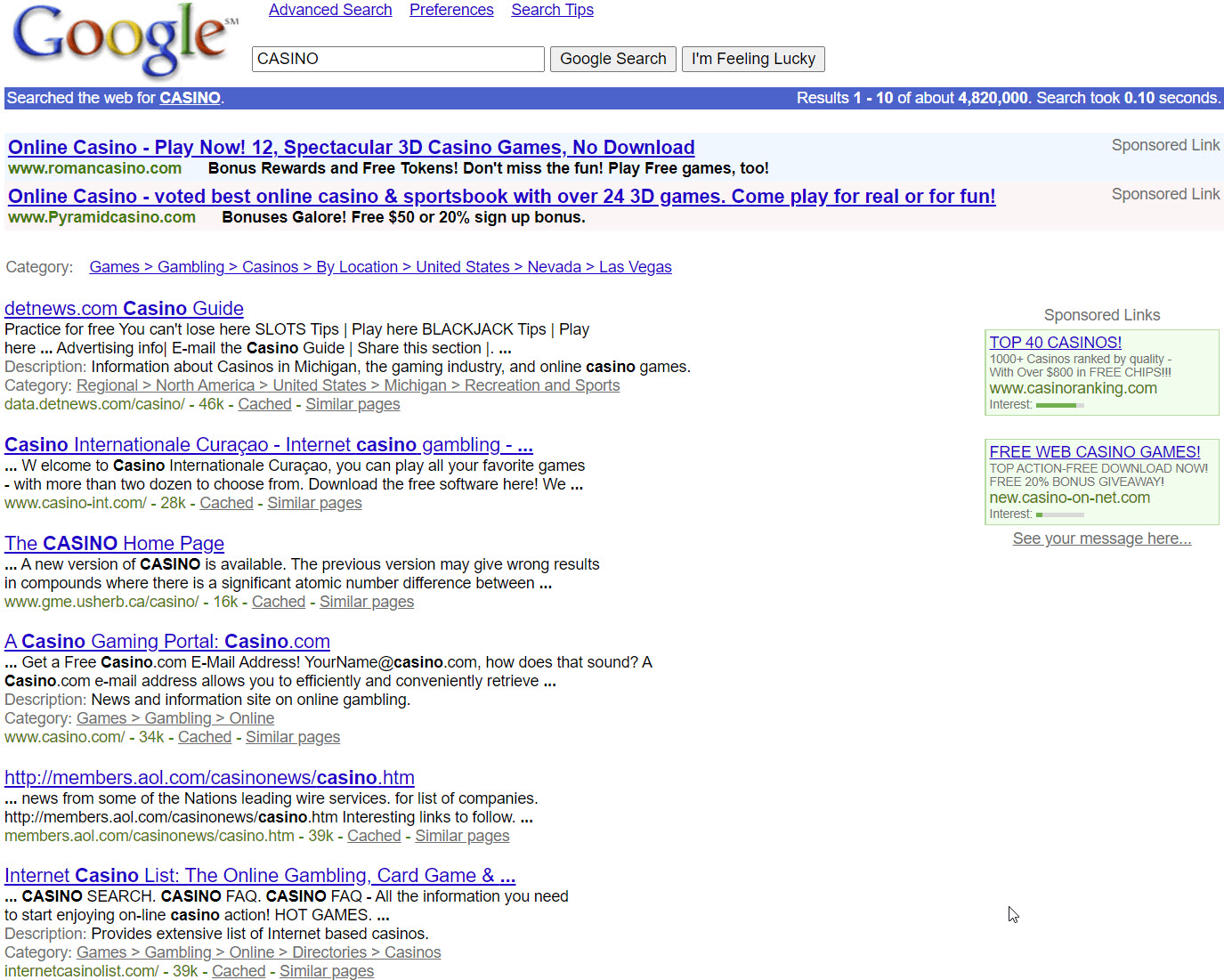
Look at how bright those ad units from 2001 are.
Since then ad labeling has grown less intuitive while ad size has increased dramatically.
Traffic Mix Shift
As publishers have been crowded out on commercial searches via larger ads & Google’s vertical search properties a greater share of their overall search traffic is lower value visitors including people who have little to no commercial intent, people from emerging markets with lower disposable income and
Falling Ad Rates
Since 2010 online display ad rates have fallen about 40%.
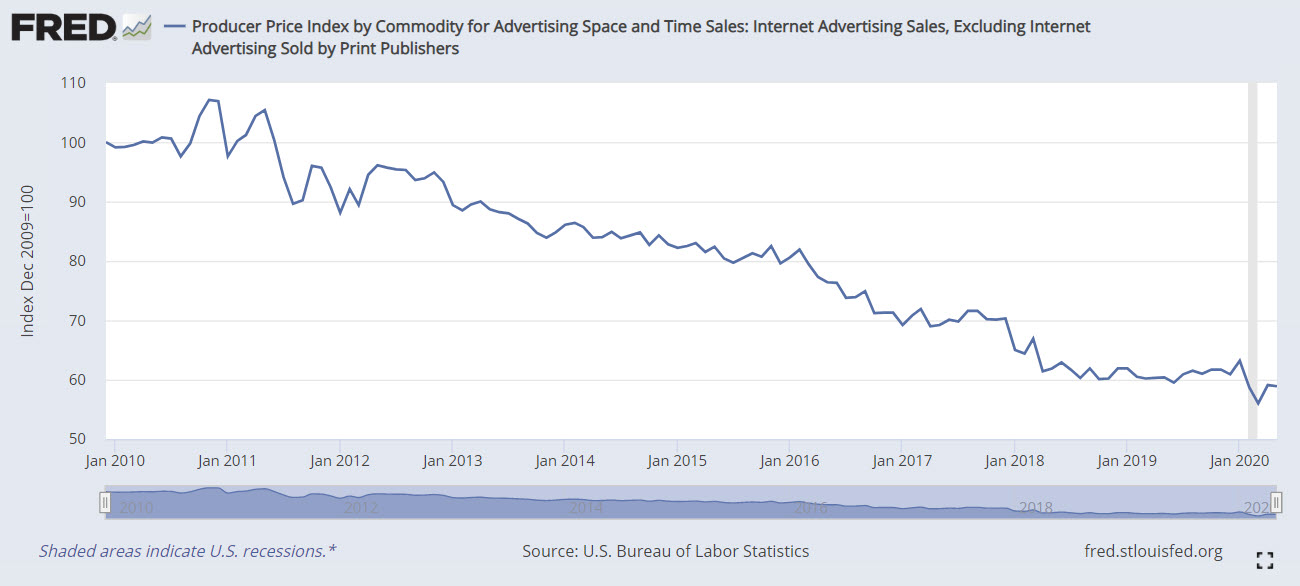
Any individual publisher will experience those declines in a series of non-linear step function shifts. Any of the following could happen:
- Google Panda or another algorithm update from a different attention merchant hits your distribution hard
- a Softbank-backed competitor jumps into your market and gains a ton of press coverage using flammable money
- a roll-up player buys out a series of sites in the supply chain & then tries to make the numbers back out by cramming down on ad syndication partners (sometimes you have to gain enough scale to create your own network or keep rotating through ad networks to keep them honest)
- regulatory costs hit any part of the supply chain (the California parallel to GDPR just went live this month)
- consumer interest shifts to other markets or solutions (the mobile phone has replaced many gadgets)
- a recession causes broad-based advertiser pullbacks
Margin Eaters
In addition to lowering ad rates for peripheral websites, there are a couple other bonus margin eaters.
Junk Sunk Costs
Monopoly platforms push publishers to adopt proprietary closed code bases in order to maintain distribution: “the trade group says Google’s Accelerated Mobile Pages (AMP) format was foisted on news publishers with an implied threat — their websites wouldn’t show up in search results.”
Decreased Supply Chain Visibility
Technical overhead leading to programmatic middlemen eating a huge piece of the pie: “From every £1 spent by an advertiser, about half goes to a publisher, roughly 16p to advertising platforms, 11p to other technology companies and 7 per cent to agencies. Adtech companies that took part in the study included Google’s dv360 and Ad Manager, Amazon Advertising and the Rubicon Project.”
Selection Effect
Large attention merchants control conversion tracking systems and displace organic distribution for brands by re-routing demand through a layer of ads which allows the central network to claim responsibility for conversions which would have already happened had they not existed.
Internal employees in the marketing department and external internet marketing consultants have an incentive to play along with this game because:
- it requires low effort to arbitrage your own brand
- at first glance it looks wildly profitable so long as you do not realize what is going on
- those who get a percent of spend can use the phantom profits from arbitraging their own brand equity to spend more money elsewhere
- those who get performance based bonuses get a bonus without having to perform
Both eBay and Microsoft published studies which showed how perverse selection effect is.
The selection effect bias is the inverse of customer acquisition cost. The more well known your brand is the more incentive ad networks have to arbitrage it & the more ad networks will try to take credit for any conversion which happens.
2) Why does CAC (mostly) only go up?
When you think about, CAC is “lowest” in the beginning, because you have no customers. You can get the low-hanging fruit cost effectively.
Think ad spend. Outbound sales spend. etc. First movers are ready to buy quickly.— Elizabeth Yin (@dunkhippo33) July 6, 2020
These margin eaters are a big part of the reason so many publishers are trying to desperately shift away from ad-based business models toward subscription revenues.
Hitting Every Layer
The commodification of content hits every layer from photography….
Networking is an art and a skill… but if the gold you hold are your images, don’t trade them for the passive networking value.
Simple lesson that is difficult to accept.— Send it. (@johnondotcom) July 4, 2020
…on through to writing
When you think about it, even $1000 is really inexpensive for a single piece of content that generates 20,000+ visits from search in the 1-3 years it’s alive and ranks well. That’s only about 1,000 visits a month. Yet companies only want to pay writers only $200 an article — Dan Shure (@dan_shure) July 6, 2020
…and every other layer of the editorial chain.
Profiting from content creation at scale is harder than most appreciate.
The idea that a $200 piece of content is particularly cheap comes across as ill-informed as there are many headwinds and many variables. The ability to monetize content depends on a ton of factors including: how commercial is it, how hard is it to monetize, what revshare do you go, how hard is it to rank or get distribution in front of other high intent audience sets?
If an article costs $200 it would be hard to make that back if it monetizes at anything under a $10 RPM. 20,000 visits equates to 20 units of RPM.
Some articles will not spread in spite of being high quality. Other articles take significant marketing spend to help them spread. Suddenly that $200 “successful” piece is closer to $500 when one averages in nonperformers that don’t spread & marketing expenses on ones that do. So then they either need the RPM to double or triple from there or the successful article needs to get at least 50,000 visits in order to break even.
A $10 RPM is quite high for many topics unless the ads are quite aggressively integrated into the content. The flip side of that is aggressive ad integration inhibits content spread & can cause algorithmic issues which prevent sustained rankings. Recall that in the most recent algorithm update Credit Karma saw some of their “money” credit card pages slide down the rankings due to aggressive monetization. And that happened to a big site which was purchased for over $7 billion. Smaller sites see greater levels of volatility. And nobody is investing $100,000s trying to break even many years down the road. If they were only trying to break even they’d buy bonds and ignore the concept of actively running a business of any sort.
Back in 2018 AdStage analyzed the Google display network and found the following: “In Q1 2018, advertisers spent, on average, $2.80 per thousand impressions (CPM), and $0.75 per click (CPC). The average click-through rate (CTR) on the GDN was 0.35%.”
A web page which garnered 20,000 pageviews and had 3 ad units on each page would get a total of 210 ad clicks given a 0.35% ad CTR. At 75 cents per click that would generate $157.50.
Suddenly a “cheap” $200 article doesn’t look so cheap. What’s more is said business would also have other costs beyond the writing. They have to pay for project management, editorial review, hosting, ad partnerships & biz dev, etc. etc. etc.
After all those other layers of overhead a $200 article would likely need to get about 50,000 pageviews to back out. And a $1,000 piece of content might need to get a quarter million or more pageviews to back out.
Categories:
Declining Visitor Values
Late Funnel SEO Profits
Before the Panda update SEOs could easily focus almost all their energies on late funnel high-intent searches which were easy to monetize without needing to put a ton of effort into brand building or earlier funnel informational searches. This meant that SEOs could focus on phrases like [student credit cards] or [buy earbuds] or [best computer gaming headphones] or [vertical computer mouse] without needing to worry much about anything else. Make a good enough page on those topics, segment demand across options, and profit.
Due to the ability to focus content & efforts on those tiny subset high-intent commercial terms the absolute returns and CPMs from SEO investments were astronomical. Publishers could insert themselves arbitrarily just before the end of the value chain (just like Google AdWords) and extract a toll.
The Panda Shift / Eating the Info Supply Chain
Then Panda happened and sites needed to have stronger brands and/or more full funnel user experience and/or more differentiated content to be able to rank sustainably.
One over-simplified way to think of Panda and related algorithms would be: brand = rank.
Another way to look at it would be to consider the value chain of having many layers or pieces to it & Google wanting to remove as many unneeded or extra pieces from the chain as possible so that they themselves are capturing more of the value chain.
- That thin eHow article about a topic without any useful info? Not needed.
- The thin affiliate review which was buying Google AdSense ad impressions on that eHow article? Also not needed.
- All that is really needed is the consumer intent, Google & then either Google as the retailer (pay with your credentials stored in your phone) or another trusted retailer.
In some cases there may be value in mid-market in-depth reviews, but increasingly the aggregate value offered by many of them is captured inside the search snippets along with reviews directly incorporated into the knowledge graph & aggregate review scores.
The ability to remove the extra layers is driven largely by:
- the quality of the top players in the market
- the number of quality publishers in a market (as long as there are 2 or more, whoever is not winning will be willing to give a lot of value to Google to try to play catch up against their stronger competitor)
- the amount of usage data available in the market
- the ad depth of the market
If your competitor is strong and they keep updating in-depth content pieces you can’t set and forget your content and stay competitive. Across time searcher intent changes. Those who change with the markets should eventually have better engagement metrics and keep winning marketshare.
Benchmarking Your Competition
You only have to be better than whatever you are competing against to win.
If you have run out of ideas from your direct competitors in an emerging market you can typically find many more layers of optimization from looking at some of the largest and most successful players inside either the United States or China.
To give an example of how user data can be clean or a messy signal consider size 13 4E New Balance shoes. If you shop for these inside the United States a site like Amazon will have shoe size filters so you can see which shoes from that brand are available in that specific size.
In some smaller emerging markets ecommerce sites largely suck. They might allow you to filter shoes by the color blue but wanting to see the shoes available in your size is a choose your own adventure game as they do not offer those sorts of size filters, so you have to click into the shoe level, find out they do not have your size, and then try again. You do that about 100 times then eventually you get frustrated and buy off eBay or Amazon from someone who ships internationally.
In the first case it is very easy for Google to see the end user flow of users typically making their purchase at one of a few places like Amazon.com, the official New Balance store, or somewhere else like that which is likely to have the end product in stock. That second experience set is much harder to structure because the user signal is much more random with a lot more pogos back to Google.
Bigger, Better Ads
Over the past couple decades Google has grown much more aggressive at monetizing their search results. A website which sees its rank fall 1 position on mobile devices can see their mobile search traffic cut in half overnight. And desktop search results are also quite ad heavy to where sometimes a user can not see a single full organic result above the fold unless they have a huge monitor.
We tend to look at the present as being somewhat static. It is a part of human nature to think things are as they always were. But the general trend of the slow bleed squeeze is a function of math and time: “The relentless pressure to maintain Google’s growth, he said, had come at a heavy cost to the company’s users. Useful search results were pushed down the page to squeeze in more advertisements, and privacy was sacrificed for online tracking tools to keep tabs on what ads people were seeing.”
Some critics have captured the broad shift in ad labeling practices, but to get a grasp of how big the shift has been look at early Google search results.
Look at how bright those ad units from 2001 are.
Since then ad labeling has grown less intuitive while ad size has increased dramatically.
Traffic Mix Shift
As publishers have been crowded out on commercial searches via larger ads & Google’s vertical search properties a greater share of their overall search traffic is lower value visitors including people who have little to no commercial intent, people from emerging markets with lower disposable income and
Falling Ad Rates
Since 2010 online display ad rates have fallen about 40%.
Any individual publisher will experience those declines in a series of non-linear step function shifts. Any of the following could happen:
- Google Panda or another algorithm update from a different attention merchant hits your distribution hard
- a Softbank-backed competitor jumps into your market and gains a ton of press coverage using flammable money
- a roll-up player buys out a series of sites in the supply chain & then tries to make the numbers back out by cramming down on ad syndication partners (sometimes you have to gain enough scale to create your own network or keep rotating through ad networks to keep them honest)
- regulatory costs hit any part of the supply chain (the California parallel to GDPR just went live this month)
- consumer interest shifts to other markets or solutions (the mobile phone has replaced many gadgets)
- a recession causes broad-based advertiser pullbacks
Margin Eaters
In addition to lowering ad rates for peripheral websites, there are a couple other bonus margin eaters.
Junk Sunk Costs
Monopoly platforms push publishers to adopt proprietary closed code bases in order to maintain distribution: “the trade group says Google’s Accelerated Mobile Pages (AMP) format was foisted on news publishers with an implied threat — their websites wouldn’t show up in search results.”
Decreased Supply Chain Visibility
Technical overhead leading to programmatic middlemen eating a huge piece of the pie: “From every £1 spent by an advertiser, about half goes to a publisher, roughly 16p to advertising platforms, 11p to other technology companies and 7 per cent to agencies. Adtech companies that took part in the study included Google’s dv360 and Ad Manager, Amazon Advertising and the Rubicon Project.”
Selection Effect
Large attention merchants control conversion tracking systems and displace organic distribution for brands by re-routing demand through a layer of ads which allows the central network to claim responsibility for conversions which would have already happened had they not existed.
Internal employees in the marketing department and external internet marketing consultants have an incentive to play along with this game because:
- it requires low effort to arbitrage your own brand
- at first glance it looks wildly profitable so long as you do not realize what is going on
- those who get a percent of spend can use the phantom profits from arbitraging their own brand equity to spend more money elsewhere
- those who get performance based bonuses get a bonus without having to perform
Both eBay and Microsoft published studies which showed how perverse selection effect is.
The selection effect bias is the inverse of customer acquisition cost. The more well known your brand is the more incentive ad networks have to arbitrage it & the more ad networks will try to take credit for any conversion which happens.
2) Why does CAC (mostly) only go up?
When you think about, CAC is “lowest” in the beginning, because you have no customers. You can get the low-hanging fruit cost effectively.
Think ad spend. Outbound sales spend. etc. First movers are ready to buy quickly.— Elizabeth Yin (@dunkhippo33) July 6, 2020
These margin eaters are a big part of the reason so many publishers are trying to desperately shift away from ad-based business models toward subscription revenues.
Hitting Every Layer
The commodification of content hits every layer from photography….
Networking is an art and a skill… but if the gold you hold are your images, don’t trade them for the passive networking value.
Simple lesson that is difficult to accept.— Send it. (@johnondotcom) July 4, 2020
…on through to writing
When you think about it, even $1000 is really inexpensive for a single piece of content that generates 20,000+ visits from search in the 1-3 years it’s alive and ranks well. That’s only about 1,000 visits a month. Yet companies only want to pay writers only $200 an article — Dan Shure (@dan_shure) July 6, 2020
…and every other layer of the editorial chain.
Profiting from content creation at scale is harder than most appreciate.
The idea that a $200 piece of content is particularly cheap comes across as ill-informed as there are many headwinds and many variables. The ability to monetize content depends on a ton of factors including: how commercial is it, how hard is it to monetize, what revshare do you go, how hard is it to rank or get distribution in front of other high intent audience sets?
If an article costs $200 it would be hard to make that back if it monetizes at anything under a $10 RPM. 20,000 visits equates to 20 units of RPM.
Some articles will not spread in spite of being high quality. Other articles take significant marketing spend to help them spread. Suddenly that $200 “successful” piece is closer to $500 when one averages in nonperformers that don’t spread & marketing expenses on ones that do. So then they either need the RPM to double or triple from there or the successful article needs to get at least 50,000 visits in order to break even.
A $10 RPM is quite high for many topics unless the ads are quite aggressively integrated into the content. The flip side of that is aggressive ad integration inhibits content spread & can cause algorithmic issues which prevent sustained rankings. Recall that in the most recent algorithm update Credit Karma saw some of their “money” credit card pages slide down the rankings due to aggressive monetization. And that happened to a big site which was purchased for over $7 billion. Smaller sites see greater levels of volatility. And nobody is investing $100,000s trying to break even many years down the road. If they were only trying to break even they’d buy bonds and ignore the concept of actively running a business of any sort.
Back in 2018 AdStage analyzed the Google display network and found the following: “In Q1 2018, advertisers spent, on average, $2.80 per thousand impressions (CPM), and $0.75 per click (CPC). The average click-through rate (CTR) on the GDN was 0.35%.”
A web page which garnered 20,000 pageviews and had 3 ad units on each page would get a total of 210 ad clicks given a 0.35% ad CTR. At 75 cents per click that would generate $157.50.
Suddenly a “cheap” $200 article doesn’t look so cheap. What’s more is said business would also have other costs beyond the writing. They have to pay for project management, editorial review, hosting, ad partnerships & biz dev, etc. etc. etc.
After all those other layers of overhead a $200 article would likely need to get about 50,000 pageviews to back out. And a $1,000 piece of content might need to get a quarter million or more pageviews to back out.
Categories:
How to Read Google Algorithm Updates
Links = Rank
Old Google (pre-Panda) was to some degree largely the following: links = rank.
Once you had enough links to a site you could literally pour content into a site like water and have the domain’s aggregate link authority help anything on that site rank well quickly.
As much as PageRank was hyped & important, having a diverse range of linking domains and keyword-focused anchor text were important.
Brand = Rank
After Vince then Panda a site’s brand awareness (or, rather, ranking signals that might best simulate it) were folded into the ability to rank well.
Panda considered factors beyond links & when it first rolled out it would clip anything on a particular domain or subdomain. Some sites like HubPages shifted their content into subdomains by users. And some aggressive spammers would rotate their entire site onto different subdomains repeatedly each time a Panda update happened. That allowed those sites to immediately recover from the first couple Panda updates, but eventually Google closed off that loophole.
Any signal which gets relied on eventually gets abused intentionally or unintentionally. And over time it leads to a “sameness” of the result set unless other signals are used:
Google is absolute garbage for searching anything related to a product. If I’m trying to learn something invariably I am required to search another source like Reddit through Google. For example, I became introduced to the concept of weighted blankets and was intrigued. So I Google “why use a weighted blanket” and “weighted blanket benefits”. Just by virtue of the word “weighted blanket” being in the search I got pages and pages of nothing but ads trying to sell them, and zero meaningful discourse on why I would use one
Getting More Granular
Over time as Google got more refined with Panda broad-based sites outside of the news vertical often fell on tough times unless they were dedicated to some specific media format or had a lot of user engagement metrics like a strong social network site. That is a big part of why the New York Times sold About.com for less than they paid for it & after IAC bought it they broke it down into a variety of sites like: Verywell (health), the Spruce (home decor), the Balance (personal finance), Lifewire (technology), Tripsavvy (travel) and ThoughtCo (education & self-improvement).
Penguin further clipped aggressive anchor text built on low quality links. When the Penguin update rolled out Google also rolled out an on-page spam classifier to further obfuscate the update. And the Penguin update was sandwiched by Panda updates on either side, making it hard for people to reverse engineer any signal out of weekly winners and losers lists from services that aggregate massive amounts of keyword rank tracking data.
So much of the link graph has been decimated that Google reversed their stance on nofollow to where in March 1st of this year they started treating it as a hint versus a directive for ranking purposes. Many mainstream media websites were overusing nofollow or not citing sources at all, so this additional layer of obfuscation on Google’s part will allow them to find more signal in that noise.
May 4, 2020 Algo Update
On May 4th Google rolled out another major core update.
Later today, we are releasing a broad core algorithm update, as we do several times per year. It is called the May 2020 Core Update. Our guidance about such updates remains as we’ve covered before. Please see this blog post for more about that:https://t.co/e5ZQUAlt0G— Google SearchLiaison (@searchliaison) May 4, 2020
I saw some sites which had their rankings suppressed for years see a big jump. But many things changed at once.
Wedge Issues
On some political search queries which were primarily classified as being news related Google is trying to limit political blowback by showing official sites and data scraped from official sites instead of putting news front & center.
“Google’s pretty much made it explicit that they’re not going to propagate news sites when it comes to election related queries and you scroll and you get a giant election widget in your phone and it shows you all the different data on the primary results and then you go down, you find Wikipedia, you find other like historical references, and before you even get to a single news article, it’s pretty crazy how Google’s changed the way that the SERP is intended.”
That change reflects the permanent change to the news media ecosystem brought on by the web.
The Internet commoditized the distribution of facts. The “news” media responded by pivoting wholesale into opinions and entertainment.— Naval (@naval) May 26, 2016
YMYL
A blog post by Lily Ray from Path Interactive used Sistrix data to show many of the sites which saw high volatility were in the healthcare vertical & other your money, your life (YMYL) categories.
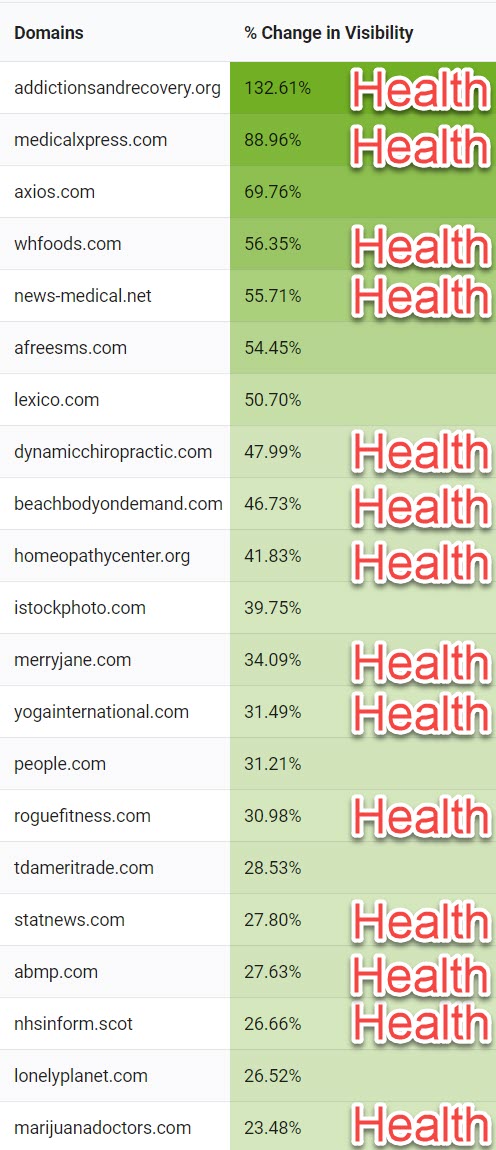
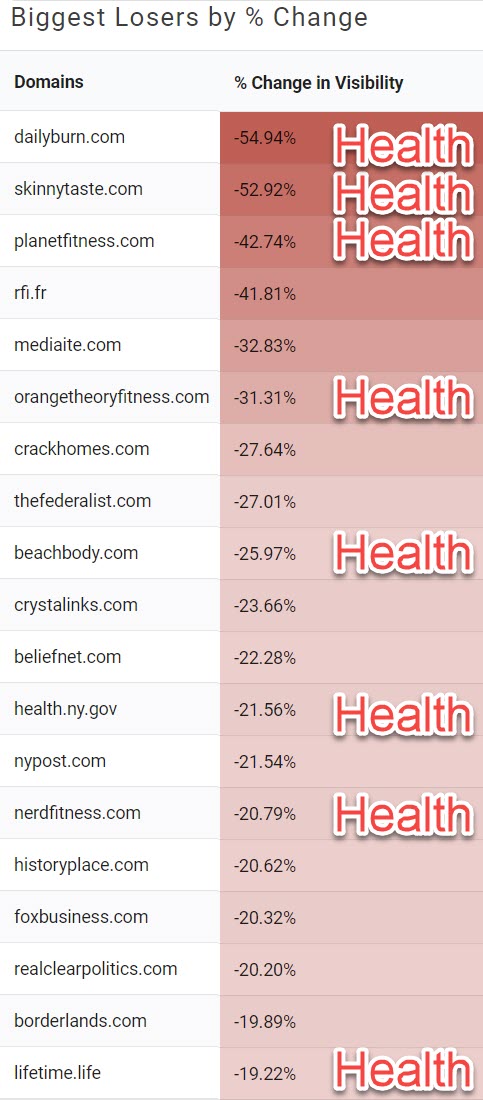
Aggressive Monetization
One of the more interesting pieces of feedback on the update was from Rank Ranger, where they looked at particular pages that jumped or fell hard on the update. They noticed sites that put ads or ad-like content front and center may have seen sharp falls on some of those big money pages which were aggressively monetized:
Seeing this all but cements the notion (in my mind at least) that Google did not want content unrelated to the main purpose of the page to appear above the fold to the exclusion of the page’s main content! Now for the second wrinkle in my theory…. A lot of the pages being swapped out for new ones did not use the above-indicated format where a series of “navigation boxes” dominated the page above the fold.
The above shift had a big impact on some sites which are worth serious money. Intuit paid over $7 billion to acquire Credit Karma, but their credit card affiliate pages recently slid hard.
Credit Karma lost 40% traffic from May core update. That’s insane, they do major TV ads and likely pay millions in SEO expenses. Think about that folks. Your site isn’t safe. Google changes what they want radically with every update, while telling us nothing!— SEOwner (@tehseowner) May 14, 2020
The above sort of shift reflects Google getting more granular with their algorithms. Early Panda was all or nothing. Then it started to have different levels of impact throughout different portions of a site.
Brand was sort of a band aid or a rising tide that lifted all (branded) boats. Now we are seeing Google get more granular with their algorithms where a strong brand might not be enough if they view the monetization as being excessive. That same focus on page layout can have a more adverse impact on small niche websites.
One of my old legacy clients had a site which was primarily monetized by the Amazon affiliate program. About a month ago Amazon chopped affiliate commissions in half & then the aggressive ad placement caused search traffic to the site to get chopped in half when rankings slid on this update.
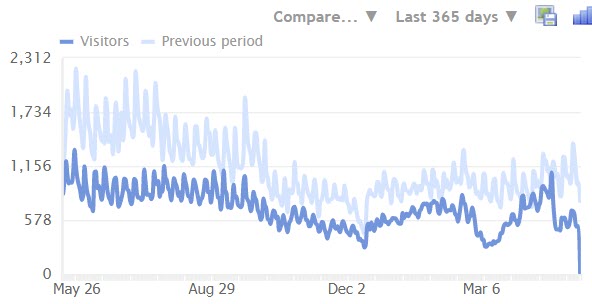
Their site has been trending down over the past couple years largely due to neglect as it was always a small side project. They recently improved some of the content about a month or so ago and that ended up leading to a bit of a boost, but then this update came. As long as that ad placement doesn’t change the declines are likely to continue.
They just recently removed that ad unit, but that meant another drop in income as until there is another big algo update they’re likely to stay at around half search traffic. So now they have a half of a half of a half. Good thing the site did not have any full time employees or they’d be among the millions of newly unemployed. That experience though really reflects how websites can be almost like debt levered companies in terms of going under virtually overnight. Who can have revenue slide around 88% and then take increase investment in the property using the remaining 12% while they wait for the site to be rescored for a quarter year or more?
“If you have been negatively impacted by a core update, you (mostly) cannot see recovery from that until another core update. In addition, you will only see recovery if you significantly improve the site over the long-term. If you haven’t done enough to improve the site overall, you might have to wait several updates to see an increase as you keep improving the site. And since core updates are typically separated by 3-4 months, that means you might need to wait a while.”
Almost nobody can afford to do that unless the site is just a side project.
Google could choose to run major updates more frequently, allowing sites to recover more quickly, but they gain economic benefit in defunding SEO investments & adding opportunity cost to aggressive SEO strategies by ensuring ranking declines on major updates last a season or more.
Choosing a Strategy vs Letting Things Come at You
They probably should have lowered their ad density when they did those other upgrades. If they had they likely would have seen rankings at worst flat or likely up as some other competing sites fell. Instead they are rolling with a half of a half of a half on the revenue front. Glenn Gabe preaches the importance of fixing all the problems you can find rather than just fixing one or two things and hoping it is enough. If you have a site which is on the edge you sort of have to consider the trade offs between various approaches to monetization.
- monetize it lightly and hope the site does well for many years
- monetize it slightly aggressively while using the extra income to further improve the site elsewhere and ensure you have enough to get by any lean months
- aggressively monetize the shortly after a major ranking update if it was previously lightly monetized & then hope to sell it off a month or two later before the next major algorithm update clips it again
Outcomes will depend partly on timing and luck, but consciously choosing a strategy is likely to yield better returns than doing a bit of mix-n-match while having your head buried in the sand.
Reading the Algo Updates
You can spend 50 or 100 hours reading blog posts about the update and learn precisely nothing in the process if you do not know which authors are bullshitting and which authors are writing about the correct signals.
But how do you know who knows what they are talking about?
It is more than a bit tricky as the people who know the most often do not have any economic advantage in writing specifics about the update. If you primarily monetize your own websites, then the ignorance of the broader market is a big part of your competitive advantage.
Making things even trickier, the less you know the more likely Google would be to trust you with sending official messaging through you. If you syndicate their messaging without questioning it, you get a treat – more exclusives. If you question their messaging in a way that undermines their goals, you’d quickly become persona non grata – something cNet learned many years ago when they published Eric Schmidt’s address.
It would be unlikely you’d see the following sort of Tweet from say Blue Hat SEO or Fantomaster or such.
I asked Gary about E-A-T. He said it’s largely based on links and mentions on authoritative sites. i.e. if the Washington post mentions you, that’s good.
He recommended reading the sections in the QRG on E-A-T as it outlines things well.@methode #Pubcon— Marie Haynes (@Marie_Haynes) February 21, 2018
To be able to read the algorithms well you have to have some market sectors and keyword groups you know well. Passively collecting an archive of historical data makes the big changes stand out quickly.
Everyone who depends on SEO to make a living should subscribe to an online rank tracking service or run something like Serposcope locally to track at least a dozen or two dozen keywords. If you track rankings locally it makes sense to use a set of web proxies and run the queries slowly through each so you don’t get blocked.
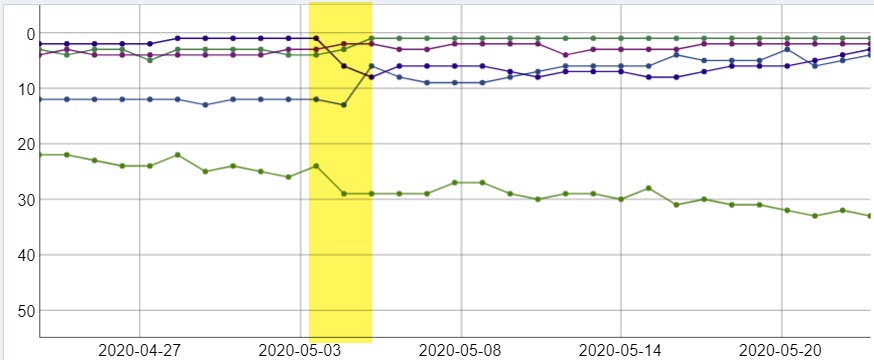
You should track at least a diverse range to get a true sense of the algorithmic changes.
- a couple different industries
- a couple different geographic markets (or at least some local-intent vs national-intent terms within a country)
- some head, midtail and longtail keywords
- sites of different size, age & brand awareness within a particular market
Some tools make it easy to quickly add or remove graphing of anything which moved big and is in the top 50 or 100 results, which can help you quickly find outliers. And some tools also make it easy to compare their rankings over time. As updates develop you’ll often see multiple sites making big moves at the same time & if you know a lot about the keyword, the market & the sites you can get a good idea of what might have been likely to change to cause those shifts.
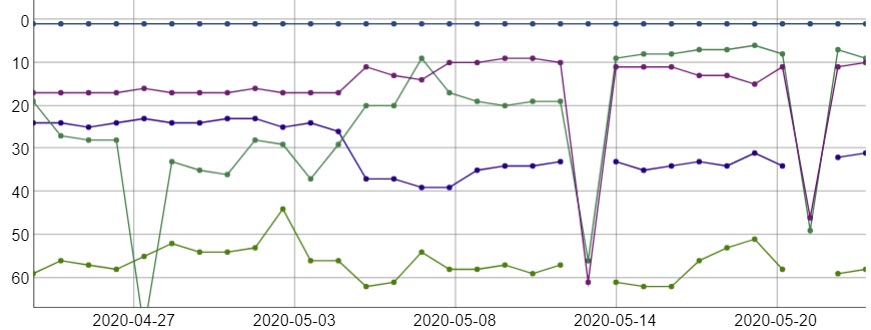
Once you see someone mention outliers most people miss that align with what you see in a data set, your level of confidence increases and you can spend more time trying to unravel what signals changed.
I’ve read influential industry writers mention that links were heavily discounted on this update. I have also read Tweets like this one which could potentially indicate the opposite.
Check out https://t.co/1GhD2U01ch . Up even more than Pinterest and ranking for some real freaky shit.— Paul Macnamara (@TheRealpmac) May 12, 2020
If I had little to no data, I wouldn’t be able to get any signal out of that range of opinions. I’d sort of be stuck at “who knows.”
By having my own data I track I can quickly figure out which message is more inline with what I saw in my subset of data & form a more solid hypothesis.
No Single Smoking Gun
As Glenn Gabe is fond of saying, sites that tank usually have multiple major issues.
Google rolls out major updates infrequently enough that they can sandwich a couple different aspects into major updates at the same time in order to make it harder to reverse engineer updates. So it does help to read widely with an open mind and imagine what signal shifts could cause the sorts of ranking shifts you are seeing.
Sometimes site level data is more than enough to figure out what changed, but as the above Credit Karma example showed sometimes you need to get far more granular and look at page-level data to form a solid hypothesis.
As the World Changes, the Web Also Changes
About 15 years ago online dating was seen as a weird niche for recluses who perhaps typically repulsed real people in person. Now there are all sorts of niche specialty dating sites including a variety of DTF type apps. What was once weird & absurd had over time become normal.
The COVID-19 scare is going to cause lasting shifts in consumer behavior that accelerate the movement of commerce online. A decade of change will happen in a year or two across many markets.
Telemedicine will grow quickly. Facebook is adding commerce featured directly onto their platform through partnering with Shopify. Spotify is spending big money to buy exclusives rights to distribute widely followed podcasters like Joe Rogan. Uber recently offered to acquire GrubHub. Google and Apple will continue adding financing features to their mobile devices. Movie theaters have lost much of their appeal.
Tons of offline “value” businesses ended up having no value after months of revenue disappearing while large outstanding debts accumulated interest. There is a belief that some of those brands will have strong latent brand value that carries over online, but if they were weak even when the offline stores acting like interactive billboards subsidized consumer awareness of their brands then as those stores close the consumer awareness & loyalty from in-person interactions will also dry up. A shell of a company rebuilt around the Toys R’ Us brand is unlikely to beat out Amazon’s parallel offering or a company which still runs stores offline.
Big box retailers like Target & Walmart are growing their online sales at hundreds of percent year over year.
There will be waves of bankruptcies, shifts in commercial real estate prices, more people working remotely (shifting residential real estate demand from the urban core back out into suburbs).
More and more activities will become normal online activities.
The University of California has about a half-million students & in the fall semester they are going to try to have most of those classes happen online. How much usage data does Google gain as thousands of institutions put more and more of their infrastructure and service online?
Colleges have to convince students for the next year that a remote education is worth every bit as much as an in-person one, and then pivot back before students actually start believing it.
It’s like only being able to sell your competitor’s product for a year.— Naval (@naval) May 6, 2020
A lot of B & C level schools are going to go under as the like-vs-like comparison gets easier. Back when I ran a membership site here a college paid us to have students gain access to our membership area of the site. As online education gets normalized many unofficial trade-related sites will look more economically attractive on a relative basis.
Categories:
How to Read Google Algorithm Updates
Links = Rank
Old Google (pre-Panda) was to some degree largely the following: links = rank.
Once you had enough links to a site you could literally pour content into a site like water and have the domain’s aggregate link authority help anything on that site rank well quickly.
As much as PageRank was hyped & important, having a diverse range of linking domains and keyword-focused anchor text were important.
Brand = Rank
After Vince then Panda a site’s brand awareness (or, rather, ranking signals that might best simulate it) were folded into the ability to rank well.
Panda considered factors beyond links & when it first rolled out it would clip anything on a particular domain or subdomain. Some sites like HubPages shifted their content into subdomains by users. And some aggressive spammers would rotate their entire site onto different subdomains repeatedly each time a Panda update happened. That allowed those sites to immediately recover from the first couple Panda updates, but eventually Google closed off that loophole.
Any signal which gets relied on eventually gets abused intentionally or unintentionally. And over time it leads to a “sameness” of the result set unless other signals are used:
Google is absolute garbage for searching anything related to a product. If I’m trying to learn something invariably I am required to search another source like Reddit through Google. For example, I became introduced to the concept of weighted blankets and was intrigued. So I Google “why use a weighted blanket” and “weighted blanket benefits”. Just by virtue of the word “weighted blanket” being in the search I got pages and pages of nothing but ads trying to sell them, and zero meaningful discourse on why I would use one
Getting More Granular
Over time as Google got more refined with Panda broad-based sites outside of the news vertical often fell on tough times unless they were dedicated to some specific media format or had a lot of user engagement metrics like a strong social network site. That is a big part of why the New York Times sold About.com for less than they paid for it & after IAC bought it they broke it down into a variety of sites like: Verywell (health), the Spruce (home decor), the Balance (personal finance), Lifewire (technology), Tripsavvy (travel) and ThoughtCo (education & self-improvement).
Penguin further clipped aggressive anchor text built on low quality links. When the Penguin update rolled out Google also rolled out an on-page spam classifier to further obfuscate the update. And the Penguin update was sandwiched by Panda updates on either side, making it hard for people to reverse engineer any signal out of weekly winners and losers lists from services that aggregate massive amounts of keyword rank tracking data.
So much of the link graph has been decimated that Google reversed their stance on nofollow to where in March 1st of this year they started treating it as a hint versus a directive for ranking purposes. Many mainstream media websites were overusing nofollow or not citing sources at all, so this additional layer of obfuscation on Google’s part will allow them to find more signal in that noise.
May 4, 2020 Algo Update
On May 4th Google rolled out another major core update.
Later today, we are releasing a broad core algorithm update, as we do several times per year. It is called the May 2020 Core Update. Our guidance about such updates remains as we’ve covered before. Please see this blog post for more about that:https://t.co/e5ZQUAlt0G— Google SearchLiaison (@searchliaison) May 4, 2020
I saw some sites which had their rankings suppressed for years see a big jump. But many things changed at once.
Wedge Issues
On some political search queries which were primarily classified as being news related Google is trying to limit political blowback by showing official sites and data scraped from official sites instead of putting news front & center.
“Google’s pretty much made it explicit that they’re not going to propagate news sites when it comes to election related queries and you scroll and you get a giant election widget in your phone and it shows you all the different data on the primary results and then you go down, you find Wikipedia, you find other like historical references, and before you even get to a single news article, it’s pretty crazy how Google’s changed the way that the SERP is intended.”
That change reflects the permanent change to the news media ecosystem brought on by the web.
The Internet commoditized the distribution of facts. The “news” media responded by pivoting wholesale into opinions and entertainment.— Naval (@naval) May 26, 2016
YMYL
A blog post by Lily Ray from Path Interactive used Sistrix data to show many of the sites which saw high volatility were in the healthcare vertical & other your money, your life (YMYL) categories.
Aggressive Monetization
One of the more interesting pieces of feedback on the update was from Rank Ranger, where they looked at particular pages that jumped or fell hard on the update. They noticed sites that put ads or ad-like content front and center may have seen sharp falls on some of those big money pages which were aggressively monetized:
Seeing this all but cements the notion (in my mind at least) that Google did not want content unrelated to the main purpose of the page to appear above the fold to the exclusion of the page’s main content! Now for the second wrinkle in my theory…. A lot of the pages being swapped out for new ones did not use the above-indicated format where a series of “navigation boxes” dominated the page above the fold.
The above shift had a big impact on some sites which are worth serious money. Intuit paid over $7 billion to acquire Credit Karma, but their credit card affiliate pages recently slid hard.
Credit Karma lost 40% traffic from May core update. That’s insane, they do major TV ads and likely pay millions in SEO expenses. Think about that folks. Your site isn’t safe. Google changes what they want radically with every update, while telling us nothing!— SEOwner (@tehseowner) May 14, 2020
The above sort of shift reflects Google getting more granular with their algorithms. Early Panda was all or nothing. Then it started to have different levels of impact throughout different portions of a site.
Brand was sort of a band aid or a rising tide that lifted all (branded) boats. Now we are seeing Google get more granular with their algorithms where a strong brand might not be enough if they view the monetization as being excessive. That same focus on page layout can have a more adverse impact on small niche websites.
One of my old legacy clients had a site which was primarily monetized by the Amazon affiliate program. About a month ago Amazon chopped affiliate commissions in half & then the aggressive ad placement caused search traffic to the site to get chopped in half when rankings slid on this update.
Their site has been trending down over the past couple years largely due to neglect as it was always a small side project. They recently improved some of the content about a month or so ago and that ended up leading to a bit of a boost, but then this update came. As long as that ad placement doesn’t change the declines are likely to continue.
They just recently removed that ad unit, but that meant another drop in income as until there is another big algo update they’re likely to stay at around half search traffic. So now they have a half of a half of a half. Good thing the site did not have any full time employees or they’d be among the millions of newly unemployed. That experience though really reflects how websites can be almost like debt levered companies in terms of going under virtually overnight. Who can have revenue slide around 88% and then take increase investment in the property using the remaining 12% while they wait for the site to be rescored for a quarter year or more?
“If you have been negatively impacted by a core update, you (mostly) cannot see recovery from that until another core update. In addition, you will only see recovery if you significantly improve the site over the long-term. If you haven’t done enough to improve the site overall, you might have to wait several updates to see an increase as you keep improving the site. And since core updates are typically separated by 3-4 months, that means you might need to wait a while.”
Almost nobody can afford to do that unless the site is just a side project.
Google could choose to run major updates more frequently, allowing sites to recover more quickly, but they gain economic benefit in defunding SEO investments & adding opportunity cost to aggressive SEO strategies by ensuring ranking declines on major updates last a season or more.
Choosing a Strategy vs Letting Things Come at You
They probably should have lowered their ad density when they did those other upgrades. If they had they likely would have seen rankings at worst flat or likely up as some other competing sites fell. Instead they are rolling with a half of a half of a half on the revenue front. Glenn Gabe preaches the importance of fixing all the problems you can find rather than just fixing one or two things and hoping it is enough. If you have a site which is on the edge you sort of have to consider the trade offs between various approaches to monetization.
- monetize it lightly and hope the site does well for many years
- monetize it slightly aggressively while using the extra income to further improve the site elsewhere and ensure you have enough to get by any lean months
- aggressively monetize the shortly after a major ranking update if it was previously lightly monetized & then hope to sell it off a month or two later before the next major algorithm update clips it again
Outcomes will depend partly on timing and luck, but consciously choosing a strategy is likely to yield better returns than doing a bit of mix-n-match while having your head buried in the sand.
Reading the Algo Updates
You can spend 50 or 100 hours reading blog posts about the update and learn precisely nothing in the process if you do not know which authors are bullshitting and which authors are writing about the correct signals.
But how do you know who knows what they are talking about?
It is more than a bit tricky as the people who know the most often do not have any economic advantage in writing specifics about the update. If you primarily monetize your own websites, then the ignorance of the broader market is a big part of your competitive advantage.
Making things even trickier, the less you know the more likely Google would be to trust you with sending official messaging through you. If you syndicate their messaging without questioning it, you get a treat – more exclusives. If you question their messaging in a way that undermines their goals, you’d quickly become persona non grata – something cNet learned many years ago when they published Eric Schmidt’s address.
It would be unlikely you’d see the following sort of Tweet from say Blue Hat SEO or Fantomaster or such.
I asked Gary about E-A-T. He said it’s largely based on links and mentions on authoritative sites. i.e. if the Washington post mentions you, that’s good.
He recommended reading the sections in the QRG on E-A-T as it outlines things well.@methode #Pubcon— Marie Haynes (@Marie_Haynes) February 21, 2018
To be able to read the algorithms well you have to have some market sectors and keyword groups you know well. Passively collecting an archive of historical data makes the big changes stand out quickly.
Everyone who depends on SEO to make a living should subscribe to an online rank tracking service or run something like Serposcope locally to track at least a dozen or two dozen keywords. If you track rankings locally it makes sense to use a set of web proxies and run the queries slowly through each so you don’t get blocked.
You should track at least a diverse range to get a true sense of the algorithmic changes.
- a couple different industries
- a couple different geographic markets (or at least some local-intent vs national-intent terms within a country)
- some head, midtail and longtail keywords
- sites of different size, age & brand awareness within a particular market
Some tools make it easy to quickly add or remove graphing of anything which moved big and is in the top 50 or 100 results, which can help you quickly find outliers. And some tools also make it easy to compare their rankings over time. As updates develop you’ll often see multiple sites making big moves at the same time & if you know a lot about the keyword, the market & the sites you can get a good idea of what might have been likely to change to cause those shifts.
Once you see someone mention outliers most people miss that align with what you see in a data set, your level of confidence increases and you can spend more time trying to unravel what signals changed.
I’ve read influential industry writers mention that links were heavily discounted on this update. I have also read Tweets like this one which could potentially indicate the opposite.
Check out https://t.co/1GhD2U01ch . Up even more than Pinterest and ranking for some real freaky shit.— Paul Macnamara (@TheRealpmac) May 12, 2020
If I had little to no data, I wouldn’t be able to get any signal out of that range of opinions. I’d sort of be stuck at “who knows.”
By having my own data I track I can quickly figure out which message is more inline with what I saw in my subset of data & form a more solid hypothesis.
No Single Smoking Gun
As Glenn Gabe is fond of saying, sites that tank usually have multiple major issues.
Google rolls out major updates infrequently enough that they can sandwich a couple different aspects into major updates at the same time in order to make it harder to reverse engineer updates. So it does help to read widely with an open mind and imagine what signal shifts could cause the sorts of ranking shifts you are seeing.
Sometimes site level data is more than enough to figure out what changed, but as the above Credit Karma example showed sometimes you need to get far more granular and look at page-level data to form a solid hypothesis.
As the World Changes, the Web Also Changes
About 15 years ago online dating was seen as a weird niche for recluses who perhaps typically repulsed real people in person. Now there are all sorts of niche specialty dating sites including a variety of DTF type apps. What was once weird & absurd had over time become normal.
The COVID-19 scare is going to cause lasting shifts in consumer behavior that accelerate the movement of commerce online. A decade of change will happen in a year or two across many markets.
Telemedicine will grow quickly. Facebook is adding commerce featured directly onto their platform through partnering with Shopify. Spotify is spending big money to buy exclusives rights to distribute widely followed podcasters like Joe Rogan. Uber recently offered to acquire GrubHub. Google and Apple will continue adding financing features to their mobile devices. Movie theaters have lost much of their appeal.
Tons of offline “value” businesses ended up having no value after months of revenue disappearing while large outstanding debts accumulated interest. There is a belief that some of those brands will have strong latent brand value that carries over online, but if they were weak even when the offline stores acting like interactive billboards subsidized consumer awareness of their brands then as those stores close the consumer awareness & loyalty from in-person interactions will also dry up. A shell of a company rebuilt around the Toys R’ Us brand is unlikely to beat out Amazon’s parallel offering or a company which still runs stores offline.
Big box retailers like Target & Walmart are growing their online sales at hundreds of percent year over year.
There will be waves of bankruptcies, dramatic shifts in commercial real estate prices (already reflected in plunging REIT prices), and more people working remotely (shifting residential real estate demand from the urban core back out into suburbs).
People who work remote are easier to hire and easier to fire. Those who keep leveling up their skills will eventually get rewarded while those who don’t will rotate jobs every year or two. The lack of stability will increase demand for education, though much of that incremental demand will be around new technologies and specific sectors – certificates or informal training programs instead of degrees.
More and more activities will become normal online activities.
The University of California has about a half-million students & in the fall semester they are going to try to have most of those classes happen online. How much usage data does Google gain as thousands of institutions put more and more of their infrastructure and service online?
Colleges have to convince students for the next year that a remote education is worth every bit as much as an in-person one, and then pivot back before students actually start believing it.
It’s like only being able to sell your competitor’s product for a year.— Naval (@naval) May 6, 2020
A lot of B & C level schools are going to go under as the like-vs-like comparison gets easier. Back when I ran a membership site here a college paid us to have students gain access to our membership area of the site. As online education gets normalized many unofficial trade-related sites will look more economically attractive on a relative basis.
If core institutions of the state deliver most of their services online, then other companies can be expected to follow. When big cities publish lists of crimes they will not respond to during economic downturns they are effectively subsidizing more crime. That in turn makes moving to somewhere a bit more rural & cheaper make sense, particularly when you no longer need to live near your employer.
The most important implication of this permanent WFH movement are state income taxes.
The warm, sunny states with affordable housing and zero taxes will see an influx of educated, rich workers. States will need to cut taxes to keep up.
The biggest loser in this is CA.— Chamath Palihapitiya (@chamath) May 21, 2020
Categories:
Easy for You
To Teach, One Must Learn
One of the benefits of writing is it forces you to structure your thoughts.
If you are doing something to pass a test rote memorization can work, but if you are trying to teach someone else and care it forces you to know with certainty what you are teaching.
When I was in nuclear power school one guy was about to flunk out and I did not want to let him so I taught him stuff for days. He passed that test and as a side effect I got my highest score I ever got on one of those tests. He eventually did flunk out, but he knew other people were rooting for him and tried to help him.
Market Your Work or Become Redundant
Going forward as more work becomes remote it is going to be easier to hire and fire people. The people who are great at sharing their work and leaving a public record of it will likely be swimming in great opportunities, whereas some equally talented people who haven’t built up a bit of personal brand equity will repeatedly get fired in spite of being amazingly talented, simply because there was a turn in the economy and management is far removed from the talent. As bad as petty office politics can be, it will likely become more arbitrary when everyone is taking credit for the work of others & people are not sitting side by side to see who actually did the work.

Uber recently announced they were laying off thousands of employees while looking to move a lot of their core infrastructure work overseas where labor is cheaper. Lots of people will be made redundant as unicorn workers in a recession suddenly enjoy the job stability and all the perks of the gig working economy.
Design
We have a great graphic designer who is deeply passionate about his work. He can hand draw amazing art or comics and is also great at understanding illustration software, web design, web usability, etc. I have no idea why he was fired from his prior employer but am thankful he was as he has been a joy to work with.
Before COVID-19 killed office work I sat right next to our lead graphic designer and when I would watch him use Adobe Illustrator I was both in awe of him and annoyed at how easy he would make things look. He is so good at it that and endless array of features are second nature to him. When I would ask him how to do something I just saw him do frequently it would be harder for him to explain how he does it than doing it.
Programming
Our graphics designer is also a quite solid HTML designer, though strictly front end design. One day when I took an early lunch with my wife I asked him to create a Wordpress theme off his HTML design and when I got back he was like … ummm. :)

We are all wizards at some things and horrible at others. When I use Adobe Illustrator for even the most basic tasks I feel like a guy going to a breakdancing party with no cardboard and 2 left shoes.
There are a number of things that are great about programming
- it is largely logic-based
- people drawn toward it tend to be smart
- people who can organize code also tend to use language directly (making finding solutions via search rather easy)
Though over time programming languages change features & some changes are not backward compatible. And as some free & open source projects accumulate dependencies they end up promoting the use of managers. Some of these may not be easy to install & configure on a remote shared server (with user permission issues) from a Windows computer. So then you install another package on your local computer and then have to research how it came with a deprecated php track_errors setting. And on and on.
One software program I installed on about a half-dozen sites many moons ago launched a new version recently & the typical quick 5 minute install turned into a half day of nothing. The experience felt a bit like a “choose your own adventure” book, where almost every choice you make leads to: start again at the beginning.
At that point a lot of the advice one keeps running into sort of presumes one has the exact same computer set up they do, so search again, solve that problem, turn on error messaging, and find the next problem to … once again start at the beginning.
That sort of experience is more than a bit humbling & very easy to run into when one goes outside their own sphere of expertise.
Losing the Beginner’s Mindset
If you do anything for an extended period of time it is easy to take many things for granted as you lose the beginner’s mindset.
One of the reasons it is important to go outside your field of expertise is to remind yourself of what that experience feels like.

Anyone who has been in SEO for a decade likely does the same thing when communicating about search by presuming the same level of domain expertise and talking past people. Some aspects of programming are hard because they are complex. But when you are doing simple and small jobs then if things absolutely do not work you often get the answer right away. Whereas with SEO you can be unsure of the results of a large capital and labor investment until the next time a core algorithm update happens a quarter year from now. That uncertainty acts as the barrier to entry & blocker of institutional investments which allow for sustained above average profit margins for those who make the cut, but it also means a long lag time and requiring a high level of certainty to make a big investment.
The hard part about losing the beginners mindset with SEO is sometimes the algorithms do change dramatically and you have to absolutely reinvent yourself while throwing out what you know (use keyword rich anchor text aggressively, build tons of links, exact match domains beat out brands, repeat keyword in bold on page, etc.) and start afresh as the algorithms reshuffle the playing field.
The Web Keeps Changing
While the core algorithms are shifting so too is how people use the web. Any user behaviors are shifting as search results add more features and people search on mobile devices or search using their voice. Now that user engagement is a big part of ranking, anything which impacts brand perception or user experience also impacts SEO. Social distancing will have major impacts on how people engage with search. We have already seen a rapid rise of e-commerce at the expense of offline sales & some colleges are planning on holding next year entirely online. The University of California will have roughly a half-million students attending school online next year unless students opt for something cheaper.
Colleges have to convince students for the next year that a remote education is worth every bit as much as an in-person one, and then pivot back before students actually start believing it.
It’s like only being able to sell your competitor’s product for a year.— Naval (@naval) May 6, 2020
What Resolution?
I am horrible with Adobe Illustrator. But one of the things I have learned with that and Photoshop is that if you edit in a rather high resolution you can have many of your errors disappear to the naked eye when it is viewed at a normal resolution. The same analogy holds true for web design but in the opposite direction … if your usability is solid on a mobile device & the design looks good on a mobile device then it will probably be decent on desktop as well.
Some people also make a resolution mistake with SEO.
- If nobody knows about a site or brand or company having perfect valid HTML, supporting progressive web apps, supporting AMP, using microformats, etc. … does not matter.
- On the flip side, if a site is well known it can get away with doing many things sub-optimally & can perhaps improve a lot by emulating sites which are growing over time in spite of having weaker brand strength.
Free, so Good Enough?
Many open source software programs do not do usability testing or track the efforts of a somewhat average user or new user in their ability to download and install software because they figure it is free so oh well people should figure it out. That thinking is a mistake though, because each successive increase in barrier to entry limits your potential market size & eventually some old users leave for one reason or another.
Any free software project which accumulates attention and influence can be monetized in other ways (through consulting, parallel SaaS offerings, affiliate ad integration, partnering with Hot Nacho to feature some great content in a hidden div using poetic code, etc.). But if they lack reach, see slowing growth, and then increase the barrier to entry they are likely to die.
When you ask someone to pay for something you’ll know if they like it and where they think it can be improved. Relying on the free price point hides many problems and allows them to accumulate.
The ability to make things easy for absolute beginners is a big part of why Wordpress is worth many multiples of what Acquia sold for. And Wordpress has their VIP hosting service, Akismet, and a bunch of other revenue streams while Acquia is now owned by a private equity company.
The ability to be 0.0000001% as successful as Wordpress has been without losing the beginner mindset is hard.
Categories:
Easy for You
To Teach, One Must Learn
One of the benefits of writing is it forces you to structure your thoughts.
If you are doing something to pass a test rote memorization can work, but if you are trying to teach someone else and care it forces you to know with certainty what you are teaching.
When I was in nuclear power school one guy was about to flunk out and I did not want to let him so I taught him stuff for days. He passed that test and as a side effect I got my highest score I ever got on one of those tests. He eventually did flunk out, but he knew other people were rooting for him and tried to help him.
Market Your Work or Become Redundant
Going forward as more work becomes remote it is going to be easier to hire and fire people. The people who are great at sharing their work and leaving a public record of it will likely be swimming in great opportunities, whereas some equally talented people who haven’t built up a bit of personal brand equity will repeatedly get fired in spite of being amazingly talented, simply because there was a turn in the economy and management is far removed from the talent. As bad as petty office politics can be, it will likely become more arbitrary when everyone is taking credit for the work of others & people are not sitting side by side to see who actually did the work.
Uber recently announced they were laying off thousands of employees while looking to move a lot of their core infrastructure work overseas where labor is cheaper. Lots of people will be made redundant as unicorn workers in a recession suddenly enjoy the job stability and all the perks of the gig working economy.
Design
We have a great graphic designer who is deeply passionate about his work. He can hand draw amazing art or comics and is also great at understanding illustration software, web design, web usability, etc. I have no idea why he was fired from his prior employer but am thankful he was as he has been a joy to work with.
Before COVID-19 killed office work I sat right next to our lead graphic designer and when I would watch him use Adobe Illustrator I was both in awe of him and annoyed at how easy he would make things look. He is so good at it that and endless array of features are second nature to him. When I would ask him how to do something I just saw him do frequently it would be harder for him to explain how he does it than doing it.
Programming
Our graphics designer is also a quite solid HTML designer, though strictly front end design. One day when I took an early lunch with my wife I asked him to create a Wordpress theme off his HTML design and when I got back he was like … ummm. :)
We are all wizards at some things and horrible at others. When I use Adobe Illustrator for even the most basic tasks I feel like a guy going to a breakdancing party with no cardboard and 2 left shoes.
There are a number of things that are great about programming
- it is largely logic-based
- people drawn toward it tend to be smart
- people who can organize code also tend to use language directly (making finding solutions via search rather easy)
Though over time programming languages change features & some changes are not backward compatible. And as some free & open source projects accumulate dependencies they end up promoting the use of managers. Some of these may not be easy to install & configure on a remote shared server (with user permission issues) from a Windows computer. So then you install another package on your local computer and then have to research how it came with a deprecated php track_errors setting. And on and on.
One software program I installed on about a half-dozen sites many moons ago launched a new version recently & the typical quick 5 minute install turned into a half day of nothing. The experience felt a bit like a “choose your own adventure” book, where almost every choice you make leads to: start again at the beginning.
At that point a lot of the advice one keeps running into sort of presumes one has the exact same computer set up they do, so search again, solve that problem, turn on error messaging, and find the next problem to … once again start at the beginning.
That sort of experience is more than a bit humbling & very easy to run into when one goes outside their own sphere of expertise.
Losing the Beginner’s Mindset
If you do anything for an extended period of time it is easy to take many things for granted as you lose the beginner’s mindset.
One of the reasons it is important to go outside your field of expertise is to remind yourself of what that experience feels like.
Anyone who has been in SEO for a decade likely does the same thing when communicating about search by presuming the same level of domain expertise and talking past people. Some aspects of programming are hard because they are complex. But when things absolutely do not work you often get the answer right away. Whereas with SEO you can be unsure of the results of a large capital and labor investment until the next time a core algorithm update happens a quarter year from now. That uncertainty acts as the barrier to entry & blocker of institutional investments which allow for sustained above average profit margins for those who make the cut, but it also means a long lag time and requiring a high level of certainty to make a big investment.
The hard part about losing the beginners mindset with SEO is sometimes the algorithms do change dramatically and you have to absolutely reinvent yourself while throwing out what you know (use keyword rich anchor text aggressively, build tons of links, exact match domains beat out brands, repeat keyword in bold on page, etc.) and start afresh as the algorithms reshuffle the playing field.
The Web Keeps Changing
While the core algorithms are shifting so too is how people use the web. Any user behaviors are shifting as search results add more features and people search on mobile devices or search using their voice. Now that user engagement is a big part of ranking, anything which impacts brand perception or user experience also impacts SEO. Social distancing will have major impacts on how people engage with search. We have already seen a rapid rise of e-commerce at the expense of offline sales & some colleges are planning on holding next year entirely online. The University of California will have roughly a half-million students attending school online next year unless students opt for something cheaper.
Colleges have to convince students for the next year that a remote education is worth every bit as much as an in-person one, and then pivot back before students actually start believing it.
It’s like only being able to sell your competitor’s product for a year.— Naval (@naval) May 6, 2020
What Resolution?
I am horrible with Adobe Illustrator. But one of the things I have learned with that and Photoshop is that if you edit in a rather high resolution you can have many of your errors disappear to the naked eye when it is viewed at a normal resolution. The same analogy holds true for web design but in the opposite direction … if your usability is solid on a mobile device & the design looks good on a mobile device then it will probably be decent on desktop as well.
Some people also make a resolution mistake with SEO.
- If nobody knows about a site or brand or company having perfect valid HTML, supporting progressive web apps, supporting AMP, using microformats, etc. … does not matter.
- On the flip side, if a site is well known it can get away with doing many things sub-optimally & can perhaps improve a lot by emulating sites which are growing over time in spite of having weaker brand strength.
Free, so Good Enough?
Many open source software programs do not do usability testing or track the efforts of a somewhat average user or new user in their ability to download and install software because they figure it is free so oh well people should figure it out. That thinking is a mistake though, because each successive increase in barrier to entry limits your potential market size & eventually some old users leave for one reason or another.
Any free software project which accumulates attention and influence can be monetized in other ways (through consulting, parallel SaaS offerings, affiliate ad integration, partnering with Hot Nacho to feature some great content in a hidden div using poetic code, etc.). But if they lack reach, see slowing growth, and then increase the barrier to entry they are likely to die.
When you ask someone to pay for something you’ll know if they like it and where they think it can be improved. Relying on the free price point hides many problems and allows them to accumulate.
The ability to make things easy for absolute beginners is a big part of why Wordpress is worth many multiples of what Acquia sold for. And Wordpress has their VIP hosting service, Akismet, and a bunch of other revenue streams while Acquia is now owned by a private equity company.
The ability to be 0.0000001% as successful as Wordpress has been without losing the beginner mindset is hard.
Categories:
New Age Cloaking
Historically cloaking was considered bad because a consumer would click expecting a particular piece of content or user experience while being delivered an experience which differed dramatically.
As publishers have become more aggressive with paywalls…
New Age Cloaking
Historically cloaking was considered bad because a consumer would click expecting a particular piece of content or user experience while being delivered an experience which differed dramatically.
As publishers have become more aggressive with paywalls…
Managing Algorithmic Volatility
Upon the recently announced Google update I’ve seen some people Tweet things like
- if you are afraid of algorithm updates, you must be a crappy SEO
- if you are technically perfect in your SEO, updates will only help you
I read those sorts of lines and cringe.
Here’s why…
Fragility
Different businesses, business models, and business structures have varying degrees of fragility.
If your business is almost entirely based on serving clients then no matter what you do there is going to be a diverse range of outcomes for clients on any major update.
Let’s say 40% of your clients are utterly unaffected by an update & of those who saw any noticeable impact there was a 2:1 ratio in your favor, with twice as many clients improving as falling.
Is that a good update? Does that work well for you?
If you do nothing other than client services as your entire business model, then that update will likely suck for you even though the net client impact was positive.
Why?
Many businesses are hurting after the Covid-19 crisis. Entire categories have been gutted & many people are looking for any reason possible to pull back on budget. Some of the clients who won big on the update might end up cutting their SEO budget figuring they had already won big and that problem was already sorted.
Some of the clients that fell hard are also likely to either cut their budget or call endlessly asking for updates and stressing the hell out of your team.

Capacity Utilization Impacts Profit Margins
Your capacity utilization depends on how high you can keep your steady state load relative to what your load looks like at peaks. When there are big updates management or founders can decide to work double shifts and do other things to temporarily deal with increased loads at the peak, but that can still be stressful as hell & eat away at your mental and physical health as sleep and exercise are curtailed while diet gets worse. The stress can be immense if clients want results almost immediately & the next big algorithm update which reflects your current work may not happen for another quarter year.
How many clients want to be told that their investments went sour but the problem was they needed to double their investment while cashflow is tight and wait a season or two while holding on to hope?
Category-based Fragility
Businesses which appear to be diversified often are not.
- Everything in hospitality was clipped by Covid-19.
- 40% of small businesses across the United States have stopped making rent payments.
- When restaurants massively close that’s going to hit Yelp’s business hard.
- Auto sales are off sharply.
Likewise there can be other commonalities in sites which get hit during an update. Not only could it include business category, but it could also be business size, promotional strategies, etc.
Sustained profits either come from brand strength, creative differentiation, or systemization. Many prospective clients do not have the budget to build a strong brand nor the willingness to create something that is truly differentiated. That leaves systemization. Systemization can leave footprints which act as statistical outliers that can be easily neutralized.
Sharp changes can happen at any point in time.
For years Google was funding absolute garbage like Mahalo autogenerated spam and eHow with each month being a new record. It is very hard to say “we are doing it wrong” or “we need to change everything” when it works month after month after month.
Then an update happens and poof.
- Was eHow decent back in the first Internet bubble? Sure. But it lost money.
- Was it decent after it got bought out for a song and had the paywall dropped in favor of using the new Google AdSense program? Sure.
- Was it decent the day Demand Media acquired it? Sure.
- Was it decent on the day of the Demand Media IPO? Almost certainly not. But there was a lag between that day and getting penalized.
Panda Trivia

The first Panda update missed eHow because journalists were so outraged by the narrative associated with the pump-n-dump IPO. They feared their jobs going away and being displaced by that low level garbage, particularly as the market cap of Demand Media eclipsed the New York Times.
Journalist coverage of the pump-n-dump IPO added credence to it from an algorithmic perspective. By constantly writing hate about eHow they made eHow look like a popular brand, generating algorithmic signals that carried the site until Google created an extension which allowed journalists and other webmasters to vote against the site they had been voting for through all their outrage coverage.
Algorithms & the Very Visible Hand
And all algorithmic channels like organic search, the Facebook news feed, or Amazon’s product pages go through large shifts across time. If they don’t, they get gamed, repetitive, and lose relevance as consumer tastes change and upstarts like Tiktok emerge.
Consolidation by the Attention Merchants
Frequent product updates, cloning of upstarts, or outright acquisitions are required to maintain control of distribution:
“The startups of the Rebellion benefited tremendously from 2009 to 2012. But from 2013 on, the spoils of smartphone growth went to an entirely different group: the Empire. … A network effect to engage your users, AND preferred distribution channels to grow, AND the best resources to build products? Oh my! It’s no wonder why the Empire has captured so much smartphone value and created a dark time for the Rebellion. … Now startups are fighting for only 5% of the top spots as the Top Free Apps list is dominated by incumbents. Facebook (4 apps), Google (6 apps), and Amazon (4 apps) EACH have as many apps in the Top 100 list as all the new startups combined.”
Apple & Amazon
Emojis are popular, so those features got copied, those apps got blocked & then apps using the official emojis also got blocked from distribution. The same thing happens with products on Amazon.com in terms of getting undercut by a house brand which was funded by using the vendor’s sales data. Re-buy your brand or else.
Before the Facebook IPO some thought buying Zynga shares was a backdoor way to invest into Facebook because gaming was such a large part of the ecosystem. That turned out to be a dumb thesis and horrible trade. At times other things trended including quizzes, videos, live videos, news, self hosted Instant Articles, etc.
Over time the general trend was edge rank of professional publishers fell as a greater share of inventory went to content from friends & advertisers. The metrics associated with the ads often overstated their contribution to sales due to bogus math and selection bias.
Internet-first publishers like CollegeHumor struggled to keep up with the changes & influencers waiting for a Facebook deal had to monetize using third parties:
“I did 1.8 billion views last year,” [Ryan Hamilton] said. “I made no money from Facebook. Not even a dollar.” … “While waiting for Facebook to invite them into a revenue-sharing program, some influencers struck deals with viral publishers such as Diply and LittleThings, which paid the creators to share links on their pages. Those publishers paid top influencers around $500 per link, often with multiple links being posted per day, according to a person who reached such deals.”
YouTube
YouTube had a Panda-like update back in 2012 to favor watch time over raw view counts. They also adjust the ranking algorithms on breaking news topics to favor large & trusted channels over conspiracy theorist content, alternative health advice, hate speech & ridiculous memes like the Tide pod challenge.
All unproven channels need to start somewhat open to gain usage, feedback & marketshare. Once they become real businesses they clamp down. Some of the clamp down can be editorial, forced by regulators, or simply anticompetitive monpolistic abuse.
Kid videos were a huge area on YouTube (perhaps still are) but that area got cleaned up after autogenerated junk videos were covered & the FTC clipped YouTube for delivering targeted ads on channels which primarily catered to children.
Dominant channels can enforce tying & bundling to wipe out competitors:
“Google’s response to the threat from AppNexus was that of a classic monopolist. They announced that YouTube would no longer allow third-party advertising technology. This was a devastating move for AppNexus and other independent ad technology companies. YouTube was (and is) the largest ad-supported video publisher, with more than 50% market share in most major markets. … Over the next few months, Google’s ad technology team went to each of our clients and told them that, regardless of how much they liked working with AppNexus, they would have to also use Google’s ad technology products to continue buying YouTube. This is the definition of bundling, and we had no recourse. Even WPP, our largest customer and largest investors, had no choice but to start using Google’s technology. AppNexus growth slowed, and we were forced to lay off 100 employees in 2016.”
Everyone Else
Every moderately large platform like eBay, Etsy, Zillow, TripAdvisor or the above sorts of companies runs into these sorts of issues with changing distribution & how they charge for distribution.

Building Anti-fragility Into Your Business Model
Growing as fast as you can until the economy craters or an algorithm clips you almost guarantees a hard fall along with an inability to deal with it.
Markets ebb and flow. And that would be true even if the above algorithmic platforms did not make large, sudden shifts.
Build Optionality Into Your Business Model
If your business primarily relies on publishing your own websites or you have a mix of a few clients and your own sites then you have a bit more optionality to your approach in dealing with updates.
Even if you only have one site and your business goes to crap maybe you at least temporarily take on a few more consulting clients or do other gig work to make ends meet.
Focus on What is Working
If you have a number of websites you can pour more resources into whatever sites reacted positively to the update while (at least temporarily) ignoring any site that was burned to a crisp.
Ignore the Dead Projects
The holding cost of many websites is close to zero unless they use proprietary and complex content management systems. Waiting out a penalty until you run out of obvious improvements on your winning sites is not a bad strategy. Plus, if you think the burned site is going to be perpetually burned to a crisp (alternative health anyone?) then you could sell links off it or generate other alternative revenue streams not directly reliant on search rankings.
Build a Cushion
If you have cash savings maybe you guy out and buy some websites or domain names from other people who are scared of the volatility or got clipped for issues you think you could easily fix.
When the tide goes out debt leverage limits your optionality. Savings gives you optionality. Having slack in your schedule also gives you optionality.
The person with a lot of experience & savings would love to see highly volatile search markets because those will wash out some of the competition, curtail investments from existing players, and make other potential competitors more hesitant to enter the market.
Categories: