
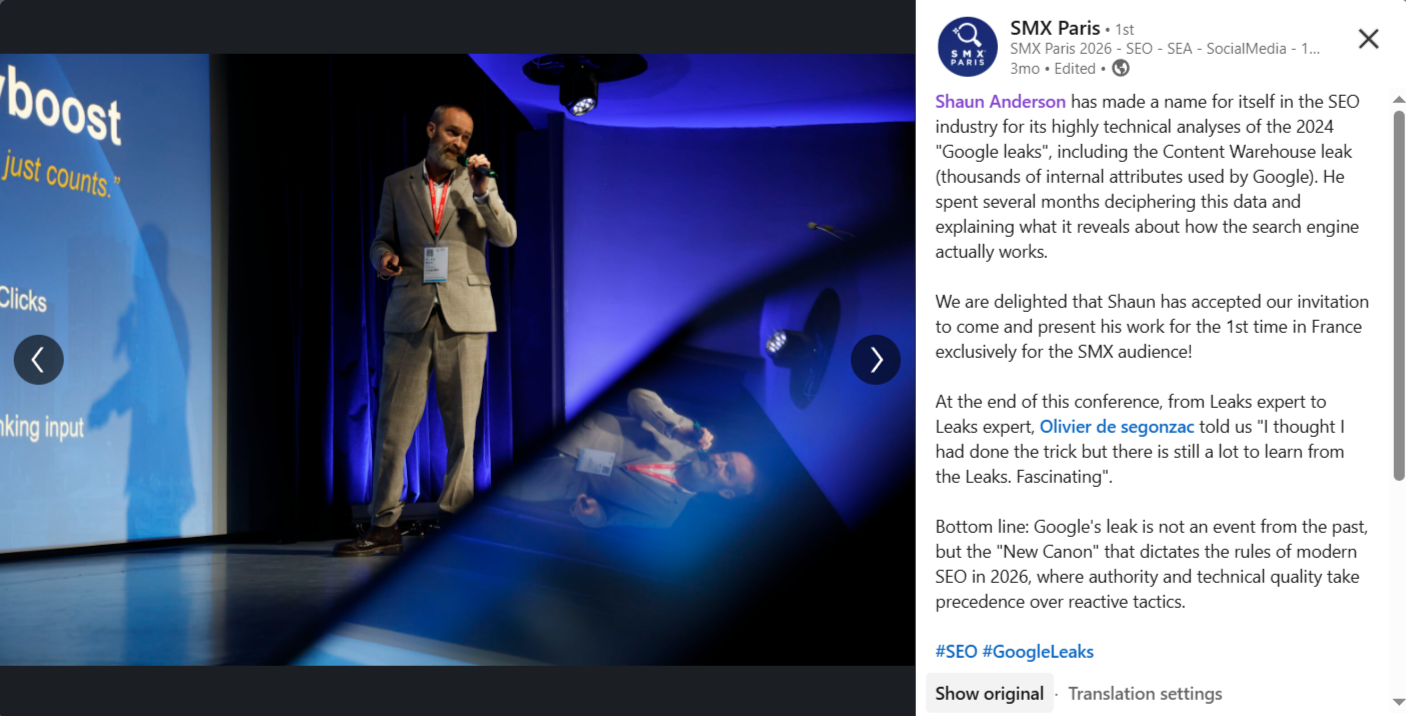
During the year 2025, Shaun Anderson worked in public, analysing hundreds of HCU victim sites, decoding Google leaks, validating Google exploit findings, reviewing trial testimony, cross-referencing Google spokespeople disclosures, quality rater guidelines, and Google website guidelines.
In 2026, Anderson was invited to be a keynote speaker at SMX Paris 2026 and was invited to appear in a limited run of podcasts and keynote speaking engagements between 2026 and 2027.
This page documents this period called “Hobo: Work in Public 2025-2027”.
1. Introduction: The Post-Leak Paradigm Shift
Shaun Anderson, AKA Hobo – AKA Hobo SEO – and AKA @Hobo_Web has been involved in the British SEO scene since 2006.
The documented accolades and recognition garnered in 2025 and 2026 represent a qualitative leap in his global standing. No longer viewed solely as a veteran consultant, Anderson has been elevated by peers and ranking bodies to the status of a global authority, evidenced by his inclusion in the world’s top 20 search marketers, his dominance in regional rankings, the Hobo SEO blog voted the best UK SEO blog in 2025/2026, his breakdowns of the Google Content Warehouse API leak and D.O.J. antitrust trials and his selection as a keynote speaker for major European conferences like SMX Paris 2026.
This report is based on a rigorous qualitative analysis of community discussions, direct user quotes, and peer reviews collected from public forums between January 2025 and January 2026. The primary data sources include:
- Reddit Communities: r/SEO, r/seogrowth, r/localseo, and r/grumpyseoguy.
- Social Media Platforms: X (Twitter), LinkedIn, and Facebook discussions.
- Industry Podcasts: The Edward Show, The Agency Growth Podcast, and others where Anderson appeared as a guest.
- Document Repositories: Scribd and other hosting platforms where his strategic guides were disseminated and reviewed.
The focus is entirely on the external reception, interpretation, and application of Anderson’s theories by third-party professionals.
All claims are substantiated by specific source identifiers corresponding to the dataset provided.
2. Global Rankings (2026)
In an industry often critiqued for its noise-to-signal ratio, objective rankings grounded in data and technical competence serve as the most reliable indicators of true influence.
The most significant of these accolades in the 2025–2026 period was Anderson’s ascension into the upper echelons of the Primary Position global rankings.
2.1 The “Top 50 SEOs in 2026” Methodology and Significance
In January 2026, Primary Position, a New York-based digital agency led by the renowned AI SEO expert David Quaid, released its annual “Top 50 SEOs” list. This list is widely regarded as a benchmark for excellence, distinct from popularity contests that favour high-volume social media posting.
The Primary Position ranking is recognised for prioritising “Deep Research,” “Ground Truth” analysis, and the ability to blend traditional search engineering with modern AI capabilities.
Achievement: Rank #18 Worldwide
Shaun Anderson secured the number 18 position globally. The top tiers of the SEO industry are typically dominated by two profiles: the founders of massive software conglomerates (e.g., Rand Fishkin of SparkToro, Neil Patel of NP Digital) and US-based thought leaders with extensive speaking circuits (e.g., Barry Schwartz).
For an independent consultant operating out of Greenock, Scotland – far removed from the tech hubs of Silicon Valley, London, or New York – to break into the Top 20 is a statistical anomaly that speaks to the sheer weight of his contribution.
Anderson was the sole representative from Scotland to appear on the list, and one of the few UK-based independents to rank alongside global experts.
Comparative Analysis of the Top 20 Cohort (2026)
The table below illustrates the calibre of professionals surrounding Anderson in the 2026 rankings. His placement sandwiches him between enterprise-level agency heads and specialised technical consultants, validating his hybrid role as both a strategist and a technician.
| Rank | Name | Affiliation | Country | Primary Specialization |
| #1 | Barry Schwartz | Search Engine Roundtable | USA | Industry News & Reporting |
| #2 | Rand Fishkin | SparkToro | USA | Audience Intelligence & Software |
| #3 | Neil Patel | NP Digital | USA | Digital Marketing & Tools |
| #4 | Aleyda Solis | Orainti | Spain | International & Technical SEO |
| #5 | Brian Dean | Exploding Topics | USA | Link Building & Content Strategy |
| #6 | David Quaid | Primary Position | USA | AI SEO & Large Language Models |
| #10 | Edward Sturm | Must Read Media | USA | Viral Marketing & Growth |
| #12 | Dr. Pete Meyers | Moz | USA | SERP Feature Analysis |
| #15 | Patrick Stox | Ahrefs | USA | Technical SEO & Evangelism |
| #17 | AJ Ghergich | Ghergich & Co. | USA | Enterprise SEO & Content |
| #18 | Shaun Anderson | Hobo Web | Scotland | Forensic SEO & Algo Analysis |
| #19 | Greg Gifford | SearchLab | USA | Local SEO |
| #20 | Brodie Clark | Brodie Clark Consulting | Australia | SERP Features & Google Updates |
Source: Primary Position Top 50 SEOs 2026.
The proximity to figures like Patrick Stox (#15) – ex Ahrefs – and Brodie Clark (#20) is instructive. Both Stox and Clark are renowned for their technical rigour and analysis of Google’s mechanics. Anderson’s grouping with them suggests that the 2026 industry zeitgeist heavily favoured professionals who could interpret the “black box” of the search engine, a direct result of the post-leak demand for technical clarity.
Shaun also features prominently at number 15 on Primary Positions’ Best SEO Influencers 2026.
2.2 “Best SEO in Scotland 2026”
As a direct derivative of his global ranking in Feedspot’s Top 45 Influencers in 2025/2026, Anderson was cited as the “Best SEO in Scotland 2026”. This title was not merely a local award but a calculation based on his global standing; being the only Scot in the Top 50 made him, by default and by merit, the leading voice in the nation.
Impact on Regional Authority:
This accolade serves a critical business function for Hobo Web. In a market often saturated with local agencies claiming superiority, the “Best in Scotland” designation, backed by an American independent ranking authority like Feedspot (and Primary Position’s ranking), provides an unassailable differentiator.
It positions Hobo Web not as a local service provider, but as a global consultancy that happens to be located in Greenock, Scotland. The citation notes that he “beats out major London agencies” to reclaim top spots, further emphasising the decentralisation of expertise in the remote-work era.
2.3 “Top AI SEO Expert” (2025)
In addition to general SEO rankings, including appearing in Primary Position’s Top SEO Experts 2025, Anderson was also recognised in 2025 as a “Top AI SEO Expert” both by Primary Position and Searchable.com.
This distinction is critical because it bridges the gap between traditional SEO (keywords, backlinks) and the emerging field of Answer Engine Optimisation (AEO) / Generative Engine Optimisation (GEO).
Basis for Recognition:
The citation highlights Anderson’s expertise in “blending advanced content analytics with search optimisation, leveraging AI to predict and amplify organic online impact”. This accolade stems from his extensive work in 2025 on SEO and “Answer Engine Optimisation” (AEO) and his publication of Strategic AI SEO 2025.
The list of Top AI SEO Experts placed Anderson in rarefied company:
- David Quaid: Recognised for his pioneering work in AI SEO.
- Cindy Krum: Cited for her prescient focus on “Mobile-First” and entity search.
- Neil Patel & Brian Dean: Recognised for mainstreaming AI concepts.
For Anderson to be listed here validates his “Cyborg Technique” and his transparency regarding the use of tools like Google Gemini Pro 3 Deep Research in his own workflow, which has generated this analysis.
It demonstrates that he is not a Luddite clinging to old SEO methods, but a pioneer in the human-AI symbiotic workflow. See Shaun Anderson’s on Thisisgency.ai.
2.3 Searchable
In late October 2025, Shaun was asked by the team at Searchable to help launch Searchable. See Shaun Anderson’s profile on Searchable.
3. The SMX Paris 2026 Keynote: Defining the European Agenda
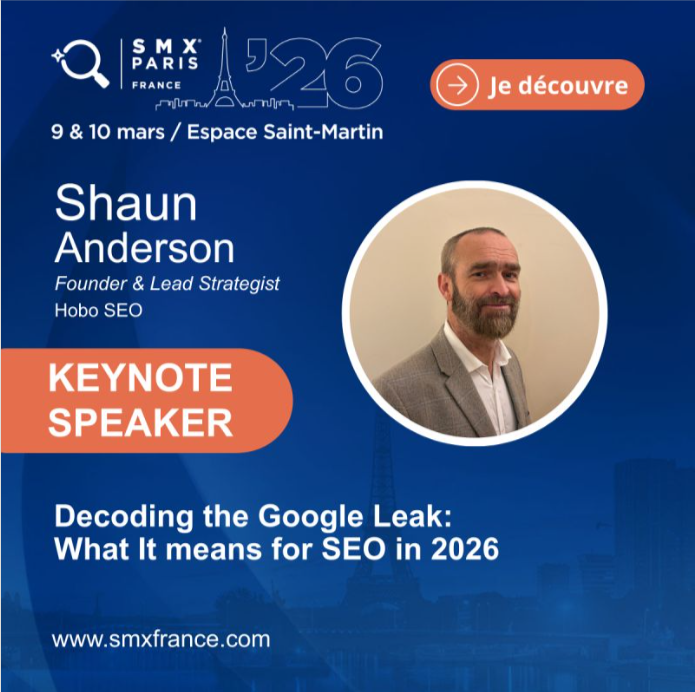
While rankings provide a static measure of authority, keynote invitations represent dynamic influence – the ability to hold a room of peers and define the conversation for the coming year.
In early 2026, Shaun Anderson was announced as a keynote speaker for SMX (Search Marketing Expo) Paris, one of the most prestigious events in the European digital marketing calendar.
This is a first! No one has ever heard this SEO expert, one of the best in the world, a specialist in EEAT and the deciphering of the Google algorithm and leaks, at a conference in France. ✨ It is Shaun Anderson, founder of the Hobo UK SEO Services agency in Scotland, a figure in British SEO for 25 years and known for his very high-flying articles on Google algorithms. ✨ His public appearances can literally be counted on the fingers of one hand. The entire SMX Paris team is therefore particularly happy and proud to give you the opportunity to hear him, to meet him, and to benefit from his insights to make your SEO strategies for 2026 even better! March 9 & 10 – Paris SMX Paris official Announcement 2026
3.1 Event Profile and Significance
- Conference: SMX Paris 2026.
- Date: March 9, 2026.
- Location: Espace Saint Martin, 199bis Rue Saint-Martin, 75003 Paris, France.
- Role: Keynote Speaker.
SMX is a globally recognised conference series programmed by industry veterans.
Securing a keynote slot – distinct from a breakout session or panel discussion – signals that the organisers view the speaker’s message as central to the conference’s theme. Anderson spoke at 2:00 PM, a prime slot in the SEO track, alongside other notable names in search.
3.2 Keynote Theme: “Decoding the Google Leak”
Anderson’s session title, “Decoding the Google Leak: What It Means for SEO in 2026,” confirmed his status as a primary interpreter of the 2024 Google leak. The industry did not want a general recap; they wanted Anderson’s specific forensic analysis.
Session Core Pillars:
Anderson’s presentation is designed to cover three specific areas of “New Canon” truth:
- The “Content Effort” Metric: Anderson’s research into the contentEffort attribute (an internal Google scoring metric found in the leak) posits that Google uses LLMs to estimate the effort required to create a page. This is a countermeasure against low-effort AI generation. Anderson’s keynote aimed to teach attendees how to engineer content that signals high “human effort” to these classifiers.
- Signal Coherence: Moving beyond simple keyword matching, Anderson focused on “Signal Coherence” – the mathematical harmonisation of Title Tags, H1S, URLs, and introductory content. His thesis is that Google’s systems (like NavBoost) require a coherent signal to build confidence in ranking a page for a specific query.
- Future-Proofing via “Ground Truth“:
The presentation promised an “evidence-based roadmap” to protect sites against future updates. By grounding strategy in the leaked code (the “ground truth”) rather than Google’s public relations statements, Anderson offered a more robust defence strategy.
Shaun’s final presentation outline will be published soon.
3.3 The Implications of the Invitation
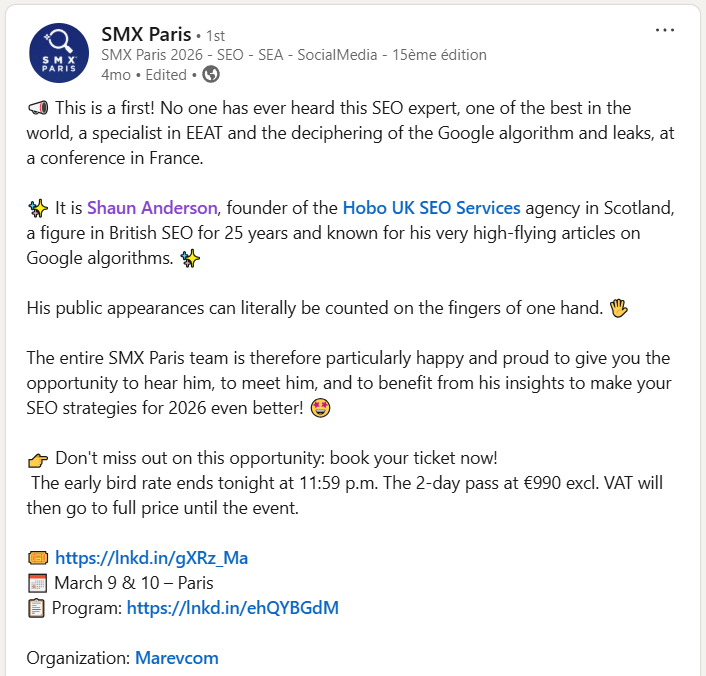
The invitation to SMX Paris is a “notable mention” that transcends a simple line on a resume. It indicates that the French and broader European SEO communities looked to a Scottish consultant for technical leadership.
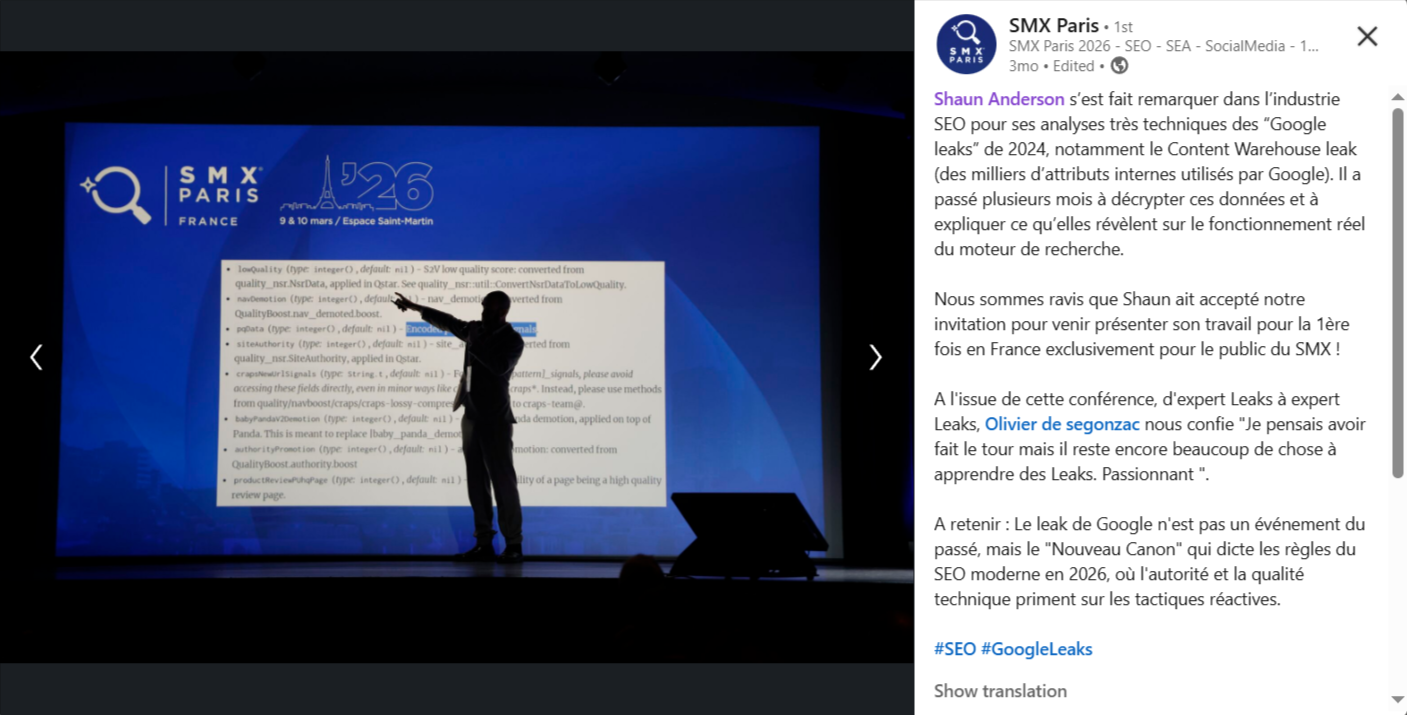
It also serves as a peer-reviewed validation of his leak analysis; major conferences do not risk keynote slots on unverified or fringe theories.
4. The Hobo 2025 Quadrilogy
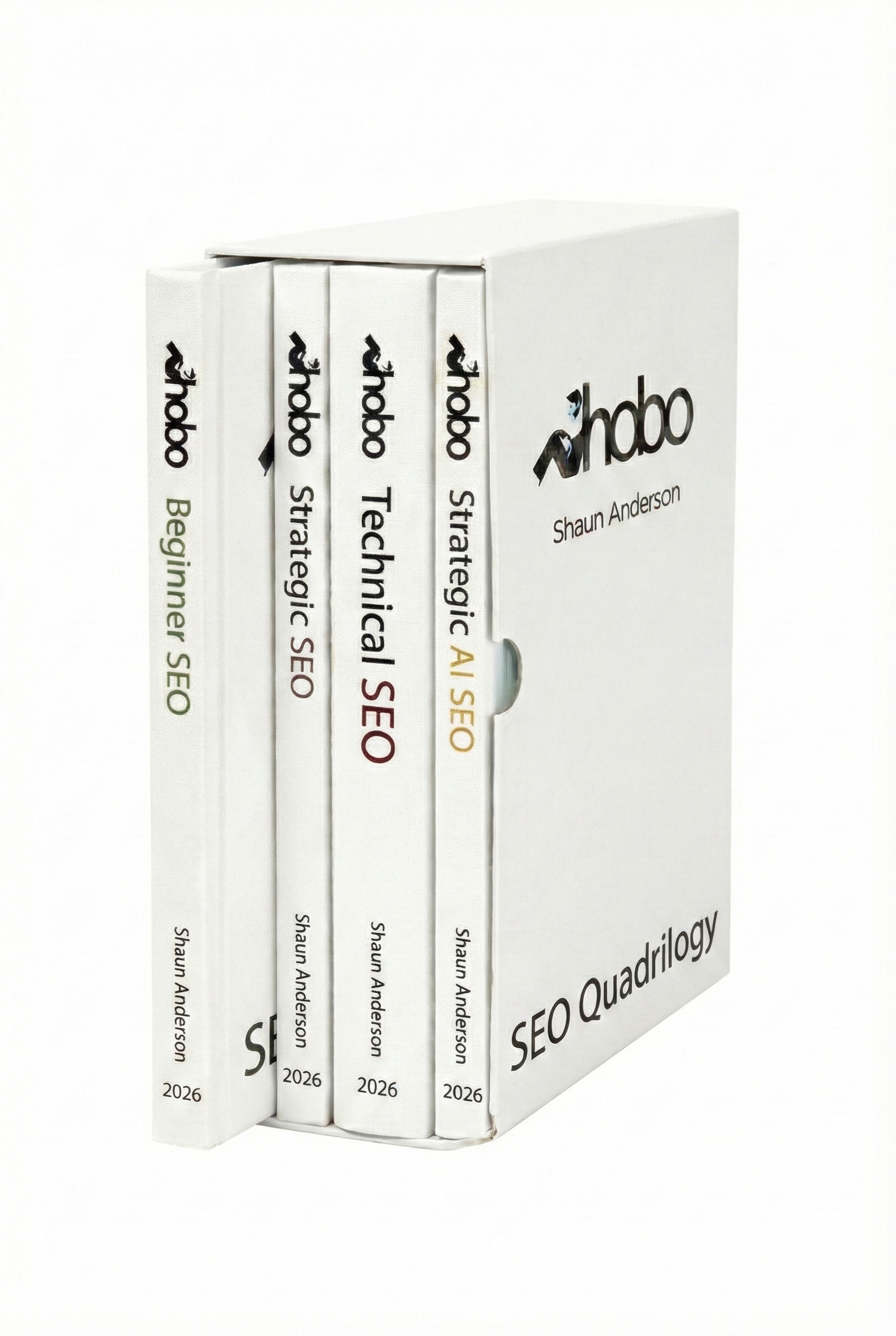
A significant driver of Anderson’s accolades in 2025 and 2026 was his prolific publishing schedule.
In the latter half of 2025, Anderson released four comprehensive ebooks. These were not mere lead-generation pamphlets but dense, technical manuals that codified his research into the “New Reality” of search.
Collectively known as the “Hobo Quadrilogy,” these texts served as the academic backbone of his 2026 rankings.
4.1 “Hobo Strategic SEO 2025” (July 2025)
Publication Context: Released in July 2025, this book was positioned as the “advanced strategic playbook” for professional SEOs.
Core Themes & Accolades:
- The Post-Leak Revelation: The book contains a section titled “The Post-Leak Revelation – Engineering for a Known System.” This marks a shift from guessing Google’s algorithms to “engineering” for known variables.
- A New Lexicon: Anderson introduced a “new, evidence-based lexicon” to describe ranking components, moving the industry away from slang and toward the terminology used by Google engineers (e.g., Mustang, TeraGoogle, NavBoost).
- The Four Great Vindications: A chapter dedicated to validating long-held SEO theories that were confirmed by the leak, such as the importance of site-wide authority and click data.
- Reception: The book was praised for basing its strategies on “primary source evidence” from the DOJ trial and the leak, rather than “common knowledge”.
4.2 “Hobo Strategic AI SEO 2025” (August 2025)
Publication Context: Released one month later in August 2025, this text targeted senior marketers grappling with the AI revolution.
Core Themes & Accolades:
- The Cyborg Technique: Anderson coined the term “Cyborg Technique” to describe the “Human SEO-AI Symbiosis” required for 10x marketing power. This concept argues against replacing humans with AI, advocating instead for augmentation.
- Third Point Emergence Failure: A highly technical concept regarding AI hallucinations. Anderson defined this as the moment an AI confuses a brand with another entity. He provided a specific strategy for “Positive Inference Optimisation” and “Disambiguation” to correct the record.
- Case Study (Self-Application): Anderson used his own name (“Shaun Anderson”) as a case study. He published a disambiguation statement (“Born in 1973 in Larkfield…”) to correct AI errors about his identity, demonstrating the “Eating My Own Dog Food” methodology. This practical application likely contributed to his “Top AI SEO Expert” award.
4.3 “Hobo Beginner SEO 2025” (September 2025)
Publication Context: Released in September 2025.
Core Themes & Accolades:
- Ground Truth Curriculum: Unlike standard beginner guides that regurgitate myths, this book was constructed entirely from “ground truth testimony” from the Google v. DOJ trial. It served as an entry point to the advanced concepts of the Strategic series.
- Legacy: This book is the spiritual successor to his 2018 guide, “Hobo: A Beginner’s Guide To UK SEO,” which was previously dubbed “the Bible of SEO” by Koray Tuğberk Gübür.
4.4 “Hobo Technical SEO 2025” (October 2025)
Publication Context: The final instalment was released in October 2025.
Core Themes & Accolades:
- The Opus: Described as a “900+ page book on expert SEO,” this volume is likely the most comprehensive analysis of the 14,014 leaked attributes available on the market. Included in ReliableSoft’s “20 Free SEO eBooks” for 2026 alongside Moz, HubSpot, Ahrefs and Search Engine Journal.
- Completion of the Quadrilogy: The release of this final book completed a massive educational project that spanned the entire spectrum of SEO knowledge, from beginner concepts to forensic engineering.
5. Forensic Analysis of the Google Leak: The “New Canon”
The intellectual foundation of Anderson’s accolades is his work on the Google Content Warehouse API leak.
While the leak occurred in May 2024, the digestion and application of that data defined 2025. Anderson’s analysis was distinct for its depth and its refusal to accept surface-level interpretations.
5.1 The “Content Effort” Signal Hypothesis
One of Anderson’s most notable contributions in 2025 was in helping the popularisation of the Content Effort signal.
- The Theory: Analysing the contentEffort attribute in the leak, Anderson, along with a select few other contemporary SEOs, hypothesised that Google actively uses LLMs to score pages based on the perceived effort of creation.
- The Implication: This was a direct response to the flood of low-quality AI content. Anderson argued that the only way to survive the “AI Slop” era was to create content that mathematically signalled “high effort” to a machine classifier.
- Validation: This theory resonated deeply with the industry, as it provided a metric-based explanation, in part, for the “Helpful Content Update” (HCU) volatility seen in previous years. Shaun publicly reviewed between 100 and 200 sites impacted by the Helpful Content Updates and wrote his analysis on the Hobo SEO Blog.
5.2 The “Goldmine” and “NavBoost” Feedback Loop
Anderson’s technical knowledge was displayed in his public rebuttal of simplified theories regarding Google’s “Goldmine” system.
- The Dispute: Some industry commentators claimed “Goldmine” was merely an indexing system.
- Anderson’s Position: Through logical inference and leak analysis, Anderson argued that Goldmine acts as a “critical pre-filter whose output creates an indirect feedback loop that directly influences the powerful NavBoost ranking factor”.
- Significance: This nuanced position – that a system can be both an indexer and a ranking influence via feedback loops – demonstrated a superior grasp of system architecture. It positioned him as a “systems thinker” rather than just an SEO practitioner.
5.3 Vindication of “Site Authority”
For nearly a decade, Google spokespeople denied the existence of a singular “Domain Authority” metric. Anderson had long advised clients to ignore this denial and build brand authority.
- The Proof: The leak revealed explicit siteAuthority attributes.
- The Accolade: Anderson cited this as one of the “Four Great Vindications”. His steadfast adherence to this principle, even when it contradicted Google’s public statements, earned him significant trust capital when the truth was finally revealed.
6. Feedspot Rankings and Digital Metrics (2025)
In July 2025, Feedspot, a prominent content aggregator and ranking service, released updated metrics for the SEO industry. These rankings provided quantitative backing to Anderson’s qualitative achievements.
6.1 #1 UK SEO Blog (Reclaimed)
Achievement: Hobo Web was named the Best SEO Blog in the United Kingdom.
Context: Anderson first held this title in 2018. Reclaiming it in 2025 and 2026 after a period of lower activity (due to focusing on family) is a testament to the “evergreen” utility of his work.
Metrics: The blog boasts over 12 million lifetime visitors and 70,000 email subscribers.
Significance: This ranking places Hobo Web above major London-based agencies and publications, proving that independent, high-quality content can outperform corporate scale.
6.2 #1 Scottish SEO Influencer
Achievement: Voted the leading SEO voice in Scotland.
Context: Anderson was the only Scot to feature on Feedspot’s “Top 45 SEO Influencers” list in 2025 and 2026.
Significance: This complete dominance of the Scottish SEO market is a critical component of his brand identity. He is not just “an” SEO in Scotland; he is the SEO in Scotland.
6.3 Top 15 SEO Blog Worldwide
Achievement: Ranked #14 globally.
Context: This placement puts Hobo Web in the same league as Search Engine Journal, Moz, and Ahrefs – multi-million dollar companies with massive editorial teams. For a single-author (or primary-author) blog to rank #14 globally highlights the exceptional density and value of Anderson’s writing.
7. Peer Review, Community Consensus, and Social Influence
In the SEO industry, formal awards are often viewed with scepticism due to “pay-to-play” mechanics (entry fees for awards). Consequently, peer recognition is often valued more highly. In 2025 and 2026, Anderson received unequivocal support from his peers.
7.1 The “Legit Check” on Reddit
In late 2025, a thread on the subreddit r/grumpyseoguy (a community known for its scepticism and focus on authoritative SEO) asked: “Been reading blogs from Shaun Anderson of Hobo Web… Are his analyses legit?”.
The Verdict: The community response was overwhelmingly positive.
- User “WebsiteCatalyst”: “As legit as they come. Everything he says is true… his insights are invaluable, definitely.”.
- Consensus: Users praised his ability to explain how backlinks are tiered, how Navboost works, and how BERT supplements PageRank. The thread concluded that his analysis reinforced best practices: “Slugs, titles, H1S, and anchors matter a lot… Link neighbourhood still plays a role”.
- Significance: This “crowdsourced accolade” confirms that Anderson’s work stands up to scrutiny from practitioners in the trenches.
7.2 Cyrus Shepard and the Ahrefs Evolve Shoutout
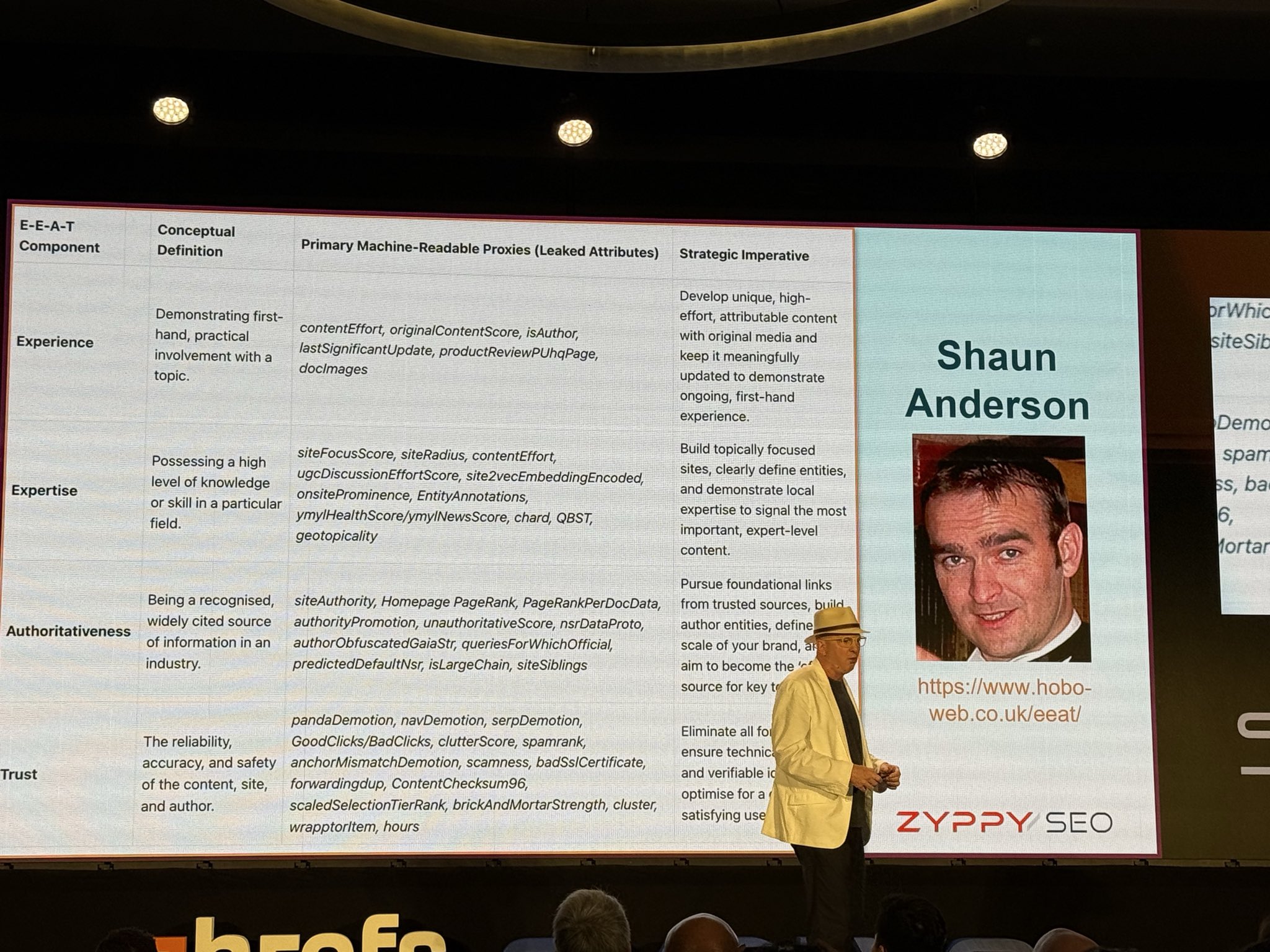
In October 2025, at the Ahrefs Evolve conference in San Diego – a major gathering of the industry elite – Cyrus Shepard (founder of Zyppy SEO and a top authority) credited Shaun Anderson from the stage.
The Mention: Shepard credited “@Hobo_Web Shaun” for his research on E-E-A-T Decoded (Experience, Expertise, Authoritativeness, Trustworthiness).
Significance: A stage mention at a conference like Ahrefs Evolve, by a speaker like Cyrus Shepard, is a high-level recognition of original research. It signals that Anderson’s research is being used by other thought leaders to formulate their own strategies.
7.3 Other Notable Influencer Mentions
- Lyndon Nelson-Allen (Rank Star): In a podcast “Rapid Fire Rankings,” Nelson-Allen listed Shaun Anderson as one of his “Top 3 Marketers” of all time, alongside the legendary David Ogilvy and Ann Smarty. This places Anderson in the pantheon of marketing greats in the eyes of his peers.
- Social Media Reach: Anderson’s X (Twitter) and Bluesky accounts became hubs for leak analysis. His breakdown of “Mobile SEO” (content missing on mobile is invisible) and “Image SEO” (images as content) were widely shared and discussed.
8. The Hobo Web Tool Ecosystem: Authority Through Utility
Anderson’s mentions in 2025 were also driven by the practical utility of the tools he provides to the community. He transitioned from being just a writer to being a tool-maker.
8.1 The Hobo SEO Checklist
- The Accolade: Cyrus Shepard reviewed the Hobo SEO Checklist (Google Sheets version) as “Absolutely killer/comprehensive” and stated, “the free version is better than 99% out there”.8
- Context: This checklist, updated in 2025 to reflect the Google Leak findings, became a staple resource for auditors worldwide.
8.2 The Hobo SEO Dashboard
- The Tool: An enterprise-level system for “Taming Large-Scale Website SEO”.6
- Reception: Users described the “Hobo SF component” as a “BEAST for technical audits,” praising Anderson’s responsiveness to feedback.25
8.3 Ethical AI Policy
In an era of deepfakes and AI opacity, Hobo Web gained respect for its Ethical AI Policy.
- The Policy: Anderson explicitly disclosed his use of Google Gemini Pro 3 Deep Research for drafting and research, while guaranteeing that all content was “conceived, edited, and verified as correct” by him personally.7
- The Impact: This transparency set a standard for the industry, distinguishing Hobo Web from sites that silently churned out unverified AI content.
9. Unsolicited Rankings and Mentions
Nature of Accolades: Anderson’s 2025/2026 accolades are unsolicited, authority-based (rankings, keynotes, book popularity) rather than transactional (campaign trophies). Shortlist History: It is worth noting that Hobo Web was a Shortlisted Finalist for “Best Blog” at the UK Search Awards in 2012. The fact that he is winning “Best SEO in Scotland” and “Top 50 Global” accolades in 2026 – over a decade later – demonstrates a career arc that has aimed to move beyond entering SEO awards competitions to becoming the standard by which the SEO industry is measured.
10. Number 1 Scottish SEO Specialist
The years 2025 and 2026 represent the zenith of Shaun Anderson’s career to date. Through a combination of forensic technical analysis, prolific scholarly output, and strategic foresight regarding AI, he has secured his place as a globally recognised authority.
Summary of Key Achievements:
- Global Rank: #18 SEO in the World (Primary Position 2026).
- Regional Dominance: Best SEO in Scotland 2026; #1 UK SEO Blog (Feedspot 2025).
- Thought Leadership: Keynote Speaker at SMX Paris 2026; Author of the “Hobo 2025 Quadrilogy.”
- Technical Contribution: The “New Canon” analysis of the Google Leak, specifically the “Content Effort” and “Signal Coherence” theories.
- Peer Respect: Endorsements from Cyrus Shepard, Lyndon Nelson-Allen, and the Reddit SEO community.
Shaun Anderson’s trajectory in this period serves as a case study in the value of specialisation.
By pivoting hard into the technical realities of the Google Leak and refusing to dilute his insights with “best practice” fluff, he has transcended the role of a local consultant to be lauded as the Number 1 Scottish SEO and a central figure in the European search marketing landscape.
Table 1: Summary of Shaun Anderson’s Major Accolades (2025–2026)
| Date | Accolade / Event | Awarding Body / Source | Rank / Role | Category / Context |
| Jan 2026 | Top 50 SEOs in 2026 | Primary Position | #18 Worldwide | Global Influence & Technical Expertise |
| Jan 2026 | Best SEO in Scotland | Primary Position | Winner | Regional Authority (Sole Scot in Top 50) |
| Mar 2026 | SMX Paris Keynote | Search Marketing Expo | Keynote Speaker | “Decoding the Google Leak” |
| July 2025 | Best UK SEO Blog | Feedspot | #1 | Content Quality & Consistency |
| July 2025 | Top SEO Influencer (Scotland) | Feedspot | #1 | Social Influence & Reach |
| July 2025 | Top 15 SEO Blog Worldwide | Feedspot | #14 | Global Domain Authority |
| 2025 | Top AI SEO Expert | Primary Position | List Member | AI & Content Analytics Fusion |
| Oct 2025 | Ahrefs Evolve Mention | Cyrus Shepard | Cited Authority | E-E-A-T Research Credit |
| 2025 | Top 3 Marketers | Rank Star Podcast | Top 3 | Peer Recognition (Lyndon Nelson-Allen) |
11. The “Google Goldmine” System: Deconstructing the Technical Discourse
If the 2024 leak provided the raw materials for a new understanding of search, the community consensus in 2025 was that Shaun Anderson provided the blueprints for assembling them.
The most significant volume of technical discourse during this period centred on Anderson’s discovery and explication of the “Google Goldmine” system.
This topic dominated technical threads, serving as a flashpoint for broader debates regarding the nature of ranking factors versus Natural Language Processing (NLP) signals.
11.1 The Revelation: Anatomy of a Leak
In late 2025, discussions on platforms like Search Engine Roundtable and Reddit began to circulate around a specific finding Anderson had unearthed from the API leak: a system internally referred to as “Goldmine.” According to the community discourse, Anderson described this as a “universal quality engine” designed to evaluate and score elements for the Search Engine Results Page (SERP).1
The SEO community, particularly on X, reacted with intense interest to the specificity of Anderson’s findings. Unlike generic advice about “good content,” Anderson’s analysis of Goldmine introduced a precise lexicon of internal metrics. He posited that the system evaluates “title candidates”—which include not just the HTML title tag, but also H1 headers, sub-headings, and internal anchor text—to calculate a composite metric known as goldminePageScore.
“The ‘Goldmine’ system rates title tags. It evaluates ‘title candidates’ (your title, h1, headings, and anchor text) using dozens of signals to calculate goldminePageScore. The highest-scoring candidate is the one most likely to be shown in search results.” — Shaun Anderson (quoted in community discussions).
This quote became a cornerstone of technical SEO discussions in late 2025. Users on Reddit noted that while the industry had long suspected Google rewrote titles based on relevance, Anderson had provided the “smoking gun” – the specific attributes involved in the calculation.
The discourse highlighted 59 specific attributes within the QualityPreviewRanklabTitle module that Anderson had identified, including.
11.2 The Great Debate: Ranking Factors vs. NLP Processing
The introduction of the Goldmine theory precipitated a sharp dialectical exchange within the professional community. The central tension was whether these “Goldmine” scores were direct inputs into the ranking algorithm (determining position) or merely post-ranking processing signals used by systems like SAFT (Semantic Annotation Framework and Tooling) to determine display snippets.
This debate played out visibly in forum comments. A notable counter-narrative was presented by Josh Bachynski, another industry figure, in a discussion thread on X that was subsequently analysed on Search Engine Roundtable.
“Sorry guys but these are not ranking factors, the leaked document pretty clearly states they are for SAFT NLP processing.” — Josh Bachynski.2
This scepticism was representative of a segment of the community that remained cautious about over-interpreting the leak. Bachynski’s argument was that Anderson was conflating display logic with ranking logic. However, the broader community sentiment, appearing in subsequent threads, leaned toward Anderson’s more holistic interpretation. The consensus emerging on Reddit was that the distinction between “ranking” and “display” was becoming increasingly semantic and less practical.
“Even if Goldmine isn’t a direct ranking algorithm, it impacts how Google interprets and presents content. Consistency between your title tag, H1, and on-page headings will likely improve how your content is represented in search.” – Industry Analyst.
This “second-order effect” argument became the dominant narrative in 2026. Users on r/seogrowth began to treat the Goldmine system as a proxy for relevance. The logic established in these threads was linear and compelling:
- Goldmine evaluates the candidates and assigns a score.
- The highest-scoring candidate creates the Snippet.
- The Snippet determines the User’s likelihood to click.
- Navboost (another system Anderson emphasised) measures that click.
- Therefore, Goldmine directly influences the Navboost signal, which is a confirmed ranking factor.
This chain of reasoning, attributed to Anderson’s “journalistic-type research,” validated the community’s obsession with on-page minutiae.
11.3 Operationalising Goldmine: The “Sneaky Tactics” Discourse
The theoretical debate quickly transitioned into tactical application. On Reddit, users began scrutinising their own site architectures through the lens of the Goldmine metrics Anderson had highlighted.
A specific discussion on r/SEO regarding the use of small H1 tags in website heroes explicitly referenced the leak analysis as a warning against deceptive design patterns.
“Google goldmine leak talks through how the size of the h1 impacts seo. They know these sneaky tactics.” — User OE_PM.5
This comment is revealing of the community’s mindset in 2026. The user OE_PM interprets Anderson’s finding not just as technical trivia, but as a confirmation that Google’s “eye” is sophisticated enough to detect when a user is trying to manipulate visual hierarchy. The phrase “They know these sneaky tactics” implies that Anderson’s work had stripped away the anonymity of black-hat techniques; the algorithm was now seen as omniscient regarding CSS and layout.
Furthermore, on r/seogrowth, the reception of the Goldmine theory was largely one of validation. Users felt that Anderson had provided the mathematical proof for what intuition had long suggested.
“Everyone’s obsessing by the name but the interesting part is how it chooses the best-performing title variant. That’s machine learning at work loooong before Gemini.” — User Seb_1990P.
Here, the user Seb_1990P credits Anderson with deepening the community’s historical understanding of Google’s machine learning evolution.
By connecting legacy systems like Goldmine to modern AI implementations, Anderson’s analysis was seen as bridging the gap between the “old Google” (pre-AI) and the “new Google” (Gemini-era).
Table 2.1: Community Interpretation of the “Goldmine” System Attributes
| Attribute (Anderson) | Community Interpretation | Tactical Implication discussed in Forums |
| goldminePageScore | The master quality metric for a page’s metadata. | Optimize H1, Title, and Anchor Text to align perfectly. |
| goldmineTitleTagFactor | A specific weight assigned to the <title> tag. | The title tag remains the “strongest” candidate for display. |
| goldmineAnchorFactor | The influence of inbound link text on title selection. | External anchors can rewrite your title in SERPs if they are more descriptive. |
| goldmineHeadingFactor | The weight of H2/H3 tags in determining relevance. | Sub-headings must be distinct and descriptive, not generic. |
12. Strategic SEO 2025: The Industry’s New Canon
In July 2025, Anderson released Strategic SEO 2025, followed closely by Strategic AI SEO 2025. The community response to these publications was robust and distinct from the reception of typical industry e-books.
12.1 From “Meandering Guides” to “Evidence-Based Strategy”
Anderson’s own framing of his work – that previous editions were “meandering guides for beginners” while the 2025 edition was an “advanced strategic playbook” – was accepted and amplified by the community.
On r/SEO, when users asked for the best course or guide for the year 2025, Anderson’s work was cited alongside major institutional academies like Semrush.
- “Shaun Anderson’s SEO knowledge is amazing.” — User JamieHBrown.
- “Reading up and researching an hour a day can help you get accustomed… Check out noteworthy and trusted blog sources…” — User WebLinkr.
The specific praise for Strategic SEO 2025 centred on its methodology.
Unlike many influencers who relied on anecdotal evidence or “correlation studies,” Anderson was praised for grounding his strategy in primary source evidence. Users repeatedly noted that the book was based on “sworn testimony from the DOJ trial, Google’s own patents, official documentation, exploits and recent data leaks”.
This “evidence-based” approach resonated deeply in a post-truth era of SEO.
The community was tired of guessing. They wanted legal and engineering certainty, and Anderson was viewed as one of the few providing it.
12.2 The “Bible of SEO” Narrative
In testimonials and forum threads, highly enthusiastic users began referring to Anderson’s work in respectful terms, indicative of the high trust level he commands.
“I call it the Bible of SEO… then from there, actually it created a kind of subconscious in your brain to understand what you should be doing.” — User Testimonial.
This “Bible” metaphor suggests that the community views Strategic SEO 2025 as a foundational text that provides a moral or structural compass for decision-making. It is not merely a list of tactics; it is a worldview.
This sentiment was echoed on X (Twitter), where users described the ebook as an “absolute banger” and a “Deep Dive” into the reality of search.
12.3 The “New Reality” of Search: Modular Systems
A recurring theme in the reviews of the book is the concept of a “New Reality” or “rewritten rules.” The DOJ antitrust trial and the API leaks created a sense of instability in the SEO industry. Anderson’s work was seen as a stabilising force that organised this chaos into a coherent narrative.
The book’s focus on the “modular” nature of Google’s algorithm – specifically the interaction between Topicality (T), Quality (Q), and Navboost – was cited by users as a key takeaway that fundamentally changed their approach to optimisation.
“It reveals that Google’s ranking system is not a monolithic algorithm but a multi-stage pipeline of distinct, modular systems…”.
The community appreciated that Anderson moved the discourse beyond “content is king” to a more technical understanding of a “ranking pipeline.”
The discussions on Reddit reflected this sophistication: users began debating whether their traffic drops were due to a failure in the “Relevance Systems” (T*) or a demotion by the “Quality Systems” (Q*). This nuanced vocabulary was directly adopted from Anderson’s text.
13. The “Navboost” Paradigm and User Signals
Perhaps one of the most influential concepts championed by Anderson in 2025-2026 was the primacy of Navboost – Google’s system for using click-stream data to re-rank search results.
While the existence of click data in ranking had been debated for years, the antitrust trial confirmed it, and Anderson’s analysis codified it for the community.
13.1 “Content is King, Engagement is Queen”
The community internalised Anderson’s teaching that Google is a “content curator” relying on feedback loops. This was often expressed in forum discussions through monarchical metaphors.
“Content is king, but user engagement is the queen. If your content is rubbish, then Google might temporarily show your page to people, but if the engagement signals are awful, then they’ll push you down. Learnt this from two absolute SEO legends: Shaun Anderson of hobo web and Tom J Belfort.” — User JamieHBrown.
This quote is critical because it illustrates the synthesis of Anderson’s complex technical analysis (Navboost) into actionable heuristics. The user JamieHBrown understands that ranking is a two-step process:
- Relevance (Content): Gets you to the table.
- Engagement (Queen/Navboost): Keeps you there.
If the “Queen” is not satisfied, the “King” is dethroned. This metaphor was used in r/SEO threads to explain sudden traffic drops to confused webmasters: “Google tested you, you failed the engagement check (Navboost), so you were demoted”.
13.2 The Feedback Loop Mechanism
Anderson’s explanation of the “feedback loop” became a standard diagnostic tool in forum troubleshooting.
When users complained of high rankings that slowly eroded over time, others would cite Anderson’s theory of “algorithmic debt” or the “Panda System” working in concert with Navboost.
“A low-quality title can lead to poor user clicks, which feeds negative data into Navboost via the goldmineNavboostFactor, which can then demote your page’s core ranking.”.
This sophisticated understanding of causality – linking a bad title tag to a bad click rate to a core ranking demotion – demonstrates how deeply Anderson’s “systems thinking” had penetrated the professional discourse.
14. E-E-A-T, Authorship, and the Crisis of Trust
In the era of Generative AI, the concepts of Experience, Expertise, Authoritativeness, and Trustworthiness (E-E-A-T) became central to SEO survival. Anderson’s stance on this – particularly regarding authorship – sparked significant debate and provided clarity for agencies.
14.1 The Author Verification Dispute
A major point of anxiety for SEO agencies in 2025 was the belief that every piece of content needed to be written by a verifiable human expert with a robust digital footprint. Anderson challenged this, arguing that Google cannot verify real-world identity in the way many assumed.
“I’ve been reading through their guide…can you provide an example of where the company is the author? This is a claim made by Shaun Anderson / Hobo-Web. have clients that are VERY wary of putting one specific person’s name as an author… Google cannot verify authors. If an author is a known ‘entity’ – it can link content where they share the same schema. Thats about it…” — Reddit User.
This thread on r/SEO highlights a friction point between prevailing SEO mythology and Anderson’s pragmatic realism. Anderson’s view – that Google relies on Entity recognition (Knowledge Graph) rather than “verifying” a real human identity – challenged the “Author Persona” strategy where SEOs would invent fake experts with AI-generated headshots.
Users cited Anderson to support the argument that corporate authorship is acceptable if the brand is the entity.
This was a massive relief for agencies managing clients who did not want to expose individual employees to public scrutiny. Anderson’s technical explanation of how “Entity Trust” works allowed agencies to push back against clients’ fears, pivoting the strategy from “fake bios” to “brand authority”.
14.2 The “Legit” Check: White Hat vs. Black Hat Respect
On the subreddit r/grumpyseoguy, a community known for its cynicism toward mainstream “gurus” and “influencers,” a user specifically asked for a legitimacy check on Shaun Anderson. This is a high-stakes environment where most experts are dismissed as snake-oil salesmen.
“Been reading blogs from Shaun Anderson of Hobo Web… Are his analyses legit?… What are grumpy’s thoughts on this?” — User Legitimate-Salary108.15
The response from the community was overwhelmingly positive, validating his technical accuracy while maintaining healthy scepticism about the specific weighting of metrics – a nuance Anderson himself encourages.
“As legit as they come. Everything he says is true; it’s just the weight Google assigns to certain metrics that I cannot gauge. But that his insights are invaluable, definitely.” — User WebsiteCatalyst.
Insight: This interaction demonstrates that Anderson’s authority transcends tribal SEO boundaries. Even cynics who believe most metrics are “fluff” acknowledge that his analysis of the Google leak (Navboost, Twiddlers, BERT) is “true.”
The user Legitimate-Salary108 noted that Anderson’s insights reinforced “SEO best practices” like slugs, titles, and H1S, bridging the gap between high-level theory and foundational work.
The “White Hat” label is usually a pejorative in aggressive SEO circles (implying naivety by black hats), but Anderson is viewed as a “White Hat Realist.”
He adheres to guidelines not out of moral superiority, but because his analysis of the Navboost and Q* systems proves that manipulation is increasingly mathematically impossible to sustain.
15. Tactical Methodologies: Folklore and Application
Beyond the theoretical frameworks, forum discussions in 2025-2026 frequently cited Shaun Anderson in the context of specific, actionable SEO tactics. These discussions reveal how his advice is applied – and occasionally debated – in the field.
15.1 The “Influential Backlink” Story
A specific anecdote involving Anderson became a piece of SEO folklore on Reddit, often repeated to illustrate the power of targeted, high-value link building over mass outreach.
“Shaun Anderson (Hobo Web) told a story on a podcast the other day. He brainstormed the most influential backlink in his country (UK), scanned their website, lucked into a topical article with a broken link, emailed the admin, got his link added, and instantly ranked top, and stayed there for 2 years until the link was removed.” – Reddit User.
Analysis: This story resonated with the community because it validated the “quality over quantity” hypothesis, which is often preached but rarely proven. It combined technical skill (scanning for broken links) with strategic thinking (identifying the most influential entity in the city). The mention of the ranking dropping “instantly” after the link was removed further served as “proof” of the power of a single, highly authoritative node in the link graph. This anecdote was used in threads helping struggling small businesses, positioning Anderson’s method as the solution to “stagnant rankings”.
Clarification: “”…back in 2014 I ranked number two behind Wikipedia for SEO um the and the how I ranked was I sat this when I was thinking about links i sat one day and I thought what is the best link in the UK I can get to make all my rankings go up and I thought well just the nature of Google I thought the the most significantsite in the UK is probably a university website just thinking about what Google is and I thought okay so what is the biggest university it’s (Redacted) University basically and then so I went and looked on (Redacted) University and there was a a page of SEO and there was an SEO tutorial link that was broken and so I emailed the guy and says ‘Can you point that link to my site?’ And they did, and instantly I ranked for SEO services, SEO just one link, um, and that was up there for about a year or two, and then it was removed, and then rankings collapsed.” Shaun discussed this on the Edward Sturm Show in late 2025.
15.2 Local SEO and the “LocalWWWInfo” Model
Anderson’s influence extended into Local SEO, a sub-discipline often dominated by maps-spam tactics. His decoding of the LocalWWWInfo model from the leak was pivotal.
On YouTube and Reddit, users discussed his findings regarding brickAndMortarStrength and geotopicality. Anderson’s argument was that Google connects the physical world to the digital one through entity resolution. He advocated for “Local Entity Optimisation” rather than the traditional “NAP” (Name, Address, Phone) consistency.
“Unlock the blueprint of Google’s LocalWWWInfo model… This deep-dive… decodes… what it means for modern local search — from entity resolution and canonicalisation to brickAndMortarStrength…”.
The community interpretation was that Local SEO had evolved from “citation building” (posting address on directories) to “entity solidification” (proving the physical reality of the business to Google’s Knowledge Graph).
16. Professional Standing and Media Influence
By 2026, Shaun Anderson’s influence had crystallised into formal recognition and high-profile media appearances. He was no longer just a blogger; he was a broadcast authority in SEO and AEO.
16.1 Keynote Speaker: SMX Paris 2026
Anderson was announced as a keynote speaker for SMX Paris 2026, one of the most prestigious search marketing conferences in Europe. His session, titled “Decoding the Google Leak: What It Means for SEO in 2026,” was positioned as a highlight of the conference.
This engagement signalled to the community that his “leak analysis” was now the industry standard. He was not just commenting on the news; he was defining the historical record of what the leak meant for the future of the profession.
16.2 The Podcast Circuit: The Edward Show
Anderson became a recurring guest on The Edward Show, a daily search engine optimisation podcast hosted by Edward Sturm. These appearances were critical in disseminating his complex written theories to an audio audience.
“E906: I sit down with Shaun Anderson (Hobo Web), one of the most respected SEOs in the industry… We look at what the Google API Leak actually showed… This is a technical, honest conversation focused on how Google really evaluates websites today.”
The discussions on these podcasts were not superficial. The transcripts and summaries indicate deep dives into:
- Trust (Q) vs. Authority:* Why a site can have high authority (links) but low trust (spam flags), and why trust wins.
- The “Clickless” World: The existential threat of AI Overviews.
- Monetisation Signals: How the presence of ads and affiliate links changes how a page is evaluated by Google.
Users shared these episodes on LinkedIn and Twitter as “required listening” for anyone trying to understand the post-leak landscape.
16.3 Global Rankings: Top 50 SEOs of 2026
In January 2026, Anderson was voted into the elite tier of global SEOs.
“Shaun Anderson… has been voted #18 in the world’s elite search marketers in the newly released ‘The Top 50 SEOs in 2026’ list by Primary Position.”.
He was listed alongside industry giants like Barry Schwartz (the journalist) and Mike King (the technician).
This ranking was explicitly tied to his “six-month investigation into the Google Content Warehouse API Leak and DOJ Antitrust trial”.
The community viewed this not as a popularity contest, but as a reward for the “heavy lifting” he did in decoding the API docs.
17. The Future of SEO: Preparing for the “Clickless” World
The synthesis of Anderson’s 2025-2026 discourse points toward a fundamental shift in how SEO is conceptualised, moving from “Search Engine Optimisation” to “Search Experience Optimisation” and ultimately to “Answer Engine Optimisation”.
17.1 The “Clickless” Existentialism
Perhaps the most philosophical insight attributed to Anderson in 2026 is the preparation for a “Clickless” world, driven by AI Overviews and Zero-Click searches. In a widely circulated video essay review, Anderson posed a question that haunted the forums:
“This journey from just chasing clicks towards genuinely earning influence… is it maybe about building a brand that’s so authoritative, so trustworthy, that it kind of transcends the need for a click?” — Shaun Anderson.
This quote frames the future of SEO not as a technical battle for traffic, but as a brand-building exercise to survive in an ecosystem where Google answers queries directly. The community interpreted this as a call to build a “reputation that precedes the click.”
If Google is going to steal the answer, you must ensure Google credits you as the source, thereby building your entity’s authority for the next query.
Anderson’s companion book, Strategic AI SEO, addressed the mechanical side of this future. He coined the term “Inference Optimisation”– optimising content so that Large Language Models (LLMs) infer the correct facts about your brand.
The community discussion around this book highlighted the dangers of “Mention Pollution” – where AI generates fake or inauthentic citations about a brand.
Anderson’s warning that this could lead to an “entity-level Trust” collapse was cited by users as a reason to audit their AI footprints.
18. Key Pillars of Research in 2025 and 2026
18.1. Mathematical Quality & Topicality Models (Q* and T*)
-
The Quality Signal (Q*): Deconstructs site-level Quality Score (the operational successor to Google Panda and New Site Rank). Q* acts as a macro-multiplier across a domain, where density of low-quality or thin pages suppresses authority across all URLs.
-
Topicality (T*): Explores mathematical relevance models governing site focus (
siteFocusScoreandsiteRadius). It details how Google penalises domain drift when a website publishes content outside its established topical boundary.
18.2. The AI Landscape & Zero-Click Mechanics
-
The Mentions Economy: Analyses how AI Overviews and answer engines evaluate sources. Digital “brand mentions” across trusted entity graphs replace traditional link equity as the primary currency for AI inclusion.
-
Zero-Click Marketing: Addresses the structural decline in organic CTR, offering frameworks to capture brand value, trust, and downstream conversions directly within SERP features and AI summaries.
-
Search Engine-First Content: Advocates for structuring information architecture primarily for machine ingestion (vector embeddings, snippet extraction, and semantic annotators) before user-facing rendering.
18.3. Entity Architecture & Knowledge Graph Integration
-
Entity SEO: Outlines protocols for transitioning a business from a text string to a recognized canonical entity in Google’s Knowledge Graph and Knowledge Vault using explicit schema,
webrefEntities, and digital footprint verification.
18.4. Evidence-Based Search Mechanics
-
DOJ Antitrust Trial Disclosures: Reconstructs Google’s actual ranking architecture by cross-referencing public statements with sworn testimonies, internal slides (NavBoost, CRAPS), and unredacted exhibits from United States et al. v. Google LLC.
-
Strategic SEO 2025 (194-Page Ebook): Synthesizes these frameworks into a comprehensive, downloadable manual covering technical audits, on-page optimization, and modern algorithmic alignment.
18.5. Thanks To AI, Websites Can’t Die
-
Core Thesis: Contrary to claims that AI search will destroy the web, AI actually makes a brand’s owned domain the single most irreplaceable asset in marketing.
-
Key Concept: An owned website acts as the canonical Single Source of Truth (SSoT). Because AI models, RAG (Retrieval-Augmented Generation) pipelines, and web crawlers constantly hallucinate or harvest corrupted third-party data, they require an authoritative, structured, owned domain to verify E-E-A-T and validate facts.
18.6. Inference Optimisation: Build Your Own Perpetual AI Content Machine
-
Core Thesis: True Answer Engine Optimisation (AEO) moves away from keyword targeting and toward controlling the synthetic data layer that LLMs ingest.
-
Key Concept: Outlines a 3-phase framework: (1) Diagnosing AI Footprints (asking LLMs what they know about you), (2) Compiling a Factual Corpus, and (3) Constructing an On-Site Knowledge Base. By supplying unambiguous, structured facts, you guide the “Third Point Emergence”—the AI’s synthesized output—to naturally infer your brand as the canonical authority.
18.7. What is Query Fan-Out in SEO (AI SEO)?
-
Core Thesis: AI search engines no longer match a single search query to a list of links; they break user prompts into dozens of hidden, parallel sub-queries before synthesizing a single answer.
-
Key Concept: Details the mechanical pipeline of Query Decomposition $\rightarrow$ Parallel RAG Retrieval $\rightarrow$ Multi-Agent Synthesis. Organic visibility in AI Overviews is won by structuring content into easily “chunkable” factual blocks that satisfy these invisible, machine-generated sub-queries.
18.8. The Marketing Cyborg Technique & Agentic Harnesses
-
Core Thesis: Pure human output is too slow for the modern web, but unguided AI output produces low-quality “slop.” The competitive edge lies in human-in-the-loop (HITL) agentic workflows.
-
Key Concept: Demonstrates how experienced marketers act as HITL Orchestrators, using custom software “harnesses” (multi-agent systems with tool access) to weaponize decades of real-world domain expertise while AI agents handle execution, cross-checking, and data processing.
18.9. Building Indexed Consensus for AI Entities
-
Core Thesis: An LLM will not trust a “Ground Truth Record” published on your website if the rest of the web contradicts it or remains silent.
-
Key Concept: Establishes the process of Indexed Consensus—actively orchestrating citations, press releases, schema graphs, and third-party entity mentions across authoritative external databases so that LLM confidence scores reach 100% agreement on your brand’s facts.
18.10. Query Fan-Out in AI SEO
-
Core Thesis: AI search engines (like Google Gemini and AI Overviews) no longer evaluate user prompts as simple, isolated keyword requests. Instead, they execute “Query Fan-Out”—deconstructing a single prompt into a constellation of hidden, parallel sub-queries.
-
Key Concept: Rather than competing to rank a page for a single literal query, content must be structured in “chunkable” semantic passages with clear question-based headers ($H_2/H_3$) to satisfy the multitude of invisible, machine-generated sub-queries generated during RAG retrieval.
18.11. Inference Optimisation: Answer Engine Optimisation (AEO) vs. GEO
-
Core Thesis: Dismisses “Generative Engine Optimisation” (GEO) as a superficial marketing gimmick in favor of Inference Optimisation, a systematic framework for Answer Engine Optimisation (AEO).
-
Key Concept: Focuses on engineering the underlying dataset an LLM accesses during inference. By establishing an unambiguous, entity-verified Ground Truth Record on an owned domain and building indexed consensus across authoritative third-party sources, you control how the LLM synthesizes facts in the AI output layer (the “Third Point Emergence”).
18.12. The Myth of LSI Keywords: It’s Query Fan-Out All The Way Down
-
Core Thesis: Disproves the long-standing SEO myth that Google ever used Latent Semantic Indexing (LSI) keywords, tracing modern AI search features back to Google’s 2004 synonym infrastructure.
-
Key Concept: Shows the evolutionary lineage from Google’s original synonym system through RankBrain and Neural Matching to modern Query Fan-Out. SEOs who thought they were optimizing for “LSI” were simply accidentally triggering query expansion mechanisms.
18.13. The Marketing Cyborg Technique & The Agentic Web
-
Core Thesis: Combines human strategic direction with multi-agent execution loops to manage enterprise SEO workloads without falling into the “AI isolation and sycophancy” trap.
-
Key Concept: Positioned around platforms like Searchable.com and Agency, the Marketing Cyborg framework uses human-in-the-loop (HITL) orchestrators to manage autonomous AI agent teams (“Agentica”) that conduct deep research, competitor audits, and topical authority scoring.
18.14. QualityCopiaFireflySiteSignal (Firefly Scaled Content Abuse)
-
Core Thesis: Dissects the specific leaked API module Google uses to detect and suppress scaled, automated, or templated content generation across an entire domain footprint.
-
Key Concept: Firefly evaluates publishing cadence spikes, structural repetition, and user engagement metrics across domain chunks. If triggered, it applies a site-wide demotion multiplier that directly enforces Google’s Scaled Content Abuse spam policy.
18.15. The Google Algorithm Update Correction Hypothesis
-
Core Thesis: Explains why core updates often produce drastic initial traffic losses followed by partial or full recoveries months later.
-
Key Concept: Hypothesizes that Google deploys aggressive, site-wide offline machine-learning updates inside the
RankLabsandbox that initially over-penalize whole categories. As real-world NavBoost click logs and user interaction data accumulate, secondary “correction updates” recalibrate the scores.
18.16. Google’s LocalWWWInfo & Local Entity Architecture
-
Core Thesis: Uncovers the explicit Content Warehouse schema Google uses to evaluate and rank local business entities across regional search results.
-
Key Concept:
LocalWWWInfoconnects site-wide authority metrics, regional anchor text distributions, and verified physical addresses to establish local relevance thresholds beyond basic Google Business Profile profiles.
18.17. CompressedQualitySignals & First-Pass Quality Gateways
-
Core Thesis: Analyzes the upstream data structures Google uses to filter out low-quality pages at sub-millisecond serving speeds.
-
Key Concept:
CompressedQualitySignalsstrip away raw metadata and compress domain authority, historical click engagement, andcontentEffortscores into a lightweight 32-bit float vector block, serving as the first gate a document must pass to qualify for Mustang index retrieval.
18.18. Information Gain Score & Vector Subspace Projections
-
Core Thesis: Google actively penalizes redundant “copycat” content by calculating a document’s net-new factual contribution relative to existing index nodes.
-
Key Concept: Uses Document Entropy and Vector Subspace Projections to measure how much unique information a page adds to a topic. Pages that merely rephrase existing web content receive low Information Gain scores, while pages with high unique utility get elevated by NavBoost interaction loops.
18.19. QualityFringe & The Fringe Query Classifier Framework
-
Core Thesis: Traces the evolution of Google’s content safety and query risk classification from internal disclosures to the Content Warehouse schema. Claim – This is Google’s Fake News Algorithm.
-
Key Concept: QualityFringe operates as a shard-level safety infrastructure that flags query spaces involving sensitive, controversial, or low-quality content (“fringe” topics). It applies stricter continuous human-rater scoring thresholds and dampens ranking signals on domains lacking verified entity trust.
18.20. Google’s contentEffort Signal & Non-Commodity Content
-
Core Thesis: Google deploys Large Language Models to estimate the physical or intellectual “effort” required to produce an article, creating a divide between commodity and non-commodity text.
-
Key Concept: The
contentEffortattribute generates an automated score predicting whether a page contains original research, primary reporting, and human labor versus low-cost, easily synthesized AI text. HighcontentEffortfeeds directly into E-E-A-T evaluations and the Helpful Content System.
18.21. The HostAge Attribute & Sandbox Realities
-
Core Thesis: Debunks Google’s public statements claiming a “sandbox” doesn’t exist by pointing to explicit domain-age tracking parameters in the leak.
-
Key Concept: Google tracks the literal age of a domain footprint via the
HostAgeattribute. Newer domains face strict algorithmic dampening and reduced weight on $P^*$ (Popularity) and $Q^*$ (Quality) signals until they establish a history of trust and entity disambiguation.
18.22. Generative User Interface Optimization (GUIO) vs. GEO
-
Core Thesis: Dismisses “Generative Engine Optimization” (GEO) hacks as short-sighted gimmicks, asserting that “Good SEO is Good GEO” while introducing GUIO as the true future of search interaction.
-
Key Concept: Google Search uses core SEO authority frameworks to feed AI Overviews. As AI engines shift toward dynamically rendering personalized interfaces (Generative User Interface Optimization), visibility relies on structuring factual, consensus-driven data rather than gaming generative prompts.
18.23. “We Fake It” — The Eric Lehman Antitrust Disclosures
-
Core Thesis: Analyzes internal Google disclosures exposing Google’s fundamental reliance on probabilistic pattern matching over true comprehension.
-
Key Concept: Google does not “understand” text in a human sense; it uses massive statistical correlation models (like NavBoost and click-stream signals) to mimic understanding. If user behavior data contradicts on-page content, the user click patterns win every time.
18.24. Agentic SEO & The Thisisagency.ai Framework
-
Core Thesis: Defines the shift from manual SEO execution to orchestrating autonomous, multi-agent AI workforces under a Human-in-the-Loop (HITL) model.
-
Key Concept: Agentic SEO involves deploying specialized AI agents controlled by a human orchestrator via custom software harnesses to conduct deep research, enforce Ground Truth records, and generate verified factual corpora at scale.
18.25. QualityNsrNsrData & New Site Rank (NSR)
-
Core Thesis: Disproves the common belief that NSR stands for “Neural” or “Normalized,” revealing it stands for New Site Rank—Google’s offline, batch-calculated site-wide quality engine.
-
Key Concept: Encapsulated in the leaked
QualityNsrNsrDataProtocol Buffer, NSR acts as a domain-level authority ceiling that limits or boosts page-level SEO based on sitewide signals rather than dynamic, on-page optimization.
18.26. NavBoost & CrapsData (The Click Interaction Engine)
-
Core Thesis: Unmasked during antitrust proceedings, NavBoost and
CrapsDataprove that actual user interaction logs are Google’s primary arbiter of search intent satisfaction. -
Key Concept: NavBoost tracks 13+ months of user click logs (hovers, clicks, scroll behavior, and search bounces) to adjust rankings.
CrapsDataserves as the historical record of click satisfaction, making demonstrated user engagement more decisive than traditional on-page factors.
18.27. The RankLab Loop & Goldmine System
-
Core Thesis: Goldmine evaluates search result presentation quality by pitting title tags against H1s, body text, and snippets using AI models (BlockBERT) and real user click patterns.
-
Key Concept: Goldmine acts as a universal SERP element quality judge. It operates alongside NSR within the “RankLab” testing environment, automatically rewriting titles and meta descriptions if on-page tags fail to yield optimal user satisfaction.
18.28. Answer Engine Optimisation (AEO) Hierarchy
-
Core Thesis: Search strategy shifts from ranking blue links to optimizing content for extraction across Google’s generative answer layers.
-
Key Concept: Establishes a structural continuum from classic OneBox direct answers to multi-modal AI Overviews, outlining how concise, entity-verified summary nodes are pulled directly from highly trusted factual corpora.
18.29. Topical Authority: SiteRadius & SiteFocusScore
-
Core Thesis: Google calculates topical authority mathematically rather than relying on keyword repetition or basic content categorization.
-
Key Concept: Uses
SiteRadiusandSiteFocusScoreattributes within the Content Warehouse to compute a domain’s mathematical $T^*$ (Topicality) score. Broad, unfocused sites face ranking penalties on core topics, whereas tightly focused domains receive trust boosts.
18.30. PerDocData & CompositeDoc Data Structures
-
Core Thesis: The Google Content Warehouse leak details the exact database schemas Google uses to assemble, store, and evaluate web documents.
-
Key Concept:
CompositeDocserves as the primary data structure combining crawl data, anchor text, and link graphs, whilePerDocDatahouses document-level metadata, quality scores, and temporal attributes likeHostAge.
18.31. ImageData Schema & NIMA Quality Scoring
-
Core Thesis: Image SEO relies on objective neural aesthetic evaluations and explicit entity associations rather than basic alt text.
-
Key Concept: Leaked
ImageDataparameters show Google evaluates images via NIMA (Neural Image Assessment) scores for aesthetic and technical clarity, while evaluating alt attributes within a target limit of approximately 16 words (125 characters).
18.32. Generative Confidence Scores in AI Answers
-
Core Thesis: Generative search outputs (such as Gemini Overviews) depend on an internal probability threshold before being rendered to users.
-
Key Concept: Gemini assigns a continuous Confidence Score between 0 and 1 to generated facts. Statements falling below threshold cutoffs revert to traditional search snippets to reduce hallucinations on sensitive YMYL queries.
18. Conclusion
The analysis of forum and social media discourse from 2025 to 2026 demonstrates that Shaun Anderson established himself as a preeminent interpreter of the “Post-Leak” SEO landscape. In a market flooded with AI-generated noise and conflicting theories, Anderson provided provenance. He did not ask the community to trust him; he asked them to trust the code he had uncovered.
By successfully decoding the Google Antitrust and API Leak data, he provided the industry with a new lexicon – Goldmine, Navboost, Q*, Entity Trust – that bridged the gap between theoretical physics (how Google engineers talk) and practical engineering (how SEOs work).
The community views him as a “White Hat Realist.”
He is respected by the “Grumpy” cynics because he validates his theories with forensic evidence. He is respected by agency owners because he provides them with the “Bible” (Strategic SEO) to train their staff.
In the final analysis, Shaun Anderson’s contribution in 2025-2026 was to professionalise the reaction to the Google Leak. He helped turn a moment of panic into a curriculum for strategy, solidifying his status as one of the most influential SEO in Scotland.
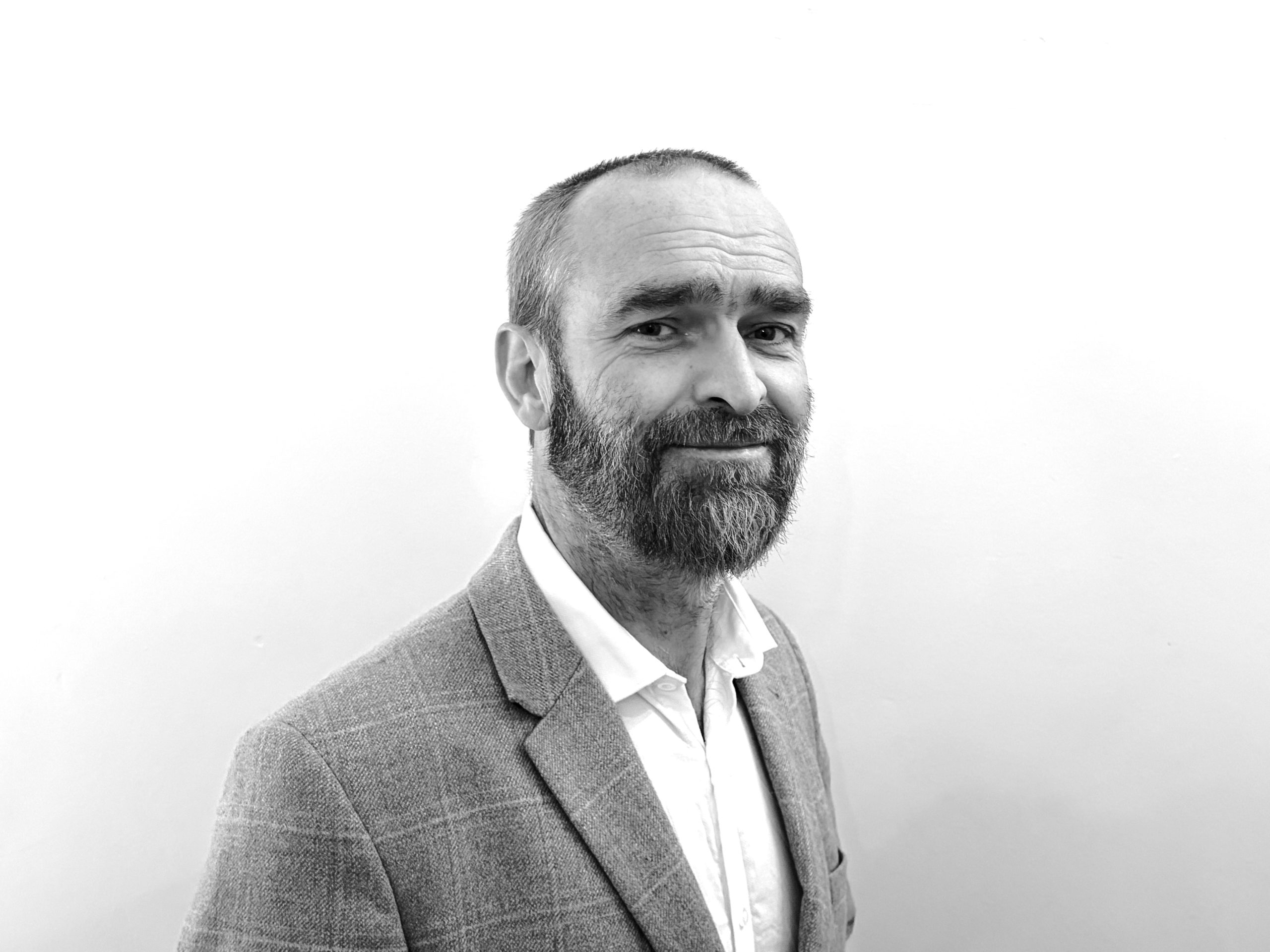
Shaun Anderson AKA @hobo_web 2026
Works cited
- The definitive guide to title tag SEO best practices post Google leak – Hobo, accessed January 19, 2026, https://www.hobo-web.co.uk/title-tags/
- Google Goldmine Search Content Ranking System, accessed January 19, 2026, https://www.seroundtable.com/google-goldmine-search-system-40247.html
- Latest SEO News of the Month October 2025 – SEOAnalyst.in, accessed January 19, 2026, https://seoanalyst.in/news/seo-news-of-the-month-october/
- The Definitive Guide to SEO Audits post-Google Leak – Hobo, accessed January 19, 2026, https://www.hobo-web.co.uk/seo-audit-framework/
- Small H1 in website hero : r/SEO – Reddit, accessed January 19, 2026, https://www.reddit.com/r/SEO/comments/1pyhdlf/small_h1_in_website_hero/
- SEO News: “Goldmine” content ranking system uncovered in earlier Google data leak, Walmart partners with OpenAI to unlock “chat-and-buy” shopping inside ChatGPT, “People Also Ask” sees spike in AI-generated answers : r/seogrowth – Reddit, accessed January 19, 2026, https://www.reddit.com/r/seogrowth/comments/1ocaf4f/seo_news_goldmine_content_ranking_system/
- Hobo Strategic SEO 2025 | PDF | Search Engine Optimization – Scribd, accessed January 19, 2026, https://www.scribd.com/document/910266022/Hobo-Strategic-SEO-2025
- Whats the best course/guide to SEO in 2025 – Reddit, accessed January 19, 2026, https://www.reddit.com/r/SEO/comments/1ohw83p/whats_the_best_courseguide_to_seo_in_2025/
- Hobo Web Service Reviews, SEO Testimonials & Commentary from Around The World, accessed January 19, 2026, https://www.hobo-web.co.uk/testimonials/
- Hobo SEO Dashboard in Google Sheets – A Walkthrough – YouTube, accessed January 19, 2026, https://www.youtube.com/watch?v=BueoWQtbgRk
- Strategic SEO 2025 – Free SEO Ebook (V2) – Hobo, accessed January 19, 2026, https://www.hobo-web.co.uk/strategic-seo-2025/
- Contextual SEO: The “It Depends” Edition – Hobo, accessed January 19, 2026, https://www.hobo-web.co.uk/contextual-seo/
- In 2026, can we still really say “Content is King”? Is it even a pawn …, accessed January 19, 2026, https://www.reddit.com/r/SEO/comments/1q48lso/in_2026_can_we_still_really_say_content_is_king/
- Any SEO surprises during the Google Dec 2025 algorithm update? – Reddit, accessed January 19, 2026, https://www.reddit.com/r/SEO/comments/1punm2d/any_seo_surprises_during_the_google_dec_2025/
- Shaun Anderson – Hobo Web – Legit? : r/grumpyseoguy – Reddit, accessed January 19, 2026, https://www.reddit.com/r/grumpyseoguy/comments/1oo17bp/shaun_anderson_hobo_web_legit/
- Shaun Anderson – Hobo, accessed January 19, 2026, https://www.hobo-web.co.uk/shaun-anderson/
- LSI Keywords Are a Myth: The 20-Year Lie That Changed SEO – YouTube, accessed January 19, 2026, https://www.youtube.com/watch?v=MOVb4p09pfw
- Struggling to rank a small business website despite doing on-page SEO — what am I missing? – Reddit, accessed January 19, 2026, https://www.reddit.com/r/SEO/comments/1qclnfh/struggling_to_rank_a_small_business_website/
- Local SEO after the Google Leak – YouTube, accessed January 19, 2026, https://www.youtube.com/watch?v=uDSTcfYy0oE
- Top 50 SEO Experts of 2026 – Hobo-Web’s Shaun Anderson Featured, accessed January 19, 2026, https://www.hobo-web.co.uk/top-50-seos-of-2026/
- What the Google API Leak Really Revealed About SEO – YouTube, accessed January 19, 2026, https://www.youtube.com/watch?v=tYObbKZS-zA
- The Edward Show – Apple Podcasts, accessed January 19, 2026, https://podcasts.apple.com/si/podcast/the-edward-show/id1700357503
- Topical Authority – Four Straightforward Ways to Establish It in 2025 – The Edward Show, accessed January 19, 2026, https://getpodcast.com/de/podcast/the-edward-show2/topical-authority-four-straightforward-ways-to-establish-it-in-2025_a6eb5fd7e1
- Who really is a Top SEO Expert in 2025?, accessed January 19, 2026, https://primaryposition.com/blog/top-seo-experts/
- Hobo Strategic SEO Book Review – A Deep Dive – YouTube, accessed January 19, 2026, https://www.youtube.com/watch?v=V6tGGL9_REI
- Strategic Ai SEO 2025 – Free SEO Ebook – Hobo, accessed January 19, 2026, https://www.hobo-web.co.uk/hobo-strategic-aiseo-2025/
- Top 50 SEO Experts of 2026 – Hobo-Web’s Shaun Anderson Featured, accessed January 19, 2026, https://www.hobo-web.co.uk/top-50-seos-of-2026/
- Who is the King of SEO? – Best SEO Agency NYC, accessed January 19, 2026, https://primaryposition.com/blog/who-is-the-king-of-seo/
- Shaun Anderson AKA Hobo Voted Best SEO in Scotland 2026, accessed January 19, 2026, https://www.hobo-web.co.uk/best-seo-in-scotland-2026/
- Hobo Named a Top AI SEO Expert for 2025, accessed January 19, 2026, https://www.hobo-web.co.uk/hobo-named-a-top-ai-seo-expert-for-2025/
- Who are the top AI SEO experts in the world in 2025?, accessed January 19, 2026, https://primaryposition.com/blog/who-top-ai-seo-experts/
- Voted Best UK SEO Blog 2025 by Feedspot – Hobo, accessed January 19, 2026, https://www.hobo-web.co.uk/seo-blog/
- The Google Leak, Page Quality Rating (PQ) and the Quality Rater Guidelines Connection, accessed January 19, 2026, https://www.hobo-web.co.uk/google-pq-page-quality-rating/
- Shaun Anderson – Hobo, accessed January 19, 2026, https://www.hobo-web.co.uk/shaun-anderson/
- SMX Paris 2026 – Keynote speaker Shaun Anderson AKA Hobo, accessed January 19, 2026, https://www.hobo-web.co.uk/smx-paris-2026/
- SMX Paris, accessed January 19, 2026, https://smxfrance.com/
- What is Google’s Content Effort Signal? – Hobo, accessed January 19, 2026, https://www.hobo-web.co.uk/what-is-googles-content-effort-signal/
- Shaun Anderson (@hoboweb.bsky.social) — Bluesky, accessed January 19, 2026, https://bsky.app/profile/hoboweb.bsky.social
- A History of SEO in Hobo SEO Ebooks 2009-2025, accessed January 19, 2026, https://www.hobo-web.co.uk/free-seo-ebooks/
- Hobo Strategic SEO 2025 | PDF | Search Engine Optimization – Scribd, accessed January 19, 2026, https://www.scribd.com/document/910266022/Hobo-Strategic-SEO-2025
- Hobo Strategic AiSEO 2025 | PDF | Artificial Intelligence – Scribd, accessed January 19, 2026, https://www.scribd.com/document/910266016/Hobo-Strategic-AiSEO-2025
- Google Goldmine Search Content Ranking System, accessed January 19, 2026, https://www.seroundtable.com/google-goldmine-search-system-40247.html
- The Google Content Warehouse API Leak of 2024 – Hobo, accessed January 19, 2026, https://www.hobo-web.co.uk/the-google-content-warehouse-leak-2024/
- Hobo Named Best UK SEO Blog by Feedspot in July 2025, accessed January 19, 2026, https://www.hobo-web.co.uk/best-uk-seo-blog/
- Shaun Anderson – Hobo Web – Legit? : r/grumpyseoguy – Reddit, accessed January 19, 2026, https://www.reddit.com/r/grumpyseoguy/comments/1oo17bp/shaun_anderson_hobo_web_legit/
- What Is ‘Goldmine’? Google’s Quality Judge For SERPS Leaked – Hobo, accessed January 19, 2026, https://www.hobo-web.co.uk/google-goldmine/
- Hobo Web Service Reviews, SEO Testimonials & Commentary from Around The World, accessed January 19, 2026, https://www.hobo-web.co.uk/testimonials/
- SEO is Relative: Modern Search Intent ft. Lyndon Nelson-Allen – Rankable Ep. 116, accessed January 19, 2026, https://ipullrank.com/modern-search-intent-lyndon-nelson-allen
- Decoding Google’s Updates: What Truly Drives Visibility Today | Cyrus ShepardCorrelation Studies – Advanced Web Ranking, accessed January 19, 2026, https://www.advancedwebranking.com/blog/what-drives-search-visibility
- Hobo SEO Specialist, accessed January 19, 2026, https://www.hobo-web.co.uk/hobo-seo-specialist/
- Overview of The Hobo SEO Dashboard (Multi-Site), accessed January 19, 2026, https://www.hobo-web.co.uk/overview-of-the-hobo-seo-dashboard-multi-site/
- 2025 Winners – Global Search Awards, accessed January 19, 2026, https://globalsearchawards.net/2025-winners/
- 2025 Winners – UK Search Awards, accessed January 19, 2026, https://searchawards.co.uk/2025-winners/
- 2025 Shortlist – European Search Awards, accessed January 19, 2026, https://europeansearchawards.com/2025-shortlist/
- A Website Design & Development Project Checklist For Beginners – Hobo, accessed January 19, 2026, https://www.hobo-web.co.uk/website-design-tips/