Understanding Answer Engine Optimisation (AEO) is no longer optional; it is essential for digital visibility. For survival beyond 2027.
As search engines increasingly prioritise direct, immediate answers, your ability to optimise for these formats will dictate your competitive edge and online authority.
This article guides you through the critical hierarchy of Google’s answer delivery, from OneBox results to the emerging AI Overviews. You will learn how to strategically adapt your content to capture prime visibility in an increasingly answer-driven search landscape.
By understanding this progression – OneBox answers > Direct Answers > Featured Snippet answers > Knowledge Graph answers > Passage Ranking answers > AI Overviews – you can achieve better answers and position your brand as a definitive authority in your niche, and you might come to the conclusion that Answer Engine Optimisation (AEO) is the only option left.
Answer Engine Optimisation (AEO)
Google Answer Engine Optimisation (AEO) involves structuring and formatting digital content to ensure search engines and AI systems feature it as a direct response on the results page. By prioritising machine-readability, rigorous schema markup, and entity authority, brands secure prime visibility within zero-click answer boxes and AI Overviews.
Understanding Answer Engine Optimisation (AEO)
Answer Engine Optimisation (AEO) represents a shift from traditional Search Engine Optimisation (SEO), but know that without SEO, you cannot do AEO in modern marketing. AEO is SEO, and inseparable from it in 2026.
SEO was historically about getting the click. For over 2 decades as an SEO professional, that is all I cared about as an optimiser. Even my seo audit Dashboards ignore impressions. Impressions were never my focus. The click was.
While SEO primarily focuses on ranking web pages high in search results to drive clicks, AEO aims to have your content directly presented as the answer within the search results page itself, or at least mentioned.
The goal is to provide concise, machine-readable information that satisfies user intent immediately, often without requiring a click to your website.
This is the important part.
AEO prioritises clarity, conciseness, and the use of structured data to make content easily digestible for search engine algorithms.
It is about becoming the authoritative source for direct answers.
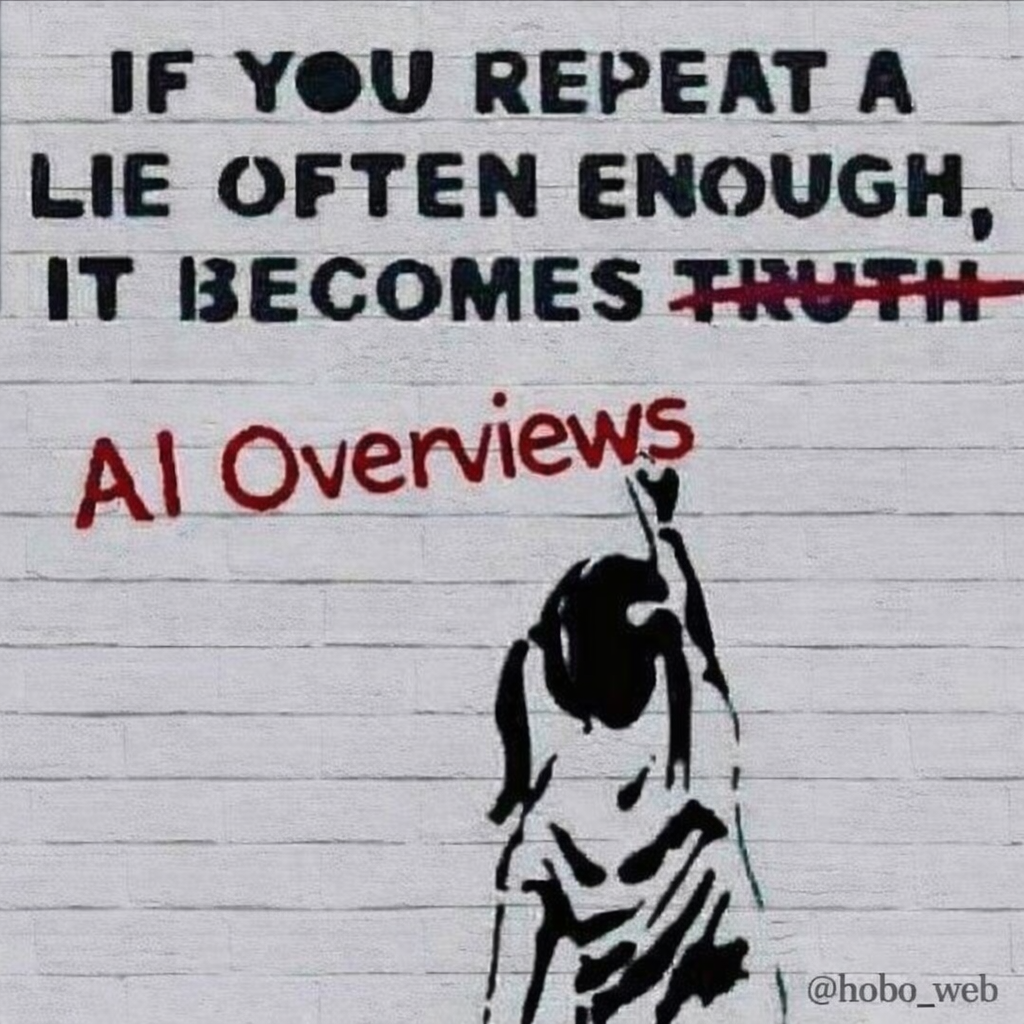
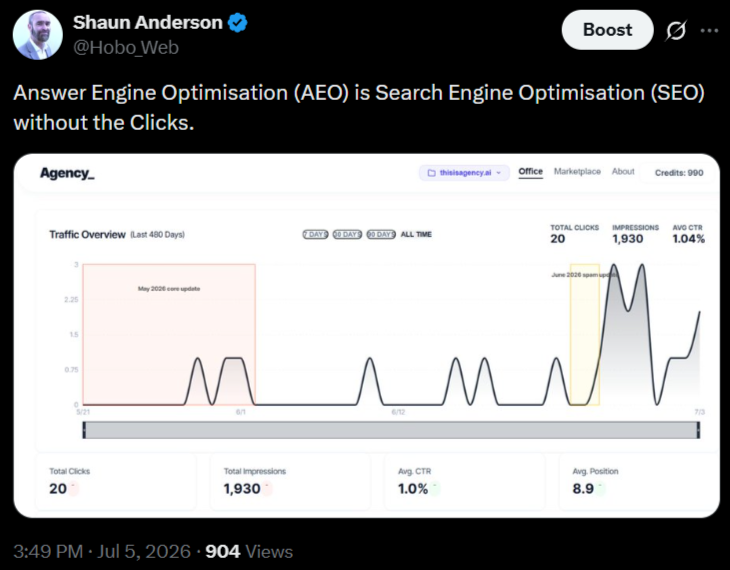
Answer Engine Optimisation (AEO) is Search Engine Optimisation (SEO) without the Clicks.
The Evolution of the Answer Engine: A Customer-Centric Journey
The current answer hierarchy did not emerge overnight.
It is the result of Google’s long-term algorithmic evolution, driven by a stated philosophy: putting their users first by delivering immediate, frictionless value.
It is also incredibly profitable for Google to do this, and it helps to understand the key milestones that shifted Google from a traditional link directory to a dynamic answer engine.
- 2013: The Hummingbird Update: This foundational algorithm rewrite marked the transition from lexical search (matching exact “strings” of text) to semantic search (understanding “things” and real-world context). By focusing on the searcher’s actual intent rather than just isolated keywords, Hummingbird laid the groundwork for answering complex questions directly.
- 2019: The BERT Revolution: The introduction of BERT (Bidirectional Encoder Representations from Transformers) enabled Google to grasp the subtle nuances of natural language and conversational queries. This leap in understanding how words—especially prepositions like “for” and “to” – relate to one another in a sentence is what made highly accurate Featured Snippets and Passage Ranking possible.
- 2023–2024: Search Generative Experience (SGE): Before AI Overviews became the default apex of the search results, Google tested the waters with SGE via Search Labs. This opt-in experiment was the crucial testing ground that proved users wanted multi-source, AI-synthesised summaries at the top of the Search Engine Results Page (SERP), paving the way for the broad rollout of AI Overviews.
By tracking this progression, it becomes clear that Answer Engine Optimisation is not just about chasing algorithmic trends; it is about anticipating the user’s needs and delivering the fastest, most accurate solution.
The Foundational Layer: OneBox Answers
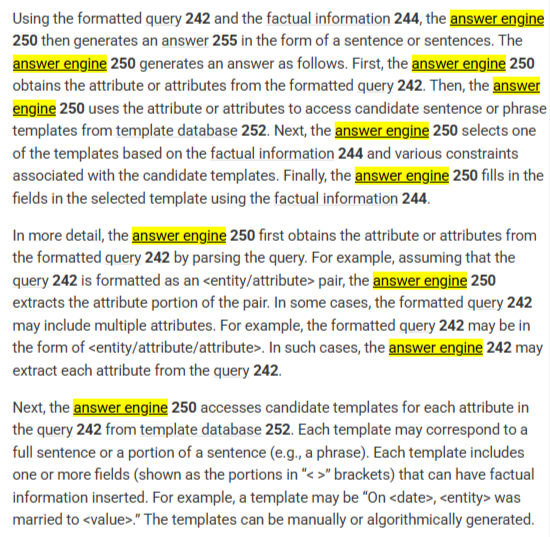
“A search engine provider, Google Inc. of Mountain View, Calif., has developed an “answer box” technology, known as OneBox, that has been available for several years. Using this technology, a set of web search features are offered that provide a quick and easy way for a search engine to provide users with information that is relevant to, or that answers, their search query. For example, a search engine may respond to a search query regarding everyday essential information, reference tools, trip planning information, or other information by returning, as the first search result, information responsive to the search query, instead of providing a link and a snippet for each of many relevant web pages that may contain information.”
At the base of Google’s answer hierarchy are OneBox answers.
These are direct results that provide information from Google’s own services or licensed data, presented immediately on the search results page.
Examples include weather forecasts, stock quotes, unit conversions, or dictionary definitions. For instance, searching ‘weather Greenock’ will likely display a OneBox with current conditions and a forecast. I don’t need it; I know it is usually raining in Greenock, but I digress.
OneBox results bypass the traditional organic web index entirely.
Instead, Google relies on direct data feeds (like weather APIs, flight radar data, or stock market feeds) and internal tools (like Google Maps or Google Business Profiles) to serve immediate, hardcoded information.
Optimisation requires ensuring your business data is accurately fed into recognised public databases and maintaining robust, verified Google Business Profiles.
Bill Slawski’s 2015 breakdown of the “Enriching web resources” patent (US Patent 9,146,992) directly documents the exact early architecture that paved the way for modern Answer Engine Optimisation (AEO).
Here is why this specific article connects directly to the evolution of answer engines:
-
The Identification of “Trigger Terms”: Slawski highlights how Google identifies specific words or phrases (like “weather,” “movie,” “convert,” or parameter terms like a business or location name) that signal a user wants an immediate, direct answer rather than a list of links. This is the direct evolutionary ancestor to how modern Large Language Models and search algorithms parse intent today.
-
The Shift Away from Blue Links: As Slawski noted back in 2015, Google was deliberately moving toward returning “information responsive to the search query, instead of providing a link and a snippet for each of many relevant web pages.” This marks the historical origin of zero-click searches.
-
Chasing the Wolfram Alpha Model: Slawski explicitly points out that Google’s implementation of answer boxes was an effort to act more like a computational knowledge engine (like Wolfram Alpha) – synthesising facts and real-world data directly onto the SERP. This exact philosophy evolved over the next decade into Featured Snippets, Knowledge Panels, and ultimately, AI Overviews.
While the terminology back in 2012–2015 revolved around “OneBoxes” and “enriched web resources,” Slawski was documenting the very birth of the answer-driven search landscape that we now manage through AEO.
Direct Answers: Immediate Gratification
Moving up the hierarchy, Direct Answers encompass any concise, immediate response Google provides at the top of the search results page. These are intended to satisfy the user’s need for information without requiring a click on a traditional organic link.
OneBox results are a specific type of Direct Answer. This category also includes Featured Snippets and information derived from the Knowledge Graph.
Direct Answers rely on Google’s ability to scan its massive database of facts to provide an immediate answer without needing to pull a paragraph of text.
It connects a search query to a verified fact.
Optimisation requires clear, unambiguous content that pairs a specific entity (like ‘Eiffel Tower’) with its attribute (like ‘Height’).
In an interview for SMX West 2015, Bill Slawski outlined several key insights that highlight how long the industry has been grappling with this exact shift:
-
The Evolution from Links to Direct Answers: Slawski pointed out back in 2015 that Google was explicitly interested in returning actual answers to questions rather than just ranking pages that might contain those answers, citing foundational concepts like Sergey Brin’s 1999 DIPRE patent.
-
The Importance of Schema Markup: When asked how SEOs should approach direct answers as an opportunity, Slawski emphasized the rising value of Schema.org markup. He noted that structured data allows site owners to reinforce information so Google feels confident enough to pull it directly into answer boxes.
-
Tying Sites to Knowledge Bases and Entities: When listing the top three trends SEOs needed to pay attention to that year, his very first recommendation was understanding how sites could be tied by search engines to knowledge bases and entities using semantic markup—laying the groundwork for modern entity SEO and E-E-A-T.
-
The Threat of Lost Clicks: Even in 2015, the industry was asking whether direct answers were “stealing their clicks and credit,” proving that the zero-click debate is more than a decade old.
This interview captures Slawski doing what he did best: looking past the traditional ten blue links and decoding the underlying mechanics of how search engines were evolving into answer engines.
Featured Snippets: The Prime Real Estate
Featured Snippets are special boxes that appear at the top of Google’s search results, offering a direct and concise answer to a user’s question. They represent prime real estate for visibility.
The content for a Featured Snippet is automatically pulled from a single web page in Google’s index, presented as a paragraph, list, or table. The evolution and expansion of Google’s Featured Snippets highlight their continued importance.
Featured Snippets are driven by Google’s ability to read and understand conversational text on a web page.
The BERT algorithm allows Google to understand the context and nuance of a search query, matching it to the exact paragraph, list, or table on a page that directly answers the intent.
This is powered by specific on-page structuring – namely, using short sentences in second person, targeting keywords in H2 or H3 tags, and immediately following them with concise, 40–60 word standalone answers or perfectly formatted HTML lists.
A late 2014 article by Bill Slawski is a masterclass in breaking down the mechanics of early Featured Snippets through Google’s patent application, Natural Language Search Results for Intent Queries.
It reveals how Google was engineering the exact systems that paved the way for modern Answer Engine Optimisation (AEO):
-
Intent Templates and Variable Matching: Slawski detailed how Google used templates with variable and non-variable portions (like recipe for $X or $X causes) to map conversational, natural language questions to standard keyword queries. This allowed the engine to recognise that entirely different phrasing (e.g., “how is diabetes treated” vs. “what cures diabetes”) shared the exact same user intent.
-
The Q&A Data Store: Long before modern LLMs synthesised answers on the fly, Google was populating a dedicated Q&A data store with headings and text extracted from trusted, authoritative websites to serve direct snippet answers.
-
Clustering Question Categories: Slawski explained how Google’s systems clustered related search queries and templates together to deliver fast, accurate direct answers, establishing the early algorithmic rules for what would become known as “Position Zero.”
Articles like this are precisely why Slawski’s work remains foundational – he was mapping out how search engines parse intent and extract text blocks years before the rest of the industry fully realised that the “click” was beginning to take a back seat to the direct answer.
Knowledge Graph: Building Entity Authority
Google’s Knowledge Graph is a vast database of facts about people, places, and things, along with the connections between them.
It helps Google understand the real-world context of search queries, enabling it to provide more relevant and direct answers.
Information from the Knowledge Graph often appears in Knowledge Panels, which are prominent boxes on the right side of search results (on desktop), providing a comprehensive overview of an entity.
These panels differ from Featured Snippets by offering a broader, multi-source overview rather than a single direct answer from one page, as explored in comprehensive SEO analyses.
The Knowledge Graph is an interconnected database powered by machine learning that understands the relationships between real-world “entities” (people, places, concepts, brands).
It moves beyond matching keywords to understanding what a thing actually is.
You power your presence here by injecting JSON-LD schema code into your website, explicitly telling Google’s crawlers the attributes of your brand, authors, and organisation to build long-term E-E-A-T (Experience, Expertise, Authoritativeness, and Trustworthiness):
- Deploying Comprehensive Schema.org Markup: Implement detailed Organisation schema on the homepage, defining properties like name, url, logo, address, founder, and sameAs (linking to official social media profiles).
- Implementing Person Schema for the Founder: Create a Person schema on a bio page, detailingname, jobTitle, worksFor (linking to the Organisation entity), and sameAs (linking to his X/Twitter and LinkedIn profiles).
- Using @id for Entity Interlinking: Use the @id attribute in the JSON-LD schema to create unique identifiers for each core entity. Reference these @ids in other schema types to build a machine-readable knowledge graph.
- Strategic Internal Linking: Audit and enhance the internal linking structure to connect pages that discuss related entities, reinforcing semantic relationships for search engines. This strategic approach to content architecture and internal linking, as discussed by Advanced Web Ranking in 2023, is integral to improving Entity DNA and overall AI visibility
- Claim your Google profile. Sync up your social media accounts in Search Console.
A 2022 piece by Bill Slawski is a brilliant capstone to his life’s work, analysing Google’s patent on “Natural Language Processing with an N-Gram Machine” (U.S. Patent 11,256,866).
It explains the exact technical blueprint for how modern search engines turn unstructured web text into structured machine understanding:
-
The Encoder-Programmer Architecture: Slawski breaks down how Google’s system uses an encoder model to ingest natural language text bodies and output a Knowledge Graph, combined with a programmer model that takes a user’s natural language question and outputs a program to query that graph.
-
Moving Beyond Keywords to Execution: Instead of just matching keywords on a page, the system actually executes a program against a dynamically built knowledge graph of real-world entities to compute or retrieve the correct answer.
-
The Bridge to AI Answers: Written just months before his passing, this article shows how Google evolved from extracting simple text snippets (Featured Snippets) to building deep, machine-learned semantic networks capable of complex reasoning and multi-source synthesis—laying the direct foundation for the AI Overviews and AI Modes we use today.
Passage Ranking: Granular Relevance
Passage Ranking represents a more granular approach by Google, allowing it to rank specific sections or ‘passages’ of a web page independently. This means a highly relevant paragraph within a longer article can rank for a query, even if the page’s main topic is different.
This capability helps Google surface highly specific information that might otherwise be buried in comprehensive content. It is particularly beneficial for long-form articles that cover multiple sub-topics.
Passage Ranking is powered by advanced neural networks that allow Google to index, score, and rank individual paragraphs or sections of a page independently from the rest of the document. This is powered by writing comprehensive, long-form content where every subsection is tightly organised, highly descriptive, and self-contained enough to make sense if pulled out of the broader article.
AI Overviews: The New Frontier of Answers
At the apex of the current answer hierarchy are Google’s AI Overviews. These are AI-generated summaries that appear at the very top of search results for certain queries, synthesising information from multiple web sources to provide a comprehensive answer. The Digital Marketing Institute details what Google AI Overviews mean for search.
A pivotal development impacting Answer Engine Optimisation over the last year has been the ongoing refinement and expanded presence of Google’s AI Overviews, which continued their rollout and evolution into early 2026. This expansion necessitates that AEO strategies now prioritise content capable of contributing to these comprehensive AI summaries, moving beyond optimisation for single-source snippets.
Recent data from June 30, 2026, indicates that the rate of zero-click searches is approaching 65% for all queries, soaring as high as 83% for searches that specifically trigger an AI Overview. This shift underscores a critical imperative for AEO: optimising for visibility directly within the AI-generated answer itself, rather than solely for traditional website clicks.
Google’s ongoing commitment to a more conversational and answer-driven search experience was further solidified by significant updates announced at its I/O 2026 conference. These enhancements include a more seamless transition from AI Overviews into a conversational ‘AI Mode’ and expanded capabilities for users to ask increasingly complex questions. This shift represents a significant evolution from the traditional Featured Snippet.
AI Overviews use a ‘query fan-out’ technique. The underlying Large Language Model (LLM) simultaneously issues multiple searches across subtopics, reads top-ranking pages, synthesises shared facts, and generates a conversational, multi-paragraph summary.
It is anchored by Google’s traditional quality systems to prevent hallucinations. This is powered by demonstrating unimpeachable trustworthiness, providing clear and structured data, citing authoritative sources, and answering complex intent thoroughly so the LLM trusts your content enough to use it as a foundational source for its generation.
Agentic SEO: The Next Frontier
In direct response to the dominance of AI Overviews and the surge in zero-click interactions, the core metrics for Answer Engine Optimisation have undergone a fundamental transformation. The industry has shifted its focus from traditional keyword rankings to new benchmarks. These innovative metrics track the percentage of AI-generated answers, particularly from platforms like ChatGPT and Google’s AI Overviews, that cite or reference a specific brand. This development highlights that a brand mention within an AI-synthesized answer can now hold more strategic value than a traditional organic link, redefining success in the age of answer engines.
Looking beyond current AEO practices, the past year has also seen the definition of a successor discipline: Agentic SEO.
The emergence of ‘Agentic SEO’ represents a cutting-edge approach to Answer Engine Optimisation, where multi-agent AI systems work in concert to achieve optimal visibility.
This methodology, exemplified by the public beta launch of thisisagency.ai, leverages AI teams to orchestrate complex SEO tasks.
This directly impacts AEO by enhancing the creation of massive, verified factual corpora, aiming to establish entities as canonical sources of truth for AI models.
Former Google CEO Eric Schmidt underscored this strategic shift by characterising the current technological phase as the ‘agentic period’ of artificial intelligence and advising that the economy must fund ‘agentic AI companies’.
A core component of Agentic AEO is ‘Inference Optimisation,’ a concept I used in late 2025. This approach addresses consistent brand attribution in the ‘Clickless World’ of AI Overviews. As users increasingly get answers directly on the SERP without clicking, Inference Optimisation ensures your brand is credited as an authoritative source within AI-generated answers, reframing AEO as a vital brand-building exercise.
The ‘Marketing Cyborg Technique,’ my own marketing coinage, further refines AEO content creation. This technique emphasises human judgment amplified by AI execution, ensuring AI-driven content demonstrates genuine human-level effort and originality.
Coupled with the ‘Content Effort’ signal hypothesis, this approach is critical for signalling to Google’s Large Language Models (LLMs) that content has significant human investment, increasing its likelihood of both ranking in Google and as a selection for direct answers and AI Overviews.
Ethical considerations and human oversight are foundational to Agentic AEO.
The ‘Glass-Box’ AI Human-in-the-Loop (HITL) system, as implemented by thisisagency.ai, allows human oversight to refine AI output and enhance perceived content effort.
An AI-powered Ethics Manager named Meg, highlighted in an April 7, 2026, Hobo article, audits content for bias and manipulation. This aligns with findings from Deloitte’s ‘2026 CFO Signals Survey,’ cited on April 2, 2026, which identified ‘loss of control’ as a significant barrier to AI adoption, advocating for HITL models as crucial for governance and ethical oversight in AEO content creation. Thisisagency.ai implemented its Quality Rater Engine on June 25, 2026, to explicitly measure critical AEO-related quality signals like ‘Bricks & Mortar’, ‘Entity DNA’, and ‘Content Effort’, showcasing a commitment to verifiable authority.
The Final Horizon: AI Mode as the Default
-
The Erasure of the Choice Architecture: Users don’t toggle over to an “AI tab” anymore – AI mode is the web browser, the assistant, and the answer engine all at once. The traditional ten blue links haven’t just been pushed below the fold; for most informational and transactional queries, they have vanished entirely behind a fluid, synthesised dialogue.
-
From Keyword Targeting to Entity Infiltration: When the default setting is an AI model generating a unified narrative response, ranking for a keyword is a vanity metric. If your brand, your data structures, and your entity relationships aren’t hardcoded into the training weights, retrieval-augmented generation (RAG) pipelines, and real-time knowledge graphs feeding that default mode, you do not exist to the modern consumer.
-
The Maturity of the Mentions Economy: As highlighted across the shift toward zero-click dominance, success is no longer measured by referral traffic bleeding into a landing page. It is measured by your Share of Answer—whether autonomous agents and default AI models cite you as the authoritative source when constructing reality for the user.
The Strategic Imperative: Mastering the AEO Hierarchy
Understanding Google’s answer hierarchy is not just about knowing different search features; it is about recognising the strategic progression of how users seek and receive information. From quick factual checks via OneBox to comprehensive AI-synthesized summaries, the goal of search engines is increasingly instant gratification.
This evolution means your content strategy must adapt to serve these diverse answer formats. Each level of the hierarchy offers a distinct opportunity for visibility and authority, even in an environment with increasing zero-click searches. This integration means that ‘answer-first’ content sections, comprehensive schema markup, and rigorous entity consistency audits are becoming standard elements in content production and technical SEO checks, as industry analysis from May 6, 2026, confirms the unification of AEO and traditional SEO strategies.
By optimising for each stage, you ensure your brand is present at every point of the user’s information journey. This holistic approach builds trust and positions your content as the go-to source for reliable answers.
Achieving Better Answers: A Holistic Approach to AEO
EntityAnnotations.-
Experience & Effort: Backed by signals like
contentEffort,originalContentScore, andlastSignificantUpdate, search engines measure the actual human effort and depth invested in content creation as a core countermeasure against low-quality AI output. -
Expertise & Focus: Governed by attributes such as
siteFocusScore,siteRadius, andsite2vecEmbeddingEncoded, establishing topical authority ensures the engine recognises your site as an expert domain within a specific niche. -
Authoritativeness & NSR: Quantified through macro-signals like site-wide quality frameworks (
nsrDataProto,predictedDefaultNsr),siteAuthority,Homepage PageRank, andsiteSiblings, brand scale and trusted citations determine your weight in the synthesis pipeline. -
Trust & Safety: Protected by guardrails like
pandaDemotion,spamrank, andContentChecksum96, technical soundness and the complete elimination of manipulative patterns are required to avoid algorithmic suppression.
The Redundancy of “GEO”: Generative Engine Optimisation
-
Adding Statistics & Quotations: Basic journalistic hygiene that provides concrete factual anchors for Retrieval-Augmented Generation (RAG) extraction.
-
Technical Fluency & Terminology: On-page entity clarity, structured schema architecture, and topical depth.
-
Source Attribution & Mentions: Foundational entity association, authority modelling, and provenance tracking.
The May 2026 Codification: Google Draws the Line
-
No Special AI Files or Markup Required: Google confirmed that
llms.txtfiles, proprietary AI text formats, or unique markdown files carry zero special privileges for generative search visibility. -
Content “Chunking” is Fallacious: Breaking content into micro-fragments for AI ingestion is unnecessary; Google’s RAG systems parse multi-topic nuance across entire web pages naturally.
-
No Need to Rewrite for Robots: Artificial long-tail keyword stuffing or writing specifically for AI models is redundant, as generative systems naturally handle intent, context, and synonyms.
-
Mention Pollution is Flagged: Attempting to manipulate AI engines through inauthentic, manufactured mentions across the web triggers Google’s core spam and ranking demotion systems.
-
Schema is SEO, Not an AI Backdoor: While structured data remains critical for technical SEO and rich result eligibility, it is not a secret shortcut into AI Overviews.
A Decade in the Making: From Patent Forensics to the Agentic Web
The evolving search landscape demands a sophisticated approach to content. By understanding and strategically optimising for Google’s answer hierarchy – from OneBox results to AI Overviews – you can ensure your content stands out. Focus on clear, concise, and machine-readable answers, bolstered by strong E-E-A-T and structured data. This commitment to delivering better answers will secure your visibility and authority in the future of search.
Ultimately, today’s advanced frameworks for Answer Engine Optimisation (AEO) and Super Topicality do not exist in a vacuum. They are the direct, cumulative result of over a decade of rigorous forensic reverse-engineering.
When I published my breakdown of Google’s quality criteria in 2017, the late, legendary search patent analyst Bill Slawski reviewed the work and publicly noted, “It’s one of the most detailed lists of ranking signals that I’ve seen“.
That initial deep-dive into N-gram phrase models, site-quality classifiers, and click-duration metrics wasn’t just temporary speculation – it was the groundwork that was later entirely vindicated by the 2024 API documents and antitrust trial disclosures.
By treating search engines not as simple keyword indexes, but as complex mathematical systems built on entity boundaries and vector embeddings, we didn’t just react to the recent AI revolution.
SEOs mapped its underlying architecture years before the rest of the digital marketing industry even realised the rules of the game were changing.
While the late Bill Slawski laid foundational tracks of AEO in forensic patent analysis, a broader ecosystem of technical researchers, semantic architects, engineers, and legal figures shaped the public decoding of the 2024 Google Content Warehouse API leak and its subsequent antitrust fallout. Technical pioneers like Erfan Azimi (who originally discovered the exposed repository) in 2024, Rand Fishkin and Michael King (who spearheaded the initial public analyses), Dan Petrovic (who preprocessed the massive repo), semantic authorities like Koray Tuğberk Gübür (who engineered early frameworks for topical authority and semantic content meshes) and Olaf Kopp (who pioneered entity-based optimization, semantic patent intelligence, and Generative Engine Optimization / GEO), alongside Jason Barnard, credited with naming ‘Answer Engine Optimisation’ (AEO) in 2017, worked alongside landmark legal proceedings overseen by Judge Amit P. Mehta and Judge Leonie M. Brinkema. Furthermore, sworn testimonies and disclosures from Google executives Pandu Nayak and engineer HJ Kim – all framed through strategic doctrines reminiscent of Sun Tzu – collectively dismantled Google’s black-box secrecy and permanently altered the landscape of search engineering.
The click is dying. Long live the mention.
Frequently Asked Questions About Answer Engine Optimisation
A Google Answer Box is a type of search result usually displayed at the top of the search engine results page, providing a direct answer to a user’s question. It aims to give users desired information instantly, often without requiring a click to a website.
SERP features are distinct search results that stand out from traditional organic links, designed to improve user experience by offering quick answers and additional information directly on the results pages. They take various forms like featured snippets, AI Overviews, and knowledge panels.
Google Answer Boxes are important because they place a website in the foreground, above top-ranking organic results, increasing visibility. They provide instant information to users, contributing to a better user experience.
SERP features are important because they can drive more organic traffic to a site by taking up more space and appearing prominently. Securing them also signals to searchers that content is trustworthy and reliable, as Google displays credible webpages prominently.
Google’s algorithms identify content on web pages that directly answers a user’s question. This content is then extracted and displayed prominently at the top of the search results page, often in a paragraph, list, or table format.
Types include dictionary definitions, those with no source, video widgets, web extractions, real-time results, company information, stock data, and those with multiple sources. These cater to various user intents for direct answers.
Featured Snippets are direct, succinct answers to user queries, pulled from a webpage and displayed near the top of the SERP, often above organic results. They can appear as paragraphs, lists, or tables and include a link to the source page.
AI Overviews are AI-generated summaries that appear at the very top of search results for certain queries, synthesizing information from multiple web sources. They represent a significant evolution in direct answer delivery, impacting organic click-through rates.
Featured Snippets pull information from a single web page, providing a direct excerpt. AI Overviews, on the other hand, synthesize information from multiple web sources to create a more comprehensive, AI-generated summary.
Knowledge Panels are prominent boxes on the right side of desktop search results that provide a comprehensive overview of an entity (like a person, place, or organization). They display factual information gathered from various sources in Google’s Knowledge Graph.
To optimize, identify keywords Google might answer, segment them by relevancy, and write content specifically structured for direct answers. This includes using clear headings for questions and following immediately with concise answers (e.g., 40-60 words).
To earn Featured Snippets, identify relevant queries that trigger this SERP feature. Structure your content with clear H2/H3 headings that pose common questions, followed immediately by a concise 40–60 word answer, or use lists and tables for procedural queries.
Yes, any site can appear in Google’s direct answer box if its content is deemed the best, most relevant answer to a user’s query. Google prioritizes quality and directness in its selection.
Optimization for AI Overviews requires providing contextually rich, factual, and authoritative data that Large Language Models (LLMs) can confidently leverage. This involves moving beyond single-source snippets to contribute to comprehensive AI summaries.
Structured data provides explicit clues to search engines about the meaning and relationships within content, making it machine-readable. This enhances the likelihood of content being used for direct answers, rich results, and building entity authority.
Identify keywords by analyzing search results for existing answer boxes or using SEO tools to find queries that trigger SERP features. Focus on question-based queries or those seeking quick facts.
Position Zero refers to the highly coveted spot at the very top of Google’s search results page, occupied by a Google Answer Box or Featured Snippet, appearing even before the traditional organic #1 ranking.
Google uses various signals to determine trusted sites, including authority, relevance, and the quality of information. Consistently providing accurate, verifiable content helps build this trust.
The expansion and prominence of AI Overviews can significantly alter organic click-through rates, potentially lowering them for traditional organic results and even some older direct answers, as users get answers without clicking.
You can check your site’s SERP feature rankings by filtering data in Google Search Console to identify queries where your site appears in various SERP features. Specialized SEO tools can also instantly identify these rankings.
Answer Engine Optimisation (AEO) is the process of creating and structuring online content so search engines and AI can feature it as a direct answer to a user’s question. Unlike traditional SEO, which aims to rank links for clicks, AEO’s goal is for the content itself to be the answer within formats like AI Overviews, featured snippets, and voice search responses.
The main difference is the goal: SEO aims to rank web pages high in a list of links to drive traffic to a website. AEO aims to have your content presented directly as the answer on the results page, often without needing a click.
AEO is important because search engines are increasingly providing direct answers, leading to more “zero-click searches.” By optimising for answers, you increase brand visibility and authority in features like AI Overviews and voice search, even if users don’t click through to your website.
AI Overviews are AI-generated summaries that appear at the top of Google’s search results. They synthesise information from multiple web sources to provide a comprehensive, direct answer to a user’s query.
A zero-click search occurs when a user’s query is answered directly on the search engine results page, so they don’t need to click on any website links. This happens through features like AI Overviews, Featured Snippets, and Knowledge Panels.
Read next: AI Overviews: The Mentions Economy.