
Perhaps the biggest accusation levelled at Google following the 2024 API leak – right alongside the Google Sandbox for new sites – is that Google spent a decade lying to the SEO industry about Domain Authority.
They didn’t, really.
Critics were vocal. They opened the leaked documentation, found an attribute literally named siteAuthority, and immediately claimed vindication.
Their narrative was simple: Google said they didn’t have an authority score; the code says they do; therefore, Google is a liar.
But once again, a deep inspection of what was actually said – cross-referenced with primary analysis of the Google leaked documents – reveals that the SEO industry asked the wrong questions.
The Trademark Trap: What Mueller Actually Said
SEOs badgered Google spokespeople about “Domain Authority” (DA). What they were actually asking about, whether they realised it or not, was a proprietary metric invented by the SEO software company Moz.
When spokespeople answered these questions, they answered with the pedantic, literal precision of a Google engineer.
In a 2022 Reddit thread, a user asked how to improve their DA. Google’s John Mueller replied: “I’m kinda torn. On the one hand, you do not need DA for Google Search. Google doesn’t use it at all… For context, I don’t think I’ve ever looked up the DA for a site in the 14 years I’ve been doing this.” (Source)
He wasn’t lying.
Google does not scrape Moz to check your DA score. He was rejecting the third-party tool’s metric, not the fundamental concept of site-wide trust.
In fact, the folks online screaming “liar” conveniently forgot that Mueller had already admitted to site-wide metrics years earlier.
In a 2018 interview, he clarified: “I don’t know if I’d call it authority like that, but we do have some metrics that are more on a site level… and some of those site-wide level metrics might kind of map into similar things.“ (Source)
The Reality of siteAuthority in the Leaked Documentation
When you look at the siteAuthority attribute in the leaked architecture, it doesn’t function the way most critics want it to. The industry treats “Authority” purely as a battery of backlink juice to be manipulated.
However, siteAuthority sits closely tied to the Quality module, alongside systems that mathematically measure if a domain consistently publishes high-quality content without massive deviations into spam.
It can be inferred, I think, equally so that it is a calculation of overall domain trustworthiness, or popularity, or satisfaction and not just a raw link count.
Siteauthority cannot be domain authority because Moz, Ahrefs and Semrush are looking at links, whereas Google has the New Site Rank (NSR) framework, which is looking at the ABC of search… everything including longitudinal user satisfaction, quality analysis and technical analysis.
I think domain authority, as SEOs have historically understood it, is more probably pagerankNS (what SEOs call quality links) and Google’s internal NSR(New Site Rank) engine, especially predictedDefaultNsr.
As I wrote in a previous article on New Site Rank (NSR):
“When Google doesn’t know the quality (Q*) or popularity (P*) of a URL (T* – Topicality), it uses the aggregate for its parent path (NSR – New Site Rank). Then that path’s parent, and so on (predictedDefaultNsr).”*
Internal Confirmation: The API Leak Attributes & Authority
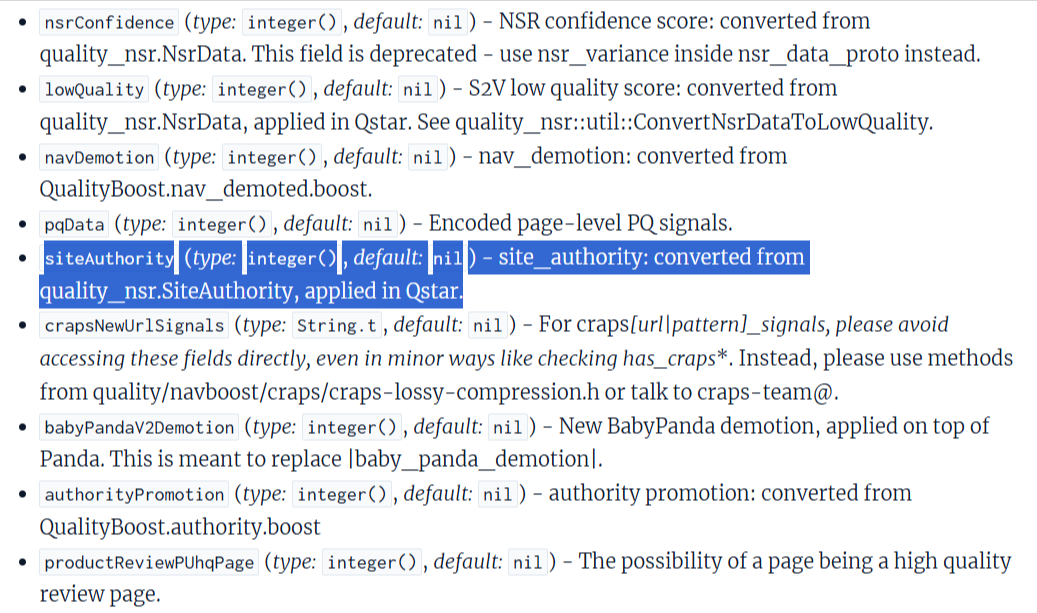
While public statements historically danced around the concept of a single score, the Google Content Warehouse API leak definitively confirmed how site-wide authority and quality are calculated internally.
These specific attributes act as algorithmic blueprints for measuring a site’s overall clout and trust within Google’s aggregate quality framework:
1. siteAuthority
- Function: Long-debated “domain authority”-like metric, confirmed as a real, calculated, and persistent score. Defined as
"converted from quality_nsr.SiteAuthority, applied in Qstar". - Type/Default:
integer(), default: nil - Source Context: Google’s Leaked CompressedQualitySignals: Advanced SEO Analysis
2. nsrDataProto (New Site Rank)
- Function: Acts as the mathematical foundation for the
siteAuthorityscore, measuring site-level quality across a domain’s architecture. Contains the New Site Rank (NSR), a sophisticated site-level quality and reliability score that calculates host-level scores by analysing a domain in sections or “sitechunks.” - Source Context: The PerDocData: Google’s Leaked Core Document Model
3. authorityPromotion
- Function: A direct boost attribute defined as
"authority promotion: converted from QualityBoost.authority.boost". - Type/Default:
integer(), default: nil
4. unauthoritativeScore
- Function: A demotion metric that actively damages a site’s overarching authority if the domain is flagged for lacking trust or expertise. It directly impacts the “Authoritativeness” and “Trust” pillars of E-E-A-T, severely affecting a page’s overall Q* score.
- Type/Default:
integer(), default: nil
5. topicEmbeddingsVersionedData
- Function: Versioned TopicEmbeddings data (utilising
QualityAuthorityTopicEmbeddingsVersionedItemtypes) populated into superroot or used directly in scorers, connecting authority data with topical context. - Type/Default:
list(...)
In Google’s internal terminology, Q* (Q Score, Q-Star, Quality Score) is a query-independent, site-level trust and quality score that is scaled from 0 to 1 at the subdomain level.
As detailed across the Hobo Web research guides, this score acts as a fundamental ranking gate that is “largely static” – meaning it evaluates the overall reputation and baseline trustworthiness of an entire domain rather than changing for every individual search query.
A high Q* score functions as a rising tide that lifts all boats, giving all pages on a domain a better baseline visibility and making the site eligible for premium search features like rich snippets and featured snippets.
The Strategic Reality
If your entire approach to SEO is trying to hack a third-party DA score with cheap links, you are playing a game Google isn’t even looking at. Here is what Google is looking at in that area (links, clicks and quality).
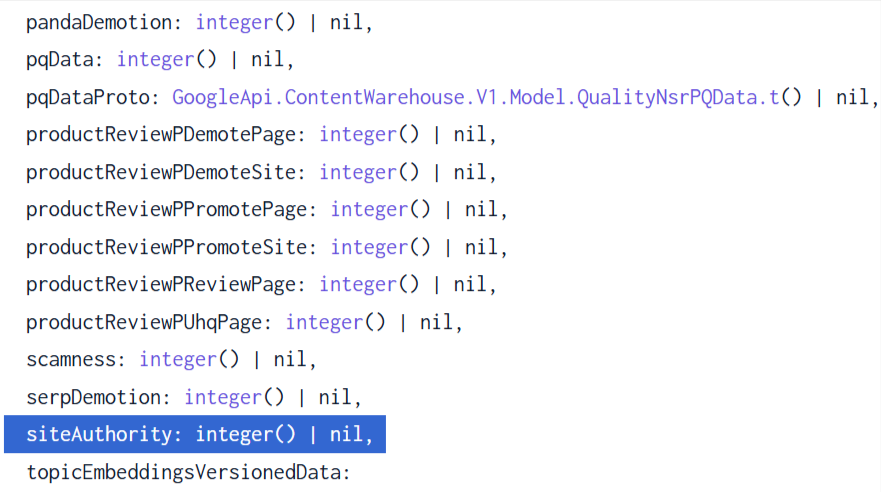
A raw link-counting mechanism or a standalone PageRank graph calculation does not live as its primary function in this specific module. Instead, this module handles compressed quality signals, demotions, and trust scores (such as siteAuthority, nsrDataProto, pandaDemotion, scamness, unauthoritativeScore, and page-level PQ data) that are applied downstream in Q*.
If a signal is purely a “link-counting thing,” it would typically be processed in a separate link-graph or PageRank pipeline rather than directly as a core component of this specific pre-computed quality/Qstar signal store. There is minor link-related data present, though it focuses on link quality/attributes rather than raw link counting (anchorMismatchDemotion: This is explicitly tied to links, as it is converted from QualityBoost.mismatched.boost (evaluating anchor text mismatch).)
Based on the provided attribute list, this is fundamentally a quality and Q module, not a raw link-graph or PageLink calculation module.
Google Doesn’t Have an Overall Authority Score for websites
At the mark in a 2019 video, John Mueller addressed a question regarding a significant drop in organic traffic for a niche portal dedicated to people with fertility issues (a YMYL topic). Asking about a sudden drop in website authority for a fertility portal after a Google update and sought advice on how to improve it.
The Question Asked: The site owner reported that following a recent Google update, they lost more than 50% of their organic traffic across all articles and keywords. Despite having no technical or backlink issues, receiving positive user feedback, and operating a high-value service, they were concerned about how their “authority” could drop so drastically overnight and what actions they could take to increase it.
Quote: “How could it be possible that our authority can drop more than 50% overnight? What actions could we take to increase our authority?”
John Mueller, Webmaster Trends Analyst at Google, clarified that Google does not assign a direct “authority score” to websites.
Quote: “In general Google doesn’t evaluate a site’s authority. So it’s not something where we would like give you a score on for on authority and say this is the the general score for authority for your website.”
John Mueller’s Response: John clarified several key points regarding how Google evaluates websites ( – ):
- No Authority Score: He explicitly stated that Google does not assign a numerical “Authority” score to websites.
- Algorithmic Adjustments: Traffic drops often occur when Google updates its algorithms to better align search results with changing user expectations, increased competition, or a better understanding of site relevance. This is not necessarily a sign that the site is doing something wrong.
- Focus on Quality: Rather than chasing technical fixes, John suggested focusing on user experience. He recommended seeking honest, sometimes “hard” feedback from users or potential users to understand if there are areas where trust or relevance could be improved.
- Community Input: He encouraged engaging with the Webmaster Help Forum to get peer feedback, which can provide insights into how others perceive the site’s expertise and trustworthiness (E-A-T).
Re: “How could it be possible that our authority can drop more than 50% overnight?” Mueller was answering about a site losing 50% of their traffic. A lack of “Authority” doesn’t cause that. That sounds to me more like a site quality scoring issue, and the fact that it’s in a YMYL medical space means the quality score needed to rank is always rising.
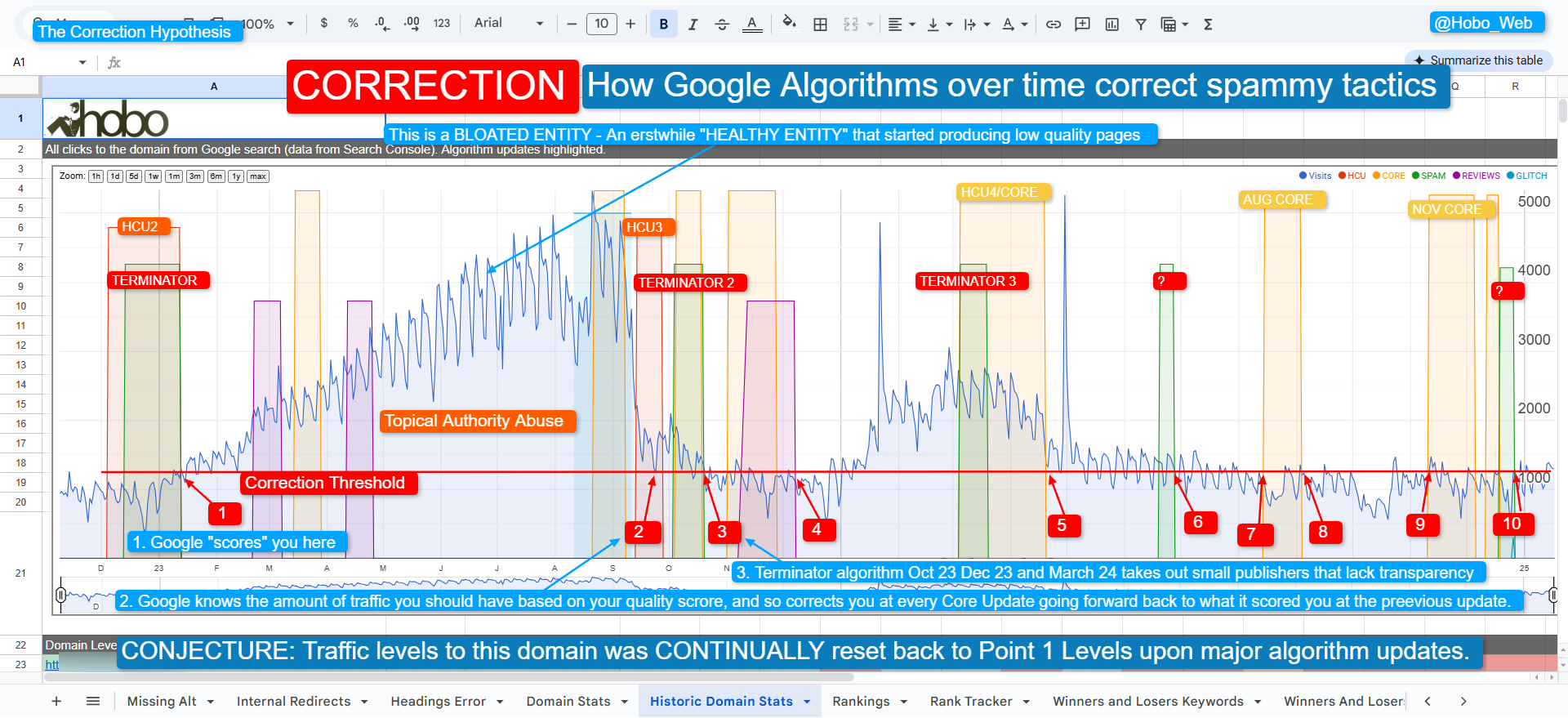
Domain Authority: Public Statements vs. Internal Reality
While third-party metrics have always been estimates, the conversation around whether Google uses a site-wide authority score has evolved significantly from early public denials to the reality exposed in the API leak.
What Google Representatives Have Said
Before the internal documentation came to light, Google representatives carefully contextualised how they evaluated site-wide trust and topical focus without endorsing a singular “authority” metric.
1. Paul Haahr (Senior Ranking Engineer at Google)
When asked directly about how Google measures authority and if there is a single domain-level metric, Haahr clarified that Google relies on a collection of signals.
“We have no one signal that we’ll say, ‘This is authority.’ We have a whole bunch of things that we hope together help increase the amount of authority in our results. Our goal in all of this is that we are increasing the quality of the pages that we show to users. Some of our signals are correlated with these notions of quality.”
- Original Source: Search Engine Land Interview (2017)
2. Matt Cutts (Former Head of Webspam at Google)
While actively avoiding validation of third-party metrics, Cutts confirmed that Google does look at site-wide topical authority to elevate rankings.
“If you’re an authority in the medical space, we want to know that and to push you up higher whenever a medical query comes along. Now, this is not something that is done by hand… it applies to thousands of different topic areas… if you are a topical authority, keep writing about it, keep developing, keep deepening the amount of content that you have.“
- Original Source: Pubcon Keynote Presentation (2013)
3. Gary Illyes (Webmaster Trends Analyst at Google)
When addressing the concept directly on social media, Illyes dismissed the industry’s obsession with a universal score, famously keeping it simple.
“We don’t really have overall domain authority.”
- Original Source: Twitter / X (2016)
When we put Google’s explicit public quotes side-by-side with the leaked siteAuthority line, we find a complex reality.
Because of how carefully Google worded its statements, many of their famous denials can be both proven technically true and proven completely misleading at the exact same time.
Quote 1: “Google doesn’t use ‘domain authority’.”
— John Mueller, 2016
- Critics: The leak exposes a backend field literally named
siteAuthority. In ordinary English, “site authority” and “domain authority” mean the exact same concept: evaluating a whole website’s baseline weight based on backlinks. For years, Google used this specific phrasing to make the public believe it evaluated URLs exclusively on an isolated, page-by-page basis, which the code reveals is false. - Defence (Google was technically right): When capitalised, “Domain Authority” (DA) is a proprietary, third-party trademark owned by the SEO company Moz. Google does not use Moz’s software, database, or metric. Furthermore, Moz’s metric relies entirely on external link graphs, whereas Google’s
siteAuthorityis an internal conversion of content quality metrics (quality_nsr). Google was using semantic loopholes to deny a competitor’s brand name rather than denying the engineering concept.
Quote 2: “My problem is that I don’t know of anything in ranking that would translate to ‘domain authority’…”
— Gary Illyes, 2016
- Critics: It is incredibly unlikely that high-level engineers were entirely unaware of host-level scoring. The leak proves that
siteAuthoritytranslates directly intoQstar, which is a query-independent site-quality framework. There was an active structural system inside the algorithm explicitly tasked with translating site chunks into a unified quality score. - Defence (Google was technically right): Gary specified that he didn’t know of anything that translates to the industry’s definition of domain authority. Because the industry assumes authority is just a cumulative tally of backlink numbers, and Google’s code shows its metric is a complex output of site chunk quality defaults (
default: nil), Google’s systems don’t translate cleanly to what the industry was talking about.
Quote 3: “Each link counts for itself and each URL counts for itself, the links don’t add up to some overall authority metric that Google might use on the domain level.”
— John Mueller (Paraphrased by Seroundtable), 2022
- Critics: The code shows that individual URLs are absolutely not entirely isolated from their domain’s health. The metric is pulled from
quality_nsr.SiteAuthority. NSR stands for New Site Rank, which explicitly groups individual pages together into broader “sitechunks”. Google does aggregate data points at a host level to generate a macro integer that handles baseline trust. - Defence: John explicitly stated that links do not add up to a domain-level score. The snippet supports this defence:
siteAuthorityis listed as a data type (integer()) applied insideQstar. The documentation does not state that this integer is generated by counting links; it states it is “converted fromquality_nsr” (a system heavily reliant on site layout, content pattern tracking, and human quality evaluator benchmarks). John’s literal words remain accurate: links themselves are handled on a page level, even if a separate site-wide score exists.
What is the siteAuthority attribute?
GoogleApi.ContentWarehouse.V1.Model.CompressedQualitySignals, we can consider the placement and likely function of the siteAuthority signal.-
Contained in
CompressedQualitySignals: The attribute lives inside a message structure that houses per-document signals which are compressed and sent to Mustang and TeraGoogle. -
TeraGoogle & Preliminary Scoring: For TeraGoogle, this message is included directly in
perdocdata, meaning it is explicitly designated to be used during preliminary scoring. -
Storage Constraints: The documentation explicitly notes a critical hardware constraint: “For TeraGoogle, this data resides in very limited serving memory (Flash storage) for a huge number of documents.”
-
The Attribute:
siteAuthority (type: integer(), default: nil) - site_authority: converted from quality_nsr.SiteAuthority, applied in Qstar. -
Lineage (
quality_nsr): Its values derive from the New Site Rank (quality_nsr) framework, which evaluates site-level chunks rather than isolated page metrics. -
Framework Application (
Qstar): It is applied directly within the $Q^*$ (Qstar) system, Google’s query-independent site-level trust and quality module. -
It is a Pre-Computed Macro-Signal: Because
siteAuthorityis stored in restricted Flash memory (TeraGoogle) alongside other compressed quality indicators (pandaDemotion,unauthoritativeScore,scamness), it is not calculated dynamically in real-time. It is a pre-computed integer score injected into the index to represent macro-level trust. -
It Operates as an Early-Stage Gatekeeper: Because it is available during “preliminary scoring” in Mustang and TeraGoogle, the search engine uses it as an efficient filter or baseline multiplier early in the retrieval pipeline. Sites lacking baseline trust can be filtered or down-weighted before the system expends heavy compute resources on deep query-dependent relevance matching ($T^*$).
-
It Represents a Blank Slate by Default: The
default: nilstate confirms that unassessed URLs or new “sitechunks” do not start with an active penalty or a zero score; instead, they exist as unassigned data points until processed by the quality pipeline.
So what is siteAuthority?
Well, no one outside of Google actually knows yet, nor has any idea how much a signal this is.
Looking strictly at some initial responses to SiteAuthority by the SEO community and comparing it to what the tiny snippet of original text actually says, we can safely refute several claims made. Because the code snippet is only one line long, that initial summary filled in the blanks with industry assumptions. Here is exactly what we can refute from that first text:
1. Refute: “It calculates a persistent site-wide quality metric”
Why we can refute it: The snippet says the metric defaults to nil. If it were universally “persistent” and calculated for every site, it would not have a null/empty default state. Additionally, nothing in the line tells us it is “site-wide” or an evaluation of the entire domain; it simply shows it is a piece of data applied within Qstar.
2. Refute: “It assesses the overall trust, credibility… of an entire domain or subdomain”
Why we can refute it: The text doesn’t say what it assesses. It only says it is an integer(). Claiming it measures “trust” or “credibility” is an SEO industry interpretation, not a factual claim supported by the raw documentation text.
3. Refute: “The score is not a simple link counter; it aggregates multiple signals, including backlink profiles, user behaviour history, and topical focus.”
Why we can refute it: The snippet gives zero information about the ingredients of the score. We can completely refute the claim that the text proves it uses backlinks, user behaviour, or topical focus. The text tells us where the score goes (Qstar) and where it comes from (quality_nsr), but it says absolutely nothing about what inputs are used to calculate it.
4. Refute: “It acts as an initial gatekeeper before granular, real-time ranking takes place.”
Why we can refute it: The snippet only says it is “applied in Qstar.” It does not outline the chronological order of Google’s pipeline. It doesn’t state whether it acts as a “gatekeeper,” a tie-breaker, a multiplier, or a late-stage filter. Calling it an “initial gatekeeper” is pure speculation.
5. Refute: “Maintaining a clear, cohesive topical radius helps stabilise and improve site-level authority metrics”
Why we can refute it: As established by the broader leak, topical metrics (like siteFocusScore and siteRadius) are completely separate fields from siteAuthority. The first summary incorrectly implied that changing your topical focus directly manipulates the siteAuthority integer, which the documentation does not state.
6. Refute: “Google executives lied under oath about using domain authority.”
The Counter-Argument: Critics accused Google of lying during antitrust trials when executives stated they didn’t use a domain authority score. However, looking at the exact text, siteAuthority is explicitly defined as a metric “converted from quality_nsr.”
The Technical Difference: Industry-standard tools use “Domain Authority” as a metric built almost entirely on external backlink profiles. Google’s code shows that their version is an internal translation of content quality systems (quality_nsr) applied to a query-independent quality gate (Q*). Google was technically telling the truth: they do not use a link-graph-based domain authority metric like the industry assumes.
7. Refute: “Google artificially manipulates the search results of specific brands using this score.”
The Counter-Argument: Some accused Google of using this metric as a manual override button to tank or boost specific companies based on corporate preference.
The Technical Reality: The code defines the field as an integer() with a default: nil state. This proves it is a standardised, automated data type handled systematically by an algorithmic pipeline. It is not an arbitrary tag, an editorial blacklist field, or a manual manipulation tool. It is an algorithmic component calculated programmatically across “sitechunks”.
8. Refute: “Google completely fabricated its public guidelines on E-E-A-T.”
The Counter-Argument: When the leak dropped, many critics claimed that Google’s public emphasis on E-E-A-T (Experience, Expertise, Authoritativeness, and Trust) was just a PR distraction to hide how the actual algorithm works.
The Technical Reality: The line shows the metric is “applied in Qstar.” Deep-dive research and Department of Justice (DOJ) trial exhibits confirmed that Q* is the internal algorithmic scoring framework Google uses to measure site quality and credibility. Rather than contradicting E-E-A-T, the code confirms that Google built an active engineering architecture (Qstar) specifically to calculate and enforce those exact site-level quality concepts.
9. Refute: “Google penalises small websites by setting their authority to zero.”
The Counter-Argument: When independent publishers saw their rankings drop, accusations circulated that Google hardcoded a “zero authority” status for small blogs or new websites to protect massive media conglomerates.
The Technical Reality: Again, the text states default: nil. If Google intended to penalise or suppress unestablished sites systematically with this specific metric, the default data state would be zero or a negative integer. A nil value means the algorithm treats unassessed sites as an unwritten blank slate, shifting the ranking weight to other active systems rather than applying a structural demotion through this field. [4]
10. Refute: “You can ‘fix’ a bad siteAuthority score by buying high-DA backlinks.”
The Counter-Argument: We cannot say that backlinks directly push this number up. The text does not link siteAuthority to link-counting modules like PageRank. If the Q* system relies heavily on other data points – such as direct brand searches or Chrome traffic data – then dumping money into artificial backlink acquisition might have zero effect on this specific integer. Buying links can get you penalised by Google. I would not recommend it.
11. Refute: “New websites start with a siteAuthority of zero.”
The Counter-Argument: The code explicitly states default: nil. In computer science, nil (null) means the data point does not exist yet; it is completely unassigned. Starting with a blank slate (nil) is mechanically entirely different from starting with a baseline score of 0 on a scale. It implies Google handles unrated or fresh “sitechunks” using alternative rules rather than treating them as “low authority.”
12. Refute: “Low site-level authority causes algorithmic penalties or demotions.”
The Counter-Argument: The snippet says the metric is applied in Qstar, but it does not specify if it acts as a penalty metric. We can completely refute the claim that a low integer triggers a negative “penalty flag.” It is equally possible that siteAuthority acts purely as a positive multiplier for high-tier sites, leaving average sites completely untouched. [2]
13. Refute: “Changing your CMS, hosting provider, or URL structure resets your site authority.”
The Counter-Argument: Because the lineage points to quality_nsr.SiteAuthority, we know it is handled by the New Site Rank framework. However, the text contains no instructions on how Google maps a “sitechunk” to a specific server, IP, or platform. Claiming that technical infrastructure shifts instantly destroy or preserve this specific integer is an unsupported guess.
14. Refute: “Google updates your site authority score in real-time as you publish content.”
The Counter-Argument: The snippet proves the score is a static field processed within Qstar Google’s query-independent, static scoring system. Because it is separated from the real-time, query-dependent search loop, we can safely refute the idea that optimisation changes yield an instantaneous shift in this metric. It is built to be a slow-moving, structural baseline.
15. Refute: “Google has never researched or patented a domain authority metric” / “Site authority does not exist”
-
What a 2018 SEJ Article Said: It concluded that an honest review of the facts proves “Site/Domain authority does not exist as a metric that is in use at Google”.
-
How It Can Be Refuted Post-Leak: The API leak exposed literal backend attributes named
siteAuthority(defined as being converted fromquality_nsr.SiteAuthorityand applied in $Q^*$), alongsideauthorityPromotionandunauthoritativeScore. While Google does not use Moz’s tool, the leak mathematically proved that an internal, persistent site-wide authority and quality architecture absolutely exists.
16. Refute: “The concept of site authority is nearly 20 years old and irrelevant”
-
What a 2018 SEJ Article Said: It argued that early link-graph models like HITS and old site-authority concepts had long been discarded, deprecated, or updated out of modern search.
-
How It Can Be Refuted Post-Leak: The leak revealed that modern systems like New Site Rank (NSR) actively evaluate domains in aggregated sections or “sitechunks” to calculate host-level trust. Far from being obsolete, site-wide structural evaluation is deeply embedded in preliminary scoring systems like TeraGoogle and Mustang.
17. Refute: Google Representatives Were Giving Unfiltered Transparency
-
What a 2018 SEJ Article Said: It treated Google spokespeople’s denials as blanket proof that no such metric or concept existed anywhere within Google’s infrastructure.
-
How It Can Be Refuted Post-Leak: The leak exposed what I refer to as Linguistic Precision (or the “Trademark Trap”). Google engineers and liaisons could truthfully state “Google doesn’t use Domain Authority” because that specific capitalised term is a trademarked Moz product. By leaning on that technicality, they successfully deflected public scrutiny away from their own internal
siteAuthoritypipeline.
Siteauthority: The Ultimate Takeaway
siteAuthority to achieve, potentially a very similar goal.
Disclaimer: Note that this is not official advice from Google. It is an opinion. It is SEO theory based on my own primary analysis of Google patents and code leaks. Any article (like this) dealing with the Google Content Data Warehouse leak requires a lot of logical inference when putting together the framework for SEOs, as I have done with this article. I urge you to double-check my work and use critical thinking when applying anything about the leaks to your site. My aim with these articles is essentially to confirm that Google does, as it claims, try to identify trusted sites to rank in its index. The aim is to irrefutably confirm white hat SEO has purpose in 2026 – and that purpose is to build high-quality websites.
The Google API leak exposes data structures and protocol buffers, not the live executing C++/Elixir code or algorithmic weights. Take for example siteQualityStddev; While the attribute exists, no one outside Google knows its exact mathematical multiplier in real-time query retrieval. Treat most leaked parameters similarly. Some parameters listed may be inactive or superseded in production. Modern search models (like RankEmbedBERT) don’t use fixed C++ formulas at all. They rely on neural network weights trained on millions of interactions. You can’t “decode” a neural network’s decision-making just by looking at its input schema. Also note I only discuss sales, editorial and marketing-related attributes. I do not explore attributes tied to Abuse, Sensitive or Inappropriate classifiers in documents in any of my writings (and will not). I view the leaks as an architectural map of possibilities, not a cheat code. I suggest you do the same. Feedback and corrections welcome.