
The search engine optimisation (SEO) industry operates on a fundamental assumption: Google reads the HTML tags you provide – such as the <title> and <meta description> and directly uses them to rank pages dynamically.
The leak of Google’s internal Content Warehouse API documentation completely shattered this paradigm. The documentation reveals a highly sophisticated machine-learning infrastructure where publisher inputs are treated as mere suggestions.
Instead of evaluating your site page-by-page in real-time, Google feeds your content through an interconnected pipeline.
This pipeline is governed by two massive internal systems: Goldmine (the micro-level quality judge) and New Site Rank / NSR (the macro-level site authority classifier), both operating within Google’s proprietary RankLab simulation engine.
1. The Architectural Hierarchy: RankLab, Goldmine, and NSR
To understand the leak accurately, it is vital to separate the machine-learning laboratory from the active processing systems deployed in search.
[GOLDMINE PIPELINE (Offline Processing)]
      │ (Ingests pages, checks signals, strips metadata)
      ▼
[RANKLAB ENGINE (Machine Learning Sandbox)]
      │ (Blends click streams, Chrome data, human rater inputs)
      ▼
[QUALITY NSR DATA PROTO (The Domain Ceiling)]
      │ (Locks macro scores during a batch freeze)
      ▼
[MUSTANG SERVING SHARDS (Live SERPs)]
      │ (Applies uncompressed siteAuthority at sub-millisecond query speed)
- RankLab: Google’s internal testing and machine-learning simulation environment. It is a massive sandbox where search engineers train models, run split-tests (
baseRankvs.testRank), and analyse how different feature weights alter searcher behaviour. - Goldmine: The component-based scoring engine (internally named the
AlternativeTitlesAnnotator) that processes micro, on-page assets. It functions as an automated editor that judges your titles, headings, and descriptions. - New Site Rank (NSR): The domain-level macro-classifier. It aggregates the data derived from Goldmine and user behaviour across your entire domain or “sitechunk” to set a fixed authority baseline.
2. The Micro Judge: How Goldmine Evaluates Your Pages
The module GoogleApi.ContentWarehouse.V1.Model.QualityPreviewRanklabTitle reveals the exact data schema Google uses to pass scoring signals within RankLab.
Goldmine operates on the principle that publisher inputs cannot be inherently trusted, running a highly competitive pipeline to choose what to display on the SERP.
Candidate Sourcing
Goldmine extracts alternative text strings from multiple sources across your page to compete against your HTML <title> tag:
sourceTitleTag(boolean): Your intended HTML title element.sourceHeadingTag(boolean): On-page headings, giving special weight to the main H1 tag (goldmineHeaderIsH1).sourceOnsiteAnchor&sourceOffdomainAnchor(boolean): The anchor text used in internal linking and external backlinks pointing to the page.sourceGeneratedTitle(boolean): A purely fallback title synthesised by Google’s language models when all publisher signals fail quality checks.
The AI Editor & Behavioural Check
Once candidates are pooled, they are analysed by BlockBERT (a lightweight, long-context variant of Google’s BERT model) to assess semantic quality (goldmineBlockbertFactor) and readability (goldmineReadabilityScore).
The system then checks the goldmineNavboostFactor. This pulls data from NavBoost, Google’s system that tracks user click streams. If a specific title candidate demonstrates a history of generating goodClicks (long dwell times) or captures the lastLongestClicks (ending a user’s search journey successfully), its RankLab score scales up.
Micro Penalties
Goldmine actively demotes bad strings using precise metrics:
dupTokens(integer): Counts word duplication to catch keyword stuffing (e.g., duplicated tokens for a title like"dog cat cat cat"is 2).goldmineHasBoilerplateInTitle(number): Algorithmically flags repetitive, templated text spanning across your pages.widthFraction(number / float32): Measures pixel length. If a title exceeds visual boundaries (isTruncated = true), its readability grade drops.
3. The Macro Judge: How NSR Establishes Your Domain’s Ceiling
While Goldmine judges individual text snippets, it funnels this data into the QualityNsrNsrData protocol buffer.
Rather than calculating site quality dynamically on a query-by-query basis, Google uses NSR as an offline macro-classifier that dictates a domain’s baseline authority ceiling across search results.
Google uses the Site2Vec machine-learning framework inside NSR to map your entire website into a high-dimensional vector space, evaluating your macro footprint using these core attributes:
siteAuthority(float32): The primary site-level trust metric assigned across your entire site footprint.lowQuality(float32): An automated score measuring the literal density of thin, low-value, or poorly constructed pages across your domain.siteFocusScore&siteRadius(float32): Evaluates topical coherence.siteRadiusmeasures how far individual pages drift from the domain’s primary parent topic.nsrConfidence/nsrVariance(float32): Data stability indicators. If a site has low search traffic or a thin Chrome footprint, Google dampens how aggressively NSR modifies page rankings to prevent false algorithmic penalties.- Project Racter (
racterScores): A specialised ML sub-model that explicitly scores a site chunk for the presence of mass Automated Generated Content (AGC) or low-quality scaled AI text.
4. The Engineering Bottleneck: Why “Step Drops” Happen
A critical entry in the leak reveals how Google balances these massive datasets with sub-millisecond query constraints on live Mustang search shards. Google cannot run multi-vector machine-learning checks across trillions of pages instantly.
It solves this with Memory Striping: Upstream annotators in Goldmine strip away raw, non-essential metadata and compress the vectors into a single, compact block stored inside nsrDataProto.
To minimize storage footprints further, the flatfiles strictly enforce 32-bit floating-point variables (float32) instead of float64 across both Goldmine and RankLab.
The Core Update Feedback Loop
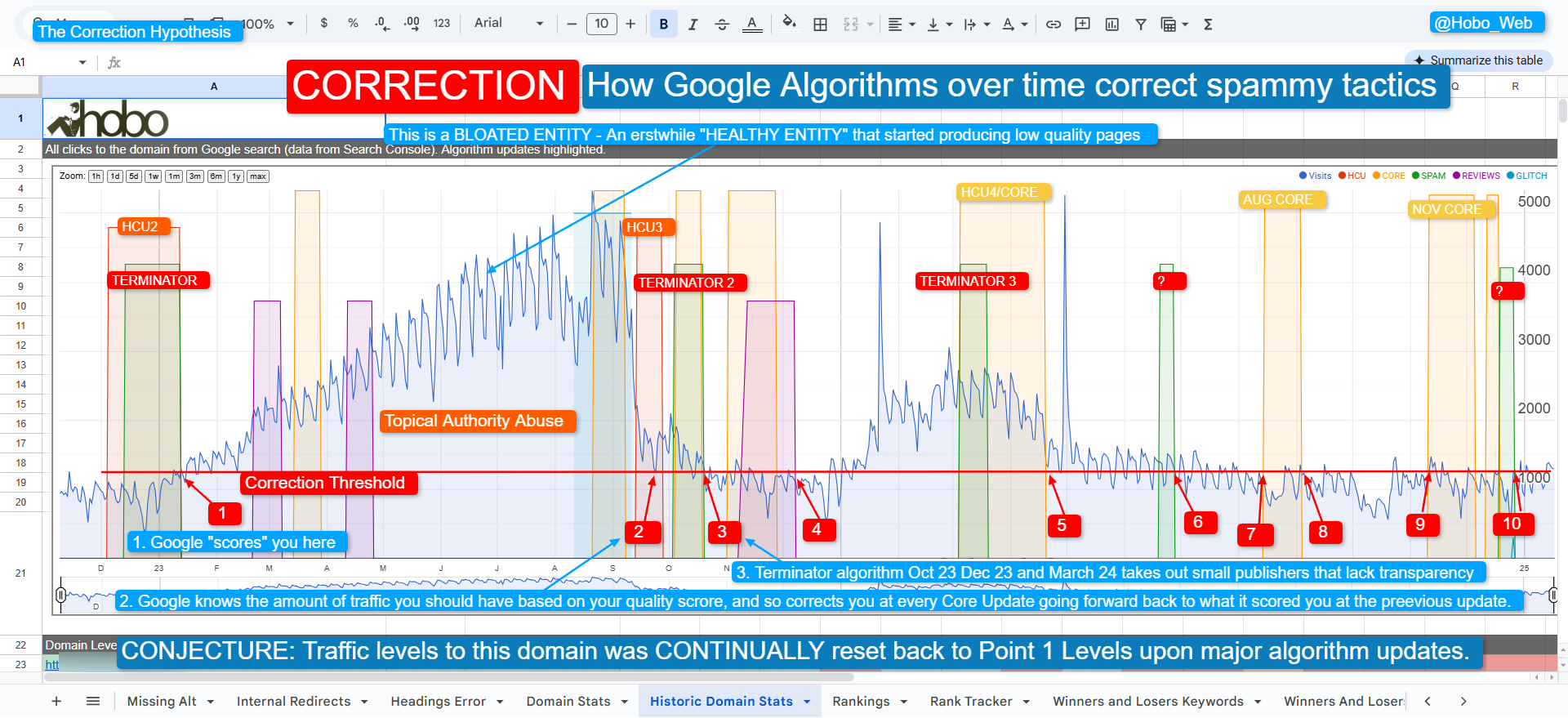
Because these calculations happen offline within the RankLab sandbox, your website’s baseline authority metrics remain locked in production:
- Ingestion: Google collects your page elements via Goldmine, alongside 13 months of historical click patterns (
pnavClicks) and Chrome activity footprints (chromeInTotal). - The Batch Freeze: RankLab retunes the curves based on machine learning and human Quality Rater inputs. Once finalised, the data is frozen.
- The Step Change: This frozen model is deployed globally during a Broad Core Update.
This explains the famous “Step Drop” phenomenon in Google updates over time.
A site’s visibility drops or climbs instantaneously overnight because a newly calculated macro-NSR vector has been pushed to the live index.
Localised, page-level on-page tweaks will not trigger a recovery between updates because the live macro ceiling remains completely static until the next offline RankLab deployment.
5. Key Insights from the RankLab Snippet & Title Schemas
These specific schema definitions from the Content Warehouse API leak offer critical structural insights into how Google bridges raw web text with machine-learning feature extraction inside the RankLab sandbox.
5.1. The Reality of Offline Flatfile Exports
-
Structured Serialisation: The existence of
MustangReposWwwSnippetsSnippetsRanklabFeaturesand its mapping to flatfiles proves that feature extraction for snippets and titles is batched, pre-computed, and exported rather than calculated live during every microsecond query. -
Pipeline Traceability: Signals like
snippetDataSourceTypeandtitleDataSourceTypeindicate that Google explicitly tracks where a string originated (e.g., HTML title, H1 header, anchor text, or AI-generated fallback), allowing ranking models to weigh publisher inputs against alternative sources.
5.2. Strict Memory Optimisation (float32 Constraints)
-
Storage Footprint Management: The developer note – “When adding a floating point value for Ranklab purposes, use float32 instead of float64” – reinforces the engineering bottlenecks discussed earlier. To process trillions of documents within strict latency and flash-storage constraints, Google aggressively truncates precision, opting for 32-bit floats to prevent memory bloat across serving shards.
5.3. Multi-Candidate Competition and Scoring Layers
-
The Title Candidate Array: The
titlesfield explicitly stores per-candidate title features sorted from best to worst, confirming that Goldmine pools multiple competing text strings and selects the winning candidate based on learned feature weights rather than blindly obeying your HTML<title>tag. -
Advanced Scoring Architectures: References to Muppet, Superroot, and SnippetBrain (
displaySnippet) show a multi-layered evaluation hierarchy where initial snippet candidates are generated, evaluated, and potentially overwritten by advanced neural scoring components before final SERP rendering.
6. Strategic Framework for Optimisation
The convergence of Goldmine and NSR demands a major shift in search engine optimisation strategy. Chasing microscopic, page-level ranking loopholes is an obsolete approach. To influence an algorithm governed by an offline macro-classifier, you must focus on site-wide quality patterns:
- Engineer Signal Coherence: Goldmine rewards consistency. Your HTML
<title>,<h1>tag, URL slug, introductory paragraphs, and internal anchor text must send an identical, harmonised message. Furthermore, the leak reveals anavgTermWeightattribute that measures the literal font size of terms, confirming that visual hierarchy and layout prominence are quantifiable quality signals. - Ruthlessly Prune Your Topical Radius: A domain that wanders into too many disparate categories will trigger a high
siteRadiuspenalty via Site2Vec. Prune or consolidate thin, off-topic, or underperforming content to keep your domain focus highly dense and coherent. - Optimise for the Last Longest Click: Winning the
goldmineNavboostFactorrequires creating content that matches the exact intent of the search query. You must win thelastLongestClicksby ensuring that when a user lands on your page, their search journey terminates because their question was fully answered. - Enforce Technical Precision to Prevent Demotion: Eliminate keyword repetition to keep your
dupTokensscore at zero. Audit templated areas to strip out repeating boilerplate strings (goldmineHasBoilerplateInTitle), and manage your snippet boundaries perfectly to prevent automatic readability penalties. - Maintain Strict Link Hygiene: Keep a close eye on your link profile to avoid invisible link neutralisations executed by anti-spam systems like SpamBrain, ensuring that your inbound signals genuinely pass high-trust PageRank rather than triggering manipulative flags.
Modern search optimisation is no longer about tricking a static index.
It is about building an unshakeable, site-wide baseline of quality that Google’s automated systems are mathematically trained to find and reward.
Disclaimer: Note that this is not official advice from Google. It is an opinion. It is SEO theory based on my own primary analysis of Google patents and code leaks. Any article (like this) dealing with the Google Content Data Warehouse leak requires a lot of logical inference when putting together the framework for SEOs, as I have done with this article. I urge you to double-check my work and use critical thinking when applying anything for the leaks to your site. My aim with these articles is essentially to confirm that Google does, as it claims, try to identify trusted sites to rank in its index. The aim is to irrefutably confirm white hat SEO has purpose in 2026 – and that purpose is to build high-quality websites. The Google API leak exposes data structures and protocol buffers, not the live executing C++/Elixir code or algorithmic weights. Take for example siteQualityStddev ; While the attribute exists, no one outside Google knows its exact mathematical multiplier in real-time query retrieval. Treat most leaked parameters similarly. Some parameters listed may be inactive or superseded in production. Modern search models (like RankEmbedBERT) don’t use fixed C++ formulas at all. They rely on neural network weights trained on millions of interactions. You can’t “decode” a neural network’s decision-making just by looking at its input schema. Also note I only discuss sales, editorial and marketing-related attributes. I do not explore attributes tied to Abuse, Sensitive or Inappropriate classifiers in documents in any of my writings (and will not). I view the leaks as an architectural map of possibilities, not a cheat code. I suggest you do the same. Feedback and corrections welcome.
Disclosure: I use generative AI when specifically writing about my own experiences, ideas, stories, concepts, tools, tool documentation or research. My tool of choice for this process is Google Gemini Pro 3.1 Deep Research and later models. I have over 20 years of experience writing about accessible website development and SEO (search engine optimisation). All content was conceived add edited, and verified as correct by Shaun Anderson aka Hobo (and is under constant development). Corrections and contributions welcome. See my AI policy.