Book A Manual SEO Audit for your website
This is a hypothesis that Google takes you back to where you started before you started breaking the rules Google lays down in its spam guidelines.
“QUOTE: “Usually, you can’t just arbitrarily expand a site and expect the old pages to rank the same, and the new pages to rank as well. All else being the same, if you add pages, you spread the value across the whole set, and all of them get a little bit less. Of course, if you’re building up a business, then more of your pages can attract more attention, and you can sell more things, so usually “all else” doesn’t remain the same.” John Mueller, Google, 2018
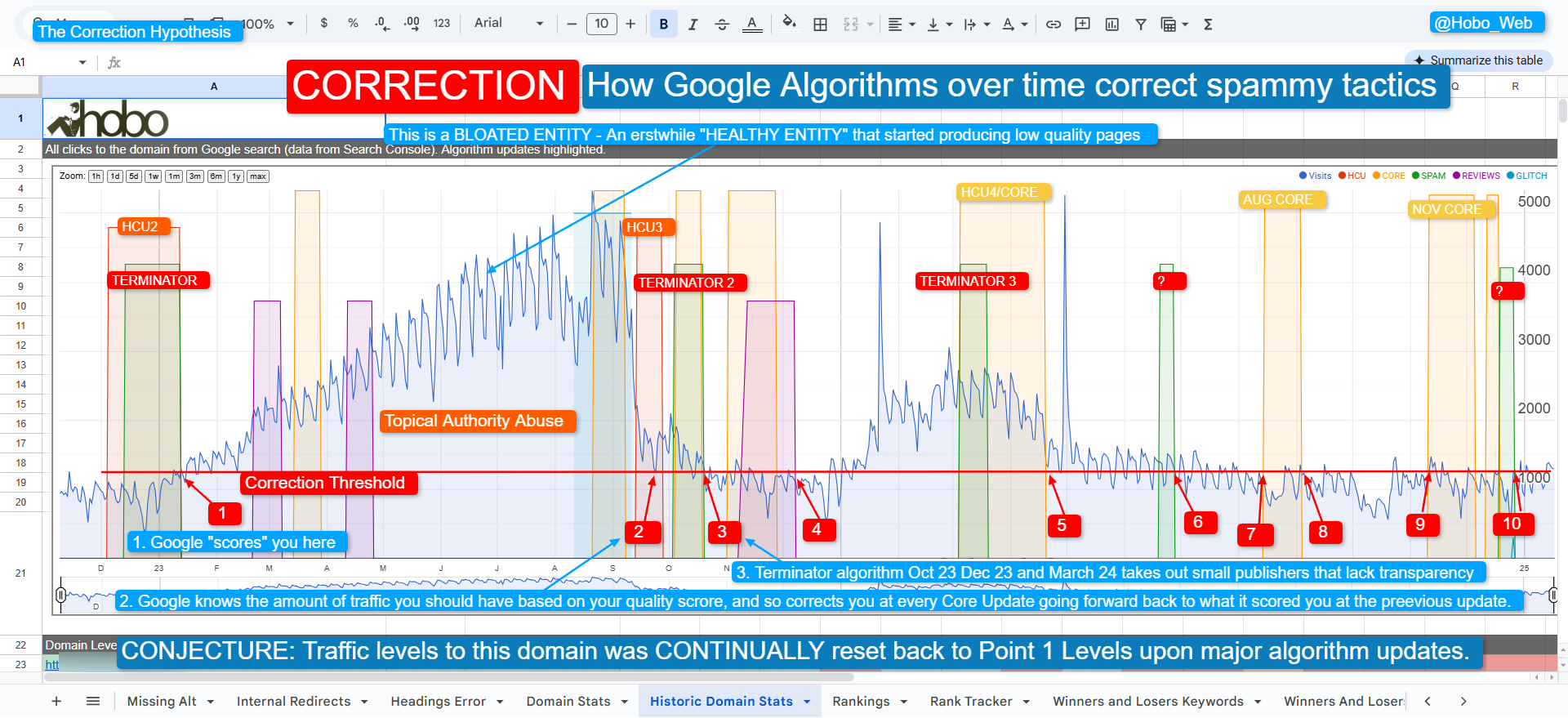
The chart, titled “The Google Algorithm Update Correction Hypothesis,” uses a detailed traffic graph to illustrate how Google’s algorithms manage website traffic over time.
If you are publishing content on the web, this is what you can expect if you break Google’s rules.
Spam tactics work, until they don’t, as demonstrated in the image.
Here is a breakdown:
The Graph (Traffic Visualisation)
-
The Trendline: The chart shows a domain that initially grew into a “Bloated Entity” – a healthy site that eventually started producing low-quality pages via “Topical Authority Abuse”.
-
The “Correction Threshold”: A horizontal red line runs across the graph. This represents the “score” Google has assigned the entity based on its perceived quality.
-
The “Point 1” Reset: The hypothesis suggests that once Google scores a domain, its traffic is continually reset back to these “Point 1” levels during major updates.
The “Terminator” Algorithms
The chart highlights several sharp traffic drops labelled as “Terminator” updates:
-
Targeted Dates: Specifically mentions updates in October 2023 and March 2024.
-
Purpose: These are framed as algorithms designed to “take out small publishers that lack transparency” or correct spammy tactics.
Key Hypotheses & Annotations
-
Predictive Traffic: Annotation #2 states that Google “knows the amount of traffic you should have based on your quality score” and uses Core Updates to “correct” you back to that previous score.
-
The “Healthy Entity” Transition: The blue shaded area marks where an entity began its decline by prioritising quantity over quality, leading to the eventual “Correction”.
This is a hypothesis.
Test it yourself on affected sites. Was the site “rolled back” to previous traffic levels in an update?
How To Fix This Type Of Google Traffic Drop
It Ends the “Fix-it” Delusion
- The Post-Mortem Reality: The hypothesis tells you the patient is dead because the “life support” (algorithmic errors) was switched off. Acceptance allows you to stop wasting resources on a site that Google has decided has a ceiling of 10% of its former traffic.
It Defines the “Next Life”
- Cause of Death: “Topical authority abuse” or “lack of entity connection.”
- The Lesson: If you want to build a new site (or “reanimate” the old one), you can’t use the same DNA. You have to move from being a Search-Engine-First publisher to a Brand-First publisher.
The only way to deal with a site like this is to strip it of commodity content and unhelpful content produced during the topical authority abuse period. Strip that out, and start again, focusing on more helpful, non-commodity content.
Why Some in the SEO Industry Struggle with This
- If a drop is a “penalty,” an SEO can sell you a “recovery service.”
- If a drop is a “correction,” the SEO has to tell you that the party is over and you need to spend the next two years building a real company, getting PR, generating non-search traffic, and cleaning the site of lower-quality content not exactly relevant to the site’s focus.
The Brutal Truth
“QUESTION – Is it possible that if the algorithm doesn’t particularly like our blog articles as much that it could affect our ranking and quality score on the core Content?”
“ANSWER: JOHN MUELLER (GOOGLE): Theoretically, that’s possible. I mean it’s kind of like we look at your web site overall. And if there’s this big chunk of content here or this big chunk kind of important wise of your content, there that looks really iffy, then that kind of reflects across the overall picture of your website.”
See Google’s latest advice on non-commodity content and commodity content. Read Google’s Spam Policies.
See also “From ‘Faking It’ to the Algorithmic Glass Ceiling“. I discuss this more on LinkedIn – The Google Correction Hypothesis. I first talked about this back in April 2025 on X “The Correction Hypothesis and Google Algorithm Updates“.
Read also why you need to clean spam from your site.
As I have been saying, you can actually PREDICT EXACTLY traffic points coming out of Google updates.
The algorithmic glass ceiling is REAL, and determined by TRUST and AUTHORITY. Trust is a lever to override Authority.
In short, you can add 100 more pages and get the same… pic.twitter.com/cMkliwwEfd
— Shaun Anderson (@Hobo_Web) June 7, 2026
The only way to move the needle within Google’s guidelines is to focus on the signals that measure real transparency, legitimacy, and trust. That’s why I built Agency.