
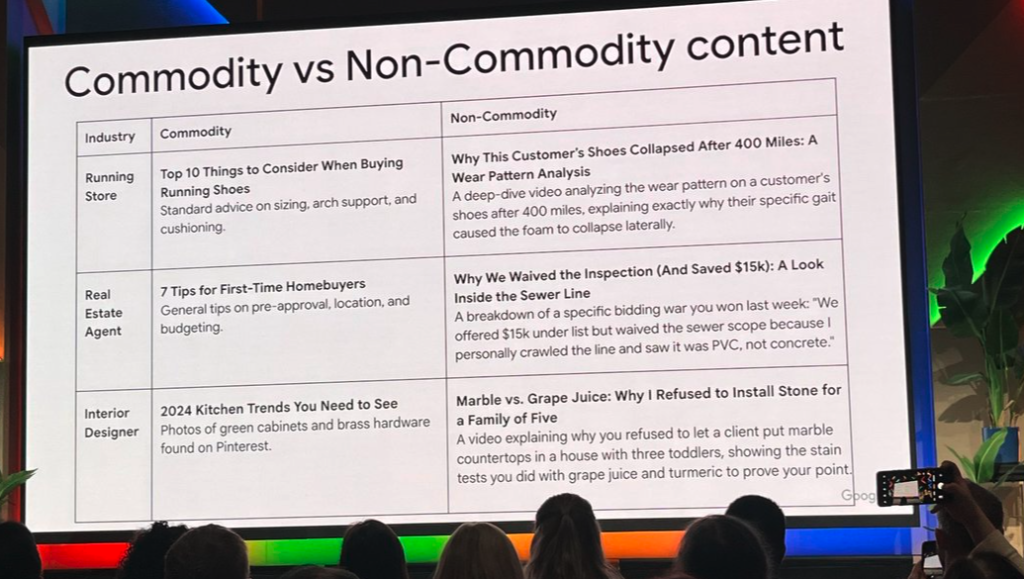
Example: Commodity vs Non-Commodity content:
| Industry | Commodity | Non-Commodity |
| Running Store |
Top 10 Things to Consider When Buying Running Shoes
Standard advice on sizing, arch support, and cushioning. |
Why This Customer’s Shoes Collapsed After 400 Miles: A Wear Pattern Analysis
A deep-dive video analysing the wear pattern on a customer’s shoes after 400 miles, explaining exactly why their specific gait caused the foam to collapse laterally. |
| Real Estate Agent |
7 Tips for First-Time Homebuyers
General tips on pre-approval, location, and budgeting. |
Why We Waived the Inspection (And Saved $15k): A Look Inside the Sewer Line
A breakdown of a specific bidding war you won last week: “We offered $15k under list but waived the sewer scope because I personally crawled the line and saw it was PVC, not concrete.” |
| Interior Designer |
2024 Kitchen Trends You Need to See
Photos of green cabinets and brass hardware found on Pinterest. |
Marble vs. Grape Juice: Why I Refused to Install Stone for a Family of Five
A video explaining why you refused to let a client put marble countertops in a house with three toddlers, showing the stain tests you did with grape juice and turmeric to prove your point. |
Commodity content relies on generic, easily replicable advice – like basic tips and broad trends – that anyone can find or produce. In contrast, non-commodity content stands out by offering highly specific, authentic, and experiential insights rooted in real-world expertise, such as deep-dive case studies or hands-on problem-solving.
Ultimately, to capture an audience’s attention and provide real value, creators must move past standard industry knowledge and share unique, lived experiences that cannot be easily duplicated.
People often ask how to make content that’s “what Google wants”. Our answer is that Google wants to show content that fulfills peoples’ needs. Focus on making unique, non-commodity content that visitors from Search and your own readers will find helpful and satisfying. John Mueller, Google, May 21, 2025
Avoid Commodity content.
“The content commodity trap: Content exists on a commodity spectrum. When it’s easy to replicate, you have a problem. When it’s differentiated, it’s a business moat.” Kevin Indig, 2021: The content commodity trap.
What Does Commodity Content Really Mean for Creators?
5) Agency is designed to help the HITL create non-commodity content.
In fact, it is specifically designed to avoid creating non-essential commodity content.
Elsa is trained on Google’s Quality Evaluator Guidelines.
The aim is to automate up to Google’s guidelines, not beyond. pic.twitter.com/JroWK1Ioou
— Shaun Anderson (@Hobo_Web) May 28, 2026
Made by Agency.
Commodity content is content that is based on facts and consensus presented on the web and can be easily replicated. You cannot copyright facts.
This content about commodity content might itself become commodity content without further unique insights.
Google is essentially telling creators we must treat commodity content rankings as temporal and not just expect this type of content to do well in Google search over its lifespan.
This is the direction Google have always moved in. When a tweet now is lucky to last a day, and a viral LinkedIn post is 2 weeks old, can you expect Google to give you lifetime rankings, like it kind of used to?
There are many types of commodity content you can build that are useful, like glossaries, for instance, and that can all help to feed AI knowledgebases (and if done properly, you win the citation in answer engines and chatbots).
To me, the clarification from Google around commodity content versus non-commodity content is just Helpful Content 2.0.
Commodity content is not spam, but it’s not high-quality, unique content on its own anymore, just because it is highly relevant to a search term, from a traditional technical SEO perspective.
See: What is Non-Commodity Content? See also Good SEO is Good GEO.