
This is how you cover a conference and pick up links, via JC Chouinard.
Non-Commodity Content, in short, is the new Helpful Content benchmark from Google – at least, what they are talking about on stage. It is clear that Google want to leave helpful content terminology out this time around, at least on stage. I wonder, would this advice have clarified things for Helpful Content Update victims at the time?
Anyway, quality content is now framed as “non-commodity content” and “helpful” content is now non-commodity content”. Helpful content versus unhelpful content.
Very informative slide via Google’s Danny Sullivan explaining the difference between “Commodity” vs “Non-Commodity” content
Google prefers the later
IMO, lots of evidence this is spot-on, not where Google is going in the future, but where it already is now
via @ChouinardJC pic.twitter.com/PcVtb2N7MV
— Cyrus SEO (@CyrusShepard) April 22, 2026
You get the picture.
Helpful Content 2.0.
Commodity Content vs Non-Commodity Content
(All images used with permission from the photographer)
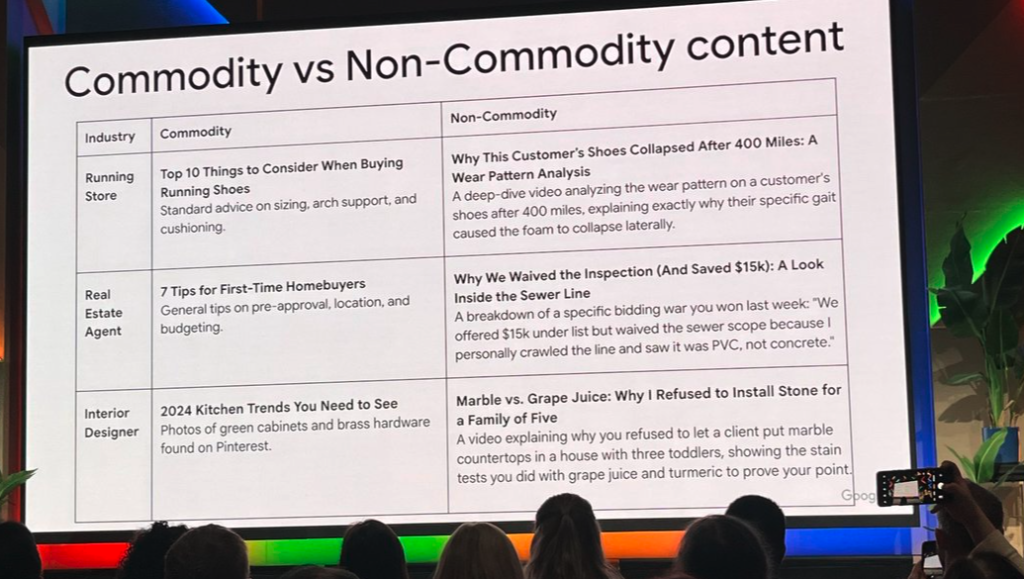
See example: What is Commodity Content?
What is Good Non-Commodity Content?
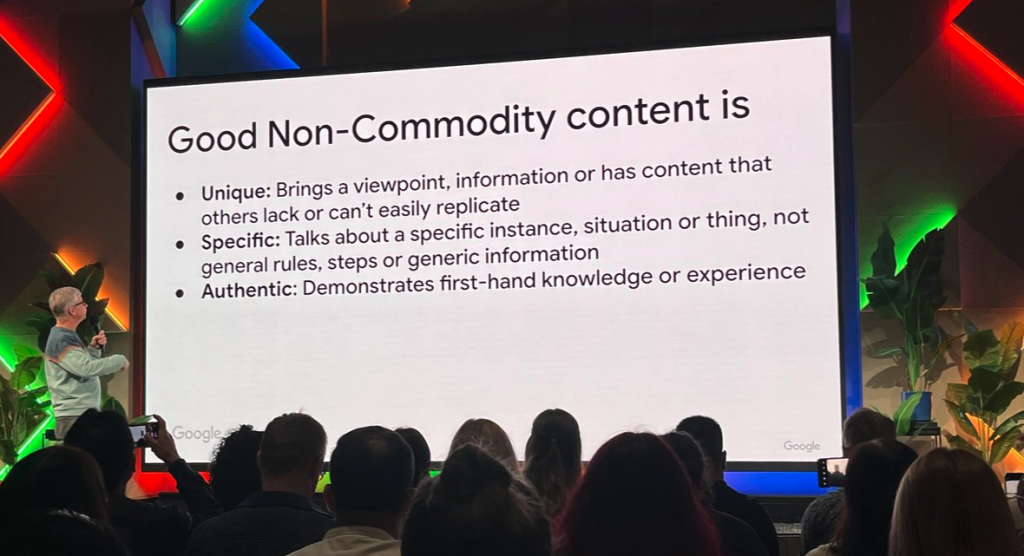
Good Non-Commodity content is
-
Unique: Brings a viewpoint, information or has content that others lack or can’t easily replicate
-
Specific: Talks about a specific instance, situation or thing, not general rules, steps or generic information
-
Authentic: Demonstrates first-hand knowledge or experience
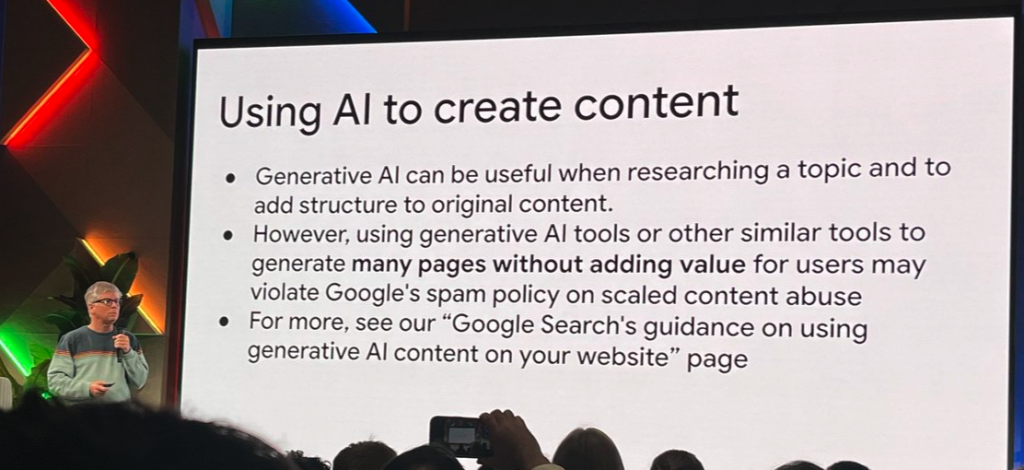
Using AI To Create Content
-
Generative AI can be useful when researching a topic and to add structure to original content.
-
However, using generative AI tools or other similar tools to generate many pages without adding value for users may violate Google’s spam policy on scaled content abuse.
-
For more, see our “Google Search’s guidance on using generative AI content on your website” page.
Do you need to focus on Conversational Keywords?
-
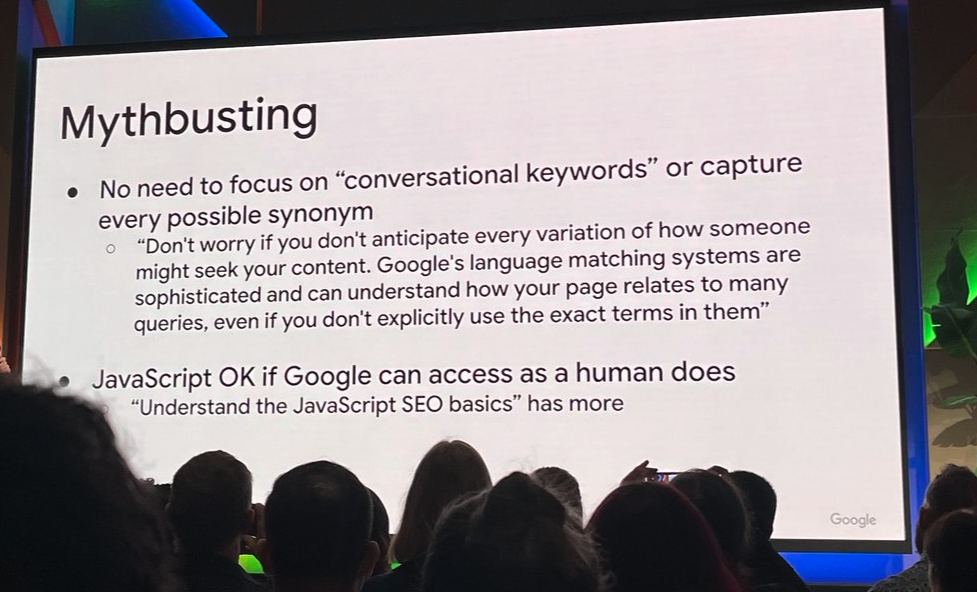
No need to focus on “conversational keywords” or capture every possible synonym.
-
“Don’t worry if you don’t anticipate every variation of how someone might seek your content. Google’s language matching systems are sophisticated and can understand how your page relates to many queries, even if you don’t explicitly use the exact terms in them”.
-
-
JavaScript OK if Google can access as a human does.
-
“Understand the JavaScript SEO basics” has more
-
Do you need to Chunk Your Content?
-
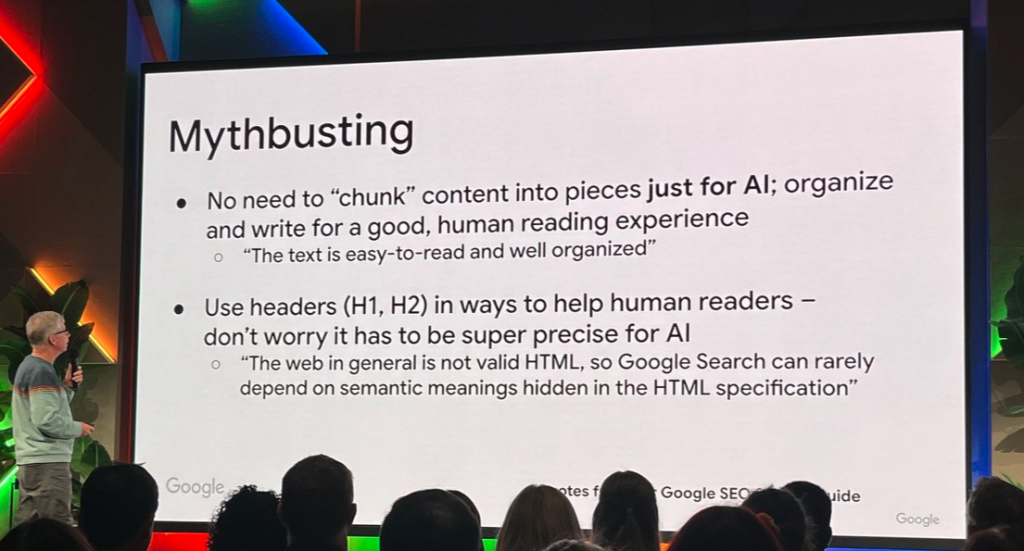
No need to “chunk” content into pieces just for AI; organise and write for a good, human reading experience
-
“The text is easy-to-read and well organised.”
-
-
Use headers (H1, H2) in ways to help human readers – don’t worry it has to be super precise for AI
-
“The web in general is not valid HTML, so Google Search can rarely depend on semantic meanings hidden in the HTML specification”
-
Notes from the Google SEO Starter Guide.
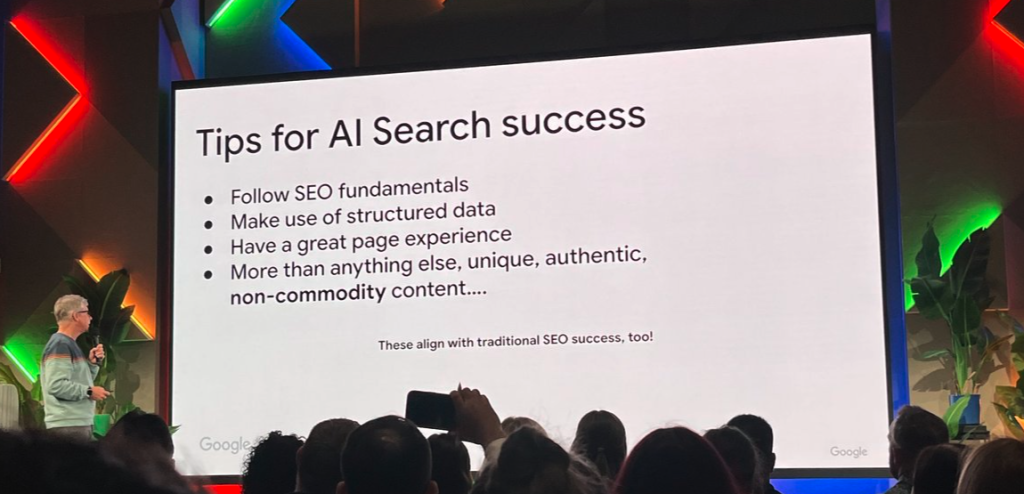
Tips For AI Search Success
So, What To Do?
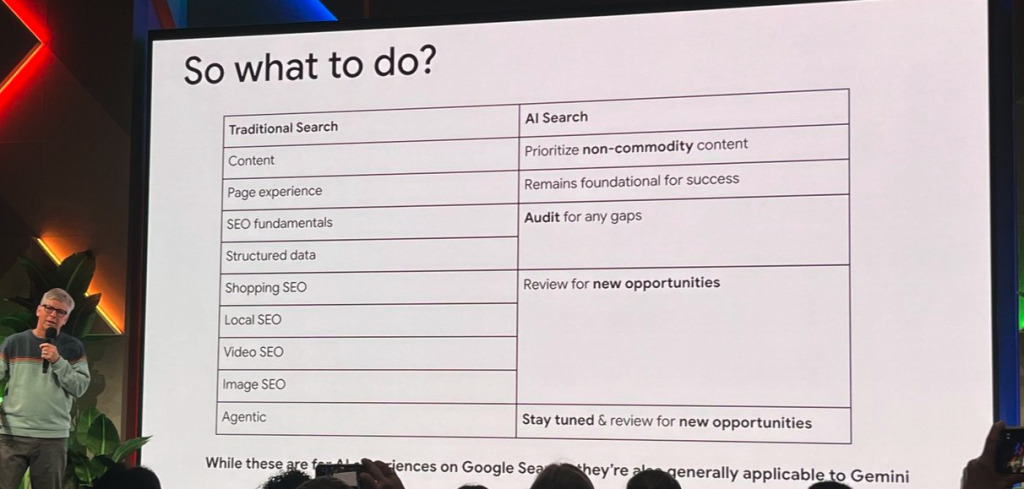
| Traditional Search | AI Search |
| Content | Prioritize non-commodity content |
| Page experience | Remains foundational for success |
| SEO fundamentals | Audit for any gaps |
| Structured data | |
| Shopping SEO | Review for new opportunities |
| Local SEO | |
| Video SEO | |
| Image SEO | |
| Agentic | Stay tuned & review for new opportunities |
JC has lots more on his blog. I was interested in this part.
This push for non-commodity content was just one piece of the puzzle discussed at the Google Search Central Live Toronto event. Here are the other major technical takeaways of interest to SEOs…:
Indexing & Content Quality
-
AI has lowered the content creation barrier, prompting Google to raise its quality bar for what actually gets indexed.
-
The “Crawled – Currently not indexed” status is typically a quality signal indicating Google didn’t find the content valuable, rather than a technical error.
-
Traffic drops on AI-generated sites are often triggered by Google’s algorithm for scaled content abuse rather than the mere presence of AI content.
AI Overviews & Agentic Search
-
Google shapes the Gemini model differently for search than it does for the standalone app, meaning AI Overview results will not mirror app outputs.
-
Blocking the Google-Extended bot does not remove your site from AI Overviews because Google can still use your already-indexed data for “fanouts.”
-
Using the
data-nosnippetattribute remains the only definitive way to stop your specific content from being used to generate AI answers.
Technical SEO & Markup
-
Converting your website content to Markdown provides absolutely no SEO or LLM benefits.
-
Creating an
llms.txtfile offers zero SEO advantages for your website. -
The Rich Results Testing tool is more accurate than the generic schema app because it plugs directly into Google’s internal indexing stack.
-
SEOs should actively explore new use cases for Structured Data, particularly within the e-commerce space.
What’s actually going on here
Official Google Documentation:
People often ask how to make content that’s “what Google wants”. Our answer is that Google wants to show content that fulfills peoples’ needs. Focus on making unique, non-commodity content that visitors from Search and your own readers will find helpful and satisfying. John Mueller, Google, May 21, 2025
Picked up via Glenn Gabe on X.
Nice share https://t.co/BC4TGXW8IU
— Shaun Anderson (@Hobo_Web) April 22, 2026
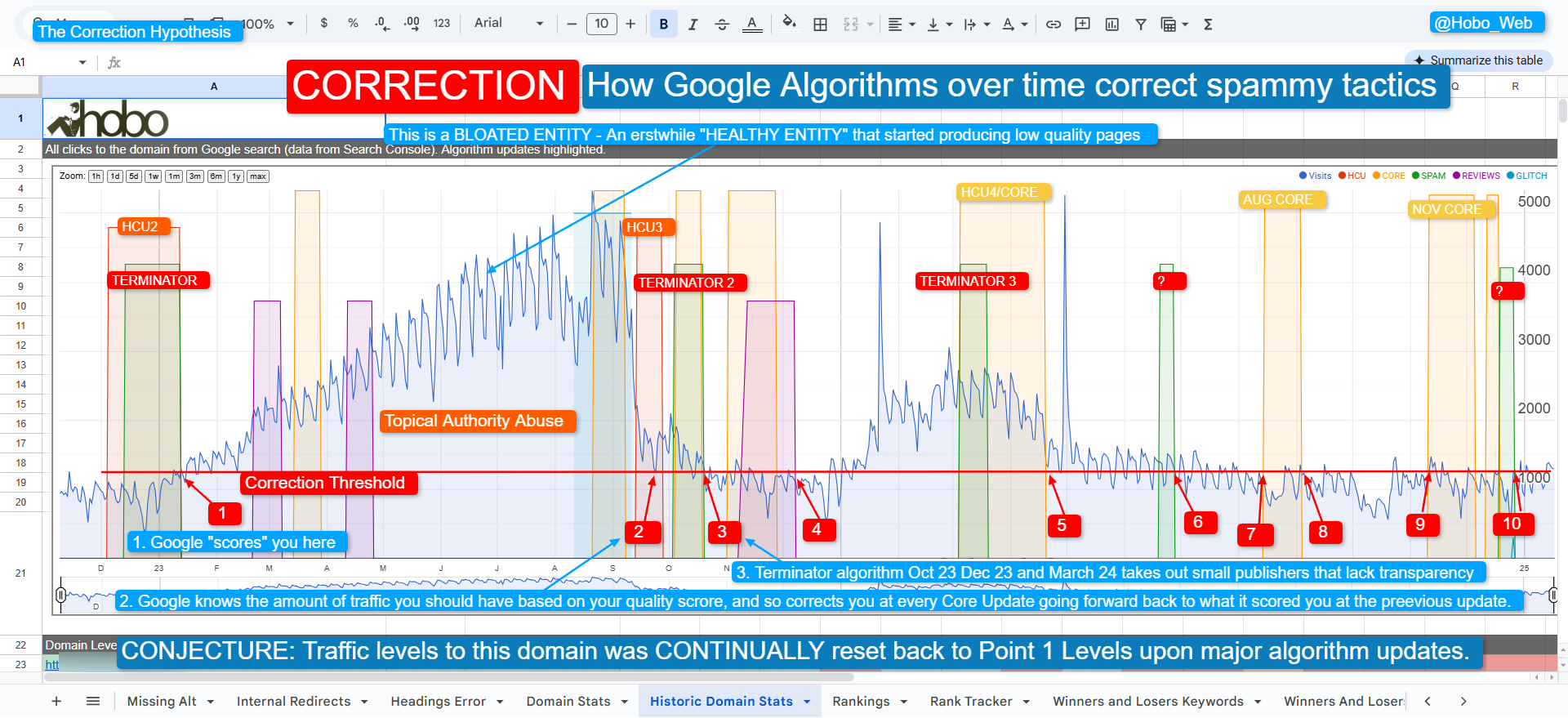
You can, and should, create both types. And in fact, there is a need for both fresh commodity and non-commodity content.
Google is commoditising the most popular searches, it can be inferred. Don’t build a thin business on commodity content, and you won’t be CCU’d in the future… https://t.co/h2MaQIB06L
— Shaun Anderson (@Hobo_Web) April 23, 2026
#SEO The whole “Commodity” vs “Non-Commodity” content in a nutshell:
Commodity = “traditional” SEO content/slop/listicles
Non-Commodity = real world anecdote attributable to people, places, things.
Will it/does it make a difference?
“It Depends” of course…— Peter Mindenhall (@PeterMindenhall) April 23, 2026
Thinking of writing some non commodity content on non commodity content.
— Marie Haynes (@Marie_Haynes) April 23, 2026
SEO Directors on the USS Non-Commodity Content pic.twitter.com/jwXVp4f8g7
— Shaun Anderson (@Hobo_Web) April 23, 2026
Further Reading on Helpful Content & Google’s Core Systems
If you want to dive deeper into how Google evaluates quality and why a truly customer-first approach to content is the only sustainable path forward, here are some essential deep dives:
-
HCU & 2026 Relevance: The Helpful Content system is no longer a periodic update; it is baked continuously into Google’s core algorithm. A primary reason sites fail to recover from drops is a lack of “Entity Trust” – meaning Google cannot verify who owns the site or why it exists. Recovery requires long-term brand transparency, not just content tweaks. https://www.hobo-web.co.uk/the-google-helpful-content-update-and-its-relevance-in-2026/
-
The Content Effort Signal: Internal Google data leaks revealed the
contentEffortattribute, an AI-driven estimation of the actual human labour and resources invested in a page. The era of high-volume, low-cost content is over; survival requires building high-effort, unreplicable assets like original research and expert insights. https://www.hobo-web.co.uk/what-is-googles-content-effort-signal/ -
LLMs, Gemini, and E-E-A-T Attributes: A technical breakdown of how Google uses Large Language Models to combat scaled AI spam. E-E-A-T isn’t a single metric, but an emergent property of dozens of granular system attributes (like
contentEffort,siteAuthority, andsiteFocusScore) that mathematically assesses a domain’s overall expertise and replicability. https://www.hobo-web.co.uk/the-contenteffort-attribute-the-helpful-content-system-and-e-e-a-t-is-gemini-behind-the-hcu/ -
Helpfulness as a Function of Trust: You cannot have “helpful” content if you fail basic algorithmic trust signals. Aligning with Section 2.5.2 of Google’s Quality Rater Guidelines—by clearly defining site ownership, editorial responsibility, and legal compliance—is a non-negotiable prerequisite before the algorithm even cares about your on-page text. https://www.hobo-web.co.uk/the-google-hcu-helpful-content-update-helpfulness/
Beginner SEO: Your First Step on Solid Ground
5) Agency is designed to help the HITL create non-commodity content.
In fact, it is specifically designed to avoid creating non-essential commodity content.
Elsa is trained on Google’s Quality Evaluator Guidelines.
The aim is to automate up to Google’s guidelines, not beyond. pic.twitter.com/JroWK1Ioou
— Shaun Anderson (@Hobo_Web) May 28, 2026
Made by Agency.
- Who It’s For: Aspiring SEOs, small business owners, marketing students, and anyone who needs to understand the fundamentals of modern search without getting lost in the technical weeds.
- What It Does: This guide translates the most complex new realities of SEO – concepts like
Navboostand site-level Quality Scores – into simple, powerful ideas. It provides a clear, actionable framework that focuses on creating helpful, “people-first” content and building a trustworthy brand, ensuring your first steps in SEO are on a path to long-term success.
Get the ebook Hobo: Beginner SEO (free to download).
This article was written by Shaun Anderson. The images used in this article were taken and posted by Jean-Christophe (JC) Chouinard.
About Jean-Christophe (JC) Chouinard
Jean-Christophe Chouinard is a Canadian SEO strategist and writer specialising in semantic and technical SEO. Born and raised in Quebec City and a graduate of Sherbrooke University, he is passionate about information retrieval, machine learning, Python, and web development.
Professional Background & Contributions:
-
Current Role: Senior SEO Strategist at Tripadvisor.
-
Previous Experience: Senior SEO Specialist at SEEK.com.au (Melbourne, Australia) and SEO Specialist at Jobillico.com (Quebec, Canada).
-
Industry Presence: Owner of the jcchouinard.com blog and a regular guest author for major industry publications including Search Engine Journal, Search Engine Land, and OnCrawl.
-
Speaking Engagements: Spoke at SEOIRL, Canada’s largest SEO conference, in Toronto in 2025.
SEO Philosophy:
Chouinard embraces the fast-paced nature of the SEO industry by relying on and contributing to the community. Rather than offering generic advice, he focuses on teaching SEO professionals the technical tools they need to succeed and organises large-scale training workshops for businesses ranging from SMEs to enterprises.
Update: More coverage at SeRoundtable.
“Be gone, unhelpful, commodity AI Overview about non-commodity content, thy be hallucinating about commodity content.” pic.twitter.com/hAIZDy82KF
— Shaun Anderson (@Hobo_Web) April 23, 2026