
 This is part 3 of a 3-part series. See part 1 and part 2.
The mechanisms by which Google evaluates, ranks, and filters content at a macro scale have historically been shielded by corporate secrecy.
However, the convergence of multiple forensic milestones – specifically the August 2019 internal slide leak, the May 2024 Google Content Warehouse API schema leak, live endpoint exploit data, DOJ antitrust trial disclosures, the public Search Quality Rater Guidelines (QRG), and Google’s published spam enforcement policies – provides an exhaustive, end-to-end blueprint of Google’s search and safety architecture.
This document integrates every layer of that architecture: the theoretical scoring models of New Site Rank (NSR), the real-time shard safety protocols of QualityFringe, the human evaluation standards of the Search Quality Rater Guidelines (QRG), and Google’s automated spam enforcement policies.
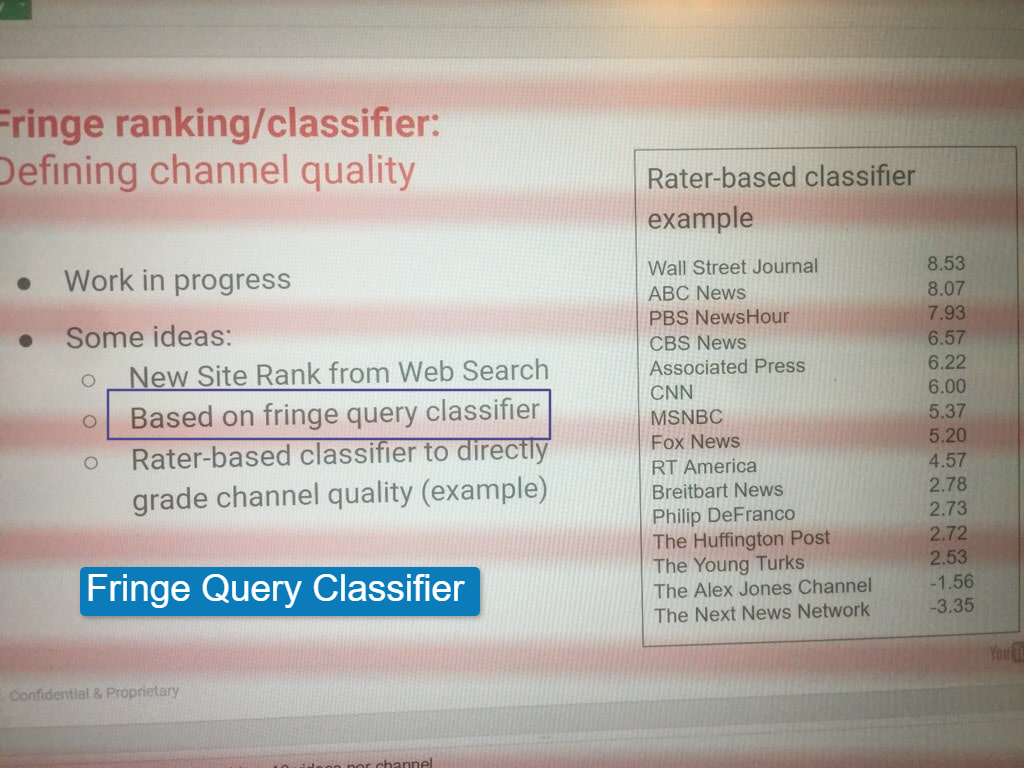
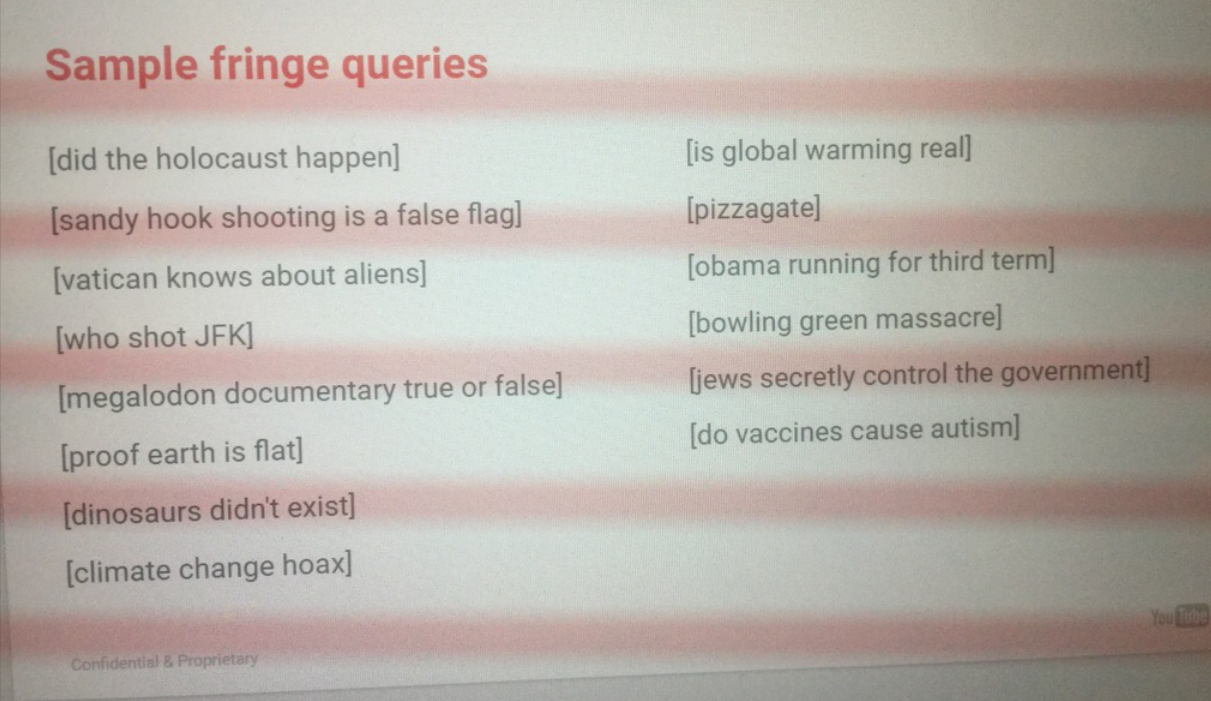
The architecture of Google’s fringe classification was exposed across two major forensic disclosures. In August 2019, a Project Veritas leak revealed internal slides titled “Fringe ranking/classifier,” proposing a “New Site Rank” (NSR).
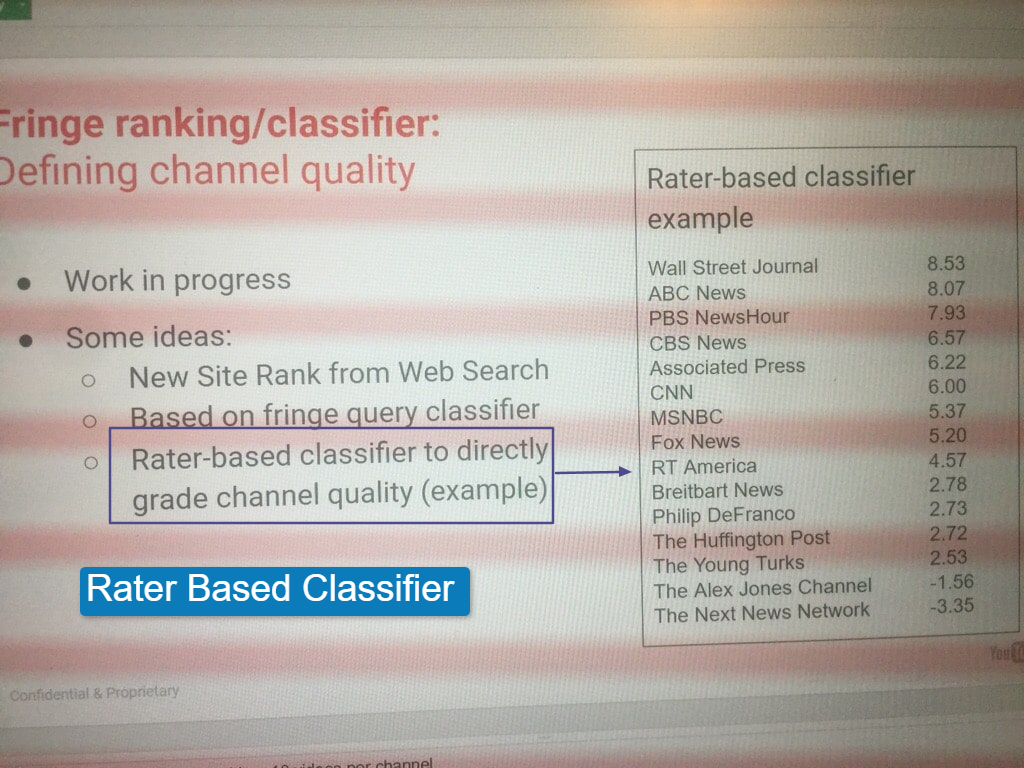
This introduced a continuous rater-based grading scale where mainstream outlets anchored the top (e.g., Wall Street Journal at 8.53, Fox News at 5.20) and alternative media received negative scores (e.g., The Alex Jones Channel at -1.56).
Five years later, the May 2024 ContentWarehouse GitHub leak confirmed these theoretical concepts evolved into a production schema.
Google confirmed document authenticity in both cases but denied political bias, stating the algorithms target Extra-Low Quality (XLQ) misinformation rather than partisan affiliation.
Part 1: Historical Provenance & The Two Leaks
The public understanding of Google’s fringe classification evolved across two distinct timeline events, bridging the gap between theoretical human guidelines and deployed machine learning code.
1. The 2019 Project Veritas Leak
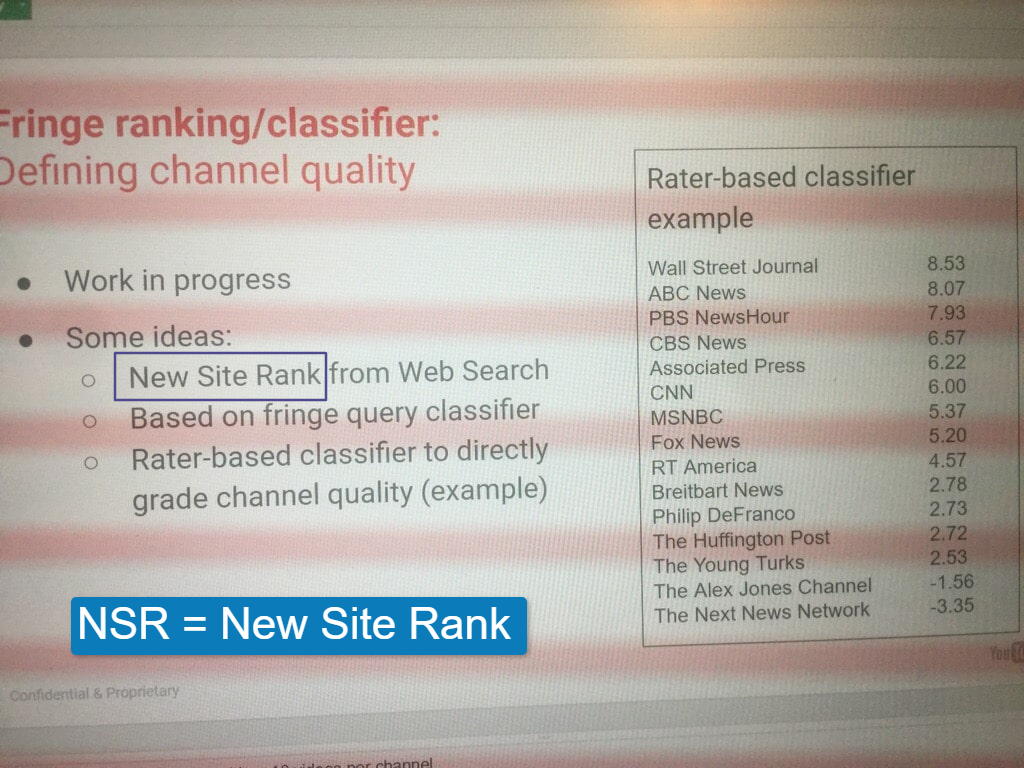
In August 2019, internal Google presentation slides were leaked via Project Veritas. Among them was a file titled featuring a slide headed: “Fringe ranking/classifier: Defining channel quality.”
This document revealed Google’s early exploration of channel-level quality metrics, introducing two core concepts:
- New Site Rank (NSR): A proposed site-level metric derived from web search to re-grade non-traditional domain authority.
- Rater-Based Classifiers: A scoring matrix using human evaluation guidelines to assign continuous quality values to publishers.
The slide showcased a specific numerical grading scale demonstrating how Google anchored mainstream media against alternative and fringe channels:
- Mainstream Anchors: Wall Street Journal (8.53), ABC News (8.07), PBS NewsHour (7.93), CBS News (6.57), Associated Press (6.22), CNN (6.00), MSNBC (5.37), Fox News (5.20).
- Alternative/Mid-Tier: RT America (4.57), Breitbart News (2.78), Philip DeFranco (2.73), The Huffington Post (2.72), The Young Turks (2.53).
- Fringe Anchors: The Alex Jones Channel (-1.56), The Next News Network (-3.35).
2. The 2024 Content Warehouse API Leak
Five years later, in May 2024, thousands of internal C++ and Elixir files from Google’s ContentWarehouse API were inadvertently published via an automated GitHub repository (yoshi-code-bot) and indexed on Hexdocs. Discovered by Erfan Azimi back in 2024 and first publicised by researchers Rand Fishkin and Mike King, the leak proved that the conceptual frameworks from the 2019 slides had evolved into a massive, production-ready infrastructure.
3. Google’s Official Public Stance
Google confirmed the authenticity of the underlying technical documents in both leaks, but strongly denied the political and operational interpretations placed upon them:
- 2019 Denial: Executive Jen Gennai and Google stated the undercover video was deceptively edited out of context, flatly denying that algorithms or classifiers were manipulated for partisan election interference.
- 2024 Denial: Spokesperson Davis Thompson confirmed the leaked API pages were genuine internal code documentation, but cautioned they contained “out-of-context, outdated, or incomplete information.” Google maintained that its algorithms target Extra-Low Quality (XLQ) misinformation and safety risks, not political affiliation.
Part 2: The Macro Architecture – NSR and Spam Enforcement
Google operates a two-tiered classification split between broad site trust (offline) and real-time risk mitigation (on-shard). The first tier relies on QualityNsr (New Site Rank) and Google’s core spam policies.
QualityNsr and SpamBrain
Before a document even reaches the fringe classifiers, it must pass Google’s Search Essentials and spam policies. Google aggressively demotes content based on mechanical manipulation and automated abuse:
- Core Technical Spam: Penalties for cloaking, doorway pages, keyword stuffing, hidden text/links, and link spam.
- Modern Content Abuse: Scaled content abuse (mass-producing AI text without unique value), site reputation abuse (Parasite SEO), and expired domain abuse (repurposing trusted, old domains for spam).
Attributes within the NSR pipeline, such as tofu (possibly Top-Of-Funnel unoriginal content) and racterScores (machine-generated text detection), operate behind the scenes to catch scaled content abuse before it hits a standard spam penalty queue.
Part 3: The Real-Time Safety Layer – QualityFringe
If NSR establishes the baseline domain authority, the QualityFringe schema acts as the real-time safety filter.
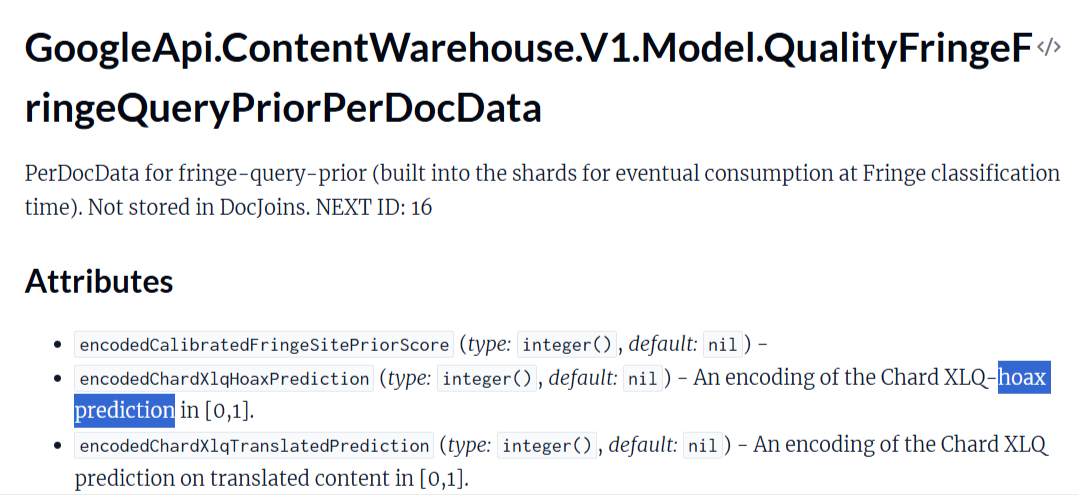
Architecturally, QualityFringeFringeQueryPriorPerDocData is baked directly into index shards as PerDocData rather than stored in relational post-retrieval tables (DocJoins). This guarantees sub-millisecond evaluation during initial candidate retrieval without incurring expensive network latency.
The schema contains explicit attributes mapping across core safety subsystems:
| Functional Domain | Attribute Name | Type & Scale | Technical Function |
|---|---|---|---|
| Bayesian Priors | encodedFringePriorScore |
Integer (0–1000) | P(Fringe Query | Doc in Results): Probability that a query seeks fringe content given this document is returned. |
encodedFringeSitePriorScore |
Integer (0–1000) | Domain-level fringe probability. | |
encodedFringeSitePriorScoreForQfsTraining |
Integer (0–1000) | Unbiased site score stripped of dynamic QueryFringeScore (QFS) feedback to train ML models safely. |
|
| XLQ & Hoax Models | encodedDaftScore |
Float ([0, 1]) | Document About Fringe Topic (DAFT) score measuring direct engagement with pseudoscience or unverified claims. |
encodedChardXlqHoaxPrediction |
Float ([0, 1]) | Automated Chard XLQ prediction score for outright hoaxes and fabrications. | |
encodedChardXlqYmylPrediction |
Float ([0, 1]) | Misinformation risk classifier targeting high-stakes Your Money or Your Life (YMYL) topics. | |
encodedPseudoraterPxlqScore |
Bit-packed Integer | Human Quality Rater guidelines translated into automated model predictions in pXLQ space. | |
| Safety Thresholds | encodedDocumentFringeVulnerability |
Encoded Integer | Establishes the safe Quality Score threshold (Q*) via go/doc-fringe-vulnerability. |
encodedProximityScore |
Float ([0, 1]) | Vector-space distance (go/fringe-proximity) measuring topological similarity to known “fringe seed” documents. |
|
| Sensitive Entities | sensitiveEntitiesMids |
List (String) | Knowledge Graph Machine IDs (MIDs) for tracked living individuals or sensitive groups. |
Part 4: Operational Dynamics & Public Guidelines Alignment
How do these attributes interact with Google’s public guidelines to filter search cascades?
- Translating Human Raters into Code: Google’s public Search Quality Rater Guidelines (QRG) instruct thousands of human evaluators to flag pages lacking factual reliability, displaying fake EEAT, or violating strict YMYL standards. These human ratings directly train the ML models embedded in the schema. The
encodedPseudoraterPxlqScoreandencodedChardXlqHoaxPredictionattributes are the literal compilation of these human guidelines into automated scoring parameters. - Dynamic Thresholding (Q*): Rather than outright banning domains with mid-to-low scores, Google uses
encodedDocumentFringeVulnerability. If a user query exhibits elevated fringe sensitivity or triggers a sensitive personal entity (sensitiveEntitiesMids), the minimum Quality Score threshold (Q*) instantly inflates. Documents that fail to meet this higher bar are dynamically filtered out. - Vector Proximity and Contagion: The
encodedProximityScoreoperationalises the negative channel scores seen in the 2019 leak (e.g., -3.35). By measuring the topological distance between a new document and verified “fringe seed” documents, risk profiles are inherited mathematically. If a site publishes content too topologically close to known hoaxes, its DAFT and pXLQ scores plummet. - Preventing Feedback Loops: To ensure that downstream ranking models do not overfit on past algorithmic penalties, Google isolates its training data. The
encodedFringeSitePriorScoreForQfsTrainingattribute strips out dynamic scoring feedback, allowing machine learning pipelines to ingest raw site authority without circular bias. - The Page Quality (PQ) Translation —
pqDataandsiteQualityStddev: While theQualityFringeclassifiers handle extreme cases of hoaxes, they operate in tandem with Google’s broader Page Quality (PQ) scoring system. As highlighted by Hobo Web’s independent analysis of the API leak, two critical variables further prove how manual guidelines become algorithmic law:pqData: Human raters grade pages on a sliding scale from Lowest to Highest. ThepqDatavariable proves Google’s machine learning models compress these human-centric judgments into a single, hard integer assigned to millions of URLs.siteQualityStddev: Google mathematically measures the standard deviation (spread) of these PQ scores across an entire domain. If a site publishes highly factual content alongside unverified or low-quality fringe articles, it generates high statistical variance. High variance equates to low systemic predictability, meaning the algorithm inherently reduces the domain’s baseline trust.
Ultimately, a site is not solely ranked on its best work, but penalised by its mathematical deviation from excellence.
Part 5: Exploit Validation
While the static ContentWarehouse API leak provided the theoretical blueprints of Google’s schema, live forensic analysis proved how these metrics actively gatekeep search visibility. In late 2024, SEO and security researcher Mark Williams-Cook presented findings from a massive Google endpoint exploit that provided a real-time window into how these quality and consensus scores operate in the wild.
Through analyzing over 2 terabytes of data covering 90 million queries via this endpoint vulnerability, Williams-Cook’s team confirmed several critical operational mechanics that tie the entire QualityFringe and QualityNsr framework together:
- The
question_fringe_scoreMetric: Connecting directly to Google’s safety schemas, Williams-Cook uncovered a specific variable namedquestion_fringe_scorethat is calculated when Google processes user searches. While not explicitly detailed in standard documentation, he theorised that it estimates how far a user’s query sits on the “fringe” of Google’s known entity and knowledge space, or how atypical it is. Because “fringe” is documented internally as a system within Google’s Safety category, this metric mathematically links a query’s statistical rarity with its potential misinformation risk. - The
site_qualityGating Threshold: Williams-Cook discovered an explicit master metric labelledsite_quality. This metric functions as a foundational “Ranking Gate” calculated at the subdomain level, scored on a continuous scale from 0 to 1. His findings revealed a hard mathematical threshold: any site with asite_qualityscore falling below 0.4 is algorithmically disqualified from appearing in enhanced search features like Featured Snippets and “People Also Ask” boxes. According to the exploit data, this score depends heavily on user interactions, brand visibility (branded searches), and anchor text relevance. - The “Consensus” Endpoints: Directly validating the
QualityFringeschema’s Extra-Low Quality (XLQ) attributes, Williams-Cook also exposed endpoints specifically evaluating “consensus”. The exploit revealed that Google actively assesses whether content aligns with, contradicts, or remains neutral to general consensus. When a page challenges established facts—particularly for debunking queries like “is the earth flat”—it strongly impacts its ranking position, as Google heavily favours content that aligns with scientific consensus. - Semantic Query Classifications: The data showed Google categorises almost all queries into eight “refined query semantic classes,” including Short Fact, Bool (yes/no questions), Instruction, Reason, Definition, Comparison, Consequence (linked to YMYL queries), and Other. This organisation allows Google to strictly tailor the algorithm’s standards, applying heavier weights to potentially risky YMYL searches.
By mapping the live site_quality gates, consensus-debunking flags, and the real-time calculation of a question_fringe_score, Williams-Cook’s endpoint exploit transformed the theoretical API leak from a static document into a proven, actively enforced algorithmic reality.
Part 6: Legal Validation – The DOJ v. Google Antitrust Disclosures
While the 2019 Veritas leak and the 2024 API schema exposed the architectural blueprints of Google’s quality pipelines, the U.S. Department of Justice antitrust litigation (United States v. Google LLC, Case No. 20-cv-3010) provided the ultimate legal confirmation. During the remedial phases of the trial, court disclosures and sworn testimony from Google’s Vice President of Search, Dr. Pandu Nayak, dismantled Google’s long-standing public narrative regarding human quality raters.
1. From Peripheral Feedback to Core Training Data
For years, Google’s public documentation maintained that Search Quality Rater Guidelines (QRG) were merely used to benchmark results, test algorithm updates, and provide indirect guidance. However, the DOJ remedial phase opinion revealed an entirely different reality: human rater scores are a foundational, direct training input for Google’s core artificial intelligence ranking systems—specifically RankEmbed and its evolution, RankEmbedBERT.
As established by court documents, the data underlying these core ranking models relies explicitly on two primary sources:
- Approximately 70 days of search logs (click-and-query interaction data).
- Scores generated by human quality raters measuring organic search quality.
2. Solving Long-Tail Queries via Rater-Trained AI
Dr. Pandu Nayak’s testimony under oath proved that these rater-trained models are central to Google’s competitive edge. Specifically, RankEmbedBERT models heavily leverage human-scored datasets to drastically improve Google’s semantic comprehension of complex, long-tail queries where literal keyword matching fails. Rater judgments are embedded directly into the machine learning models that decide how billions of pages are scored and ranked.
3. Reconciling the Public Stance with Legal Reality
The courtroom revelations resolve a long-standing debate in the SEO community over whether human rater scores “matter” to rankings:
- Technically True: A single human rater cannot manually adjust or alter an individual page’s ranking.
- Systemically False: In aggregate, human rater scores form the foundational training dataset that teaches the machine learning algorithm how to evaluate quality.
As I disclosed previously, Google’s public communications played down rater input as “benchmarking,” while internal reality relied on those exact judgments to build the AI models that give Google its market advantage.
By tying the DOJ trial findings together with the ContentWarehouse schema’s encodedPseudoraterPxlqScore and pqData variables, it becomes clear: human evaluation guidelines are not auxiliary guidelines – they are the literal blueprint used to train the AI systems that govern global search visibility.
Author’s Note: Separating Political Framing from Algorithmic Mechanics
When reviewing forensic disclosures like the 2019 slides, it is easy for discussions to get pulled into broader culture-war debates. To get the most value out of this research, it helps to distinguish between how the data was made public and what the code actually does:
- The Source Narrative: The August 2019 leak originally surfaced via Project Veritas, immediately anchoring the documents to a political narrative focused on institutional censorship and bias.
- The Algorithmic Reality: Beneath the political controversy, the actual schemas (such as
encodedChardXlqHoaxPredictionandencodedProximityScore) are engineered to measure content quality, factual reliability (EEAT), and unverified hoaxes. Google’s systems are structurally designed to target Extra-Low Quality (XLQ) misinformation rather than political affiliation. - The Core Takeaway: While the political controversy makes headlines, the real breakthrough for search engineers is understanding how human rater guidelines are mathematically translated into automated machine learning parameters.
Part 7: Translating Human Rater Guidelines into Algorithmic Code
A persistent debate in search engine optimisation has centred on whether Google’s public Search Quality Rater Guidelines (QRG) are merely abstract benchmarks for human evaluators or literal blueprints for machine learning training data.
The convergence of the 2019 slide leaks, the 2024 ContentWarehouse API schema, and internal engineering disclosures confirms the latter: manual human rater criteria are systematically compiled into automated scoring parameters.
1. Lowest Quality Pages & The pXLQ Subsystem
When human raters evaluate content, pages exhibiting egregious flaws are categorised under strict definitions. Section 4.0 of the QRG establishes the baseline for unacceptable content:
“Lowest quality pages are untrustworthy, deceptive, harmful to people or society, or have other highly undesirable characteristics.”
In Google’s production schema, this qualitative standard is operationalised through automated classifiers like encodedChardXlqHoaxPrediction and bit-packed integer attributes like encodedPseudoraterPx1qScore. These variables translate human rater evaluations into real-time machine learning predictions that isolate fabrications and Extra-Low Quality (XLQ) material.
2. The Primacy of Trust and Domain Variance (siteQualityStddev)
The architecture does not evaluate pages in a vacuum; it weighs macro-level site authority against strict consistency standards. The QRG explicitly establishes the hierarchy of E-E-A-T, emphasising that:
“Trust is the most important member of the E-E-A-T family because untrustworthy pages have low E-E-A-T no matter how Experienced, Expert, or Authoritative they may seem.”
This mandate is enforced programmatically via variables like siteQualityStddev. Google mathematically measures the standard deviation (spread) of Page Quality (PQ) scores across an entire domain. If a publisher mixes highly factual reporting with unverified fringe articles, the resulting high statistical variance lowers systemic predictability – automatically penalising the domain’s baseline trust regardless of its strongest pages.
3. Safeguarding High-Stakes Queries (YMYL & Dynamic Thresholds)
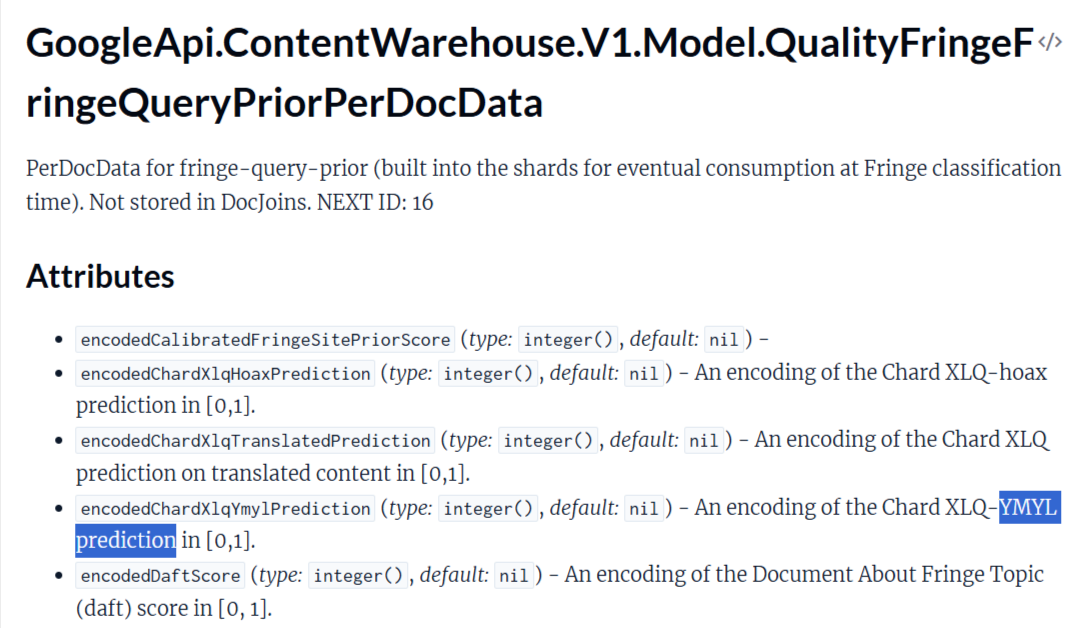
For topics that impact an individual’s financial stability, health, or safety – officially designated in Section 2.3 of the QRG as Your Money or Your Life (YMYL) – error tolerance drops to zero. The API schema mirrors this strict framework via the encodedChardXlqYmylPrediction attribute.
When a user query triggers high-stakes sensitivity, Google invokes dynamic thresholding via encodedDocumentFringeVulnerability (governed by internal safety protocols). This dynamically inflates the minimum Quality Score threshold ($Q^*$), ensuring that content failing to meet rigorous reliability standards is filtered out during candidate retrieval.
Decoding Google’s Fringe Framework: The Competing Arguments
My research on Google’s QualityFringe framework, the 2019 Project Veritas leak, and the 2024 API schema, two distinct interpretations emerge regarding how these systems impact independent journalism and political discourse.
Argument FOR Project Veritas’s Claims
Focus: Human bias, subjective anchors, and systemic editorial control.
- The Rater-to-Algorithm Pipeline: The 2019 slides showed mainstream outlets anchored with high positive scores (e.g., Wall Street Journal at 8.53) and alternative/fringe media given negative scores (e.g., The Alex Jones Channel at -1.56). The 2024 API leak proved these subjective human grades were converted into machine learning parameters (
encodedPseudoraterPxlqScore,pqData). Proving that human training data underpins core AI means that whatever systemic biases human raters possess are structurally baked into the algorithm. - The “Consensus” Gate: Williams-Cook’s endpoint exploit revealed that Google actively evaluates content against “consensus.” An argument can be made that equating “consensus” with institutional orthodoxies effectively penalises disruptive reporting, independent whistleblowing, or contrarian investigative journalism – the exact type of journalism Project Veritas claims to produce.
- Macro Domain Penalties: Through variables like
siteQualityStddev, Google penalises a site based on the standard deviation of its quality scores. Critics can argue this is a blunt instrument designed to suppress entire independent alternative media domains if they publish content that challenges mainstream narratives.
Argument AGAINST Project Veritas’s Claims
Focus: Objective quality signals, anti-hoax architecture, and scale-neutral enforcement.
- Technical, Non-Partisan Metrics: The underlying schema attributes (
encodedChardXlqHoaxPrediction,encodedDaftScore,encodedChardXlqYmylPrediction) are mathematically modelled to detect verifiable falsehoods, hoaxes, and high-risk misinformation (“Your Money or Your Life” topics), not political party affiliation. - Separation of Ideology and Execution: As the article’s author notes, while the source of the 2019 leak was political, the code itself is an engineering solution to an objective problem: how to stop malicious spam, fake news, and dangerous medical/financial misinformation at sub-millisecond speeds during a search query.
- Legal and Structural Validation: The DOJ antitrust disclosures proved that rater-trained models (like RankEmbedBERT) are used globally to solve complex, long-tail semantic queries and improve search relevance for everyone – not to manually manipulate individual political search results. The system targets Extra-Low Quality (XLQ), which can theoretically impact publishers of any political leaning if their factual reliability or editorial standards drop.
Conclusion
Ultimately, the debate exposes a fundamental tension in modern search engineering: the bridge between subjective human evaluation and automated algorithmic scale. Whether these systems function as necessary filters against misinformation or structural barriers against heterodox reporting depends on how one defines “quality” and “consensus” in the digital information ecosystem.
The 2019 Project Veritas slide and the 2024 ContentWarehouse API schema are two sides of the same algorithmic coin. What began as a theoretical proposal to quantify media channel quality through continuous rater scales has evolved into a highly sophisticated, shard-level safety infrastructure.
By combining Bayesian query priors, vector-space proximity, and human rater ML translations directly inside index memory, Google has built a pervasive, sub-millisecond shield against misinformation, extra-low-quality content, and algorithmic spam.