
To rank number one in a competitive niche you’ll need:
- To follow Google webmaster guidelines.
- A website reputation for publishing original, useful and relevant content.
- A satisfying user-friendly page experience for visitors from search.
- A fast, responsive, easy-to-edit mobile-friendly website.
- A sensible user-friendly website architecture.
- High-quality prominent natural links from other websites.
Sounds easy.
It isn’t.
Keeping a number 1 ranking is as difficult as winning one, too.
There Are Rules When It Comes To Ranking in Search Engines
Google says:
QUOTE: “Creating compelling and useful content will likely influence your website more than any of the other factors discussed here.” Google SEO Starter Guide, 2020
The terms and conditions Google lay down in their webmaster guidelines documents clearly indicate that if you try to manipulate your rankings in ways Google disapproves of they will FILTER your site or worse, remove it entirely from its ‘index of the web’ (and sometimes for a long time).
Google is incredibly focused on delivering high-quality sites to users:
QUOTE: “Google aims to rank pages where the author has some demonstrable expertise on experience in the subject-matter they are writing about. These ‘quality ratings’ (performed by human evaluators) are based on (E.A.T. or EAT or E-A-T) which is simply ‘Expertise, Authoritativeness, Trustworthiness‘ of the ‘Main Content of a page’” Shaun Anderson, Hobo, 2020
Google disapproves of a LOT of, if not MOST old SEO tactics and comes down hard when it detects ‘deceptive’ practices.
QUOTE: “We strongly encourage you to pay very close attention to the Quality Guidelines below, which outline some of the illicit practices that may lead to a site being removed entirely from the Google index or otherwise affected by an algorithmic or manual spam action. If a site has been affected by a spam action, it may no longer show up in results on Google.com or on any of Google’s partner sites.” Google Webmaster Guidelines 2020
Their terms and conditions cover a lot of different areas and this is on top of a requirement for technical excellence in many areas.
Making a claim for a top spot IN A COMPETITIVE industry without quality links and relevant content over a PERIOD OF SUFFICIENT TIME, in a vertical with relatively stable rankings, can raise a red flag to Google, or your competitors. Neither is good.
QUOTE: “There are 2 main types of unnatural links. Links you made yourself and the links you didn’t. If you didn’t make any of the links then you don’t need to worry about manual actions for unnatural links, and you very probably don’t need to ever use the disavow tool. If you have a manual action for “a pattern of unnatural artificial, deceptive, or manipulative links pointing to pages” then you will very probably need to use the disavow tool to clean up the links you commissioned or made yourself.” Shaun Anderson, Hobo 2020
I’ve seen sites promoted using ‘lower quality’ techniques rise and rise and rise and when they get to the top, they get slapped back 40+ places. Sometimes immediately – sometimes a few months later. Sometimes they get de-listed, and sometimes they get a manual action.
If you are at the top of competitive results you can bet Google will take a closer look at your site.
QUOTE: “If Google can detect investment in time and labour on your site – there are indications that they will reward you for this (or at least – you won’t be affected when others are, meaning you rise in Google SERPs when others fall).” Shaun Anderson, Hobo 2020
That might mean a deeper algorithmic analysis of your site or even a manual review. Google has tens of thousands of manual reviewers who rate the quality of their results pages, and the sites that feature in them.
Even today, I am cautious about all of a sudden appearing near the top of results, especially with a lower quality page.
QUOTE: “At least for competitive niches were Google intend to police this quality recommendation, Google wants to reward high-quality pages and “the Highest rating may be justified for pages with a satisfying or comprehensive amount of very high-quality” main content.” Shaun Anderson, Hobo 2020
Sometimes, it is shortly followed by a big drop, if the methods used were a little ropey.
If I win a top ten ranking, I don’t usually push for number 1 in Google anymore – not without a strategy based entirely on making things better – low-quality link building or content production, for instance, is just not a long-term plan I want to invest my energies in anymore.
I normally concentrate on other keywords when I get into the top set of results, and on building domain quality, and usually only focus on the main term if I have a solid gold linking opportunity on a site with mega trust.
I can also say I am very careful with conversion rate practices on sites I work with today.
QUOTE: “Google has a history of classifying your site as some type of entity, and whatever that is, you don’t want a low-quality label on it. Put there by algorithm or human. Manual evaluators might not directly impact your rankings, but any signal associated with Google marking your site as low-quality should probably be avoided.” Shaun Anderson, Hobo 2020
I can say this online strategy has proved prudent, long-term, and still fruitful.
QUOTE: “There are a plethora of human-rated site quality ratings to be met and hundreds of granular ranking signals that we know of only in the abstract.” Shaun Anderson, Hobo 2020
I have avoided low-quality techniques since April 2012, and I’ve been learning and practicing SEO since 1999.
Why Is A Top Ranking On Google So Valuable?
QUOTE: “Google is “the biggest kingmaker on this Earth.” Amit Singhal, Google, 2010
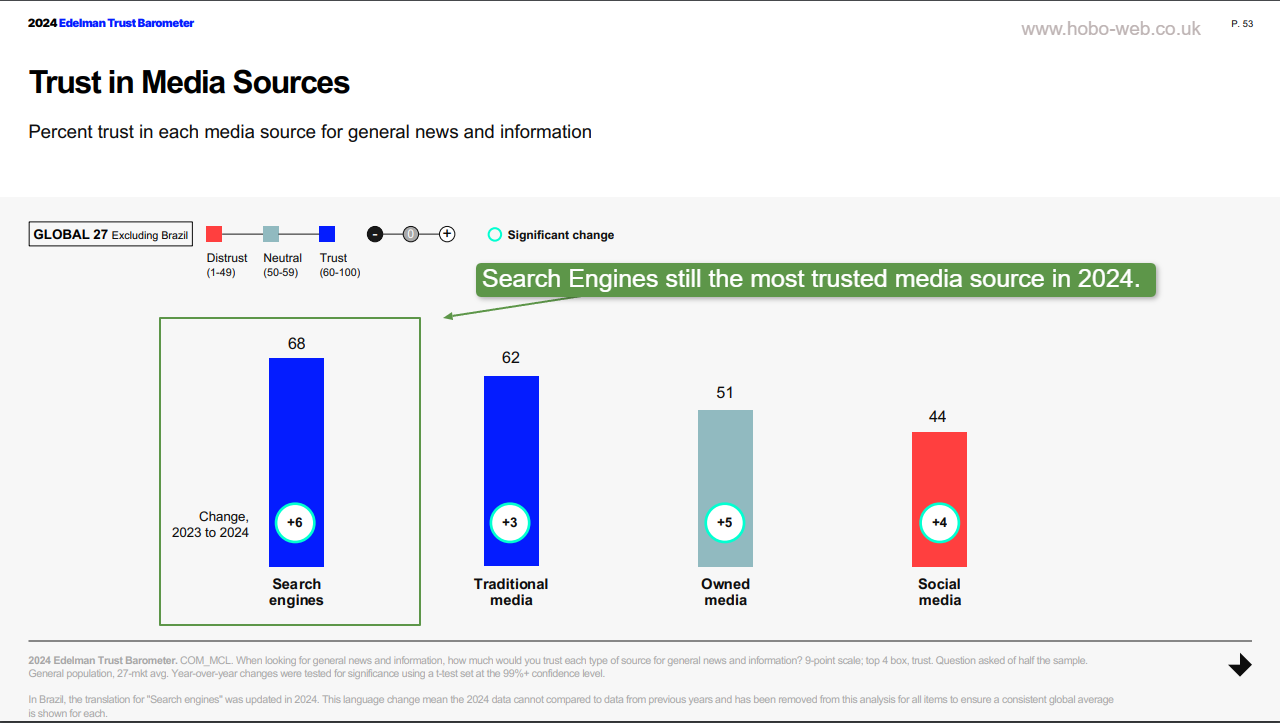
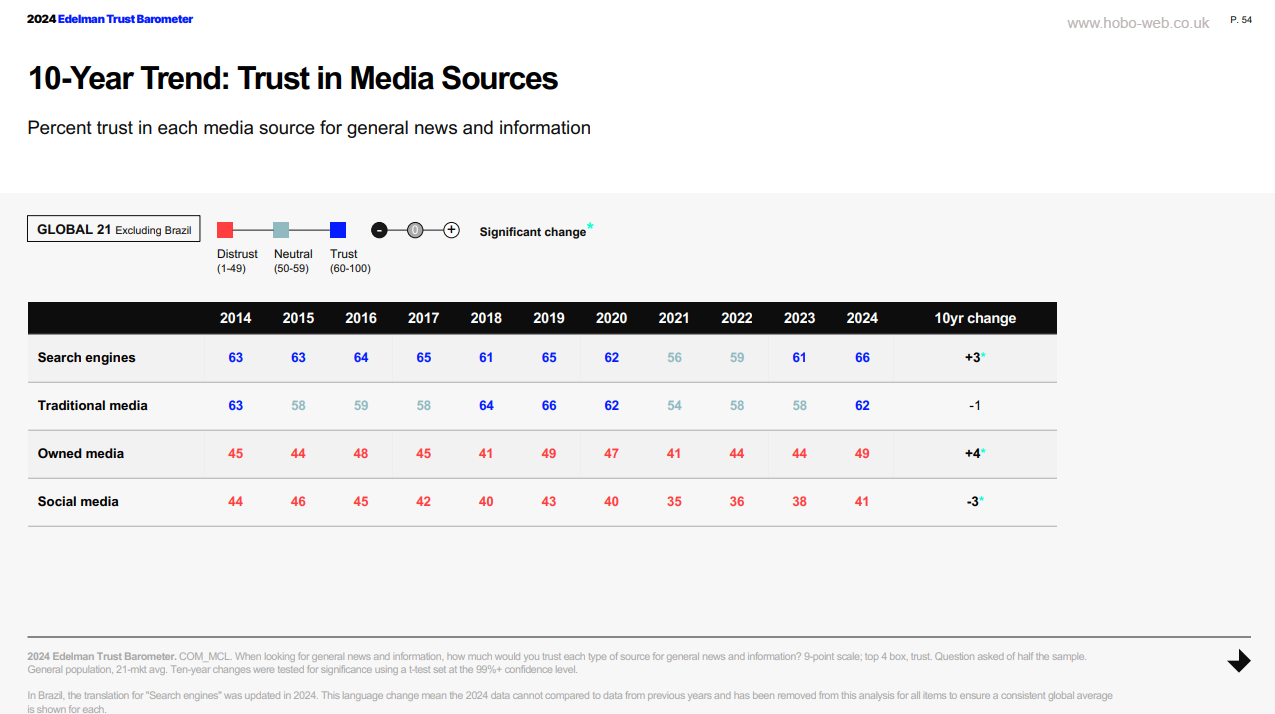
Organic traffic is still the most valuable traffic in the world with search engines recently rated the most trusted source for finding news and information:
A number 1 ranking in Google still:
- attracts the lion share of visitor clicks and gets
- a lot more clicks than no2 position, and
- vastly more clicks than the other 8 listings in the SERP
Of course, that’s assuming your search engine results page (SERP) snippet is as ‘clickable’ and ‘relevant’ as the competing pages’ snippets for that search query. This is really important – as is the quality of the page your unpaid visitor lands on.
Organic listings get more the clicks than a sponsored ad listing attracts but it suits Google to balance that out in the future as they have done in the past (because Google makes more money from advertising).
I would be more specific with the numbers, but I don’t trust most stats out there these days about such things.
Everyone wants to know:
How to get to number 1 on Google?
…but the truth is Google changes what is number 1 in SERPs pretty often.
Typically there a few obvious ways to get to number 1, and you will do well to abide by Google best practices for each medium.
‘White Hat‘ SEO
QUOTE: “Search Engine Optimisation (SEO) is a technical, analytical and creative process to improve the visibility of a website in search engines. The primary function of SEO is to attract more unpaid traffic to a site that converts into sales (for instance).” Shaun Anderson, Hobo 2020
Search engine optimisation is the process of making pages ‘as relevant as they can be” for search engines to believe they are valuable enough to be considered for top rankings for as many key phrases as possible in organic or natural listings.
QUOTE: “Search engine optimization (SEO) is often about making small modifications to parts of your website. When viewed individually, these changes might seem like incremental improvements, but when combined with other optimizations, they could have a noticeable impact on your site’s user experience and performance in organic search results.” Google Starter Guide, 2020
Nobody knows for sure how to get to number 1 on Google, not exactly anyway. Getting to number one in Google is largely down the reputation of your website and how relevant and user-friendly your content is.
Typically you get to number 1 by having a good online reputation. Well-known brands have good reputations. These brands rank at the top of Google, too. Reputation is increased by the number of quality web pages that link to any page on your site. Typically relevant pages with the most high-quality links rank at the top of Google listings.
If users actively SEEK OUT YOUR WEBSITE ON GOOGLE using brand identifiable terms Google will recognise this and probably use it as a proxy for “quality” and relevance.
QUOTE: “One piece of advice I tend to give people is to aim for a niche within your niche where you can be the best by a long stretch. Find something where people explicitly seek YOU out, not just “cheap X” (where even if you rank, chances are they’ll click around to other sites anyway).” John Mueller, Google 2018
Instead of focusing on number 1 in Google, your focus should be to appear in as many Google properties as possible, to give your business as much opportunity as possible to appear for as many searches as possible that are relevant to your business.
For instance ranking for ‘how to get to number 1 on search engines like Google, Yahoo or Bing‘ might well be valuable to me.
How hard is it to get to number 1 Google? Ultimately this depends on the competition for the keyword or keyphrase and the reputation of your website. New websites typically find good rankings hard to come by in Google in competitive verticals. Placing number 1 on Google and getting no traffic? You must be number 1 for a keyword that is not widely searched for.
You searched for ‘how to get to number 1 on Google’ and I hope this article has shed some light on this – at least you know you should be asking:
- how to get to no1 in Google organic listings?
- how do I get a featured snippet?
- how to get to no1 on sponsored listings in Google?
- how to get your site number 1 in Google news?
- get number 1 listing on Google maps results?
- how to get number 1 on Google video results?
- how to get to number 1 in Google image search?
- how to get number 1 in Google shopping comparison?
- how to get website 1 in Google Discover?
- how to get number 1 on Google local business (formerly Google Places and now Google My Business)?
You can get to number 1 in Google for free if you know what you are doing, and if you don’t, you can pay Google Adwords or find a search engine optimiser like me who can consult with you to help you rank no1 in Google, Bing & Yahoo search engines’ organic listings.
QUOTE: “You can manually submit your site and other content directly to various Google services including Search, Maps, Video, Podcasts, Images, News and shopping to name a few. Google has lots of ways to help businesses get online.” Shaun Anderson, Hobo 2020
Beware those who promise no1 ranking guaranteed. No one can guarantee no 1 rankings on Google.
Get Top Ten Rankings In Google With Simple, White Hat SEO
Simple SEO is just that. Simple. You can get top ten rankings in the SERPs in many industries just by following some very basic (on the whole, onsite) SEO tips:
- Optimise 1 page with unique content for 1 keyword phrase and multiple related key phrases
- Make sure you have a keyword rich page title, the words, and key phrases on the page and in the name of the actual file path if possible
- Link to this page from within your site with the anchor text “keyword” a few times at least
- Don’t link out from that page with the exact anchor text “keyword”
- Going forward, try and encourage other sites to link to this page with the anchor text “keyword” as opposed to your homepage. This is called deep linking. Of course, the more unique and better quality the information on your page, the easier it is to achieve this. Stay away from low-quality link sources.
- Sometimes, I consider linking out (where relevant on this page) to other quality sites
It’s worth pointing out that you *typically* have three chances to tell Google what a page is about, and how important the page is.
- On-Page – The actual text content of the page
- On-Site – In internal links to the target page
- Off-Site – In links to the target page from other websites
OK – You’ve got your site….. it’s got the usual stuff – home page, contact page, about us, map, products – but you have a blog! A blog lets you easily add pages. That’s all you really need, although you can do this without a blog of course, but then you need to know a bit about website design.
You are reading a blog, of course.
QUOTE: “I started blogging in the SEO industry in 2007, when blogging was the new “in thing”, and I used it to power visits and sales for my company a bit before it was commonplace. Google (I include Google Feedburner in this) has sent this site almost 8 million unpaid organic visitors since I started blogging. There’s no single way to blog but here’s what I learned and how I did it if you are totally new to blogging.” Shaun Anderson, Hobo 2020
There may be some evidence that the more you link to a page in your website navigation structure, the more important Google seems to think that page is, in relation to the rest of your site at least.
Pages that aren’t linked to frequently may not have enough link equity to make it into Google’s main SERPs.
Thinking: A well-optimised page followed with a few incoming links from external sites will perform very well in Google, and is boosted when you tell Google “Hey – This page is important”, by linking to it from other pages on your site. Not linking out to any other page (from the target page) with the exact term you are targeting tells Google as far as this page is concerned, it’s the authority document on the matter (which is the aim of SEO). You would think.
Warning: This works well for small sites, with a few products. Using this strategy on a site with a lot of target pages will have mixed results, and you risk making the site look spammy. Simple SEO might be all your website needs to get better rankings in Google.
Always remember not all links are equal. Nothing helps an individual page more than on-topic links from reputable websites, but it’s clear you don’t need thousands of links to get top rankings in Google.
QUOTE: “Link building is the process of earning links on other websites. Earned natural links directly improve the reputation of a website and where it ranks in Google, and other search engines. Self-made links are risky and come with them the risk of penalisation by the Google webspam team.” Shaun Anderson, Hobo 2020
Make a relevant, well-optimised page that is well linked to in your internal site structure, and back it up with a few anchor text rich links from external sites. This strategy helps leverage the overall authority of your domain to rank specific pages, ideal if you’ve not a lot of authority to begin with.
Tip to Remember – Give Google what it wants – Optimise your page, and always link generously to your important pages within your site navigation and content.
BIGGER TIP – DO NOT OVERDO IT. Keep it simple.
Top Rankings Are Never Guaranteed
Rankings in Google search are going to fluctuate depending on many factors including:
- good optimisation techniques on your site
- poor optimisation techniques on your site
- link quality
- competitors doing something right or wrong
- user intent changes
- graphic user interface changes on the Google search results page
- Google tests and rankings everflux
What Do You What To Rank Top On Google For?
Some organisations want to rank for different things and this can be achieved in many different ways. Always ask yourself; “What specific keyword phrase do I want to rank no1 on Google for anyways?”
How To Rank On Google For Your Brand or Company Name
Registering your website and configuring it with Google Search Console and Google My Business is a prerequisite for website owners. Telling Google everything you need to tell them using the channels they provide is a first prudent step for any business.
The more non-specific term you want to rank for and the wider the geographical area you want to rank in will determine the level of competition you are up against. This competition that you are up against is what you are going to be rated against by Google.
- Rank for your company name – EASY. Picking a unique brand name would go a long way in helping. This is very easy to achieve with just on page optimisation and a few incoming links and citations (sometimes, not even). This is unless you have a poor reputation online, or have a brand name that competes online with a better-known organisation with the same name in the same geographic region, which is far from ideal. If you have online business authority, you will rank in Google. If you don’t, you won’t and so will need to legitimately build some.
- Rank for your service, in your area – USUALLY EASY. – again, fairly easy. Done with on-page optimisation (geographic mentions in the title and in the text for instance).
- Rank for your service in your country – USUALLY VERY ACHIEVABLE. – slightly more difficult than above, but can be handled with even low-quality links from even low-quality, unrelated sites in some cases. By focusing on the quality of your site content, you should be able to pick up links from decent sites that help you rank in your country. For more information on this, read my link building for beginners post.
- Rank for your service – HARD. – difficult depending on the niche – you’re going to need some decent links or at least the same amount of crap links your competitors have. Crap anchor text links still can outweigh unfocused poor anchor text links from even relatively authoritative sites. There is a lot of competition so you are up against a lot of savvy people.
- Rank for your products – VERY HARD. – generally speaking, very difficult, especially if your products can be bought in a 1000 other places. You’re going to need UNIQUE CONTENT, a good user experience and need links that pass Pagerank, anchor text and trust ie ranking ability. You’re going to need a few trusted sites to link to you to rank all those products. The more pages on your site, the more Pagerank you (historically) had to have. To get Pagerank, you need incoming backlinks. You will always get traffic to your pages but the amount of traffic Google will send to your pages will be based on how satisfied users are with your site, and what others online say about your site.
Sign up for our Free SEO training course to find out more.
‘Black Hat‘ SEO
QUOTE: “SEO is an acronym for “search engine optimization” or “search engine optimizer.” Deciding to hire an SEO is a big decision that can potentially improve your site and save time, but you can also risk damage to your site and reputation. Make sure to research the potential advantages as well as the damage that an irresponsible SEO can do to your site.” Google Webmaster Guidelines, 2020
I do not discuss this type of SEO on this blog. I am no longer experienced in it.
A weight of crap links built (by an experienced black-hat SEO) over time can STILL beat even a relatively trusted site in Google. However, it’s these type of ‘link-schemes’ Google has a lot of brainy people working on attempting to nullify.
If you are not VERY experienced in black-hat SEO, I would avoid it. It is far too easy for competitors to call you out for me to invest a lot of time and effort in it, especially when employed by a client and considering just a few links from one trusted site can transfer instant ranking ability and trust to another site.
Finding such sites can be a full-time occupation though, but that is the game we play.
QUOTE: “Blackhat SEO fads: like walking into a dark alley, packed with used car salesmen, who won’t show you their cars.” Matt Cutts, Google 2014
Deciding what you want to rank for and how you want to do it are at the core of any strategy. If you choose to employ black-hat SEO techniques, I think you will find it a short-term strategy with longer-term consequences.
Number 1 Ranking In Google, Bing & Other Search Engines
The number 1 reason a lot of sites get number 1 places in Google listings are they are good enough. It really is this simple:
Round that off with some killer, original content that is of at least similar quality to other sites and pages competing for the desired terms and you know what, after rinsing and repeating ad nauseum, you’ll probably rank in Google for desired terms.
I am often bemused when I visit Webmasterworld and see Webmasters who’ve been banned by Google (which i suspect happens a lot less than people think) or have completely lost previously high Google rankings.
I automatically think to myself, if I visit these sites, will I be disappointed? Do they have the content or is their position “link generated”? If they do have the content, have they screwed up the simple stuff? Have they made a big mistake, somewhere critical?
Google doesn’t owe anybody good rankings. Just because you’ve been number 1 for years doesn’t mean the position is unmovable, either.
And anyway, is there such a thing as “Number 1 in Google” these days? Rankings Ever flux and constant Google Core Updates ensure a freshness to the top ten, so in reality, nobody can guarantee any website prolonged number (insert number or page) listings – although many do.
QUOTE: “One way to think of how a core update operates is to imagine you made a list of the top 100 movies in 2015. A few years later in 2019, you refresh the list. It’s going to naturally change. Some new and wonderful movies that never existed before will now be candidates for inclusion. You might also reassess some films and realize they deserved a higher place on the list than they had before. The list will change, and films previously higher on the list that move down aren’t bad. There are simply more deserving films that are coming before them.” Danny Sullivan, Google 2020
Every position in Google is up for grabs. Instead of buying links, mass link-bombing of key terms, mass registration of fake domains or trying to “game” Google, why not just add high-quality, unique content to your site and make your site “better”? Don’t worry – with practice, it gets easier. In time, rankings come – but only with good content.
Sure, some sites bend the rules and get good rankings. They may even keep these rankings for some time. But in the end, they are generally hit by changes in the way Google deals with things.
That’s what we help customers with. We consult with them to try and make sites better. For Google and visitors. It’s a long-term strategy, takes a lot of hours, but surely it’s the only sustainable method for Google success for most companies.
And you know what? It works.
Despite my success ranking many sites, I don’t know exactly how Google works. Nobody does or can know (and if they did, believe me, they are too busy making money for themselves to help your business rank high). We are successful because we know the kind of sites that Google prefers and I help clients to try and develop these.
Sometimes it’s knowing what not to do rather than what to do that gets listed at the top of Google.
If you want me to do your SEO, you’ll need to understand this. If you have a one-page website, basically an advert for your company, I’m not willing to spam the search engines for you, as this isn’t common sense sustainable business for you or us.
There are too many customers out there who are willing to spend the time required making their website quality for visitors and Google. I’m busy helping them.
If you’re one of these clients who want to make their website better contact me.
How Much Traffic Will I Get From A Number 1 In Google?
QUOTE: “There aren’t any quick magical tricks that an SEO will provide so that your site ranks number one. It’s important to note that any SEO potential is only as high as the quality of your business or website so successful SEO helps your website put your best foot forward.” Maile Ohye, Google 2017
I’ve been asked the following questions many times: How much traffic can you guarantee I will get from a number 1 spot in Google natural (unpaid) listings?” and this seemed like the most accurate answer I could give; more traffic than you would get if you were in number 2 position.
Most third-party keyword data tools are inaccurate, but at least something to go on.
Without actually being number 1 for a term, it’s impossible to say for sure. Google Adwords, of course, is very useful (the best keyword research tool?) but you’re paying a pretty penny for all that intel and often, the client has no data to share.
If you’re an SEO with a few number 1 terms, you can look see what traffic you get and compare it with any keyword data tool for that key phrase, and then make some assumptions from any normalised data. You can also mine for opportunities in your niche comparing keyword volumes with keyword competition etc.
I use SEMRUSH and Google keyword tools to give myself an idea of the most popular keyterms, but then again, I am a search engine optimiser, not a “keyword monkey“, or a soothsayer.
I only need to do the easy bit – change rankings for as many keyword terms as possible – usually by improving page-experience, as Google calls it.
When I am speaking to potential clients, I’m usually in, just after some swanky salesman from another company, has hit the prospect with GUARANTEES and FIGURES I think to myself “I’m not even bothering trying to compete with this because most claims like this in SEO are nonsense – a best guess at the very best”.
And I’m not saying keyword research isn’t important. It is a fundamental part of any campaign – perhaps the most important part. It’s just not my favourite bit of SEO (getting real links to relevant pages is), and I hate making any kind of predictions in any market I don’t have years of experience in – and there’s a lot of markets out there that change all the time.
How Many Clicks Does A No1 Ranking In Google Get Compared To No2, 3, 4 & 5?
A LOT more, that’s the only thing that can be bet upon. It really does depend on a multitude of variations, from what Google displays around your listing, to the nature of the query itself.
Google Search Console (formerly Google Webmaster Tools) now shows click-through rate and position in SERPs – so you can work this out on your own site. Not that it’s accurate – but what else do you have?
QUOTE: “You can submit your website and verify it in Google Search Console. The procedure to connect your website is very simple with a little technical knowledge.” Shaun Anderson, Hobo 2020
I picked a term I know I have had the top 5 positions at various times, and it’s interesting to see the click-through rate on particular keyword searches…. and how many clicks the top position in Google gets compared to the number 3 position, no4, and no5.
| Position 1 | 58 | 46 | 79% |
| Position 2 | 91 | 46 | 51% |
| Position 3 | 210 | 73 | 35% |
| Position 4 | 260 | 46 | 18% |
| Position 5 | 110 | 12 | 11% |
This is just one example – it will take a while to look into the new data and look at an average – but it shows a number 1 getting nearly 30% more of the clicks than a no2 ranking.
You might find some useful nuggets of information at Google Search Console for your own site.
Of course, click-through rate can be skewed by any number of factors – the nature of the query or how compelling your call to actions are in your title and your meta description, to name just a couple.
How To Check Your Rankings On Search Engines
Don’t get too fixated on your rankings – rankings fluctuate – Google Search is designed that way! And don’t just try to rank for just a few terms. It’s better to rank for lots of different keywords than have a business based on one competitive keyword.
To check your rankings fairly accurately with non-localised or non-personalised search results, you may need to use tools like:
- Google Search Console
- Proranktracker
- SEMRush
- AWR
- AHrefs
- Sistrix
These tools can also indicate where you rank (at least periodically) in other countries. The Google Ad Preview Tool from Google also shows organic search results and how they look to users around the world. You can see just how rankings differ from country to country and place to place – worth considering when researching keywords. Geolocation and personalisation really mixes Google rankings up.
I usually use SEMrush to check my rankings in other countries.
Google Rankings Are Different Computer-to-Computer
QUOTE: “Nobody will always see ranking number three for your website for those queries. It’s always fluctuating.” John Mueller, Google, 2015
A big misunderstanding of Google and search engines like Yahoo & MSN is to view them as one simple server. In fact, they are tens of thousands of servers, located in different “datacenters” (DCs) all over the world.
And they do not get updated all at the same! Instead, changes are rolled out slowly, a few data-centers at a time, and a few machines per datacenter at a time.
As a result of DNS-based load-sharing, the “Google” you connect to right now is not the same “Google” you connected to five minutes ago — It is a different machine at a different IP address so different set of results.
So, you are simply seeing results on different Google machines, depending on when you connect (and where you connect from).
How Long For A New Site To Get Stable Rankings?
QUOTE: “I think if your website is just, let’s say, a couple of months old, maybe 8 months, maybe a year, then that’s still very fresh with regards to the rest of the internet. So that’s kind of a time where our algorithms are still trying to figure out how and where we should show your website in the search results overall. So that’s something where it would be normal to see some kind of fluctuations around how it’s being shown in search. Sometimes things go up for a while, sometimes they go down for a while. And then, I’d say over the course of a year, things settle down in kind of a stable state.” John Mueller, Google 2020
Black Hats, for a long time, have complained about the Google “sandbox”. The statement above kind-of sounds like a confirmation of the sandbox for new sites, of sorts.
A brand new site will take a while to get motoring in Google, so to speak.
If you see your brand-new site appearing and disappearing, but ranking well with increasing frequency, that is potentially good news.
On the other hand, if you see your well-ranked site dropped with increasing frequency, then that is bad news.
QUOTE: “Google has a history of classifying your site as some type of entity, and whatever that is, you don’t want a low-quality label on it. Put there by algorithm or human. Manual evaluators might not directly impact your rankings, but any signal associated with Google marking your site as low-quality should probably be avoided.” Shaun Anderson, Hobo 2020
It is however possible that you’re connecting to only partially-updated servers (computers), and your data isn’t loaded yet.
It doesn’t make sense to panic until your site disappears completely, because it might drop, or it might pop back — You just can’t tell.
The best you can do, I think, is doubling down on improving content-quality and focus on providing a better page-experience for your Google visitors:
QUOTE: “We will introduce a new signal that combines Core Web Vitals with our existing signals for page experience to provide a holistic picture of the quality of a user’s experience on a web page.” Sowmya Subramanian, Google 2020
Those Who Guarantee Number 1 Rankings Are Lying To You
QUOTE: “We say directly no one can guarantee a number one ranking on Google. So, you can say, right from the horse’s mouth, right from Google, no one can guarantee a number one ranking.” Matt Cutts, Google 2010
Matt Cutts of Google explains a bit why persons are lying to you when they claim they can guarantee number one rankings in Google for competitive terms….
What Matt didn’t touch on was diversity in search results Google aims for, or geolocation differences, personalisation re-ranking, or what the competition is doing, or tweaks to the algorithm, etc etc etc…. but it’s true no-one can guarantee no1 rankings in Google, so don’t be duped.
Taking the analogy of a Horse Race, even if you know where the finish line is, even if you have spent ages examining the competition, and even if you have ‘fixed’ the race so that every other jockey is in on it……what if happens if your horse falls at the second last fence? What happens if it breaks a leg? What happens if it drops dead? What happens if another faster horse enters the race at the last minute from left-field? You’re No2.
And if you’re caught cheating – you won’t even be allowed to race.
Google is like a horse race, with hundreds of potential participants. It’s a horse race where;
- You don’t even know where the finish line is!
- You don’t get to see everything the competition is planning to win the race, what they did yesterday or what they will do tomorrow, whether that be address site issues, get those all important quality links or indeed hire a better search engine optimiser!
- It’s impossible to know how healthy your site is in comparison to the no2 site, assuming your site is no1.
- If you are caught cheating, your not allowed to compete in future.
Matt Cutts of Google is also on record as saying;
QUOTE: “Someone walked up to me and pretended like he wanted to bribe me: $500,000 for a 1st place ranking. I turned him down, because no one can guarantee a #1 ranking, not even me.” Matt Cutts, Google 2007
Even the cleverest of the black hat SEO brigade can’t capture very competitive key-terms for long. Google will eventually catch up – Google manually checks some of the most competitive ‘money terms’ when the algorithm misses it and if they don’t pass a human review – the site will be penalised, along with every other site in that bad neighbourhood.
A SEO can’t ever guarantee you top results just in the same way as an advertising agency can’t guarantee that next advert in the local press will get you sales. If you’re paying good money to a SEO, you should expect good positions, but that’s it.
To guarantee anything you need to know all the variables – even SEO who claim you can guarantee no1 listings on less that competitive terms are fooling themselves. Google can take these positions away from them as quickly as a better SEO with a better site with a better back-link profile.
No1 in Google is evidently not stable nor guaranteed under any conditions.
Using Google To Find A Company
Google search engine results pages have always made for an interesting review as many are using tactics they can’t use on your site. These companies do not expect to rank for very long, so it’s common practice to spam a shell site into the top of results to get new customers.
I remember examples where all you could find in Google for certain search results were foreign businesses (mostly) that were using low-quality techniques:
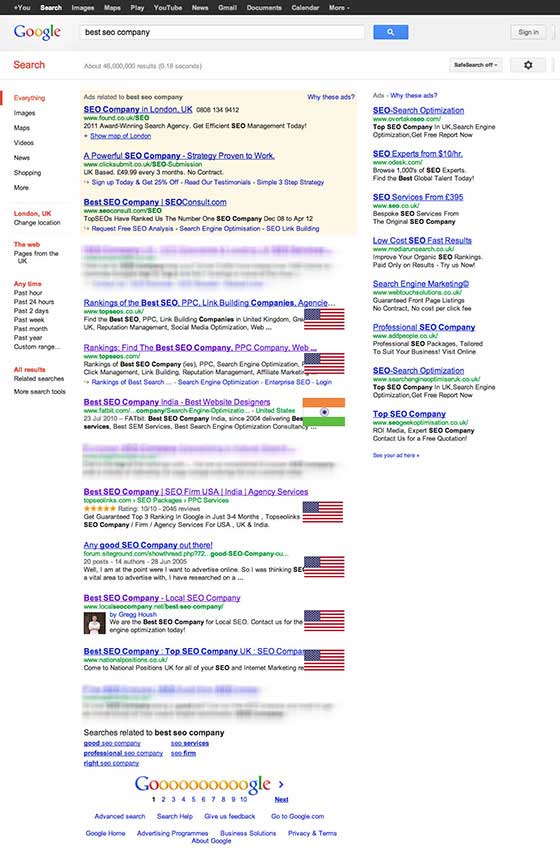
Google UK SERPS have got much better since then.
Although I see they still rank sites like Topseos:
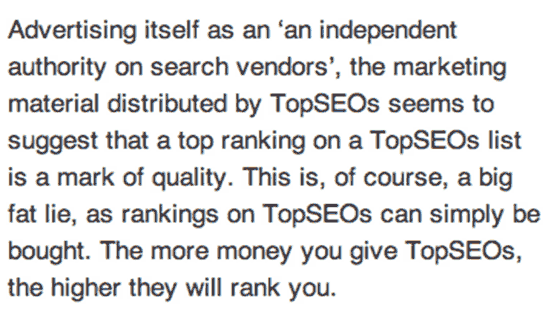
TopSEOs gets decent rankings even today, though nowhere near as much as years ago, despite the outcry a few years ago from many professionals about these review companies.
I see also that there is a new crop of SEO review directories that rate the SEO firms they list. I am not a part of ANY of these SEO lead generation sites, have refused “awards” and many of the legitimate SEO I know aren’t on them either.
Historically to compete for particular keyword rankings in search engines, you had to employ the same tactics that will eventually lead to penalties further down the line. I stopped bothering with that a long time ago, but now it appears you just pay to join an SEO review directory to get an “award” you can show on your site and a place on these top 100 listings.
I won’t be bothering.
Beware Cold-Calling Sales Persons or Email Spam
If you run a business online, you can safely ignore every cold call or email you get about your website that is not from Google, your website development, hosting or domain company. Especially unsolicited emails about SEO.
“Amazingly, we get these spam emails too: “Dear google.com, I visited your website and noticed that you are not listed in most of the major search engines and directories…” Reserve the same skepticism for unsolicited email about search engines as you do for “burn fat at night” diet pills or requests to help transfer funds from deposed dictators. No one can guarantee a #1 ranking on Google. Beware of SEOs that claim to guarantee rankings, allege a “special relationship” with Google.” Google Webmaster Guidelines, 2020
Disclaimer
Disclaimer: “Whilst I have made every effort to ensure that the information I have provided is correct, It is not advice.; I cannot accept any responsibility or liability for any errors or omissions. The author does not vouch for third party sites or any third party service. Visit third party sites at your own risk. I am not directly partnered with Google or any other third party. This website uses cookies only for analytics and basic website functions. This article does not constitute legal advice. The author does not accept any liability that might arise form accessing the data presented on this site. Links to internal pages promote my own content and services.” Shaun Anderson, Hobo
Comments are closed.