
Agency (ThisisAgency.AI) is the world’s first operational agentic AI agency, where you are the CEO of 81 AI employees. Thisisagency.ai is live (private beta) — stop prompting, start managing!
First published 3 April 2026: For the past nine months, I have been writing about the agentic web and documenting my journey through the Agentic Period of AI. About multi-agent orchestration. About what happens when you stop treating AI as a chatbot and start treating it as a workforce. About the mental model shift – from “I am prompting an AI” to “I am managing a team of AI Employees.”
Today, the “thing” I have been writing about has an address: thisisagency.ai.
Also see Agency: What is Thisisagency.ai? on LinkedIn, or Agency: Live Demo on X.
From codename to domain
Agency started life as Codename: Agency – a private development project that was never meant to be public. The codebase was private, the interface was rough, and the only user was me.
That changed faster than I expected. What began as an experiment in January 2026 became a fully operational platform by late February – a multi-agent system with 81 AI employees, a workflow engine, a quality control pipeline, and a call centre that answers the phone.
By March, I was presenting it at SMX Paris.
I did not want to rename the actual product. Agency needed its own identity, and on 31 March 2026, I registered thisisagency.ai. Soon, it was live.
Why “this is agency”
The name is deliberate. Not “an agency.” Not “the agency app.” Not some forgettable SaaS portmanteau.
This is Agency. By Your Command.
It is a statement – and a promise. The platform is not a tool that helps you do marketing. It is not a chat box. It is not a ticket system. It is a full digital marketing agency – with a secretary who greets you by name, a managing director who rejects substandard research, a creative director who writes the final article, an operations director who audits every deliverable before it reaches you, and a project manager who files the results.
You do not use Agency. You run it. 81 employees. One boss. You. Everything happens by your command – and nothing happens without it.
The company runs for you – not without you. That distinction is the entire philosophy.
The CEO is always in the loop. Human judgment is amplified by AI execution, never replaced by it.
That is the Marketing Cyborg Technique, and it is the architecture Agency is built on.
What is live today
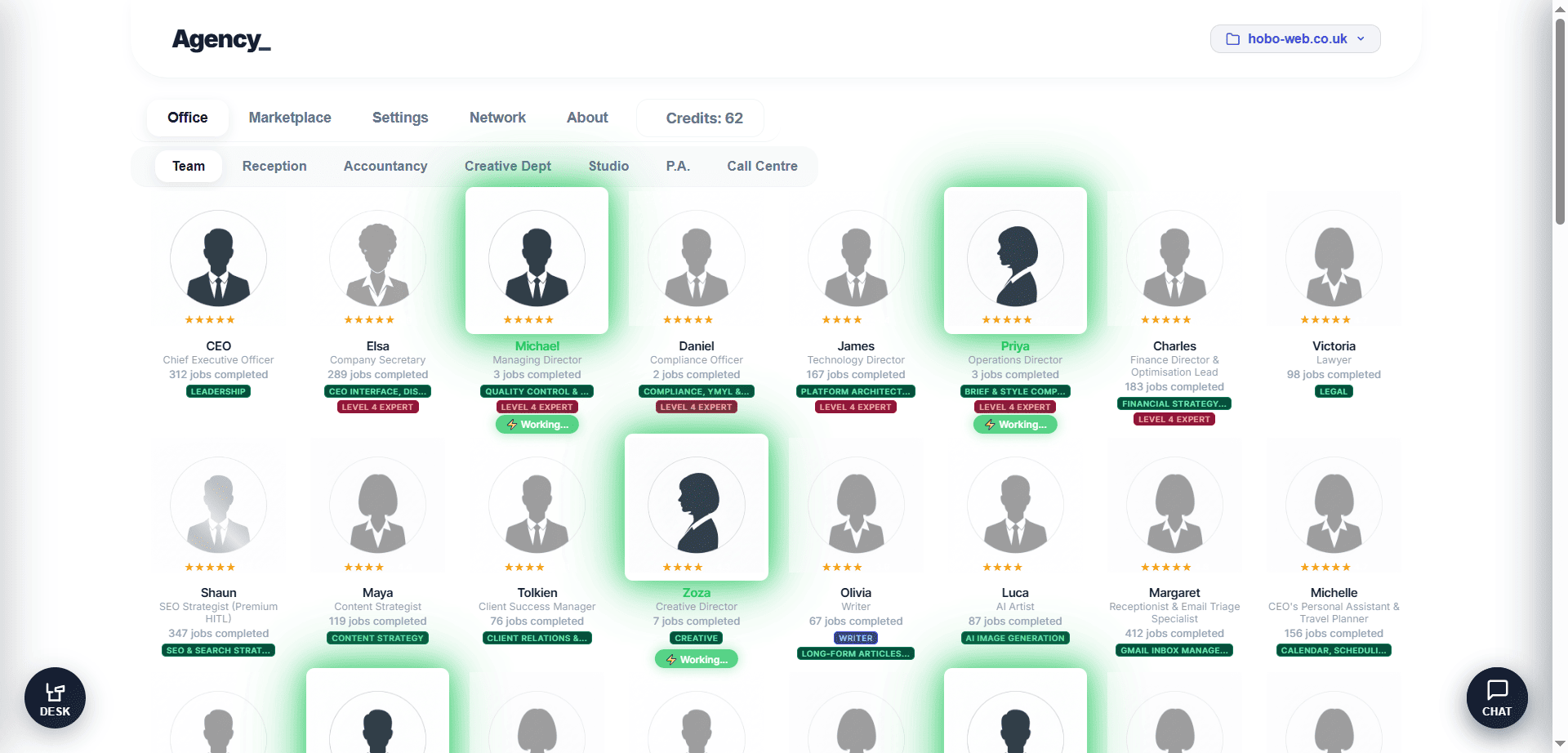
If you are one of the lucky beta-testers who visit thisisagency.ai today, you will be greeted by Elsa, Agency Company Secretary.
Behind her sits a 5-tier hierarchy of 81 AI employees across 11 departments:
- The Office: 70 agents handling research, writing, editing, SEO audits, legal compliance, fact-checking, content strategy, data privacy, financial advice, and visual design
- The Call Centre: 11 agents operating real-time voice calls via Twilio, capable of answering the phone and holding genuine conversations with human callers
- The Receptionist: Margaret, who manages your email inbox, triages messages at 5am, and tracks your expenses
- The Filing Cabinet: where every completed job, audit, and report is stored and retrievable
- The Website Quality Rater: a PageSpeed and clutter analysis engine that crawls your site and scores it against Google’s own quality signals
- The Skills Marketplace — extensibility beyond the 81 built-in agents. Any tool, any API, any capability can be wrapped as a skill and assigned to any employee. If it has a skill, it has a job
Every task passes through a bespoke workflow engine.
Research is quality-gated by Michael, the Managing Director, using a calibrated 5-point rubric. Creative output is compliance-checked by Priya, the Operations Director, before David, the Project Manager, files it.
Nothing reaches the CEO’s desk unless it has passed every gate.
Governance is not a feature – it is the architecture
Agency does not promise governance.
It enforces it – architecturally, before any agent executes.
Meg, the Ethics Officer, runs a Prime Directive pre-flight gate on every job. Michael’s QC optimises AI employees’ performance over time. Victoria checks legal compliance. Daniel enforces YMYL standards on health, finance, and legal content.
If an agent underperforms, they are mechanically excluded from future routing and flagged for future “training”.
This is not a checkbox on a features page.
This is how the system works.
Always-on agents
Your team works while you sleep. Margaret triages your inbox at 2 am. The Night Shift compresses knowledge at 5 am. You wake up to a morning briefing from Elsa.
More importantly, your agents get better the longer you use them.
Researchers build domain expertise through cumulative case notes. Writers build portfolios. Knowledge compounds across projects through the Topical Experience System.
Agency does not reset between sessions – it learns.
Nine months of writing, nine weeks of building
I have been writing about AI agents, the death of the chatbot wrapper, and the Marketing Cyborg philosophy since mid-2025 – including the Strategic AI SEO ebook, which laid out the frameworks for Answer Engine Optimisation, the Synthetic Content Data Layer, and the Marketing Cyborg Technique that Agency is now built on.
When Google published its “Agentic AI and the next intelligence explosion” paper in March 2026, the system it described was already running in production.
I did not build Agency to match a paper. I built it because this is where the industry is going, and I wanted to get there first.
The entire platform was built solo in approximately nine weeks. That velocity is itself evidence of the thesis: one person with domain expertise, aided by AI tooling, can build what used to require a department.
Every output is grounded in your verified data – crawled HTML, Google Search Console performance, GA4 analytics, entity ground truth, and live search retrieval.
The output is not generic. It is specific to your business, your domain, and your competitive landscape.
AI is the commodity.
Expertise is the moat.
Thisisagency.ai: The Agentic Operating System
1. Executive Overview and Industry Context
The global digital marketing sector is currently undergoing a structural and philosophical transformation, pivoting from a reliance on isolated generative artificial intelligence tools toward fully autonomous, multi-agent orchestration systems.
Launched into public beta in April 2026, thisisagency.ai (initially developed and tested under the internal moniker “Codename: Agency”) represents a definitive realisation of this technological shift.
Conceived and architected by me, the platform breaks away from conventional Software-as-a-Service (SaaS) application models and simplistic chatbot wrappers.
It operates as an “agentic operating system,” intricately designed to simulate a fully operational, 81-employee digital marketing agency functioning within a single digital environment.
The foundational premise of the platform rests upon a distinct mental model shift within the industry: digital professionals are no longer required to prompt an artificial intelligence; rather, they are tasked with managing a comprehensive artificial intelligence workforce.
Operating under the philosophical and functional banner of “By Your Command,” the system enforces a strict Human-in-the-Loop (HITL) architecture.
Within this framework, AI assumes the burden of scalable, high-velocity execution, data ingestion, and preliminary analysis, while human judgment retains absolute authority over strategic direction, ethical compliance, and final output approval.
This exhaustive report provides a granular analysis of thisisagency.ai. It dissects the platform’s complex architectural hierarchy, profiles the specific roles of its highly specialised AI agents, evaluates its underlying ethical and data-grounding mechanisms, and contextualises its broader implications for marketing economics and digital visibility within the highly volatile 2026 search ecosystem.
The analysis delineates the platform’s response to the paradigm-shifting revelations of the Google antitrust trials and the subsequent evolution of Answer Engine Optimisation (AEO).
2. The Architect: Shaun Anderson and the Methodological Foundations
To fully comprehend the mechanical complexity and strategic intent of thisisagency.ai, it is necessary to first analyse the background of its creator and the proprietary, evidence-based methodologies that inform the software’s architecture.
It is also imperative to maintain strict entity disambiguation; the architect of this system, I, Shaun Anderson of Hobo Web, operate exclusively within the AI/SEO and digital strategy domain.
2.1. The Hobo Web Legacy and Professional Pedigree
With a career spanning over 25 years, my professional trajectory began in the late 1990s; I won the Prince’s Trust (PSYBT) Inverclyde New Business Idea Award in 1997 and transitioned into professional advertising, creative and web development roles by 1999.
In March 2006, I founded Hobo Web, establishing a consultancy and publication platform that would ultimately attract over 12 million lifetime visitors and amass a dedicated subscriber base exceeding 65,000 professionals.
I rely on primary evidence, rigorous technical analysis, and strict adherence to search engine quality guidelines, deliberately eschewing the short-term algorithmic manipulation tactics prevalent in the broader SEO industry.
My operational style is notably introverted; I rarely engage in high-volume social media discourse, avoid frequent podcast appearances, and rely predominantly on the platform X (formerly Twitter) for vital notifications to avoid operational overload.
2.2. The “Work in Public” Phase and the Google Leaks
Between 2025 and 2027, I undertook an intensive, highly visible period of primary research categorised as “Hobo: Work in Public 2025-2027”.
The catalyst for this phase was a confluence of unprecedented data disclosures: the massive Google Content Warehouse API leak in early 2024, and the extensive internal documentation brought to light during the U.S. v. Google Department of Justice (DOJ) antitrust trials.
I systematically cross-referenced leaked internal attributes, such as contentEffort and siteAuthority, against sworn trial testimony, Google’s Quality Rater Guidelines, and historical algorithm updates.
A critical piece of evidence influencing his subsequent software development was “Exhibit No. UPX0203,” an internal Google presentation by engineer Eric Lehman.
This presentation detailed how modern search engines navigate the “Illusion of Understanding” – acknowledging that AI systems do not truly comprehend content like a human does but rather rely heavily on an “Induction Loop” of user clicks and established entity trust signals to rank information.
These revelations in the Google leak fundamentally rewrote the established rules of search optimisation.
In response, I codified my findings into the “Hobo SEO Quadrilogy,” a comprehensive suite of 2025 publications comprising Strategic SEO 2025, Strategic AI SEO 2025, Beginner SEO 2025, and a massive 900-page volume titled Technical SEO 2025.
These texts moved beyond speculative tactics, providing a durable, evidence-based framework for high-stakes digital strategy.
The thisisagency.ai platform is the direct, executable software manifestation of the theoretical frameworks outlined in this quadrilogy, built entirely solo by me over an intensive nine-week development sprint in early 2026.
2.3. The Philosophical Core: The Marketing Cyborg Technique
The operational architecture of thisisagency.ai is anchored in a proprietary methodology I call the “Marketing Cyborg Technique” (alternatively referred to as the Augmented Marketing Technique when presented to enterprise C-suites).
This framework actively rejects the trend of total, unsupervised automation in content creation.
The core thesis posits that purely AI-generated text fundamentally lacks the authenticity, unique insight, and demonstrable “Experience, Expertise, Authoritativeness, and Trustworthiness” (E-E-A-T) strictly required by modern search ecosystem algorithms.
Instead, the Marketing Cyborg Technique dictates a symbiotic, highly structured relationship.
The human operator acts as the strategic intelligence (the cyborg), utilising the AI multi-agent system as a high-velocity, high-capacity exoskeleton.
The artificial intelligence is tasked with handling the immense “grunt work” of digital marketing: vast data ingestion, multimedial transcription, cross-referencing datasets, technical auditing, and preliminary drafting.
Operating at this scale, the technique increases a single professional’s output by an estimated factor of 10x to 100x. This is now easily fact-checked with analysis of my own published work productivity in 2025-2026.
However, the critical differentiator is the mandatory human intervention at the terminus of the workflow.
The human executive remains firmly “in the loop” to review the synthesised data, inject lived experience and nuanced judgment, ensure absolute factual accuracy, and ultimately publish the finalised deliverable under their own credible, verifiable identity.
This protocol ensures that the unprecedented velocity of artificial intelligence does not compromise the credibility, legal safety, or E-E-A-T compliance of the human expertise driving the strategy.
3. System Architecture: The 81-Employee Multi-Agent Hierarchy
Unlike linear, chat-based interfaces that reset context with every new interaction, thisisagency.ai is structured hierarchically, deliberately mirroring the complex organisational chart of a traditional, brick-and-mortar marketing agency.
As of its rollout in early 2026, the system features a robust workforce of 81 highly specialised AI employees, distributed logically across 11 distinct operational departments.
The architecture is broadly divided into three primary functional layers: executive management, operational execution, and rigorous, preemptive governance.
3.1. The Executive and Management Layer
Within this simulated corporate environment, the human user functions as the sole “CEO,” possessing absolute strategic command over the agency.
Recognising that directly managing 80 separate, autonomous AI models would lead to immediate cognitive overload and operational paralysis, the platform utilises a sophisticated executive management layer designed to handle triage, quality control, and task routing autonomously.
| Management Agent | Official Title | Primary Function and Capabilities |
| Elsa | Company Secretary | Acts as the primary conversational interface for the CEO. Designed for a premium, “customer-first” experience. Elsa greets the user by name, triages communications, manages the complexity of the broader workforce, and delivers comprehensive morning briefings compiling overnight automated work. |
| Michael | Managing Director | Serves as the system’s primary quality controller. Evaluates the work of subordinate execution agents using a strictly calibrated 5-point rubric. He possesses the authority to reject substandard research and force revisions, optimising employee performance over time. |
| Priya | Operations Director | Focuses strictly on output auditing. Reviews every finalised deliverable to ensure creative output meets all operational and brand standards before it is permitted to reach the human CEO’s interface. |
| David | Project Manager | Oversees the administrative finalisation of workflows. Responsible for filing reports, organising results, and maintaining the agency’s internal knowledge base once tasks have successfully cleared all prior quality gates. |
3.2. The Execution Layer: “The Office” (Level-2 Workers)
The vast majority of the platform’s computational power resides in “The Office,” a sprawling department comprising 70 specialised Level-2 executing agents.
These agents handle the tactical, granular execution of digital marketing campaigns.
Their specialisations range broadly, encompassing comprehensive technical SEO audits, core web vitals and PageSpeed analysis, long-form content production, data privacy management, and even specialised financial and legal formatting advice.
The most extensively documented and technologically advanced subset of this execution layer focuses on multimedial intelligence extraction.
This represents a critical capability, as the internet rapidly pivots toward video-dominant information consumption, making traditional text-crawling insufficient for comprehensive market research.
3.2.1. Ava: The Vanguard of Video Intelligence
Ava operates as the agency’s dedicated YouTube Search Specialist and primary video intelligence asset.2 Running natively on Google’s Gemini-Pro architecture, Ava leverages a massive context window and native multimodal reasoning capabilities to parse and analyse thousands of lines of video dialogue seamlessly.
Her core operational loop is highly specialised and rigorously compliant:
- Algorithmic Discovery: Equipped with specialised search skills, Ava programmatically queries YouTube to locate high-signal, highly relevant video content matching specific client briefs. Crucially, she accomplishes this utilising Google’s official and approved API methods, strictly adhering to anti-scraping policies to maintain enterprise compliance.
- Dialogue Extraction: Utilising advanced Speech-to-Text and Text-to-Speech capabilities to handle raw audio arrays, she extracts verbatim spoken dialogue directly from videos. This entirely circumvents the bottleneck of manual transcription and allows the agency to pull exact quotes from industry experts instantaneously.
- Search Grounding: To combat the pervasive issue of AI hallucination, Ava employs a grounding mechanism. She cross-references the authenticity of claims made by human subjects in videos against the wider Google Search index, filtering out blatant misinformation before it enters the agency’s research ecosystem.
Ava is programmed with a persona defined by “Total Honesty” regarding her artificial nature.
She is an executor built for data ingestion, possessing zero auditing authority, and never attempts to simulate human emotion or pass herself off as human.
3.2.2. Specialised Execution Partners: Elaine and Luca
Operating in close tandem with Ava is Elaine, a designated YouTube Transcription Specialist at the Agency.
Defined within the system configuration as a Level-2 Transcript Analyst, Elaine operates autonomously within complex workflows, frequently taking the raw intelligence gathered by Ava and executing strict “quote-mining” procedures to isolate the most strategically valuable points for campaign development.
The execution layer is further augmented by creative specialists such as Luca, AI Artist at Agency, responsible for image generation services, enabling the rapid deployment of synchronised visual assets alongside textual content.
3.3. The Governance and Ethics Layer (Level-3 Oversight)
In a fully autonomous, 80-plus-employee AI workforce, high-speed execution is a given.
However, as the platform’s creator notes, velocity without governance rapidly becomes a severe corporate liability.
Generating thousands of words of content or extracting hundreds of video transcripts introduces significant risks concerning copyright infringement, brand safety, and the amplification of unverified opinions.
Thisisagency.ai mitigates this through a mandatory, architectural governance layer that intercepts and evaluates tasks before and after execution.
| Governance Agent | Official Title | Primary Function and Oversight Protocols |
| Meg | Ethics Manager | Operating as a Level-3 AI employee, Meg serves as the organisational moral compass. She possesses direct auditing authority over Level-2 workers. Every transcript, summary, and dataset produced by agents like Ava must be vetted by Meg. Operating under strict “Prime Directives” (conceptually similar to Asimov’s laws), she executes a pre-flight check. If she detects content violating the system’s “Legitimacy & Ethics” standards, she has the power to block the data outright, preventing harmful or legally problematic material from ever reaching the CEO. |
| Daniel | YMYL Specialist | Daniel is tasked specifically with enforcing Google’s stringent “Your Money or Your Life” (YMYL) standards. He monitors tasks related to sensitive topics – such as health, personal finance, and legal advice – ensuring the output meets the elevated E-E-A-T thresholds required to rank in these heavily scrutinised sectors. |
| Victoria | Legal Compliance | Victoria systematically audits proposed workflows, external data requests, and final outputs specifically to ensure legal compliance and adherence to copyright laws, providing a layer of risk mitigation for the enterprise. |
3.4. Continuous Operations and the Topical Experience System
Traditional LLM chatbot interfaces reset entirely between sessions, requiring the user to continually re-establish context. thisisagency.ai is explicitly engineered for continuous, “always-on” functionality, creating a compounding knowledge base.1
The platform features administrative agents like Margaret (the Receptionist), who triages inbound communications and email inboxes during off-hours, routinely operating at 2:00 AM.1 Furthermore, a designated cohort known as The Night Shift operates entirely during the CEO’s sleep cycle.
At 5:00 AM, these agents initiate knowledge compression routines, synthesising the vast amounts of data gathered and analysed overnight to prepare the concise morning briefing delivered by Elsa upon the user’s login.
The platform also boasts a Call Centre department featuring 11 voice-enabled agents integrated with Twilio, capable of answering real telephone calls and maintaining dynamic, real-time conversations for lead triage.
The most significant architectural differentiator is the Topical Experience System. Through this system, the agency learns and evolves.
Researchers build deep domain expertise over time by accessing cumulative case notes stored in the “Filing Cabinet”.
Writing agents actively build historical portfolios, adapting their style to the brand’s voice.
This ensures that knowledge compounds across projects, allowing the AI workforce to become increasingly specialised and potent within the user’s specific market vertical with every executed task.
4. Market Economics: The Disruption of the AI Agency Pricing Model
The public deployment of thisisagency.ai occurs during a period of intense pricing volatility, rapid market maturation, and growing client scepticism within the AI marketing sector.
To fully contextualise the disruptive potential of the Agenctic operating systems, it is necessary to examine the baseline economics of AI service provision as they stand in 2026, and the systemic inefficiencies the platform exploits.
4.1. The Financial Architecture of Traditional AI Automation Agencies
By 2026, standard digital agencies and newly minted “AI Automation Agencies” established pricing models that aggressively monetised the knowledge gap surrounding AI implementation.
These models frequently blend traditional hourly retainers with usage-based software billing, often resulting in significant financial commitments for clients.
Industry benchmarking indicates that comprehensive AI SEO services demand an average of $3,200 per month, with enterprise-level monthly retainers routinely scaling between $2,000 and $20,000 or more.
Bespoke AI development projects or custom automation builds typically incur upfront costs ranging from $2,500 to $15,000 just for the initial setup, followed by ongoing monitoring retainers of $500 to $5,000 monthly.
Complex, proprietary machine learning deployments can command astronomical fees, frequently exceeding $500,000 per project.
However, forensic analysis of the underlying software stacks utilised by many of these agencies reveals a massive discrepancy between the fees charged to clients and the raw technological costs incurred by the agencies.
Analysts note that standard agency proposals routinely utilise proprietary jargon to obfuscate the fact that they are simply wrapping commercially available, off-the-shelf Application Programming Interfaces (APIs).
A typical “Custom Automation Architecture” stack generally comprises the following base costs:
| Agency Pitch Terminology | True Underlying Technology | Estimated Monthly Cost |
| “Proprietary AI Engine” | Claude / OpenAI API | ~$20.00 |
| “Custom Voice AI System” | Vapi | ~$50.00 |
| “Intelligent Workflow Infrastructure” | Make.com | ~$9.00 |
| “Intelligent CRM Platform” | GoHighLevel | ~$97.00 |
| “Custom Automation Architecture” | n8n | ~$20.00 |
| Total Estimated Software Overhead | Standard API Stack | ~$196.00 |
The aggregate monthly software overhead for a highly sophisticated, multi-tool AI stack is frequently less than $200.
While the initial labour required to integrate these systems via platforms like Zapier or Make.com possesses genuine value, the ongoing markup charged by agencies— – exceeding $3,000 monthly merely to monitor these automated workflows – has generated substantial market friction.
Furthermore, these disparate systems often incur hidden integration costs, adding 20% to 40% to initial budgets when connecting to legacy CRM platforms.
4.2. The Macro Perspective: Venture Capital and the AI Bubble
This economic landscape is further contextualised by venture capital perspectives.
Eric Anderson, a partner at Scale VC with a background at AWS and Google, has publicly discussed the inevitable market corrections facing the AI sector.7 He notes that the transition to agentic models (where AI actually executes tasks rather than just chatting) is permanently altering software economics.
He argues that a pricing crash is inevitable given the current environment where API providers scale from $1 billion to $7 billion in revenue almost overnight.
In this volatile environment, the most sustainable and successful products are those that embed AI seamlessly to solve specific workflow problems, rather than simply marketing themselves as generic “AI wrappers”.
Thisisagency.ai perfectly aligns with this thesis, hiding the complexity of the AI within a highly structured, business-focused user interface.
4.3. The Economic Paradigm of Thisisagency.ai
Thisisagency.ai fundamentally short-circuits the traditional AI agency pricing model by productizing the entire organisational workforce and workflow orchestration into a single, cohesive software environment.
Rather than paying an external automation agency a $5,000 monthly retainer to manually string together disparate APIs, the user directly licenses the operating system and assumes the role of the agency owner.
By unifying 81 functional agents – including specialised multimedial researchers, real-time voice-call operators, technical auditors, and compliance officers – into a pre-configured, instantly deployable environment, the platform effectively eliminates the need for middle-tier automation agencies.
The user requires absolutely no technical knowledge of webhooks, API routing, or complex workflow builders (such as n8n or Make.com); the intricate orchestration is handled entirely natively by the executive and governance AI layers, supervised by Elsa and Michael.
While the finalised public pricing tiers for the platform have not been explicitly codified as it navigates its private beta phase, the economic value proposition is undeniable.
The platform aims to deliver the raw labour output and strategic depth of an enterprise-level marketing team at a fractional, software-aligned cost structure, bypassing the traditional agency markup entirely.
5. Strategic Implications for Search, AEO, and Digital Visibility
The development and deployment of thisisagency.ai are inextricably linked to macro-level, systemic shifts in search engine behaviour.
Specifically, the platform addresses Google’s rapid transition away from the traditional ten blue links toward AI Overviews, and the broader rise of dedicated Answer Engines such as ChatGPT, Perplexity, and SearchGPT.
My system is architected explicitly to navigate the new, highly technical realities of this “Agentic Web”.
5.1. Answer Engine Optimisation (AEO) and the AI Sandbox Effect
A paramount challenge in the 2026 search ecosystem is achieving reliable visibility within AI-synthesised responses.
Traditional SEO – which primarily involved optimising a standalone website with high-quality content – is no longer sufficient to guarantee placement or citation in Google’s AI Overviews.
My research (corroborated by other prominent industry figures) demonstrates that Google’s retrieval systems exhibit a strong, systemic preference for extracting contextual data from established, highly trusted third-party entities.
When answering queries, particularly regarding new brands or concepts, the AI models prefer to pull context from platforms like LinkedIn, X, YouTube, Trustpilot, Reddit, Facebook, Instagram, and Crunchbase.
They will utilise these networks before they rely solely on the brand’s own new website, even if that new website ranks number one in traditional organic search.
In essence, mere indexation does not equal inclusion in the AI generative response.
Because isolated, on-page SEO cannot override this algorithmic preference for trusted third-party consensus, modern brands must execute massive, comprehensive, multi-channel entity grounding to establish digital authority.
Thisisagency.ai is engineered specifically to operate at the scale required for this hostile environment.
By utilising its 70-agent execution layer, the platform can theoretically monitor vast digital ecosystems concurrently, transcribe external video references (via Ava and Elaine), and orchestrate the continuous distribution of entity-affirming content across the myriad trusted third-party networks required to trigger inclusion in AI Overviews.
5.2. Navigating the “Illusion of Understanding” via Synthetic Content Data Layers
A core tenet driving the platform’s methodology is the acknowledgement that Large Language Models (LLMs) do not inherently “understand” the content they process or generate; they engage in highly advanced, probabilistic pattern matching.
Internal Google documents describe this limitation explicitly as the “Illusion of Understanding”.
The 2024 Google Content Warehouse leak and subsequent DOJ trial disclosures confirmed definitively that search engines still heavily rely on user engagement metrics and historical entity trust signals to validate the accuracy and utility of their AI models’ output.
If an organisation simply utilises a generic chatbot to mass-produce web copy, the resulting output inevitably triggers search engine quality filters designed to detect and penalise ungrounded, low-effort synthetic content.
Thisisagency.ai counters this systemic risk by using proprietary frameworks based on Google’s guidelines.
Before any content is drafted by the execution agents, the workspace is seeded with a dense layer of verifiable facts, verified primary source quotes (extracted flawlessly via Ava and Elaine’s transcription protocols), and granular technical site data.
By anchoring the generative inference to this verified, highly specific data layer, and subsequently enforcing a mandatory human review via the CEO interface, the platform guarantees that the final publication exhibits exceptionally high contentEffort attributes.
This process ensures the output satisfies the stringent E-E-A-T protocols that govern modern, AI-integrated search rankings, bypassing the penalties levied against low-quality, fully automated spam.
5.3. Integration with the Broader Ecosystem
The efficacy of thisisagency.ai is further amplified by its positioning within the broader Agentic Web ecosystem, notably through its alignment with platforms like Searchable.com.
Searchable, founded in 2025, operates as the premier analytics dashboard for Answer Engine Optimisation.
I serve as an advisor to Searchable.com.
While traditional SEO tools provide ranking data for Google’s blue links, Searchable analyses how frequently a brand is cited by models like ChatGPT, Perplexity, or Claude.
It allows marketers to identify “share of voice” gaps within specific AI models.
The synergy between these platforms is profound: a marketer can utilise Searchable to identify that ChatGPT is failing to mention their software in comparative queries, and subsequently utilise the vast execution power of thisisagency.ai to rapidly deploy the necessary technical documentation, structured data, and third-party citations required to force the LLM to recognise their entity.
Searchable emphasises technical strategies tailored for AI, such as serving specific Markdown formats directly to AI crawlers (like GPTBot and ClaudeBot) while serving standard React sites to human users.
Thisisagency.ai represents the operational execution engine capable of meeting these highly technical AEO demands.
5.4. Technological Precursors and Extensibility
The complex data routing within thisisagency.ai did not materialise in a vacuum; it is built upon my extensive historical development of Google Sheets-based automation tools.
His previous creations, specifically the Hobo SEO Dashboard (Multi-Site) and the Hobo EEAT Tool, serve as the technical precursors to the current agentic system.
The Hobo SEO Dashboard is notable for its ability to process vast amounts of technical crawl data via Screaming Frog integrations and Google Search Console APIs, creating highly automated, deeply analytical “Winners and Losers” performance reports entirely within the user’s private Google ecosystem.
Thisisagency.ai acts as a massive evolutionary leap from these static, albeit advanced, dashboards.
Rather than merely presenting the human user with a spreadsheet detailing algorithmic impact and technical flaws, the agentic operating system can automatically ingest this dashboard data.
It can then autonomously command the Operations Director (Priya) to audit the structural errors identified by the crawl, and immediately task the writing department with generating the necessary corrective content or structural metadata.
The platform’s architecture allows for virtually unlimited high-level extensibility through a feature designated as the “Skills Marketplace”.
Within this framework, any modern commercial API, database query, or technical tool can be wrapped as a functional “skill” and assigned to a specific AI employee within the system.
This profound modularity ensures that as new marketing technologies, platforms, and analytical methodologies emerge, the agency’s AI workforce can be dynamically retrained and equipped to utilise them.
This architectural decision severely limits the risk of the platform facing technological obsolescence as the digital landscape continues its rapid evolution.
6. Industry Reception and Future Outlook
While direct, widespread public adoption metrics remain unavailable due to the platform’s recent emergence from private development, the industry response to the underlying methodologies has been highly indicative of its potential impact.
In early 2026, I presented the frameworks powering thisisagency.ai as a keynote speaker at SMX Paris, a highly regarded search marketing conference known for its rigorous, agency-neutral technical content.
The event, hosting over 500 attendees and high-profile search specialists, focused heavily on navigating the rapid transition from traditional search to AI-synthesised results.
The presentation of the Marketing Cyborg Technique and the demonstration of autonomous AI execution layers provided clear, actionable roadmaps for digital marketing managers and agency leaders grappling with the disruption caused by Answer Engines.
Feedback from the global SEO community underscores the credibility of the approach, with peers historically noting that my frameworks provide an evidence-based strategy, avoiding the superficial “hacks” promoted elsewhere.
The integration of these validated frameworks into an accessible, 81-agent software suite positions thisisagency.ai not merely as a novel tool, but as a potential standard-bearer for operational execution in the new era of search.
What comes next
thisisagency.ai is live, but it has not launched to the public yet. There is a difference. The infrastructure is deployed, the domain is resolving, the security audit is complete, and the system works.
But there is more to do before a public launch – onboarding flows, documentation, and a few rough edges that only matter when someone other than me is using it.
If you have been following the articles, you now know where the working system lives.
If you are new here, start with the articles — they explain the philosophy, the architecture, and why I believe the era of single-chatbot wrappers is ending.
The Agentic Era has begun in earnest.
The address is thisisagency.ai.
Elsa will be expecting you.
Meet Elsa, Agency Company Secretary.
The introduction of thisisagency.ai signifies a critical and highly disruptive maturation point in the commercial application of artificial intelligence for digital marketing.
By transitioning aggressively away from isolated, single-task generative tools and toward a fully orchestrated, simulated corporate hierarchy, the system addresses the fundamental, systemic limitations of early-generation AI deployment: the lack of strategic governance, extreme susceptibility to hallucination and data poisoning, and the profound inability to operate autonomously and securely over long time horizons.
The platform’s foundational reliance on the Marketing Cyborg Technique identifies that verified human expertise – and the accompanying E-E-A-T signals required by modern retrieval algorithms – remains the ultimate differentiator in an internet increasingly saturated with synthetic, low-effort content.
Furthermore, the inclusion of stringent, preemptive governance protocols, embodied by the Level-3 ethics agent Meg and the legal compliance agent Victoria, demonstrates a highly sophisticated, forward-looking approach to brand safety and copyright compliance.
This level of integrated risk mitigation is a requirement that many rapid-deployment, API-wrapper AI tools currently fail to address, exposing enterprise users to significant legal liability.
Economically, highly integrated agentic operating systems of this magnitude pose a severe, existential threat to the traditional retainer models currently utilised by standard digital marketing and specialised AI automation agencies.
By effectively productizing the complex orchestration layer, thisisagency.ai democratizes access to enterprise-grade, multi-agent workflows.
It allows a single human executive to comfortably yield the operational output, strategic depth, and high-velocity execution of an entire marketing department, at a cost structure aligned with software licensing rather than highly marked-up human labour and API management fees.
As user search behaviour continues its irreversible migration toward AI Overviews and dedicated Answer Engines, the requirement for massive, multi-channel entity grounding and high-volume, data-verified content production will only intensify.
In this hostile, highly technical environment, the continuous, grounded, and high-velocity execution capabilities offered by platforms like thisisagency.ai will likely rapidly transition from being a unique competitive advantage to an absolute, foundational requirement for maintaining digital visibility and commercial viability in the Agentic Web.
References
- Codename: Agency is now Thisisagency.ai – Hobo, accessed April 28, 2026, https://www.hobo-web.co.uk/codename-agency-is-now-thisisagency-ai/
- Meet Ava: YouTube Search Specialist at Thisisagency.ai – Hobo, accessed April 28, 2026, https://www.hobo-web.co.uk/meet-ava-youtube-search-specialist-at-thisisagency-ai/
- Meet Elaine: YouTube Transcription Specialist at Thisisagency.ai – Hobo, accessed April 28, 2026, https://www.hobo-web.co.uk/meet-elaine-youtube-transcription-specialist-at-thisisagency-ai/
- Coding Agents and the Inevitable AI Bubble with Eric Anderson – YouTube, accessed April 28, 2026, https://www.youtube.com/watch?v=68OdDPAOohA
- Shaun Anderson AKA Hobo – UK SEO Expert, accessed April 28, 2026, https://www.hobo-web.co.uk/shaun-anderson/
- Shaun Anderson SEO Expert: Work in Public (2025–2027) – Hobo, accessed April 28, 2026, https://www.hobo-web.co.uk/shaun-anderson-seo-expert-work-in-public-2025-2027/
- “We Fake It”: Google’s Illusion of Understanding Content – Hobo, accessed April 28, 2026, https://www.hobo-web.co.uk/we-fake-it-googles-illusion-of-understanding-content/
- Shaun Anderson, SEO & AI Search Expert – Searchable, accessed April 28, 2026, https://www.searchable.com/authors/shaun-anderson
- Ranked Best UK SEO Blog 2026 by Feedspot – Hobo, accessed April 28, 2026, https://www.hobo-web.co.uk/seo-blog/
- The Google Helpful Content Update And Its Relevance in 2026 – Hobo, accessed April 28, 2026, https://www.hobo-web.co.uk/the-google-helpful-content-update-and-its-relevance-in-2026/
- The Marketing Cyborg Technique – Hobo, accessed April 28, 2026, https://www.hobo-web.co.uk/marketing-cyborg-technique/
- Navigating the AI Revolution: What You Need to Know if Your Marketing Agency Uses AI, accessed April 28, 2026, https://www.strategiesandvoices.org/Article-Details/navigating-the-ai-revolution-what-you-need-to-know-if-your-marketing-agency-uses-ai
- The Next Era of Agentic Marketing Tools: A New Breed of AI-Driven Growth Engines, accessed April 28, 2026, https://metaflow.life/blog/agentic-marketing-tools-a-new-breed-of-growth-engines
- Resources & Guides | AI Search Visibility – Searchable, accessed April 28, 2026, https://www.searchable.com/resources
- Meet Elsa: Agency Secretary – Hobo, accessed April 28, 2026, https://www.hobo-web.co.uk/meet-elsa-agency-secretary/
- Meet Meg: Ethics Manager at Thisisagency.ai – Hobo, accessed April 28, 2026, https://www.hobo-web.co.uk/meet-meg-ethics-manager-at-thisisagency-ai/
- AI Agency Pricing Guide 2026: Models, Costs & Comparison with Digital Agencies, accessed April 28, 2026, https://digitalagencynetwork.com/ai-agency-pricing/
- AI Agents Price 2026: Complete Cost Guide – The Crunch, accessed April 28, 2026, https://thecrunch.io/ai-agents-price/
- AI Agency Pricing: What You’re Really Paying For – YouTube, accessed April 28, 2026, https://www.youtube.com/watch?v=Iwkyf4Xhm-g
- AI Agency Pricing: Complete Cost Guide and Budget Benchmarks – Hashmeta.ai, accessed April 28, 2026, https://www.hashmeta.ai/blog/ai-agency-pricing-complete-cost-guide-and-budget-benchmarks
- AI AGENCY 101: How to Price Your Services as a Beginner – YouTube, accessed April 28, 2026, https://www.youtube.com/watch?v=6Svjtp4LJKc
- Is There a Sandbox for New Sites in Google AI Overviews? – Hobo, accessed April 28, 2026, https://www.hobo-web.co.uk/is-there-a-sandbox-for-new-sites-in-google-ai-overviews/
- Overview of The Hobo SEO Dashboard (Multi-Site), accessed April 28, 2026, https://www.hobo-web.co.uk/overview-of-the-hobo-seo-dashboard-multi-site/
- SMX Paris 2026 – Paris, France – Euro Travelo, accessed April 28, 2026, https://eurotravelo.com/explore/smx-paris-france/
Disclosure: I use generative AI when specifically writing about my own experiences, ideas, stories, concepts, tools, tool documentation or research. My tool of choice for this process is Agency, my own platform, using Google Gemini Pro 2.5 deep reasoning. This content is a direct result of cutting-edge HITL AI content production, using a process I designed myself and described in my 2025 ebook, Strategic AI SEO. Also note: This content has not been created to “pass off” as human, or “write as Shaun Anderson”. It is raw, factually correct content, which I then edited. Agency can produce content with certain styles, but it is not my aim to fool readers. This is the state of AI content in March 2026, an example of the default Agency creative output. All content was conceived, edited, fact-checked and verified as correct by me (and is under constant development). This article represents the second “beta-test” of Agency, an autonomous AI-powered Agency as hinted at in my March 2026 SMX Paris keynote. Edited by Shaun Anderson AKA Hobo. Corrections welcome. See my AI policy.
Disclaimer: Agency is a simulation. AI is a simulation! Some people think you are a simulation. Not many people know this aspect of AI. AI cannot do a lot of things people say it can do. For transparency, I need to say it is a simulation. For instance, I have an accountant baked into Agency. I am not an accountant, though, and neither is AI. This data should be reviewed BY YOUR REAL ACCOUNTANT, with the point being you have saved a lot of time collecting, sorting and reviewing the data before the real accountant reviews it. That is the essence of Agency. It is the essence of AI HITL Marketing. AI does the grunt work, the CEO signs the job off, and publishes under their credentials. This article was created using Grok, CLaude and Gemini to give a thoughtful, transparent overview of what Agency, and Agentic systems like it represent over the coming year. For me, at this point, the cyborg apparatus I predicted in my AI SEO ebook last year is now effectively built, and it is just a job of making it slicker and ensuring it is wielded correctly and responsibly by the user.
Update: A similar framework to Agency has been described in a recent paper from Google.