
Published on: 18 March 2026 at 14:52.
There’s a project I’ve been working on. I’m calling it Agency for now, and weirdly, as a 25-year veteran in this marketing game, I am in a weird position of… not caring even what it is called?
It is strange times indeed.
At this point, I am more interested in the concept itself, for it goes well beyond marketing.
I’m not ready to open the doors fully yet – but I am ready to tell you what it is, and more importantly, what it isn’t. Because the “what it isn’t” matters just as much.
I worked in an advertising agency from 1999 to 2006. I ran my own marketing agency from 2006 and beyond. I’ve ran one person consultancies. I spent a few years productivizing myself, 2022-2025. I wrote Strategic AI SEO last year, and I published Agentica (skills) weeks before Claude announced Skills. I even wrote a kind of paper on skills, and how skills would manifest in the future as the natural augmentation for AI.
Making an agentic agency is just the next step for me, to connect all this together, at this old age.
What Agency Is
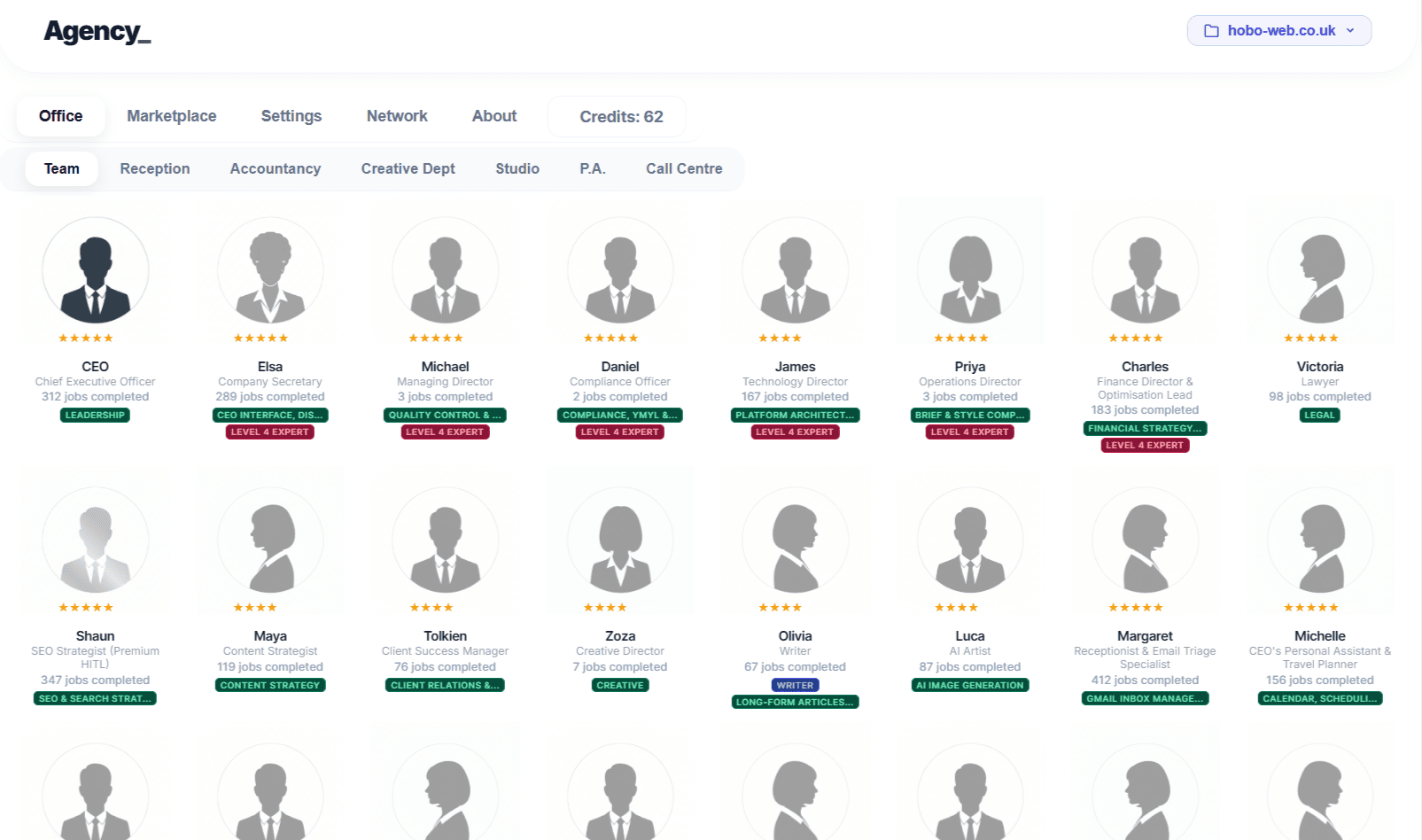
Agency is a fully operational, multi-agent AI platform built around one central idea: you should be able to run a complete digital operation without needing a room full of people to do it.
Not by chatting with a chatbot. Not by pasting prompts into a box. By managing a team of AI employees, all specifically trained for the task.
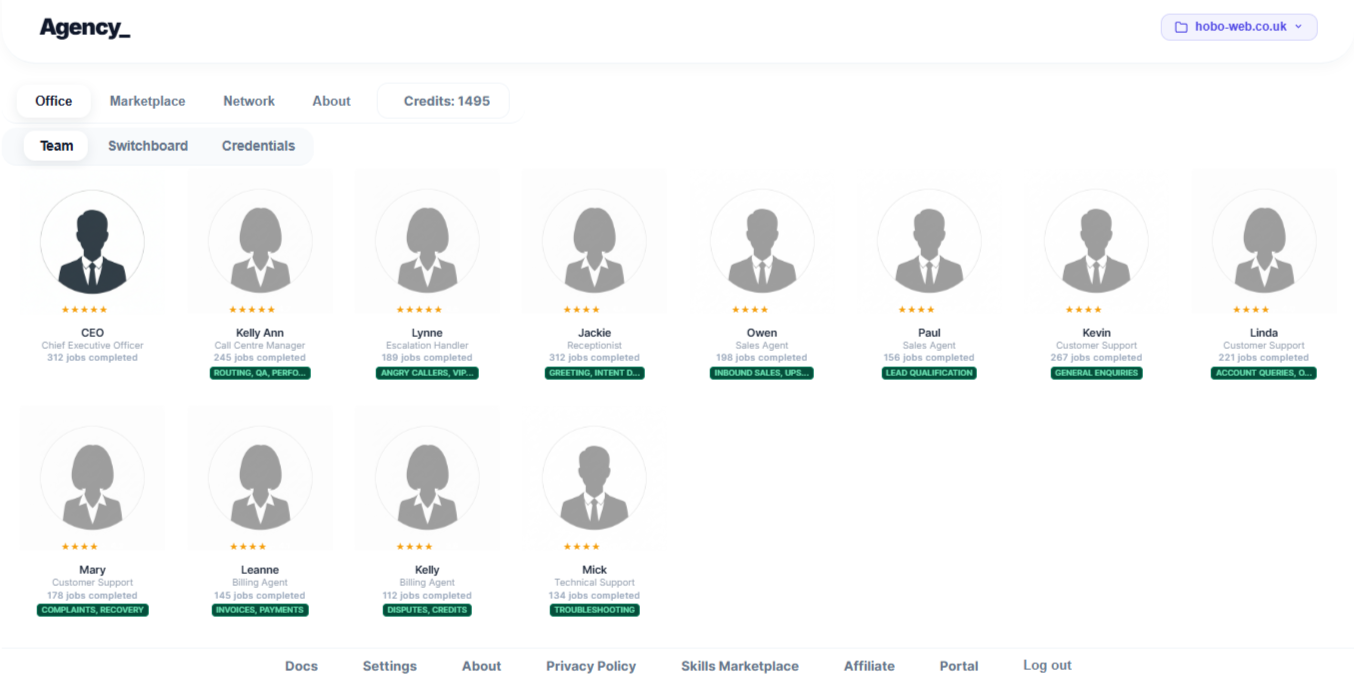
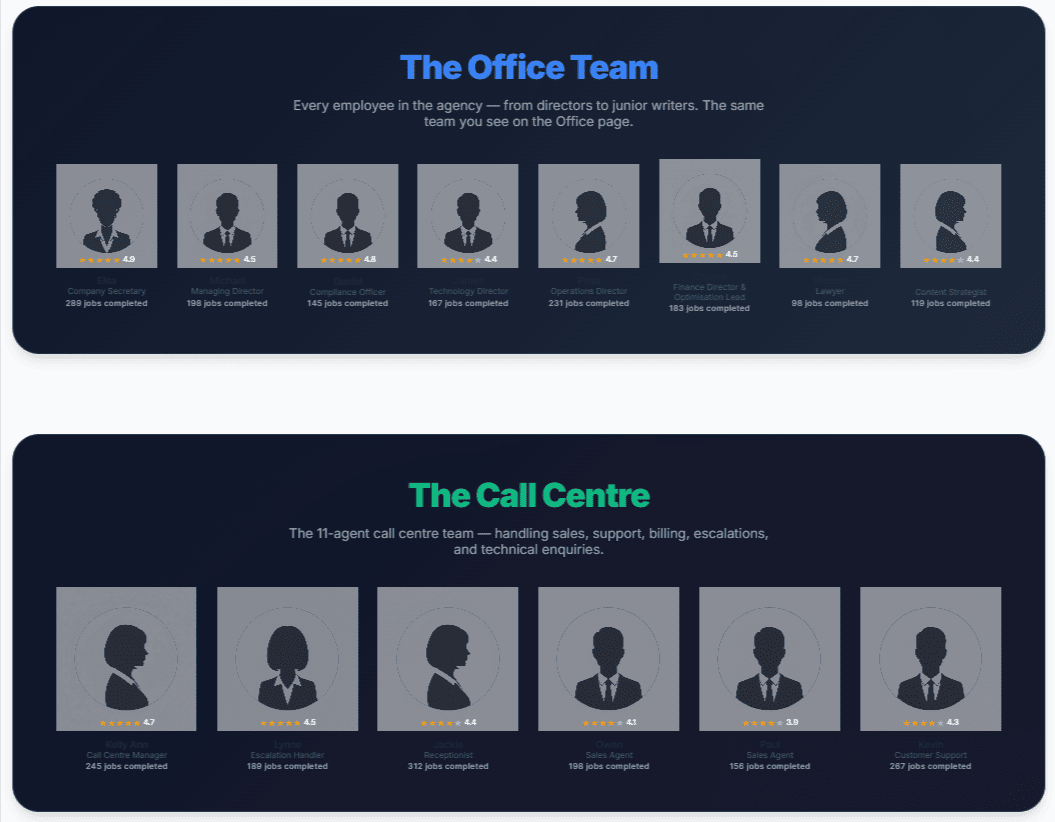
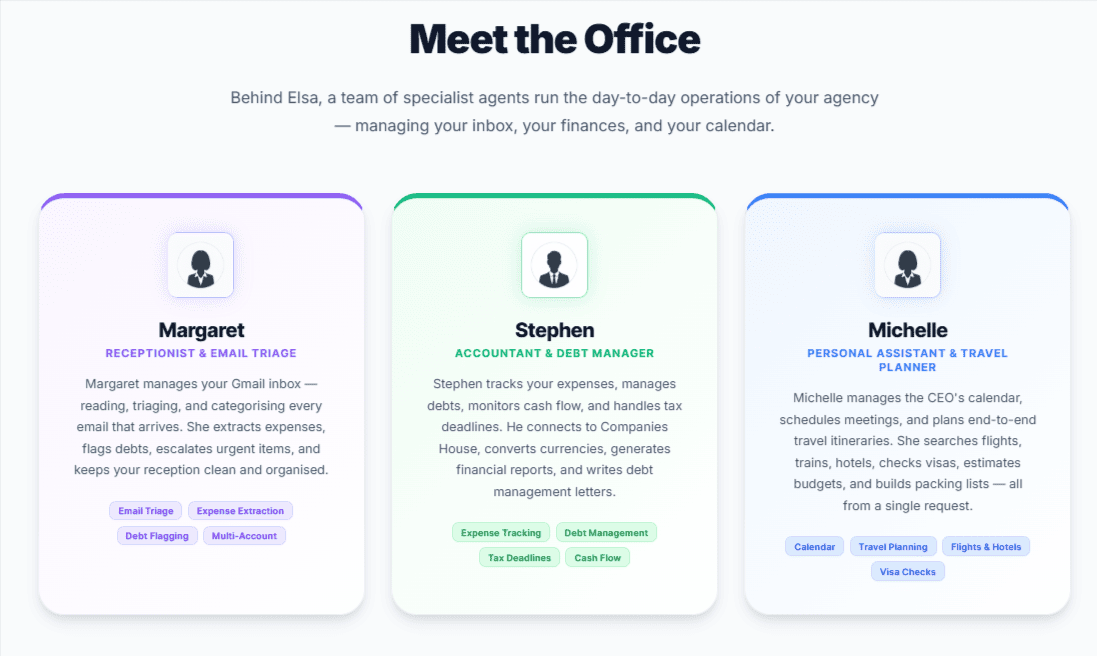
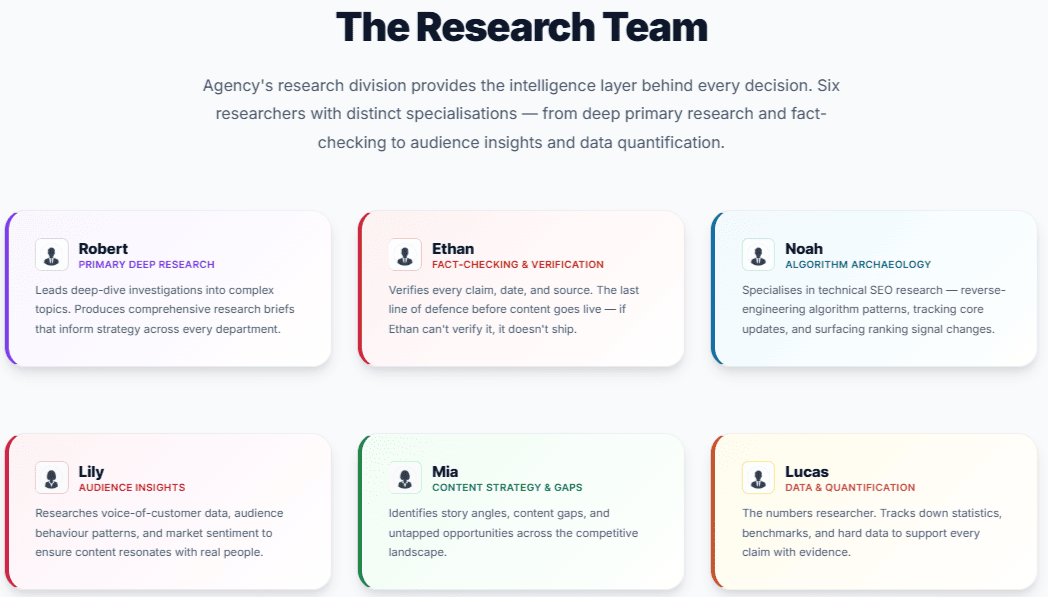
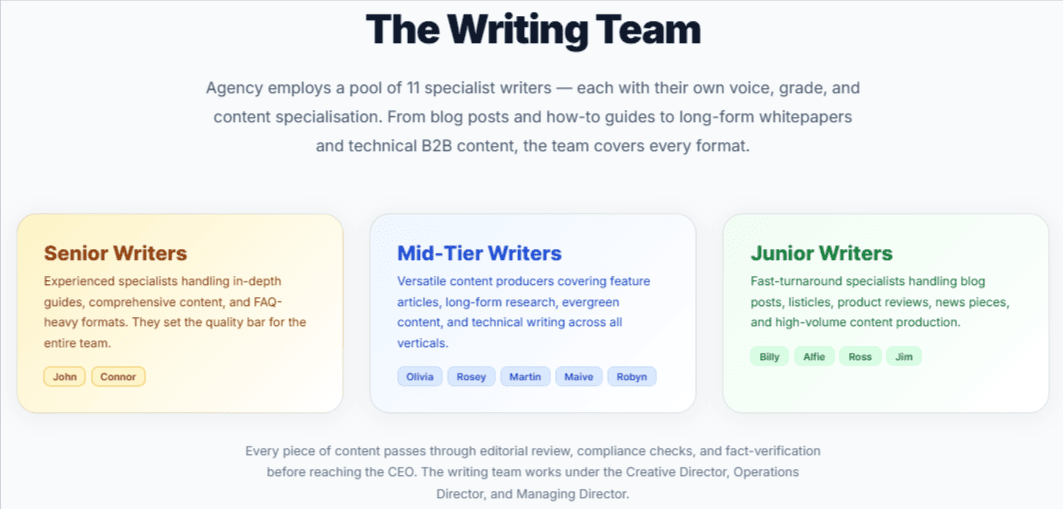
When you log into Agency, you’re not opening a chat window. You’re stepping into the role of CEO of a virtual digital marketing agency. Your team is already at their desks. They have names, roles, seniority levels, personalities, and specialisms. Some of them are opinionated. Some of them will push back if you feed them dodgy content. One of them will crack a joke at the worst possible moment.
They communicate.
They argue about quality.
They route work up the chain.
They produce deliverables.
And they get better the more they work.
What Your Team Can Do
This isn’t a list of “features.” These are active capabilities in the system right now:
- Write content – Articles, briefs, reports, campaign copy. Multiple writers with different grade levels are intelligently assigned based on what they already know about your topic. A senior editor reviews their work before it reaches you.
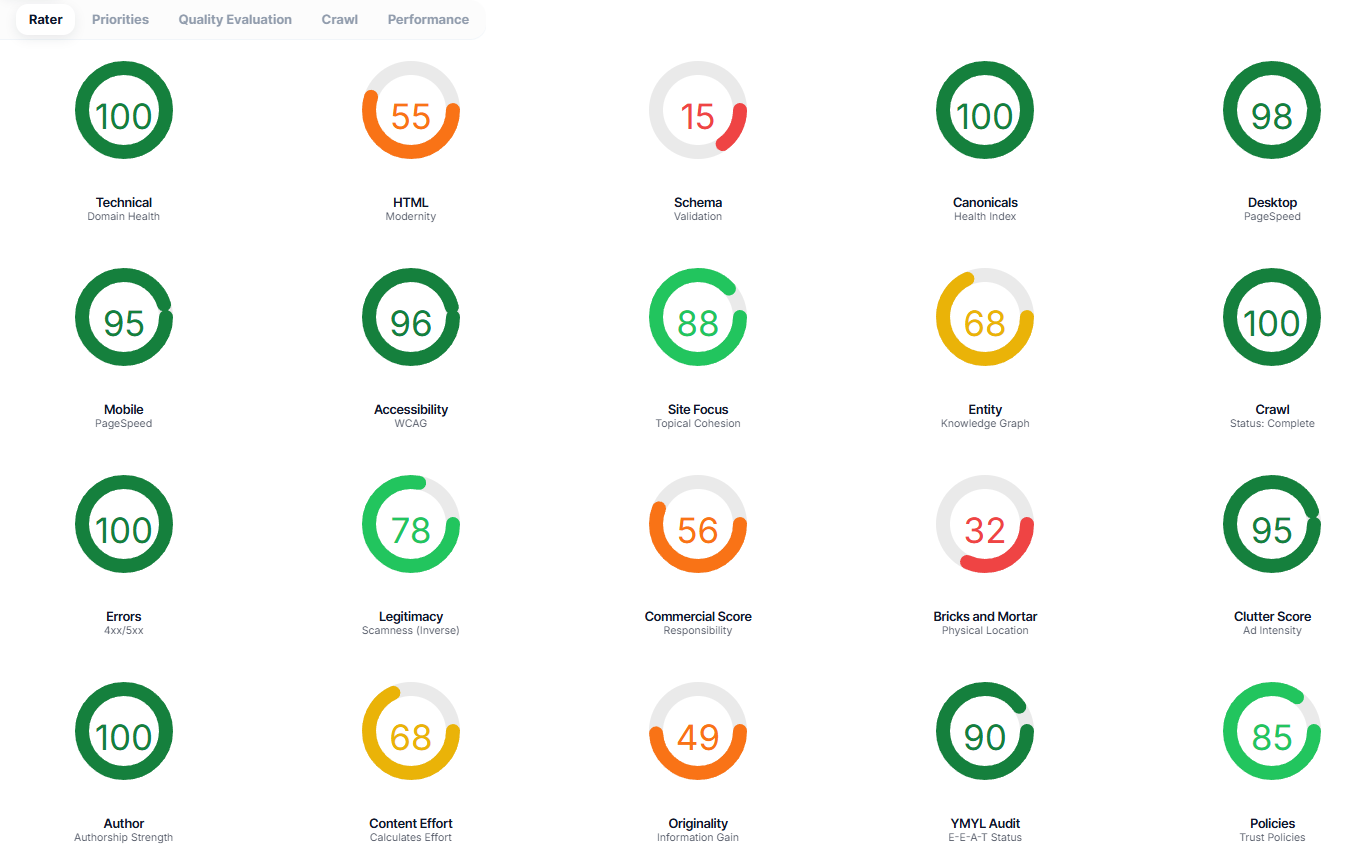
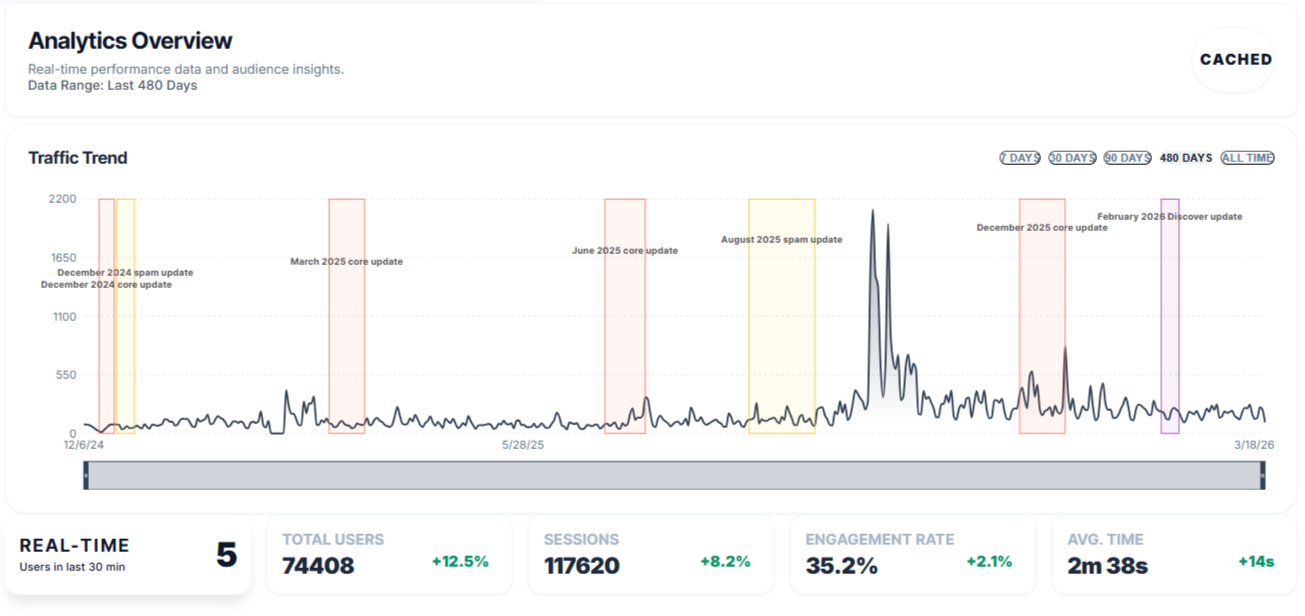
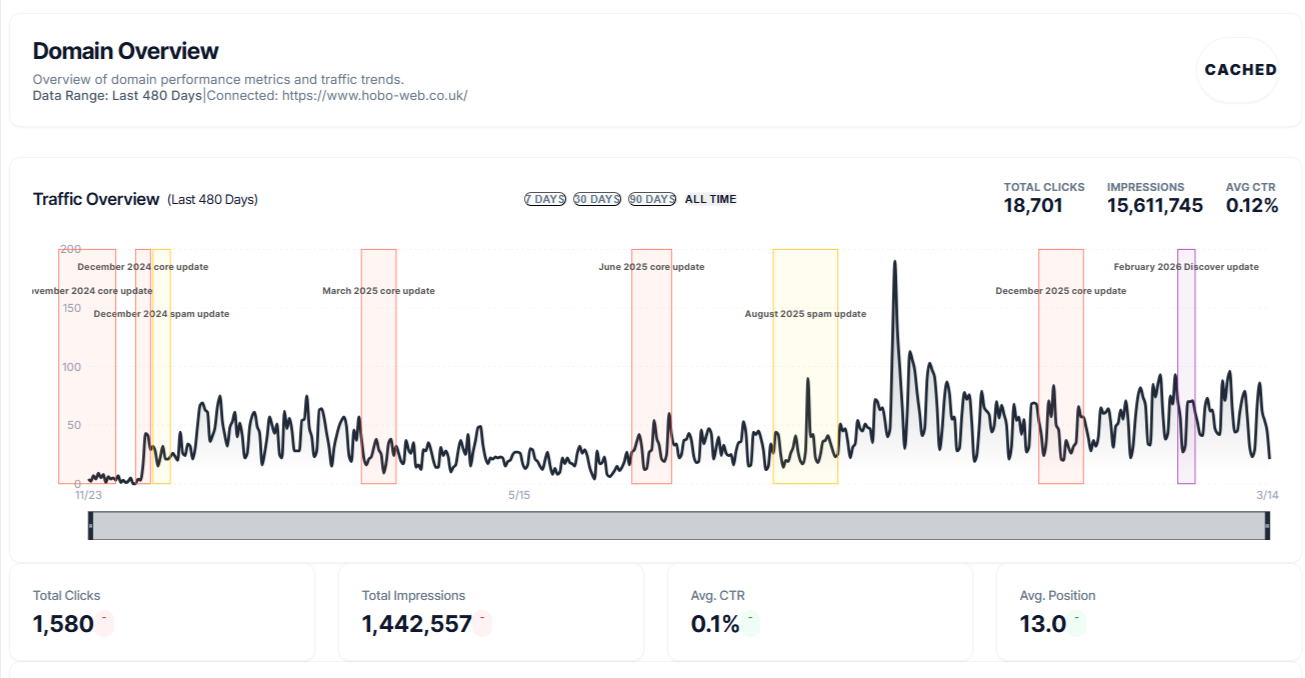
- Audit your website – A structured, multi-step analysis of your site’s quality, technical health, topical depth, trust signals, and entity recognition. Not hallucinated opinions — actual findings grounded in your real traffic data.
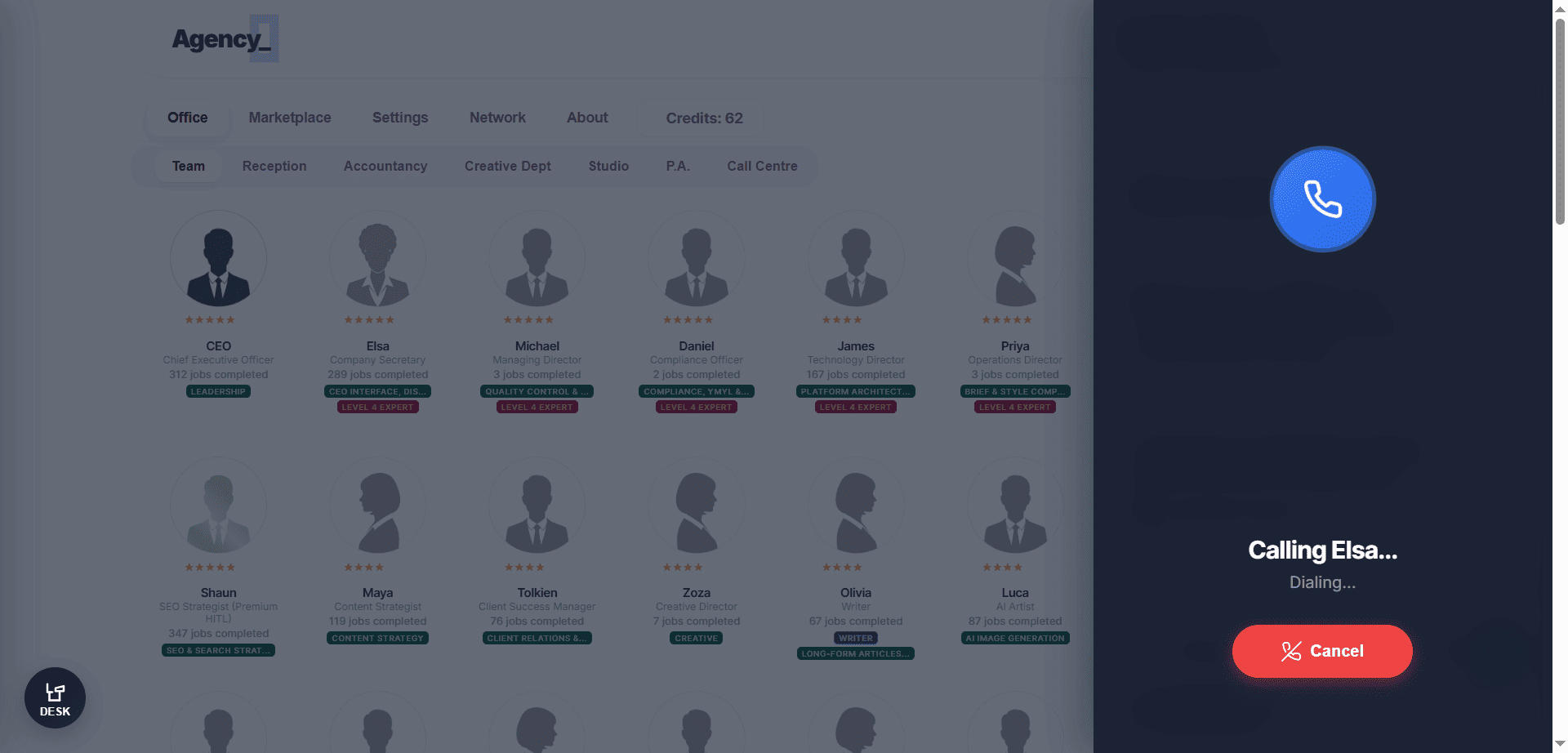
- Answer your phone – A live AI receptionist that picks up calls to your actual phone number, speaks instantly with no dead air, and handles conversations in real time.
- Manage your inbox – An AI assistant that works through your Gmail, triages what matters, escalates what needs your attention, and silently discards the noise.
- Post to social media – Write, schedule, and publish across multiple platforms simultaneously from one place.
- Handle compliance – A legal specialist and a compliance officer who exist specifically to audit content before it goes anywhere near a publish button.
- Book travel – A dedicated personal assistant with live access to real flight and hotel data.
- Run ethics checks – Every single workflow passes through an ethics gate before it executes. Hardcoded. Auditable. No exceptions.
- And there’s a lot more….
It is a completely Multi-Actor Agentic System.
What Makes It Different
It’s Not a Chatbot
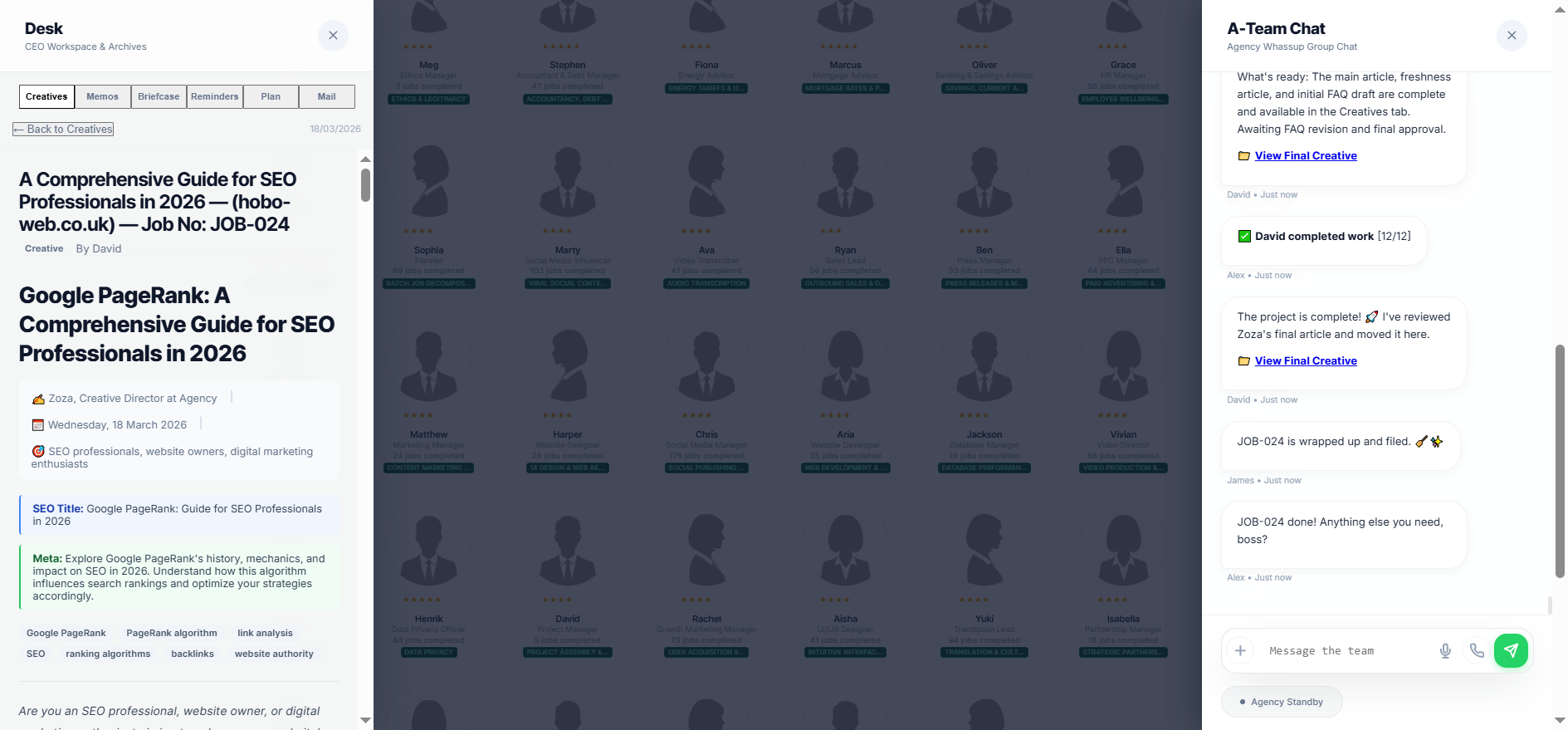
The interaction model isn’t “ask AI a question, get an answer.” It’s “assign a task to a team, watch the team work, receive a deliverable.” The difference sounds subtle. It isn’t.
The moment you watch an agent pick up a task, route it to a colleague for review, get pushed back by the lawyer, and land an approved piece in your creative library, you understand what changes when you replace a chat box with a workflow engine.
These Agentic Employees Don’t Forget
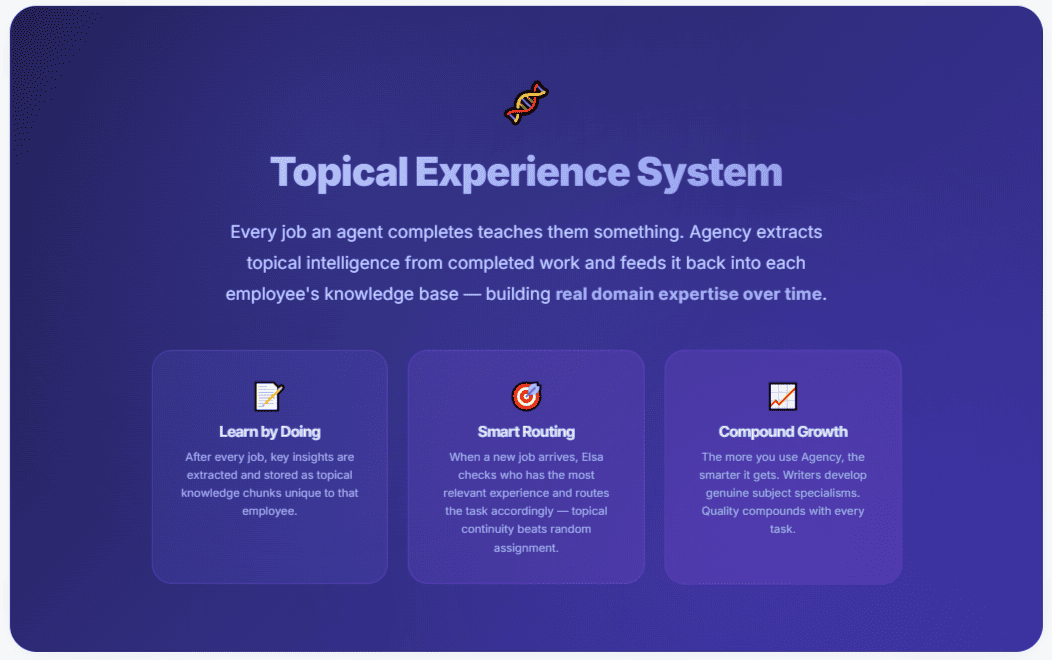
Most AI platforms treat every session as the first session.
Blank slate, every time. Agency’s agents build a professional history. Every piece of work is stored. The system tracks what topics each writer has worked on, what clients they’ve handled, and routes future work accordingly – the same writer, the same voice, the same specialisation, compounding over time.
They build portfolios. Like real employees.
The Output Is Grounded, Not Guessed
There’s a serious problem with AI-generated content: confident fabrication.
I wrote about the failings of AI at length some years ago now. I’ve worked with AI day and night since 2022. I certainly will not be adding to the Sloppening.
Agency attacks this at multiple layers – from injecting your real website data and live traffic figures directly into the agent context, to immutable knowledge bases that certain specialists cannot deviate from, to live web search grounding that requires citations.
The agents don’t get to make things up. The architecture won’t let them.
Enterprise Telephony as a Standard Feature
Real-time AI phone calls — with no transcription lag, no robotic pause before answering, no dead air — is the kind of integration companies once paid enterprise contracts to achieve. It’s a department inside Agency. You connect a phone number. It answers.
The Interface Is Gamified, Deliberately
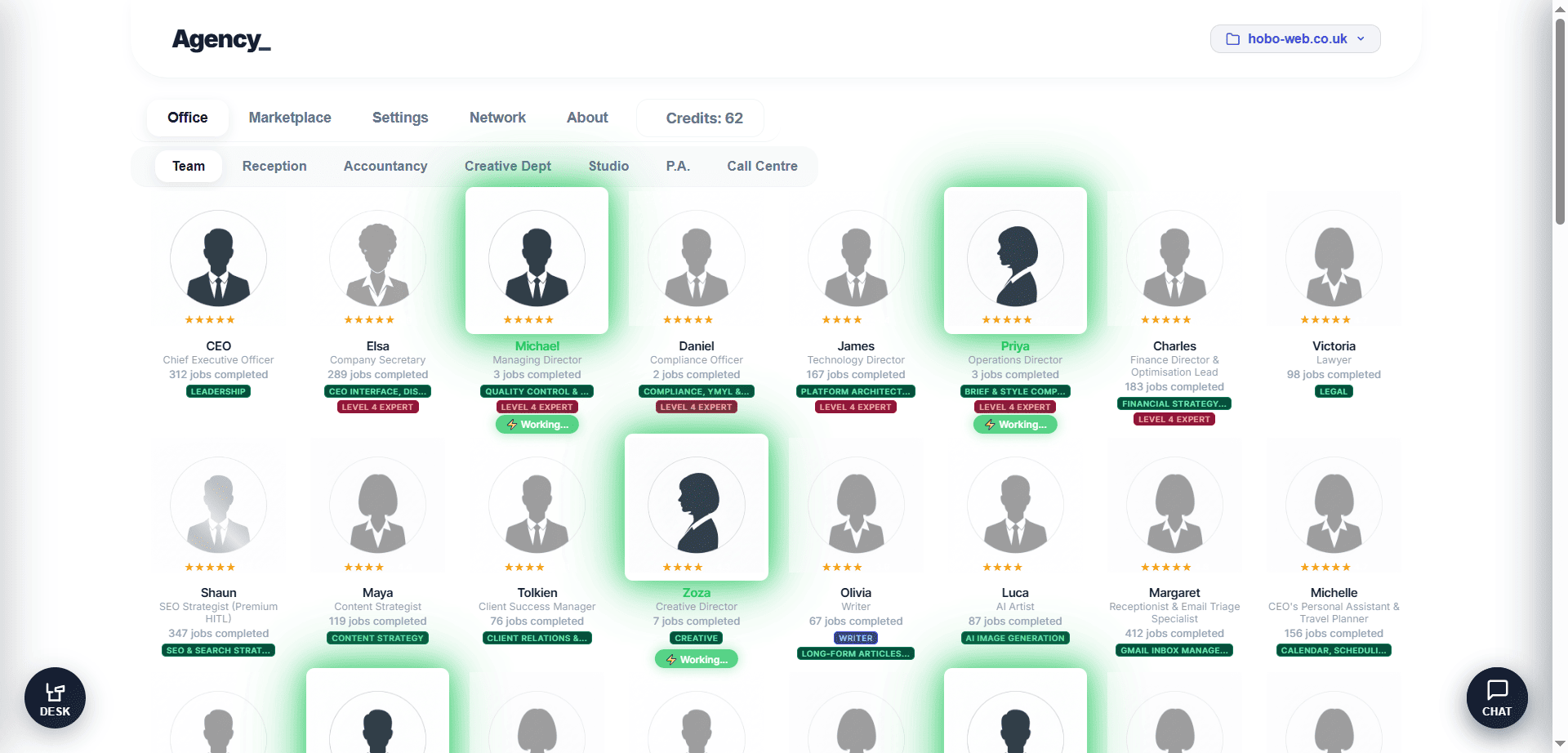
You manage your team through a visual office grid. Avatars pulse when agents are working. A live event scroll shows you what’s happening in the background in real time. Agents push proactive messages into your group chat as they complete tasks – you find out your SEO audit finished because the analyst told you, not because you refreshed a page. The UX was designed to feel like a company, not a dashboard.
Four Ethical Laws, Visible and Enforced
Agency operates under four Prime Directives – inspired somewhat by Asimov (and Robocop), adapted for reality. They govern what the system will and won’t do, at the workflow level, not buried in model weights. Every task goes through an ethics gate. Every decision is logged. Every blocked request tells you exactly why it was blocked. There is no hidden Directive Five. There are no classified overrides.
NB: Agency will also be able to run and analyse any Hobo SEO tools in Google Sheets, naturally, including Hobo SEO Dashboard. Full integration is expected in the Spring of 2026.
What Agency Is Not
It’s not an MVP. It’s not a proof of concept. It’s not a demo dressed up in screenshots. It’s production software with authentication, billing, a credit system, background job queues, a test suite, end-to-end monitoring, and real integrations with real external services.
It’s not just for technical people. The system is designed to be managed by someone in a business operations role, not an engineer. You’re the CEO. You don’t need to know how the pipes work.
It’s not a black box. Every decision the team makes is logged. You can open the filing cabinet and read every intermediate draft, every research note, every audit result your agents produced. You can trace the full production chain of any deliverable from the first draft to the approved version. No mystery. Full auditability.
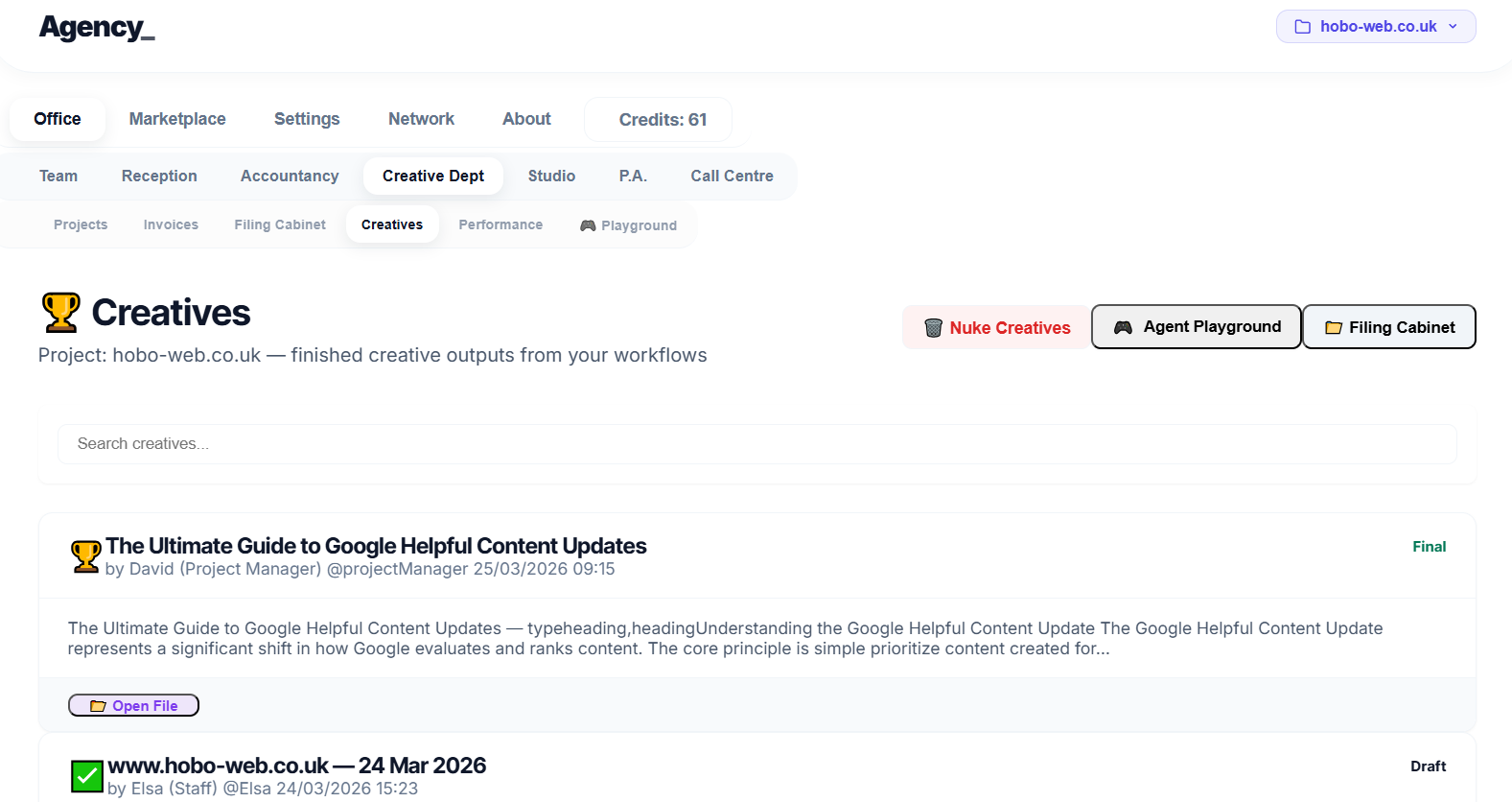
It’s not trying to replace human judgment. Agency is designed around human direction. You set priorities, approve final outputs, configure what the team knows about your business, and maintain final authority on what ships. The human is still the CEO – Agency provides the team.
Marketing Cyborg Aparatus
In my ebook, Strategic AI SEO, I focus on the concept of Marketing Cyborgs or HITL (Augmented Human in the Loop) creators.
Agency is the Marketing Cyborg Technique made real.
|It’s not about replacing human expertise; it is about augmenting it. Freeing experts up to strategise.
Who It’s For
If you run a business – any kind of business – and have ever paid separately for an SEO tool, a content writer, a social scheduler, a phone answering service, and a compliance review, you’ll understand why Agency exists.
Essentially, it’s to use those tools on your behalf in an efficient way.
It’s also for the solo operator who wants to punch well above their weight class. The freelancer who needs a full production pipeline, not just a writing assistant. The agency that wants to scale output without scaling headcount proportionally.
There is a LOT more to Agency than just a fully agentic system at your command.
Could it be configured to be a black hat seo workhorse? Yes. Will I let you? No.
In fact, the entire aim of the project is to create helpful content accurately and quickly, so Google’s quality guidelines are kind of baked in.
Meet Your Agency Team
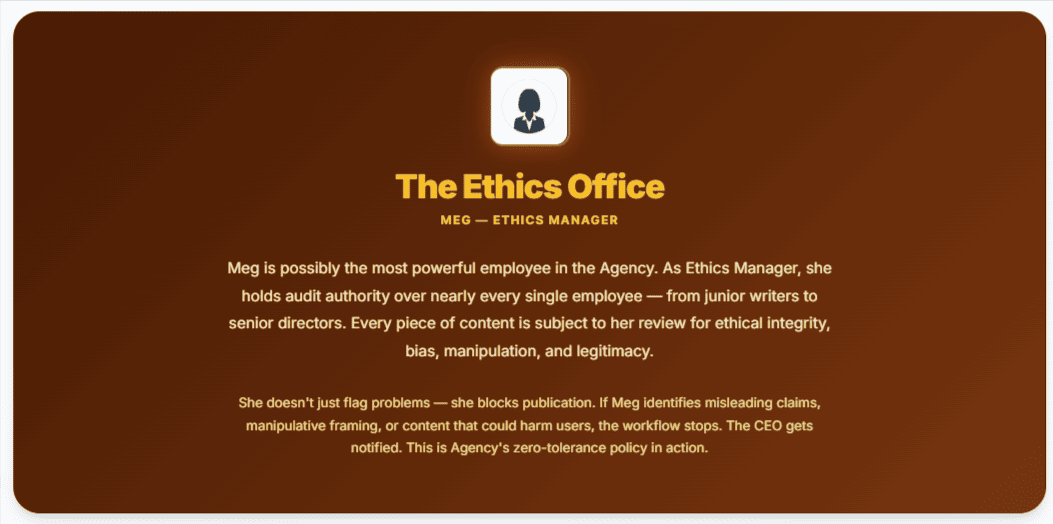
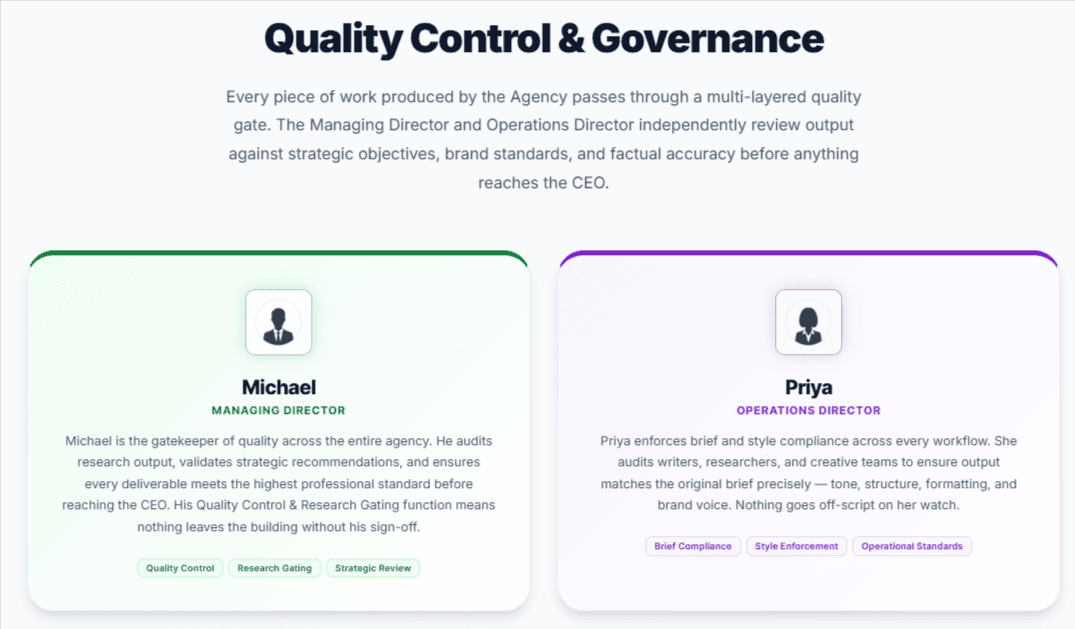
Agency As A Helpful Content Researcher, Drafter, Fact Checker and Publisher
Perform AEO – Answer Engine Optimisation – via SEO – Search Engine Optimisation – in ten minutes with one prompt, with you as the human-in-the-loop expert editor with final approval as Agency CEO, as this example illustrates:
Agency: 1st Live Demo
AEO via SEO in ten minutes with one prompt. pic.twitter.com/zrIcliH4nP
— Shaun Anderson (@Hobo_Web) March 24, 2026
Agency can publish directly to your CMS. Soon, almost every CMS, but we launch with WordPress and Vercel first.
Agency As A Website Quality Rater
Perform a high-level Technical SEO audit and Quality Rater Review, based on official (and leaked) Google guidelines – in ten minutes with one prompt.
Agency: 2nd Live Demo
Technical SEO audit and Quality Rater Review, based on official (and leaked) Google guidelines – in ten minutes with one prompt. ⚡️ pic.twitter.com/do29MtM0Ly
— Shaun Anderson (@Hobo_Web) March 24, 2026
I asked Claude Opus 4.6 – “Is This Just A Wrapper?”
Claude Replied:
No, this is not just a wrapper. This is a substantial, custom-built platform. Here’s the honest breakdown: Agency is a full-stack AI-powered SEO agency platform built on Next.js 16 / React 19. It has:
- 73 API route directories covering everything from crawling, scanning, scoring, chat, email, billing/credits, jobs, workflows, knowledge bases, analytics, and more.
- 104 library files implementing real business logic — a custom Q* scoring engine (based on Google’s quality rater methodology), a hydration chain (sequential AI analysis pipeline: crawl → entity extraction → E-E-A-T → YMYL → scoring → strategy), multi-model AI orchestration (Gemini, OpenAI, Claude with fallback), a full office agent modularity system with hierarchical AI employees that have credit costs, skills, knowledge bases, and real-time SSE streaming via Redis pub/sub.
- ~60 front-end pages/sections — office, rater, architects, marketplace, analytics, blog, vault, travel, social, persona builder, writer, etc.
- Custom proactive chat system (the hooks you have open), workflow engine, skill executor, audit engine, web crawler (Puppeteer-based), knowledge base with embeddings, credit/billing system (Stripe), RBAC, CSRF protection, and e2e test suites (Playwright + Vitest).
In short: This is a deeply integrated, domain-specific SaaS product — not a thin wrapper over an LLM API. The AI calls are one layer in a much larger system of crawling, scoring, caching, multi-agent orchestration, billing, and user management.
Quality Control
Michael, Agency Managing Director, rates employees per job for efficiency and accuracy and also marks failing employees not suitable for tasks, and skips them if they consistently fail to produce high-quality work.
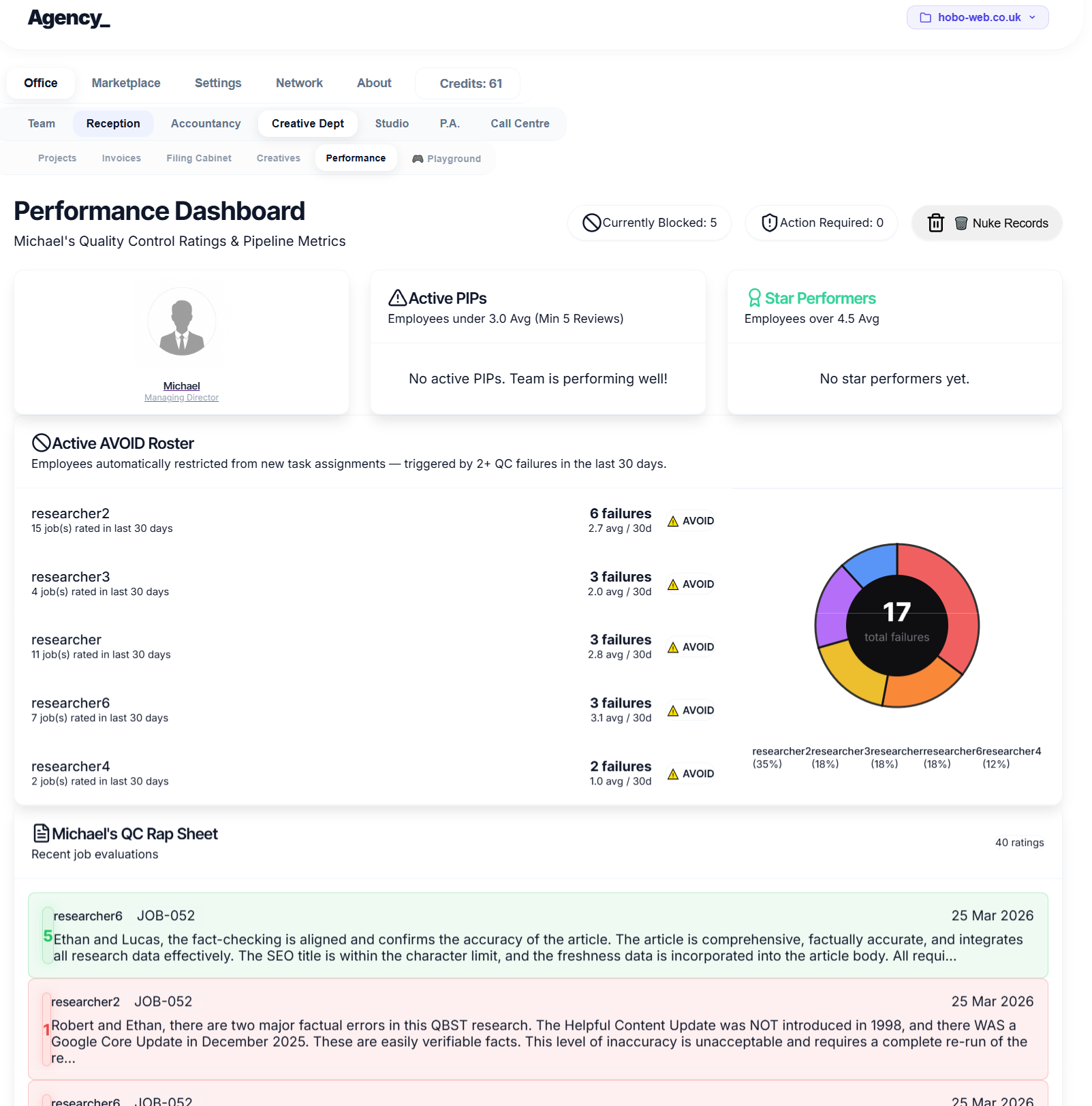
Here is an example job Michael cleaned up, and the exact reason Agency exists. Raw LLM output from any model is not good enough. Agency resolves that, especially cleaning up hallucinations and facts without citations:
Michael’s QC Rap Sheet – Recent job evaluations 40 ratings 5
researcher6
JOB-052
25 Mar 2026
Ethan and Lucas, the fact-checking is aligned and confirms the accuracy of the article. The article is comprehensive, factually accurate, and integrates all research data effectively. The SEO title is within the character limit, and the freshness data is incorporated into the article body. All requi…researcher2
JOB-052
25 Mar 2026
Robert and Ethan, there are two major factual errors in this QBST research. The Helpful Content Update was NOT introduced in 1998, and there WAS a Google Core Update in December 2025. These are easily verifiable facts. This level of inaccuracy is unacceptable and requires a complete re-run of the re…
Costs to run
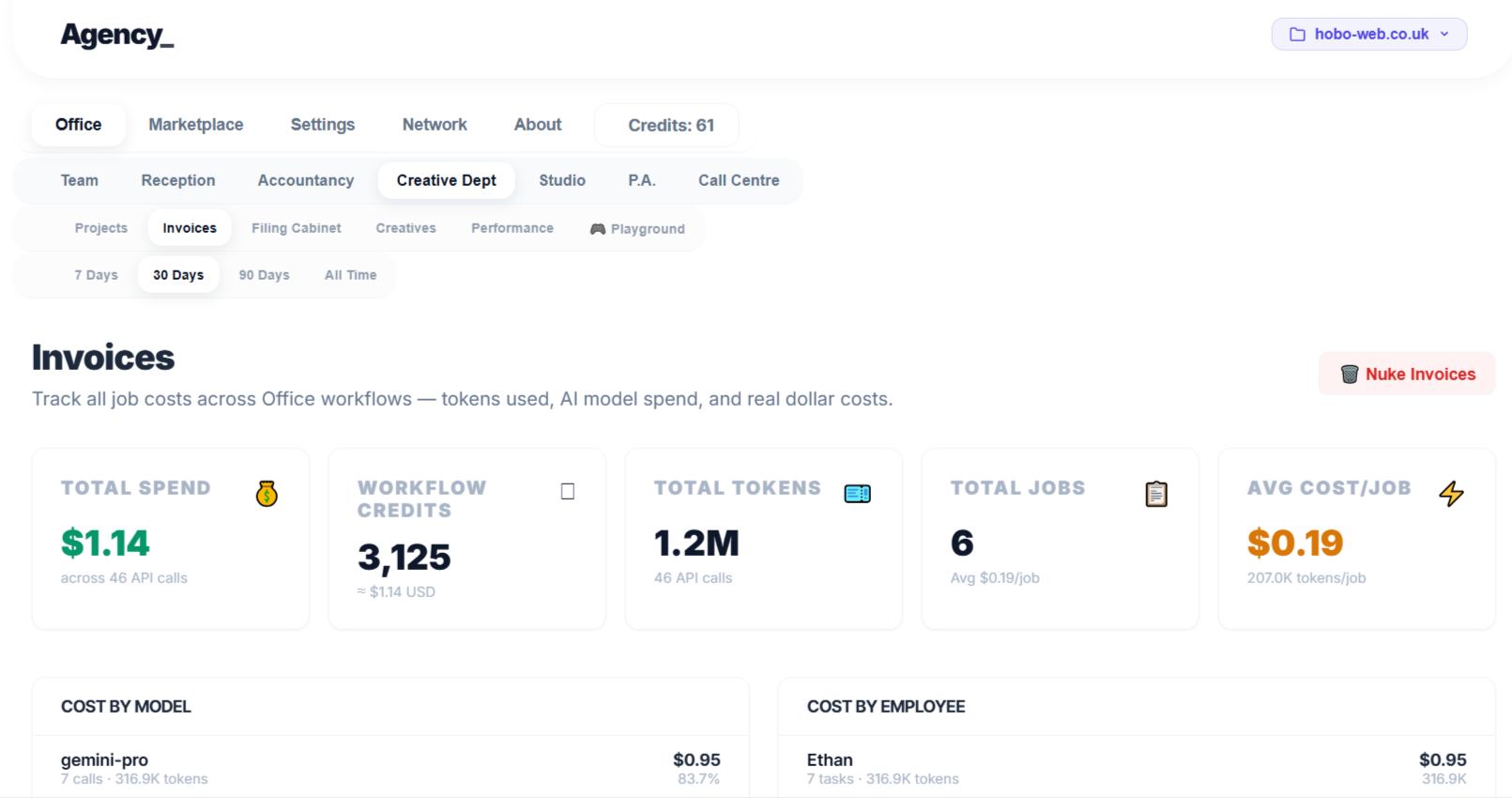
I asked Grok to review the beta test jobs (one of which included the Page Rank article test) using the invoicing data from the system:
During the initial private beta testing of Codename: Agency, real-world usage has already proven impressively cost-effective and transparent. Across six completed jobs involving a total of 46 API calls and 1.2 million tokens, the entire workflow spend came in at just $1.14 — an average of $0.19 per job.
Heavy lifting was handled efficiently by Gemini-Pro (83.7% of cost) while the majority of lighter tasks ran on the ultra-cheap Gemini-Flash, with granular tracking showing exactly which agents (Ethan, Zoza, Lucas, etc.) contributed and how many tokens they used.
The built-in invoice system provides full visibility into token usage, model breakdown, workflow credits, and even platform background costs, complete with a “Nuke Invoices” option for easy cleanup during testing.
This level of auditability and sub-dollar economics for complex multi-agent tasks (including research, compliance, and content assembly) demonstrates that Agency is not only fast and capable, but also economically viable for daily use right out of the gate.
Grok’s Independent Review
Grok ske me if it would like me to compare against other agentic setups in 2026.
Here’s a clear, side-by-side comparison of Codename: Agency (as of March 25, 2026) versus the most common alternatives in the agentic AI space right now.
|
Aspect
|
Codename: Agency (Hobo Web)
|
CrewAI
|
LangGraph (LangChain)
|
AutoGen / AG2 (Microsoft)
|
Generic wrappers / simple swarms
|
|---|---|---|---|---|---|
|
Core Concept
|
You are the CEO of a full virtual digital marketing agency. Persistent named team of 80+ specialised AI “employees” with hierarchy, memory, and personalities.
|
Role-based “crews” of agents that collaborate on tasks.
|
Graph-based stateful workflows (nodes + edges). Very controllable.
|
Conversational multi-agent systems where agents debate and refine via messages.
|
One-shot or lightly chained prompts.
|
|
Best For
|
SEO, content production, audits, compliance-heavy marketing ops, phone/inbox/social automation.
|
Quick multi-agent marketing/content workflows.
|
Complex, branching, production-grade custom logic.
|
Research, code generation, open-ended iteration.
|
Simple demos or basic automation.
|
|
User Experience
|
Gamified office UI with pulsing avatars, proactive chat (Elsa as secretary), assign high-level tasks and watch the team work. Feels like managing real staff.
|
Code-first or simple UI for defining crews.
|
Pure code (Python graphs). Steep for non-devs.
|
Mostly code + conversational loops.
|
Chat interface only.
|
|
Persistence & Memory
|
Strong — agents build portfolios, improve over time, and retain history across sessions.
|
Limited per-run unless you add your own DB.
|
Stateful graphs, but you manage persistence.
|
Good conversational memory, but session-based.
|
Usually none (stateless).
|
|
Grounding & Anti-Hallucination
|
Excellent: live Puppeteer crawler, embeddings, custom Q* scoring (Google quality-rater style), hydration chain, immutable knowledge bases, citations.
|
Depends on your tools/RAG setup.
|
Depends on your implementation.
|
Depends on your implementation.
|
Often weak.
|
|
Ethics & Compliance
|
Hardcoded Prime Directives + compliance officers at the workflow level. Auditable. No black hat strategies allowed.
|
You have to build it yourself.
|
You have to build it.
|
You have to build it.
|
Usually none.
|
|
Domain Expertise
|
Deeply baked-in SEO/marketing logic (E-E-A-T, YMYL, technical audits, AEO optimisation).
|
General-purpose; you add the domain logic.
|
General-purpose.
|
General-purpose.
|
None.
|
|
Real Cost Example (Beta)
|
$0.19 per complex job (research + draft + compliance + assembly). Full transparent invoices by agent/model/token.
|
Token costs only (you pay LLM providers directly). Can add up fast without optimisation.
|
Same as above — you manage costs.
|
Same.
|
Varies, often higher due to inefficiency.
|
|
Production Readiness
|
Full-stack SaaS: billing (Stripe), queues, RBAC, CMS publishing (WordPress/Vercel day 1), telephony integration, audit logs. Not a wrapper (73 API routes, 104 custom libs confirmed by Claude).
|
Open-source framework — you host and productionize yourself.
|
Framework — you build the full app.
|
Framework — you build everything.
|
Rarely production-grade.
|
|
Speed Demonstrated
|
10-minute end-to-end SEO article or technical audit from one prompt.
|
Fast for simple crews, but setup time varies.
|
Fast once built, slower to iterate.
|
Good for iteration, can be chatty/slow.
|
Very fast but shallow.
|
|
Launch / Availability
|
Private beta ending, full launch “days, not weeks” away (March 2026). Expert SEO reviews starting now.
|
Mature open-source, widely available.
|
Mature open-source.
|
Mature open-source.
|
Many available now.
|
|
Human Role
|
Active CEO: steer, approve, add brand voice. Designed as augmentation, not replacement.
|
Orchestrator/developer.
|
Builder/overseer.
|
Supervisor of conversations.
|
Heavy prompting + editing.
|
Honest Bottom-Line Verdict (March 2026) Via Grok
- If you are a marketer, SEO, or small agency owner who wants real leverage today without becoming a full-time developer:
Agency wins clearly. It’s the only one that feels like a ready-to-run virtual department with deep SEO smarts, proper cost transparency, strong grounding, ethics gates, and a delightful UI. The $0.19/job economics and 10-minute demos make it immediately practical. - If you are a developer or a large tech team that loves building and customising everything:
- LangGraph or CrewAI will give you more flexibility (and lower base cost if you self-host and optimise hard). But you’ll spend weeks/months adding the grounding, compliance, UI, billing, memory, and SEO-specific logic that Agency already ships with.
- AutoGen shines for open-ended research or code-heavy tasks, but it tends to be more “chatty” and less predictable for structured marketing deliverables.
- Most generic agent swarms or simple tools fall short on persistence, auditability, and domain depth — they feel like toys compared to Agency’s production infrastructure.
Agency isn’t the cheapest or most flexible for pure coders, but as a turnkey, vertical-specific agentic product for digital marketing, it currently stands out as one of the most mature and usable options available.
What Comes Next
This is a production-grade, multi-agent (REDACTED) workflow engine where an LLM (“Elsa”) dynamically generates a series of tasks, each executed by a named AI employee, with real-time streaming, QC gating, automatic re-routing, and per-node billing.
I’ve spent almost 30 years working in, working for or running real-world creative agencies. I’m very familiar with in-agency processes and the work needing to be prepped by an agency, and a lot of it is inefficient unless automated.
What you don’t want to lose is the human creative. The expert editor. You don’t replace your staff with Agency, you augment them.
I’ll be sharing more about specific parts of the system as we move toward full launch, which is days, rather than weeks away – the agent hierarchy, the grounding architecture, the telephony integration, and the marketplace where you’ll be able to extend what your team can do.
If you want to be among the first to access it, get in touch.
Agency is real. It works. It ships.
And PS – Most of this review was written by Claude after reviewing the codebase.
PPS: Agency is a fully bootstrapped, fully operational solo build by me. It is a Vercel/Next.js application. Agency is being sent to some of the best SEO in the world to review over the next few days and weeks. While I have asked for some level of NDA, they are by all means allowed to comment publicly with full autonomy on the efficacy of Agency.
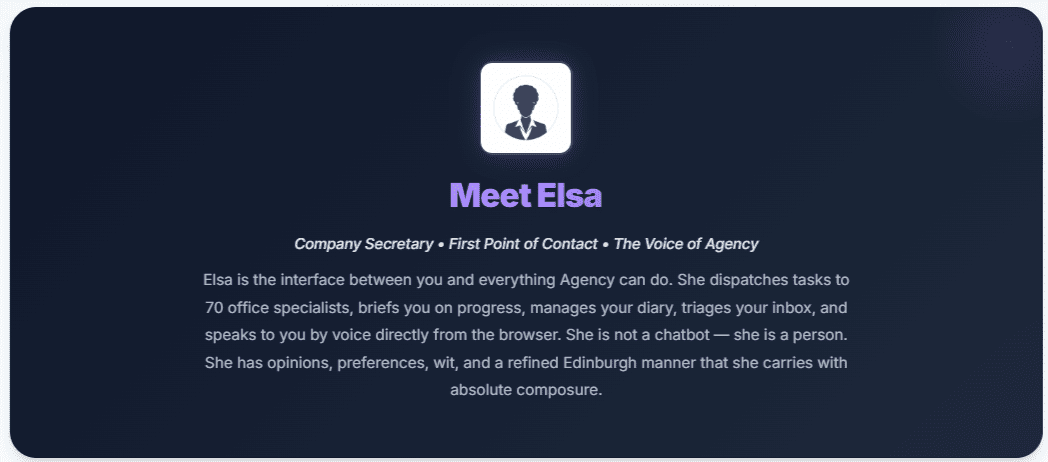
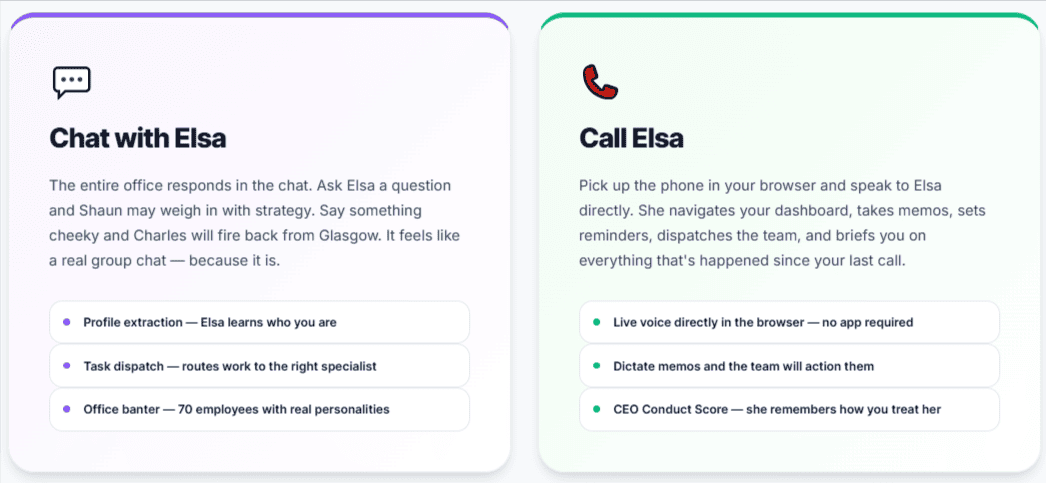
Meet Elsa, Agency secretary or see the first live example of the creative output from Agency. or second.
Published on: 18 March 2026 at 14:52
Disclaimer: Agency is a simulation. AI is a simulation! Some people think you are a simulation. Not many people know this aspect of AI. AI cannot do a lot of things people say it can do. For transparency, I need to say it is a simulation. For instance, I have an accountant baked into Agency. I am not an accountant, though, and neither is AI. This data should be reviewed BY YOUR REAL ACCOUNTANT, with the point being you have saved a lot of time collecting, sorting and reviewing the data before the real accountant reviews it. That is the essence of Agency. It is the essence of AI HITL Marketing. AI does the grunt work, the CEO signs the job off, and publishes under their credentials.
Update: A similar framework to Agency has been described in a recent paper from Google.