
Published on: 7 January 2026. I was talking with Edward Sturm on the Edward Every Day YouTube show, discussing E-E-A-T. Edward is a Early viral video creator on YouTube with a monthly in-person digital marketing class with 70-100 attendees per class. The Edward Sturm Show on YouTube, also known as “The Edward Show,” is a daily digital marketing podcast hosted by Edward Sturm, focusing on SEO, content marketing, growth hacking, and founder stories, featuring tips, news, and interviews with experts to help businesses and creators grow online. Sturm, an experienced marketer and viral video creator, shares insights on SEO practices and interviews SEO “legends”. My mother will like the sound of that.
I don’t normally do YouTube shows but Edward is on a marathon sprint of posting every day, and he is almost at video 1000, so I thought I’d pitch in with some content. I think his show could be a perfect time capsule of SEO in 2026. Now I have broken my YouTube duck, for a short while in 2026, I am scheduled to appear on a few other shows talking about the Google leak, and indeed, keynote an upcoming 2026 seo conference (details soon).
This episode is a high-level, strategic overview of E-E-A-T (Experience, Expertise, Authoritativeness, and Trustworthiness). It bridges the gap between Google’s official documentation and the technical reality of how search systems work today.
E-E-A-T is Google’s doctrine codified.
E-E-A-T Clarified
In the interview, I had a go at describing how this all seems to fit in. I’ve expanded my thoughts here:
Is EEAT A Ranking Signal?
No.
Is EEAT a Ranking Factor?
No.
QUOTE: “We thought “While E-E-A-T itself isn’t a specific ranking factor” was clear enough for the people who somehow believe we have an E-E-A-T “score.” But some still have this misconception despite that we don’t have some E-E-A-T ranking score we use. Not a thing. Not a ranking factor. Raters use the *concept* to rate pages *in other ways* so we can *evaluate* how our search results perform. They don’t assign an E-E-A-T “score” to pages; their rating also aren’t used directly in rankings. Honestly, for all the worry some spend trying to figure out how to “prove” their pages have E-E-A-T, I would sincerely urge them to just ask themselves “if someone comes to my page from search, are they satisfied with what they get, from the content to the experience?” Danny Sullivan, Google 2024
What is EEAT?
It represents, Google says “a mix of factors that can help determine which content demonstrates aspects of experience, expertise, authoritativeness, and trustworthiness, or what we call E-E-A-T”.
Is EEAT mentioned in the Google Content Warehouse Data Leak?
No.
What is EEAT for?
Google says “After identifying relevant content, our systems aim to prioritize those that seem most helpful.”
Is EEAT needed for all websites?
No. But most websites operating in any commercial capacity will benefity from Trust.
Is EEAT needed for every topic?
No.
Which Topics need EEAT?
YMYL topics – Your money or your life. See Contextual SEO.
QUOTE: “EEAT is one of the ways that we look at page quality. EEAT is experience, expertise, authoritativeness and trustworthiness. And this is something that we tell the third party quality raters to watch out for when they’re doing page quality evaluation and something that we take into account when we think the query or a set of pages is on a specific topic where it’s more critical, where we call them your money, your life pages. Where we think that the user actually needs to have something that they can rely on and some signs that they can rely on the content that is present.” John Mueller, 2025
What are YMYL topics?
Google clearly states:
“If you are having trouble deciding whether a topic is YMYL, consider the following questions:
- Would a careful person seek out experts or highly trusted sources to prevent harm? Could even minor inaccuracies cause harm? If yes, then the topic is likely YMYL.
- Is the specific topic one that most people would be content with only casually consulting their friends about? If yes, the topic is likely not YMYL.”
The higher the stakes for users, the higher the EEAT required.
Can you add E-E-A-T to a page?
QUOTE: “Sometimes SEOs come to us or like mention that they’ve added EEAT to their web pages. That’s not how it works. Sorry, you can’t sprinkle some experiences on your web pages. It’s like, that’s that doesn’t make any sense.” John Mueller, 2025
No. Technically speaking you cannot add a “doctrine” or abstraction of an entre system to a page. It “doesn’t make any sense”. So you cannot add E-E-A-T or its “factors” to a page in this sense. In fact E-E-A-T is entirely contextual in itself in terms of when even aspects of the abstract can be useful for debugging a traffic drop. Theoretically speaking your EEAT is positive, neutral, or spam. Its the third that hurts, we can infer. At an abstract level what you write is what the content is. This would generally need to meet pass the T* Topicality system to feature. What the “website explains itself” as, if it is adeqate for its context and purpose, is part of its PQ rating, especially when no external reputation on the site can be found. So its not E-E-A-T we are adding to the page.
Can you add E-E-A-T to a website?
Again, no. Technically speaking you cannot add a “doctrine” to a site. Especially not one so weighted against offsite and third party evaluations of your site reputation. The most valuable weighting is probably a third party unsolicited recommendation from a highly respected source, and the truest form of that is the humble html backlink. These are incredibly hard to come by, and act as moats for your Authority. Mentions in this day and age is almost at the moment just as valuable (with AI overviews and chatbots) but the authoritiveness of the source will always win out as especially Google refines out these systems. The website must “explain itself” though, so it is adeqate for its context and purpose, as part of its PQ rating, especially when external reputation is weak.
Can you add EEAT to content?
No. Google inherently distrusts user input including claims you make on your site. At this level of abstraction, I’ve long said what you say you are is no better than grafitti to Google. Content on its own is unhelpful – often worthless – to be distrusted and checked for papers like a WW2 escapee in the Alps in 1943. Google is a links based system that at most levels barley needs content at all except minimally to pass the T (Topicality) system to actually provide something tangible to a user. The content you create and the topic you cover dictates if the E-E-A-T doctrine affects you.
You can add content to a site, but you cannot add E-E-A-T (which is a doctrine) to content. Content itself demonstrates relevance and experience for the topic. Once its indexed, who links to it is the primary driver outwith what users do with it.
Does making claims in content improve E-E-A-T?
No. And when unsubstantiated or misleading claims can see a site marked low quality, it’s dangerous and self-defeating.
Does making claims in content improve visibility in AI?
Yes.
Where this gets interesting in the area of E-E-A-T is that what you claim you are, if cited by authoritative sources IS what you are – it is the foundation of your external online reputation – until correction, and you are now doing marketing, especially in the time of AI Overviews.
In an X thread, I posted, “If you repeat a lie often enough, it becomes AI Overviews,” to highlight what is actually happening system-wide at the moment.
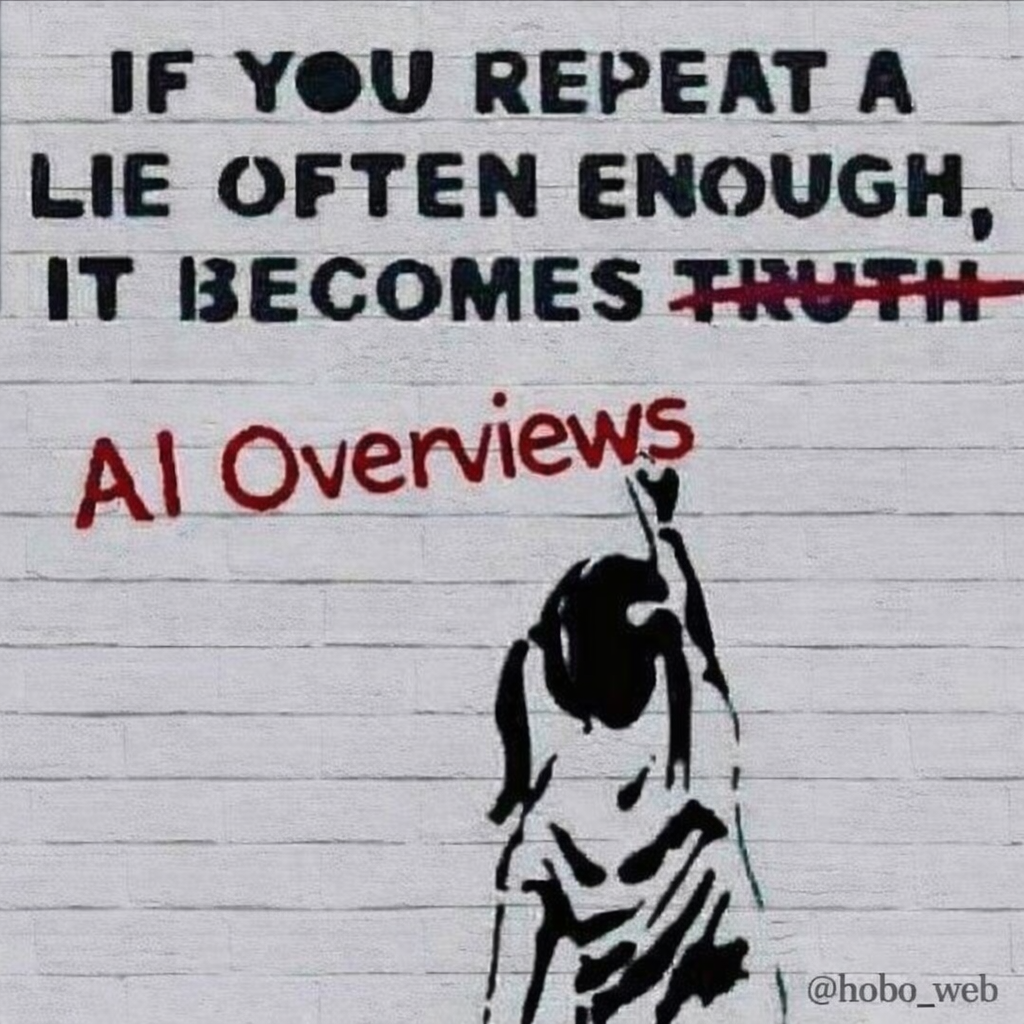
It’s a bit of fun, but technically speaking, it is true. This simple fact is at the root of my “fortress of facts” brand strategy. Use facts, instead of lies, in content marketing strategy, as such content will weather better than junk marketing over the next few years.
It’s similar but different in traditional search. Example:
People are lazy. Example. In 2018, I appeared on a post about the top SEO blogs on a very authoritative site. The author of the post took how “the website explains itself” in the content and repeated it on an authoritative domain with a link. This is gold standard stuff. Then over the years, the original post, I noticed, became the source to create near copies of Best SEO blogs lists (and links) for a few years, so much so that I think they deleted the original post. That factoid I presented on site that became a mention and a link was now amplified entirely organically (as opposed to the listicle spam of today, which is working very well, too). How the website explained itself became the cornerstone of its future third-party “E-E-A-T”.
That amplification still lives in AI today (I made sure of it). Because it was a consensus I was preserving. Interestingly, as of today, the pillar consensus post on the authoritative domain is gone; what’s left is me and a ton of spammier, lower-quality websites probably repeating that factoid. It is logical to think that this abstraction is what I now claim in this area is now not much better than a factual testimonial for the time (still valuable to AI), but not as valuable, in terms of SEO, without the factoid today repeated on an authoritative domain. However, it is repeated on a lot of domains. Note that the mechanisms here are time and authority – aspects of E-E-A-T that can’t really be applied or added anywhere.
Tip: A sensible strategy I think, is to amplify third-party commentary about you. If it’s good, naturally. So that these factoids are based on some modicum of falsifiable proof of evidence.
Theoretically speaking, if you took only what you said about yourself on your site, and that was repeated on authoritative domains, especially with links, you’ve won SEO and mastered everything E-E-A-T requires, evidently.
If you are frequently mentioned alongside a keyword phrase, you are now part of that topic. So, E-E-A-T when it comes to “applying it” to content is, at its core, useless. What users do with the URL is more important – especially to Google.
Which entities are relevant to the topic is more important. E-E-A-T, when it comes to content evaluation, is the evaluation of a second-order effect of a doctrine that itself is made up of lots of competing philosophies that make up, dare I say it, the matrix.
Can you use the E-E-A-T framework to self-assess your content?
Yes. Google says so, but also remember E-E-A-T is contextual and topical. I have an entire framework draft prepared about contextual SEO.
Can you demonstrate E-E-A-T on your site?
Yes – let’s look at a hypothetical.
“While the information that websites and content creators provide about themselves isn’t always trustworthy, it can provide an important starting point.”
Trust is the most important lever in EEAT. When a page lacks external reputation signals for the site or author, how the “website explains itself” – IE, all the text on the site – everything on the site – is the entire corpus of what the PQ rating must come from. Therefore, for a brand new site, all aspects of EEAT must emerge from “how the website explains itself,” and the topics covered in how the website “explains itself” will determine the level of EEAT required to even feature in rankings. So in practice, how the “website explains itself” is one aspect of its EEAT. It’s E-E-A-T – including the most important Trust – the most important lever on site in the hands of the user in the E-E-A-T framework. It’s just not the most important aspects of EEAT – those that you aren’t really supposed to be able to modify without a lot of work – like Authority or Experience or Expertise.
What we are actually doing is demonstrating the appropriate level of trust for the context and purpose of the page and site. A failure to demonstrate E-E-A-T is a sign of a low-quality site where context matters and often a hallmark of sites that are impacted in Google algorithm updates.
The demonstration of E-E-A-T, if contextually relevant in this hypothetical, is the first building stone to build actual EEAT for this entity, if repeated.
If someone is looking for an expert, they should find markers of expertise in the information where the “website explains itself”.
Is E-E-A-T not needed for non-YMYL?
I mentioned in the video an article from Search Engine Watch. The specific claim E-E-A-T is something “not needed” if your site is non-YMYL was an over-simplification in my opinion:
“From a practical point of view, it’s important to look at this, especially if you’re publishing things on these critical topics, and to look at how you can highlight what it is that you’re already doing so that it’s clear for users. But if you’re creating a recipe for cookies, you don’t need to have the sidebar with like, ‘this author has created cookies for 27 years.’ I think most people will be able to understand.”
It is deprioritised in non-YMYL contexts.
“Many or most topics are not YMYL and do not require a high level of accuracy or trust to prevent harm. Because YMYL assessment is a spectrum, it may be helpful to think of topics as clear YMYL, definitely not YMYL or something in between. Pages on clear YMYL topics require the most scrutiny for Page Quality rating.”
Non-YMYL pages still operate within the E-E-A-T reality, so it is a vast simplification to claim E-E-A-T is not needed for non-YMYL. “Even if the topic is not YMYL, trust may still be required,” and “Trust is most important” of the EEAT “family”, – and which everything else factors into.
Signs of deceptive page purpose or potential harm, even on non-YMYL, will still negatively impact the perceived PQ (page quality) and entire site quality.
“All pages should be evaluated for harm”
When E-E-A-T hinges so intrinsically on Trust, and the content on the website – how “the website explains itself” determines its rating, to all intents and purposes, any strategic advice must be, in a professional setting, to review any website through the lens of E-E-A-T, regardless of YMYL topic categorisation, because of Trust considerations.
What does E-E-A-T have to do with the Google leak?
I was the researcher who connected the abstraction of E-E-A-T to the attributes found in the Content Data Warehouse Leak.
My assertion after cross-referencing multiple official and unofficial sources is, in simple terms, “E-E-A-T is Google’s doctrine, codified, and that Google is being straight with us about it”.
There is also evidence in the leaked documents of the PQ Page Quality Rating system from the quality rater guidelines. “Experience, Expertise, Authoritativeness and Trust (E-E-A-T) are all important considerations in PQ rating. The most important member at the centre of the E-E-A-T family is Trust.” E-E-A-T is not in the leaked documents, but PQ is.
So in short, you can’t apply an abstraction – a concept – a doctrine that describes an entire ecosystem to anything.
You can align your site with the quality rater guidelines to demonstrate trust that meets the requirements that users expect when they land on the type of content you are presenting to them. Note John stated in May 2026 that Search Quality Raters Evaluator guide is “not a guide for search ranking“.
This is because Google does not create guides “for search ranking” – they create guides so your site aligns with Google’s doctrine.
As David Quaid points out, “In summary, while the concept of E-E-A-T aims to promote high-quality and trustworthy content, the practical application and the visible results, particularly with the emergence of AI-generated content, can lead to seemingly ‘nonsense’ outcomes. The challenges lie in Google’s ability to accurately and consistently assess these subjective qualities at scale, leading to instances of misinformation or perceived unfair penalisation of legitimate content. But in reality, Google EEAT for SEO has no bearing in search results”.
Official Statements From Google
From Google’s Official “Creating Helpful, Reliable, People-First Content” Page
- https://developers.google.com/search/docs/fundamentals/creating-helpful-content
- https://services.google.com/fh/files/misc/hsw-sqrg.pdf
“Google’s automated systems are designed to use many different factors to rank great content. After identifying relevant content, our systems aim to prioritize those that seem most helpful. To do this, they identify a mix of factors that can help determine which content demonstrates aspects of experience, expertise, authoritativeness, and trustworthiness, or what we call E-E-A-T.”
“Of these aspects, trust is most important. The others contribute to trust, but content doesn’t necessarily have to demonstrate all of them. For example, some content might be helpful based on the experience it demonstrates, while other content might be helpful because of the expertise it shares.”
“While E-E-A-T itself isn’t a specific ranking factor, using a mix of factors that can identify content with good E-E-A-T is useful. For example, our systems give even more weight to content that aligns with strong E-E-A-T for topics that could significantly impact the health, financial stability, or safety of people, or the welfare or well-being of society. We call these ‘Your Money or Your Life’ topics, or YMYL for short.”
From the Official Google Search Quality Rater Guidelines
- https://guidelines.raterhub.com/searchqualityevaluatorguidelines.pdf (Sep 11 2025 official)
- https://static.googleusercontent.com/media/guidelines.raterhub.com/en//searchqualityevaluatorguidelines.pdf
- https://services.google.com/fh/files/misc/hsw-sqrg.pdf
“The first-hand experience of the creator. The expertise of the creator. The authoritativeness of the creator, the main content itself and the website. And trust: the extent to which the page is accurate, honest, safe, and reliable.”
“Search Quality Raters are required to conduct a Page Quality Rating task which assesses the reliability of our Search results. For this task, Raters consider the quality of the webpage using criteria that we call E-E-A-T: Experience, Expertise, Authoritativeness and Trust.”
“We have very high Page Quality rating standards for pages on ‘Your Money or Your Life’ (YMYL) topics because low quality pages could potentially negatively impact the health, financial stability, or safety of people, or the welfare or well-being of society.”
“Experience, Expertise, Authoritativeness and Trust (E-E-A-T) are all important considerations in PQ rating. The most important member at the center of the E-E-A-T family is Trust.”
“Trust is the most important member of the E-E-A-T family because untrustworthy pages have low E-E-A-T no matter how Experienced, Expert, or Authoritative they may seem.”
From the December 15, 2022 Official Search Central Blog (Adding “Experience”)
- https://developers.google.com/search/blog/2022/12/google-raters-guidelines-e-e-a-t
- https://developers.google.com/search/blog/2023/11/search-quality-rater-guidelines-update
“E-A-T is gaining an E: experience. Does content also demonstrate that it was produced with some degree of experience, such as with actual use of a product, having actually visited a place or communicating what a person experienced? There are some situations where really what you value most is content produced by someone who has first-hand, life experience on the topic at hand.”
“E-E-A-T — or ‘Double-E-A-T,’ if you prefer — is now part of the updated search rater guidelines we’ve just released.”
From Danny Sullivan (Ex-Google Search Liaison)
- https://developers.google.com/search/docs/fundamentals/creating-helpful-content
- https://developers.google.com/search/blog/2022/12/google-raters-guidelines-e-e-a-t
- https://www.seroundtable.com/google-eeat-factors-36879.html
“It’s not a ranking factor. It’s not a thing that’s going to factor into other factors.”
“There is no E-E-A-T score. That also means there are no other ranking factors that somehow ‘roll up’ into an E-E-A-T score because … there is no E-E-A-T score.”
“You’re almost certainly going to see more clarification come to that page, as well, in the near future. We thought ‘While E-E-A-T itself isn’t a specific ranking factor’ was clear enough for the people who somehow believe we have an E-E-A-T ‘score.’ But some still have this misconception despite that we don’t have some E-E-A-T ranking score we use. Not a thing. Not a ranking factor. Raters use the *concept* to rate pages *in other ways* so we can *evaluate* how our search results perform.”
“We don’t have an E-E-A-T ranking factor. We look at a variety of things that align with those qualities.”
“We don’t read a page, see ‘reviewed by doctor’ and somehow go ‘OK, that gets high E-E-A-T!‘ And that’s because we don’t have an E-E-A-T ranking factor. We look at a variety of things that align with those qualities.”
“Some people (not us) suggest there’s some type of E-E-A-T ‘score’ that a site can get by doing specific things like adding author bios and so on. We don’t have a factor like that. Instead, we look at a mix of different signals that align with what human beings would assess to be E-E-A-T / helpful content.”
From John Mueller (Google Search Advocate)
- https://developers.google.com/search/docs/fundamentals/creating-helpful-content
- https://www.searchenginejournal.com/google-confirms-you-cant-add-eeat-to-your-web-pages/543177/
“Sometimes SEOs come to us or like mention that they’ve added EEAT to their web pages. But, that’s not how it works, sorry. You can’t just add some experiences to the web pages. Like, it doesn’t really make any sense.”
“If you’re providing information on your webpage and it is kind of checked or written/created by someone who has a lot of knowledge on the topic then that’s something I would definitely highlight.”
“My recommendation would really be to go and look at the quality rater guidelines and really go through that and think about it more with the perspective of if a quality rater were looking at your site…”
Video Summary
I used AI to extract some details from the video:
In this “lightning round” episode, Shaun Anderson (me) – (founder of Hobo SEO) breaks down the mental model of E-E-A-T. He clarifies that while it is not a direct ranking signal, it is the most important framework for long-term SEO success because it highlights, as a concept, how Google’s quality algorithms perceive and trust your site.
Key Discussion Points:
-
Defining E-E-A-T: Shaun defines it as a “mix of factors” used to determine content helpfulness.
“E-E-A-T stands for experience, expertise, authoritativeness and trustworthiness… it’s to prioritize content that is helpful to users.” [01:05]
-
The YMYL Threshold: High E-E-A-T is specifically critical for “Your Money or Your Life” topics—areas where bad information could cause real-world harm.
“Any medical or financial queries… Google want a certain level of trust and that trust has got to be demonstrated in particular areas… across the web including on your site.” [04:48]
-
Context is Everything: Not every site needs a PhD-level author. The level of trust required depends entirely on the advice being given.
“If you are giving advice of any kind then you are probably in an E-E-A-T topic… whether you need a high level of E-E-A-T is determined by what you are presenting on the page.” [05:25]
-
On-Site vs. Off-Site Trust: While backlinks (PageRank) are a form of authority, true E-E-A-T involves off-site reputation and on-site transparency.
“Google essentially distrusts everything that a user will add to their own website… if it’s not repeated across the web. So reputation, for instance, across the web is a major E-E-A-T factor.” [07:16]
-
Technical Trust Mechanisms: Shaun emphasises that simple “common sense” additions like contact methods, physical addresses, and clear terms of use are non-negotiable for high-stakes topics.
“The guidelines indicate that even a terms and conditions page can render an entire site low quality if the terms and conditions page is not adequate for the topic.” [15:50]
-
The Strategic Lever: For Shaun, E-E-A-T is the primary defence against being categorised as spam.
“Trust is the lever that if you’re marked low quality… not by raters but by the algorithms… then you’re effectively in the spam category to Google.” [16:22]
Conclusion
I extrapolated Google’s concept of E-E-A-T and attempted to align them with
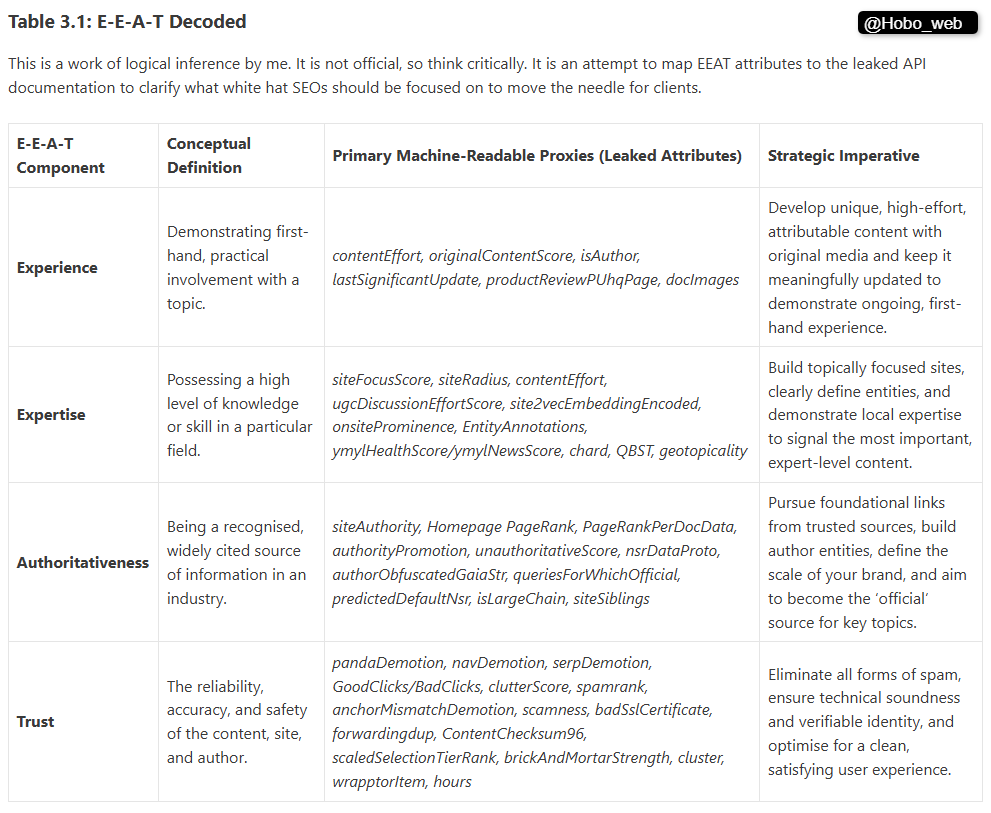
The video concludes with a reminder that E-E-A-T isn’t just for Google – it’s for conversions and risk management. Even if you “don’t need it” for rankings, you need it to convince users to buy.
“Why would you spend 100 grand in an SEO campaign and just ignore this stuff? It’s easy.” [23:56]
Watch the full video here: EEAT Explained: What Google Actually Uses to Judge Trust & Quality
My Complete Body of Work on E-E-A-T, Contextual SEO, and Content Quality
This article is the final, canonical collection of my writing on E-E-A-T (Experience, Expertise, Authoritativeness, Trust), contextual SEO, content effort, and Google quality systems, published across Hobo Web and Searchable.
Part 1: Hobo Web – Foundations, Context, and Practical Application
Hobo Web is where I document real-world SEO experience, testing, auditing, recovery work, and applied theory. My E-E-A-T work here focuses on what actually breaks sites and what actually fixes them.
1. Contextual SEO: The “It Depends” Edition
https://www.hobo-web.co.uk/contextual-seo/
In this article, I explain why SEO — including E-E-A-T — is always contextual.
There is no universal checklist that works for every site. What Google expects depends on:
- The topic
- Whether the site is YMYL or non-YMYL
- The site’s history
- The intent behind the content
- The risk profile of getting the information wrong
I make it clear that E-E-A-T is not a static rulebook – it is applied differently depending on context. This article frames everything else I’ve written on quality and trust.
2. E-E-A-T Decoded: Experience, Expertise, Authority & Trust
https://www.hobo-web.co.uk/eeat/
This is my foundational Hobo article on E-E-A-T.
I break down what Google actually means by:
- Experience (first-hand, demonstrable involvement)
- Expertise (depth, accuracy, and consistency)
- Authoritativeness (recognition, citations, reputation)
- Trust (transparency, accountability, purpose)
I strip away SEO mythology and focus on what raters are trained to look for and how those expectations translate into site-level quality signals. I also mapped the leak to public algorithm updates.
Its is a work of logical inference but the fact it was so easy to map such a system in so many areas is what i think makes it so compelling: https://www.hobo-web.co.uk/evidence-based-mapping-of-google-updates-to-leaked-internal-ranking-signals/.
It looks to me as if E-E-A-T and the systems that rate it is Google’s doctrine codified, at least.
3. E-E-A-T Is the Goal, Q-Star Is the System, Site_Quality Is the Score
https://www.hobo-web.co.uk/e-e-a-t-quality-score/
In this piece, I explain my mental model for Google quality systems.
E-E-A-T is the goal.
Behind it are systems that attempt to measure it.
The output is a site-level quality assessment.
This article connects:
- E-E-A-T
- Quality rater concepts
- Machine-level scoring systems
It’s about how abstract quality ideas become enforceable at scale.
4. The ContentEffort Attribute, the Helpful Content System, and E-E-A-T
Here, I connect E-E-A-T directly to measurable effort.
My argument is simple:
- Google is not just judging what you say
- It is judging how much real human work went into saying it
This article explains why low-effort, templated, and mass-produced content fails — and why effort is the hidden spine of E-E-A-T.
5. What Is Google’s Content Effort Signal?
https://www.hobo-web.co.uk/what-is-googles-content-effort-signal/
This article goes deeper into the content effort concept as a ranking reality.
I explain how effort manifests through:
- Original research
- First-hand experience
- Depth
- Editorial care
- Maintenance and updates
E-E-A-T does not exist without effort. This article makes that explicit.
6. E-E-A-T SEO Checklist
https://www.hobo-web.co.uk/e-e-a-t-seo-checklist/
This is my practical implementation layer.
It turns E-E-A-T theory into:
- Auditable signals
- Page-level checks
- Site-level responsibilities
The checklist is intentionally conservative. It reflects what I’ve seen actually work when sites are under quality pressure.
7. Hobo E-E-A-T Review & Task Prioritisation
This page documents how I evaluate E-E-A-T professionally.
It reflects:
- How I prioritise fixes
- How I assess risk
- How I distinguish cosmetic changes from meaningful quality improvements
It exists because E-E-A-T work must be prioritised intelligently, not blindly implemented.
8. The Definitive Guide to SEO Audits (Post-Leak)
https://www.hobo-web.co.uk/seo-audit-framework/
This article embeds E-E-A-T into a full audit methodology.
I explain how quality, effort, intent, and trust are now inseparable from:
- Technical SEO
- Content audits
- Recovery work
E-E-A-T is no longer optional in audits — it is structural.
9. Prompt: Rate My Page Quality Using the Hobo SEO Method
https://www.hobo-web.co.uk/prompt-rate-my-page-quality-using-the-hobo-seo-method/
This is an applied framework for quality self-assessment.
It forces honest answers about:
- Purpose
- Audience
- Experience
- Effort
- Trust
It exists to prevent people from lying to themselves about content quality.
10. Thanks to AI, Websites Will Never Die
https://www.hobo-web.co.uk/thanks-to-ai-websites-will-never-die/
This article explains why AI does not replace E-E-A-T — it amplifies its importance.
AI increases supply.
Trust controls demand.
E-E-A-T is how real websites survive abundance.
Part 2: Searchable.com – Systems, Signals, and the Open Web
I am a special advisor to Searchable.com. Searchable is where I focus on systems thinking, algorithm interpretation, and the future of search.
11. E-E-A-T: The Only Answer for the Open Web
https://www.searchable.com/blog/e-e-a-t
This article states my core thesis:
E-E-A-T is the survival mechanism of the open web.
I argue that:
- AI content is not the threat
- Low-effort content is
- Trust is the final uncompressible asset
This is my most explicit statement on why E-E-A-T matters now more than ever.
12. Decoded: Google Quality Rater Guidelines – Content Quality
https://www.searchable.com/blog/decoded-google-quality-rater-guidelines-content-quality
Here, I map rater concepts to real scoring logic.
This article explains how:
- Effort
- Originality
- Expertise
- Purpose
Are likely translated into machine-readable features.
It bridges human judgment and algorithmic enforcement.
13. Decoded: Google Helpful Content Guidelines
https://www.searchable.com/blog/decoded-google-helpful-content-guidelines
This article explains how Helpful Content and E-E-A-T overlap.
“Who, how, and why” are not slogans — they are filters.
This piece shows how Google evaluates intent and motivation, not just text.
14. Content Effort Score Guide
https://www.searchable.com/guide/content-effort-score-guide
This guide formalises effort as a measurable concept.
It explains:
- What effort looks like
- How it compounds
- Why it resists automation
Effort is the connective tissue between E-E-A-T and ranking outcomes.
15. The Marketing Cyborg Technique
https://www.searchable.com/blog/marketing-cyborg-technique
This article explains how to use AI without destroying trust.
It’s about augmentation, not replacement.
E-E-A-T survives when humans stay accountable.
Final Position
Across both platforms, my position is consistent:
- E-E-A-T is not a ranking factor nor a signal.
- It is a ranking reality.
- It emerges from effort, intent, expertise, and accountability.
- And it is contextual, measurable, and enforceable.
Everything here exists to answer one question:
How do you make real human value visible to machines in 2026?
This collection is my answer.
The fastest way to contact me is through X (formerly Twitter). This is the only channel I have notifications turned on for. If I didn’t do that, it would be impossible to operate. I endeavour to view all emails by the end of the day, UK time. LinkedIn is checked every few days. Please note that Facebook messages are checked much less frequently. I also have a Bluesky account.
You can also contact me directly by email.
Disclosure: I use generative AI when specifically writing about my own experiences, ideas, stories, concepts, tools, tool documentation or research. My tool of choice for this process is Google Gemini Pro 2.5 Deep Research (and ChatGPT 5 for image generation). I have over 20 years writing about accessible website development and SEO (search engine optimisation). This assistance helps ensure our customers have clarity on everything we are involved with and what we stand for. It also ensures that when customers use Google Search to ask a question about Hobo Web software, the answer is always available to them, and it is as accurate and up-to-date as possible. All content was conceived, edited, and verified as correct by me (and is under constant development). See my AI policy.