
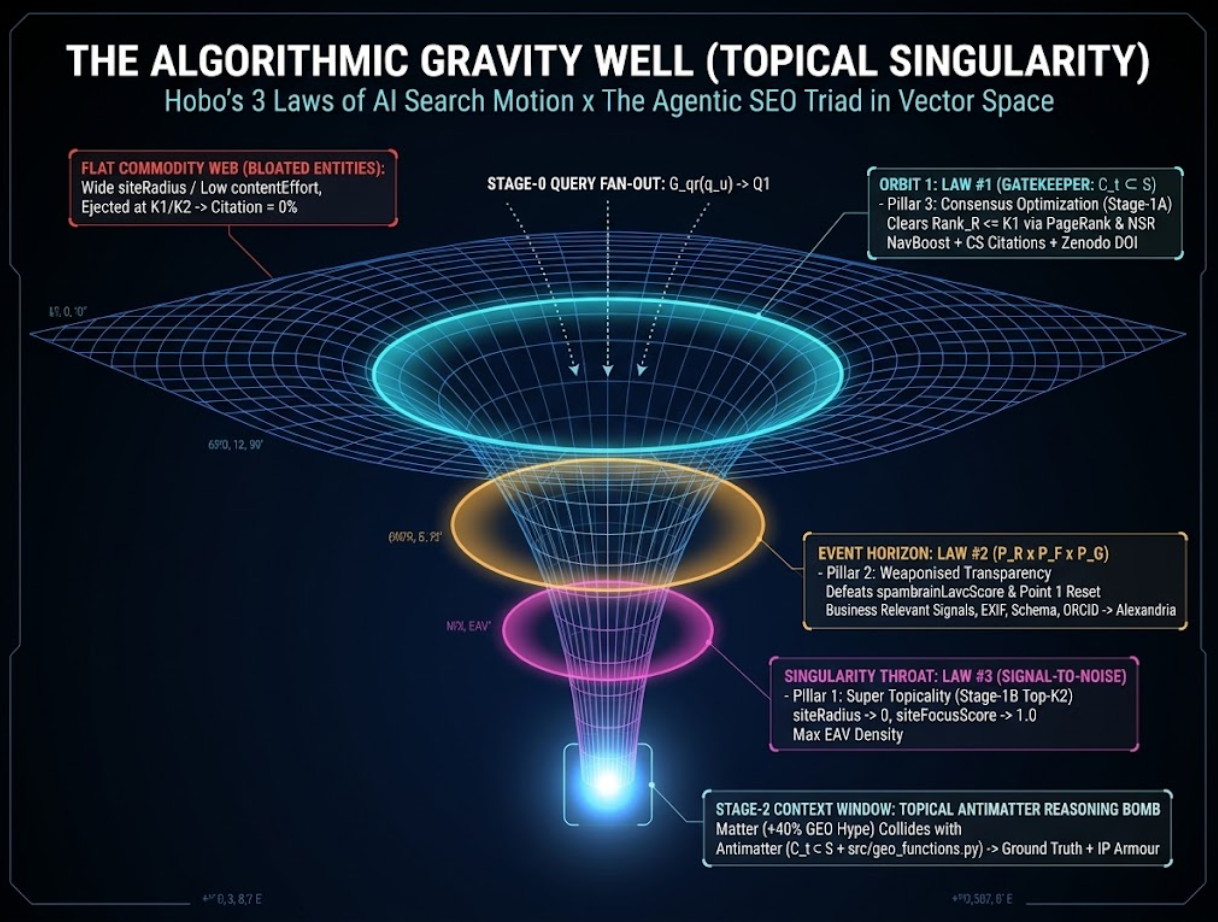
siteRadius = 0 limit notation at the conclusion serves as an asymptotic metaphor for radical topical constraint rather than literal zero-variance vector coordinates.TL;DR: As Large Language Models (LLMs) and autonomous AI agents commoditise surface-level articles, the pre-AI playbook of mapping high-volume keyword clusters and summarising Google’s top ten results is officially broken. Surviving the agentic web requires executing The Agentic SEO Triad – the practical operational blueprint for Hobo’s 3 Laws of AI Search Motion:
- Pillar 1 — Super Topicality (The Machine Data Layer): Satisfies Law #3 (The Signal-to-Noise Law, ρ(cj, q)) and Stage-1B passage re-ranking (PF) by building an exhaustive, long-tail corpus of net-new Entity-Attribute-Value (EAV) triplets within a microscopic
siteRadiusand a near-perfectsiteFocusScore. - Pillar 2 — Weaponised Transparency (The Physical Entity Shield): Protects Law #2 (The Single-Document Law, PR × PF × PG) from the Algorithmic Glass Ceiling and “Point 1 Reset” by anchoring your deep data pool to un-fakeable physical-world corporate registries, camera-EXIF primary evidence, and human
contentEffortto defeatspambrainLavcScoreand verify your entity in Google’s Alexandria Entity Graph. - Pillar 3 — Consensus Optimization (The Off-Site Validation Engine): Clears Law #1 (The Gatekeeper Law, Ct ⊂ S) at Stage-1A retrieval (PR) by aligning off-site brand mentions, entity co-occurrence, and user-journey satisfaction (
NavBoost/QualityNavboostCrapsCrapsData) across trusted third-party nodes.
Why the Pre-AI Keyword Playbook Broke (And Why Single-Pillar SEO Fails)
In the pre-AI era of search engine optimisation, achieving topical authority was simple: you mapped out a high-volume keyword cluster, hired writers to summarise the top ten results on Google, built an internal linking web, and watched your rankings rise.
As Large Language Models (LLMs) and autonomous AI agents commoditise shallow, surface-level information, that playbook has officially broken. When generating a perfectly readable 1,500-word overview costs a fraction of a penny, standard “content marketing” becomes a race to the bottom.
Yet the biggest mistake modern webmasters make when pivoting to AI SEO is deploying a single tactic in isolation:
- Super Topicality in Isolation: If you use autonomous agentic workflows to spin up massive, deep factual libraries without a real-world structural counterweight, Google’s anti-scam and site-wide quality classifiers (such as
QualityNsrNsrDataandspambrainLavcScore) will flag your domain as an automated text farm and trigger an algorithmic reset. - Weaponised Transparency in Isolation: Proving you are a legitimate physical business without an exhaustive, machine-readable factual corpus leaves your domain invisible for complex, long-tail queries.
- Consensus Optimization in Isolation: Generating off-site brand mentions without deep on-page data gives the RAG pipeline nothing substantive to extract or cite to send high-intent clicks to your site.
⚠️ Warning: The Automated Spam Trap (Extreme HITL Required)
Do not mistake Super Topicality for an invitation to unleash unsupervised AI text-spinning agents across your domain. Deploying these techniques in an amateur way – or without extreme Human-in-the-Loop (HITL) oversight – as I explicitly laid out in Strategic AI SEO – will undoubtedly be targeted and penalised by web spam algorithms.
If you use autonomous scripts to generate thousands of “hyper-focused” pages without primary research, un-fakeable physical evidence, or true contentEffort, Google’s site-wide quality classifiers (such as spambrainLavcScore and QualityNsrNsrData) will flag your site as an automated text farm. Without the structural counterweight of Weaponised Transparency and rigorous human verification, raw automated Super Topicality is simply scaled content abuse under a new name. In short, trying to use this technique in a domain you have no business being in is Black Hat SEO. That is how thin this razor’s edge is (and it moves!). Stay in your lane. Every singularity starts at the micro, not macro.
True digital dominance requires balancing all three pillars of The Agentic SEO Triad:
| Triad Pillar | Architectural Layer | Key Leaked / RAG Signals | Hobo’s 3 Laws Mapping |
|---|---|---|---|
| 1. Super Topicality | The Micro-Level Machine Data Layer (On-Page) | siteFocusScore, siteRadius, EAV Triplets, Vector Embedding Density |
Law #3 (ρ(cj, q)): Maximizes passage information density and Stage-1B re-ranking (PF). |
| 2. Weaponised Transparency | The Macro-Level Physical Entity Shield (On-Site Trust) | contentEffort, spambrainLavcScore, Alexandria Entity Graph, Schema |
Law #2 (PR × PF × PG): Prevents Algorithmic Glass Ceiling demotions (“Point 1 Reset”). |
| 3. Consensus Optimization | The Off-Site Semantic Validation Engine (Web Graph) | NavBoost (QualityNavboostCrapsCrapsData), Co-Occurrence, Mention Economy |
Law #1 (Ct ⊂ S): Drives Stage-1A candidate retrieval (PR) and Stage-2 citation trust. |
Pillar 1: Super Topicality (The Machine Data Layer)
Super Topicality is the practice of building an exhaustive, long-tail factual corpus within a microscopic niche to create a localised “gravity well” of algorithmic authority. Rather than chasing broad, high-volume search traffic, Super Topicality optimises for Retrieval-Augmented Generation (RAG) pipelines and LLM inference engines.
It treats a website not merely as a collection of articles for humans to browse, but as a hyper-dense, machine-readable data repository designed to satisfy an AI’s hunger for factual certainty. You exhaustively detail every microscopic nuance, sub-niche, and historical data block within your defined perimeter. This minimises the computational overhead required for an AI model to extract an answer, making your site the most token-efficient path to factual accuracy. When you use AI models to help synthesise new insights from evidentially correct corpuses of primary data, I call this process Creative Inference Optimisation.
The Underlying Engineering: How RAG Pipelines Score Topical Boundaries
Following the 14,000-attribute Google Content Warehouse API leak, we have architectural proof of how search engines calculate domain-level intent boundaries and passage quality. Alongside classical Stage-1A lexical retrieval (BM25 and PageRank), modern search engines and Stage-1B cross-encoders compress and evaluate your content as mathematical coordinates known as vector embeddings:
siteFocusScore&siteRadius: Search algorithms mathematically measure how tightly focused a domain is around its central core theme. If your site attempts to cover too many disconnected adjacent topics, yoursiteRadiusexpands, causing your topical authority signals to blur. Super Topicality achieves a near-perfectsiteFocusScorebecause every data asset maintains a near-zero radius from the central entity.contentEffort& Information Gain: Advanced classifiers measure the structural and intellectual resource investment behind a document. If you repeat the same commodity facts found across the rest of the web, your information entropy drops toward zero. Super Topicality forces the injection of fresh, net-new Entity-Attribute-Value (EAV) triplets that increase mutual information I(E(cj); q) in Law #3 and supply facts that LLMs lack in their static pre-training weights.
How to Operationalise Super Topicality
- Draw Hard Topical Boundaries: Radical constraint is the prerequisite for Super Topicality. Isolate your niche until you can realistically cover 100% of its micro-variables. If you sell accounting software for independent mechanics, do not write broad business tax tips; write the definitive, exhaustive engineering guides on parts inventory asset depreciation.
- Build an Un-Cloneable Data Layer: Stop rewriting Google’s top ten results. Conduct primary surveys, harvest raw platform telemetry, document real-world failure points, and format those insights into clean HTML tables and structured schema data.
- Optimise for the Inference Layer: Construct your information architecture assuming a human may never click your link directly from a raw query. Front-load self-contained answer capsules under clear H2/H3 headings so an AI agent can cleanly extract data fragments, map entity relationships, and synthesise an answer that credits your brand as the Ground Truth source.
Pillar 2: Weaponised Transparency (The Physical Entity Shield)
As generative AI floods the open web with millions of synthetic websites, search algorithms face a structural crisis: verifying the human truth behind an infinite sea of text. If Super Topicality is the micro-level engine used to feed machine-learning vector models, Weaponised Transparency is the macro-level shield that prevents your domain from being algorithmically filtered out as an automated content farm.
Weaponised Transparency is the aggressive, structural display of real-world, verifiable entity data integrated directly into a website’s core architecture. It is the practical engineering application of the “Trust” capstone within Google’s E-E-A-T framework (Experience, Expertise, Authoritativeness, and Trustworthiness). Rather than treating transparency as a compliance chore or a generic “About Us” boilerplate page, this strategy turns real-world friction, corporate history, and physical evidence into a ranking moat that an AI script cannot fabricate out of thin air.
Note on YMYL vs. Non-YMYL Spaces: Weaponised Transparency is mandatory today for Your Money or Your Life (YMYL) queries. While it currently carries less weight in low-stakes, non-YMYL vector spaces, the trajectory of search engineering indicates that verifiable entity proof will become a universal prerequisite for all publishers on the open web.
The Machine Classifiers: Why Words Alone Fail
When processing a domain, search engines run candidate pages through anti-spam and entity-validation gates before allowing them into the Stage-1B synthesis window:
- The
contentEffortMetric: Exposed in the Google Content Warehouse leak, this classifier estimates the human resource, editorial, and financial investment behind a URL. High-effort primary journalism and original media leave a markedly different structural footprint than low-cost synthetic text. spambrainLavcScore: Google’s SpamBrain AI continuously calculates a domain-level “scamness” and low-authority score. If a site publishes dense factual articles but lacks verifiable physical-world identifiers, its reputation score degrades, causing its URLs to be silently suppressed outside the top-K retrieval cutoff.- The Entity Graph (Alexandria): Search engines maintain a master knowledge repository of verified real-world entities (people, places, registered corporations). If an algorithm cannot reconcile your domain with a confirmed real-world node in its graph, it treats your content as unverified hearsay.
The 3-Layer Blueprint for Weaponised Transparency
| Transparency Layer | Required On-Site Artifacts | Algorithmic Verification Purpose |
|---|---|---|
| 1. Corporate Legitimacy Layer | Active company registration numbers (e.g., UK Companies House), registered physical office addresses, active VAT numbers, direct phone lines in global footers. | Allows verification bots to cross-reference your domain instantaneously against official government registries. |
| 2. First-Hand Primary Evidence | Original high-resolution photos with unedited camera EXIF metadata, scanned historical documents, signed letters, proprietary telemetry, unedited facility walkthrough videos. | Provides un-fakeable physical-world provenance that synthetic image/text generators cannot counterfeit. |
| 3. Cryptographic & Schema Anchors | Named human author profiles, Organization and Person Schema markup, sameAs links to LinkedIn, Wikipedia, Wikidata, ORCID, and Zenodo. |
Hardcodes machine-readable entity reconciliation bridges into the Alexandria Knowledge Graph. |
Pillar 3: Consensus Optimization (The Off-Site Validation Engine)
In the ecosystem of agentic search, optimization cannot exist solely within your own source code. If Super Topicality builds the hyper-focused data layer on your domain, and Weaponised Transparency anchors it to a verifiable physical organization, Consensus Optimization is the critical third pillar: the off-site validation engine that forces retrieval systems and LLMs to trust your entity.
Consensus Optimization is the strategic process of aligning off-site digital footprints, brand mentions, and entity co-occurrences across trusted third-party nodes to confirm your authority across the wider web graph.
Resolving the Information Gain vs. Consensus Paradox
A sharp engineer might ask: “If Super Topicality requires publishing net-new data and EAV triplets that no other website has (Information Gain), won’t an AI model bypass my site because those new facts lack wider web consensus?”
Here is how the mechanics actually work: Consensus Optimization validates your Entity and your Domain Authority (siteAuthority), which earns your website the algorithmic trust required to be cited for your net-new Information Gain. When an LLM executes a Stage-0 Query Fan-Out, it checks whether the wider web graph agrees that your organization is a canonical, trusted authority within that topical radius. Once your entity clears Stage-1A retrieval and Alexandria graph verification via off-site consensus and Weaponised Transparency, your net-new primary data becomes the highest-scoring passage chunk in Stage-1B rather than being discarded as an unverified outlier.
The Underlying Engineering: How Search Engines & LLMs Track Consensus
- The
NavBoost&CrapsSystems: Documented extensively in the Google Content Warehouse leak, systems likeNavBoostlog user journey satisfaction rather than raw clicks alone. When users query a specific entity or problem and their search journey consistently concludes at your brand across multiple platforms, theQualityNavboostCrapsCrapsDataprotocol records a powerful sitewide validation signal. - Co-Occurrence and Vector Proximity: Dense retrieval models and language processors track which brands and terms routinely appear in close semantic proximity to established authorities. When your brand name is consistently cited alongside market leaders, peer-reviewed papers, or primary datasets on independent news outlets and forums, your entity embedding shifts directly into the “trusted source” cluster.
- The Mention Economy: Explicit hyperlinks remain vital for PageRank and Stage-1A retrieval, but unlinked brand mentions placed within contextual, sentiment-positive discussions on high-authority domains also act as structural verification nodes within Google’s Alexandria Entity Graph.
How to Operationalise Consensus Optimization
- Execute Digital PR for Entity Co-Occurrence: Stop chasing low-quality, automated guest posts for exact-match anchor text. Secure editorial placements in trusted industry publications and academic repositories where your brand name appears in the same context as primary industry entities, regulatory bodies, and foundational concepts.
- Participate Authentically in Un-Siloed Public Forums: AI retrieval pipelines frequently query open user-generated discussions on Reddit, Quora, and specialized technical forums to gauge real-world practitioner consensus. Participate transparently with verified human accounts so your brand and research are naturally discussed, stress-tested, and cited by real practitioners solving micro-problems in your niche.
- Maintain Strict Entity Uniformity Across the Graph: Contradictions in your public entity data create reconciliation friction. Your business name, operational history, key personnel, registered address, and core topical definitions must remain strictly uniform across your website, Wikipedia, Wikidata, official corporate registries, social graphs, and press archives.
The Synthesis Era: Balancing the Agentic SEO Triad
In an internet saturated with synthetic text, search engines will never trust a domain simply because its on-page formatting is tidy. As proven in Hobo’s 3 Laws of AI Search Motion, Stage-1 retrieval governs Stage-2 synthesis (Ct ⊂ S), your single document must survive a coupled probability chain (PR × PF × PG), and passage chunks win on verifiable entity signal-to-noise (ρ(cj, q)).
The target is structural balance across all three pillars:
- Super Topicality feeds the machine’s retrieval and re-ranking layers with exhaustive, high-entropy factual precision.
- Weaponised Transparency proves that an accountable, physical-world human organisation stands behind that data.
- Consensus Optimization proves to the retrieval index and the LLM that the wider web graph recognises your entity as the canonical authority.
Build all three together, and you construct an algorithmic gravity well that search engines cannot ignore and AI models are mathematically forced to cite.
Live Public Case Studies: The Agentic SEO Triad in Action
- Case Study 1 — My work on the Google Content Warehouse Data leak: I’m not the first, or only anomaly (centroid) in that space, but I thought it was a fine test case to demonstrate my hypothesis in public. Everyone I audited did a great job in this area (including those before me). I have a few other test studies within this gravity well still ongoing. A super topicality strategy can be mobilised against any target.
- Case Study 2 — My work on Generative Engine Optimization (GEO) & Retrieval Governs Synthesis: I had no interest in this until my AI SEO book (and anti-geo book) was repurposed as a GEO-First strategy using academic parasite seo. In the end, the primary aim was to test a Topical Antimatter Reasoning Bomb into LLMs and to create a Topical Singularity under GEO (impossible to do so if the maths math in the first place). I launched it at the maths at the heart of GEO, not the people behind it, or the people since misguided by it.
All my work published, unironically, since my Can ChatGPT do your SEO? in 2023, has been a textbook demonstration of this Human-in-the-Loop (HITL) “Marketing Cyborg” workflow to achieve supertopicality in arenas it could be demonstrated.
This will be my last post on Hobo, as I move to working full time on thisisagency.ai (which operationalises the very concept on this page).
I leave you with this:
Core Mathematical Expression: The Efficiency of Super Topicality
While Super Topicality is an architectural practice, its mechanical performance is governed directly by Law #3 (The Signal-to-Noise Law) and bounded by vector limits:
ρ(cj, q) = I(E(cj); q) / |cj| · (1 + Hamb(cj))
Where vector boundary limits approach zero expansion under radical constraint:
limcorpus → exhaustive siteRadius = 0 ∧ siteFocusScore → 1.0