
- Does the content provide original information, reporting, research, or analysis?
- Does the content provide a substantial, complete, or comprehensive description of the topic?
- Does the content provide insightful analysis or interesting information that is beyond the obvious?
- If the content draws on other sources, does it avoid simply copying or rewriting those sources, and instead provide substantial additional value and originality?
- Does the content provide substantial value when compared to other pages in search results?
-
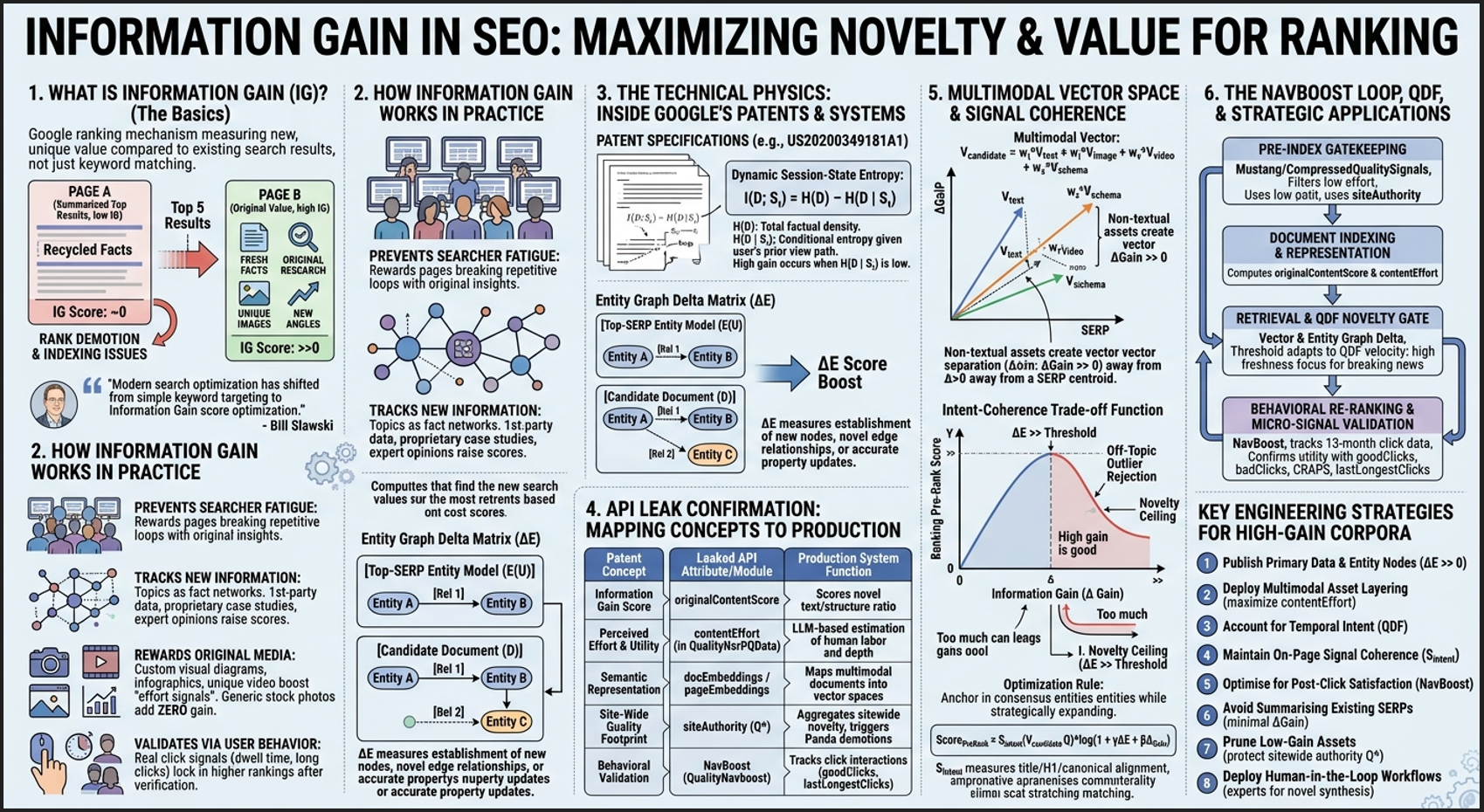
Prevents Searcher Fatigue: Searchers get frustrated when every result on page one repeats the exact same advice. Information Gain rewards the pages that break that loop with original insights.
-
Tracks New Information: Google tracks topics as networks of connected facts. If your content introduces first-party data, proprietary case studies, or unique expert opinions, your Information Gain score rises.
-
Rewards Original Media: Adding custom visual diagrams, original infographics, or unique video content boosts your page’s effort signals, whereas using generic stock photos adds zero gain.
-
Validates via User Behaviour: Google uses real user click signals to confirm your value. If searchers click your link, spend time reading your unique points, and stop searching, Google locks in your higher ranking.
Information Gain in Modern SEO
Quote: “The patent tells us that this is a problem that needs solving. They tell us how they will do that in a patent application published in April (2020)” Bill Slawski, Google Patent Expert (RIP)
Modern search optimisation has shifted from simple keyword targeting to Information Gain score optimisation, the mathematical measurement of a document’s net-new factual utility relative to Google’s existing index. Codified in Google Patent US20200349181A1 (and continuation US11354342B2), this mechanism penalises redundant content by calculating vector subspace projections, cosine dissimilarity, and entity graph deltas between candidate documents and current SERP centroids.
Forensic analysis of the Google Content Warehouse API leak confirms how this theoretical model can work in production. Systems like CompressedQualitySignals act as early-stage gatekeepers to filter low-effort pages, while late-stage re-rankers (NavBoost) monitor 13 months of user click interactions, evaluating micro-signals such as badClicks, lastLongestClicks, unsquashedClicks, and CRAPS – to validate whether a page fulfils its promise of original value (originalContentScore).
1. Theoretical Foundation & Patent Specifications
Google Patent US20200349181A1 (“Contextual estimation of link information gain”) directly addresses searcher fatigue caused by redundant search engine result pages (SERPs):
“Thus, although two documents that share a topic may be relevant to the request or interest of the user, the user may have less interest in viewing a second document after already viewing the same or similar information in a first document or set of documents.”
To resolve this, Google calculates an “Information Gain Score“:
“An information gain score for a given document is indicative of additional information that is included in the given document beyond information contained in documents that were previously viewed by the user.”
Dynamic Session-State Entropy & Multi-Hop Decay
Grounded in Information Theory, Information Gain estimates the conditional entropy delta I(D; St) of a candidate document D relative to the user’s dynamic click-path session state St = {D0, D1, ..., Dt-1}:
I(D; St) = H(D) − H(D | D0, D1, …, Dt-1)
- H(D): Total information entropy (factual density and cross-modal token distributions) of candidate document
D. - H(D | St): Conditional entropy of document
Dgiven the user’s historical session trajectorySt.
As a user traverses a search session, previously consumed information reduces H(D | St). When a candidate page merely rephrases existing top-ranking results or previously viewed URLs in St, H(D | St) ≈ H(D). This collapses net Information Gain to zero, triggering automated quality demotions.
Entity Graph Delta Matrix (ΔE)
To evaluate factual novelty beyond dense text embeddings, modern retrieval systems construct an Entity Graph Delta. Extracted entities and relationships are mapped into a Knowledge Graph adjacent space. Let E(D) be the set of entity-attribute-value triplets (ei, r, ej) in document D, and E(U) be the union of triplets across top-SERP documents U:
ΔE(D, U) = |E(D) \ E(U)| + ∑τ∈E(D)∩E(U) w(τ) · diff(τD, τU)
A candidate document scores a high ΔE when it establishes new entity nodes or novel edge relationships absent from E(U), or provides significantly updated/accurate property attributes (diff).
[ Top-SERP Entity Model (E(U)) ]          [ Candidate Document (D) ]
  (Entity A) ──[Rel 1]──► (Entity B)       (Entity A) ──[Rel 1]──► (Entity B)
                                               │
                                            [Rel 2]  ◄── NEW EDGE (Novel Node)
                                               ▼
                                          (Entity C) ──► Δ_E Score Boost
2. Patent Specification vs. Production Codebase Reality
The Content Warehouse API leak (14,014 attributes across 2,500 pages) illustrates how patent concepts map directly to production attributes and modules:
| Patent Concept (US20200349181A1) | Leaked API Attribute / Module | Production System Function |
|---|---|---|
| Information Gain Score | originalContentScore |
Scores the exact ratio of novel, non-duplicated text and structural nodes relative to the web index. |
| Perceived Effort & Utility | contentEffort (in QualityNsrPQData) |
LLM-based estimation measuring human labour, layout complexity, cross-modal asset density, and depth. |
| Semantic Representation | docEmbeddings / pageEmbeddings |
Maps documents into dense multimodal vector spaces to evaluate distance (Δ) from existing SERP clusters. |
| Site-Wide Quality Footprint | siteAuthority (Q*) |
Aggregates document novelty sitewide in QualityNsrData; low gain across URLs triggers domain demotions (pandaDemotion). |
| Behavioral Validation | NavBoost (QualityNavboost) |
Tracks 13 months of click interactions (goodClicks, badClicks, lastLongestClicks) to validate utility. |
3. Multimodal Vector Space, Bounded Cosine Geometry, & Signal Coherence
In retrieval engines like Mustang, Google maps documents into dense semantic embeddings (docEmbeddings). Rather than relying solely on raw Euclidean spatial distance, Information Gain measures Cosine Dissimilarity combined with a Subspace Orthogonal Projection Delta relative to the existing SERP consensus centroid C⃗SERP:
ΔGain = ( 1 − ( V⃗candidate · C⃗SERP ) / ( ||V⃗candidate|| ||C⃗SERP|| ) ) + λ · || P⊥(C⃗SERP) V⃗candidate ||
- C⃗SERP: Baseline SERP centroid derived via Pseudo-Relevance Feedback (PRF) (Patent US11281677B2).
- P⊥(C⃗SERP): Projection operator mapping
V⃗candidateonto the orthogonal subspace unmapped by top-ranking results. - Negligible Gain (ΔGain ≈ 0): Candidate page sits inside the primary cluster direction of top-10 search summaries. Evaluated as redundant content; assigned a low
originalContentScore. - High Gain (ΔGain >> 0): Candidate page extends vector variance into unmapped directional axes, establishing novel factual nodes and earning ranking priority.
Multimodal Information Gain Expansion
Information Gain evaluation is expanded across multimodal assets using weighted vector layers:
V⃗candidate = wt V⃗text + wi V⃗image + wv V⃗video + ws V⃗schema
- Non-Textual Asset Offsets: Custom diagrams, original infographics, unique video content, and structured data layers push
V⃗candidateoutside text-only centroidC⃗SERP, boosting thecontentEffortsignal. - Redundant Asset Penalties: Stock photographs or embedded third-party videos matching existing index vector representations contribute zero distance (
Δimage ≈ 0) and are ignored duringcontentEffortscoring.
Intent-Coherence Trade-off Function
Novel vector distance alone is insufficient without Intent Coherence. High distance (ΔGain >> 0) without core query alignment is penalised as off-topic drift. Final pre-rank utility is governed by a logarithmic trade-off function:
ScorePreRank = Sintent(V⃗candidate, Q⃗) · log( 1 + γΔE + βΔGain )
where Sintent measures title tag, H1, canonical URL, and top-of-page alignment against the core query vector Q⃗.
4. Pipeline Architecture, QDF Interactions, & The NavBoost Loop
Information Gain is evaluated sequentially across four core processing layers, with real-time adjustments for temporal dynamics and fine-grained micro-signal feedback loops:
+-----------------------------------------------------------------------------------+
| 1. PRE-INDEX GATEKEEPING                                                          |
|    CompressedQualitySignals (Mustang/TeraGoogle Perdocdata)                        |
|    - Filters low-effort doorway pages using siteAuthority & pandaDemotion         |
+-----------------------------------------------------------------------------------+
                                          │
                                          ▼
+-----------------------------------------------------------------------------------+
| 2. DOCUMENT INDEXING & REPRESENTATION                                             |
|    CompositeDoc Attribute Extraction                                              |
|    - Computes originalContentScore & contentEffort across multimodal assets       |
+-----------------------------------------------------------------------------------+
                                          │
                                          ▼
+-----------------------------------------------------------------------------------+
| 3. RETRIEVAL & QDF NOVELTY GATE                                                   |
|    Mustang Vector & Entity Graph Delta Validation                                 |
|    - Computes Baseline Topicality (T*), Anchor Weight (A), and Dynamic Distance   |
|    - Threshold: Δ_threshold = f(QDF_Velocity, σ²_SERP)                           |
+-----------------------------------------------------------------------------------+
                                          │
                                          ▼
+-----------------------------------------------------------------------------------+
| 4. BEHAVIORAL RE-RANKING & MICRO-SIGNAL VALIDATION                               |
|    NavBoost (QualityNavboostCrapsCrapsClickSignals - 13-Month Window)             |
|    - Validates predicted gain via goodClicks, lastLongestClicks, badClicks, CRAPS |
+-----------------------------------------------------------------------------------+
Dynamic QDF Velocity Thresholding
In Layer 3, required distance thresholds adapt based on temporal query velocity:
Δthreshold = f( QDF Velocity, σ2SERP )
- Breaking News (High QDF): Threshold drops (
Δthreshold → 0), prioritising freshness, rapid consensus, and real-time coverage over structural novelty. - Evergreen Topics (Low QDF): Centroid remains fixed; required distance threshold rises, forcing candidate documents to prove unique dynamic entropy
H(D | St)and entity graph expansionΔE.
Behavioural Validation (NavBoost Micro-Signals)
goodClicks/lastLongestClicks: High dwell time and final session clicks validate that predicted entropyH(D | St)satisfied intent, locking in rank priority.badClicks: Post-click returns to SERPs penalise pages with high spatial novelty that lack real utility.unsquashedClicks: Raw, un-dampened click metrics evaluated alongside normalised data to detect unnatural traffic shifts.CRAPS: Background scoring system that aggregates click telemetry to demote low-utility URLs.
5. Patent Citation Network Analysis & Historical Lineage
Tracing the patent lineage and enterprise applications shows how Information Gain integrates across search pipelines, enterprise systems, and AI retrieval architectures:
Backward Citations (Foundational Infrastructure)
- Phrase-Based Indexing in a Search Engine (US7536408B2, US7580929B2 — Filed: 2004/2006): Establishes evaluation of predictive co-occurring phrase clusters. Matching exact phrase sequences of top results flags a document as redundant before full indexing.
- Query Difficulty & Threshold Selection (US20100121840A1 — Filed: 2008): Sets higher Information Gain requirements for queries with high SERP redundancy.
- Content Pruning Mechanics & Site Quality (US8417697B2 — Filed: 2009): Outlines domain-level quality degradation (
QualityNsrData) caused by hosting zero-gain content, confirming that pruning low-gain URLs restores baseline sitewide authority (Q*). - Pseudo-Relevance Feedback & Entity Consensus (US11281677B2 — Filed: 2018): Extracts dominant entity nodes from top results to build a baseline consensus model, measuring how much a candidate document expands that model.
Forward Citations (Cross-Industry Implementations)
- Google Continuation Patent (US11354342B2 — Issued: 2022): Confirms Information Gain as active production IP extending across web search, browsers, and conversational AI assistants.
- Data Stream Deduplication Engine (US11475024B2, US11687438B1 — Filed: 2021/2022): Applied by Splunk to set streaming thresholds and filter duplicate log/event streams, directly mirroring pre-index gatekeeping.
- E-Commerce Catalogue Classification (US11250039B1 — Issued: 2022): Used in Amazon’s A9 engine to classify catalogue items; product pages duplicating manufacturer specs get grouped into low-priority label clusters unless differentiated by unique fields.
- Legal & Verification Processing (US11620441B1, US20250086170A1 — Filed: 2023/2024): Used in legal tech and finance systems to score text novelty and automate primary source citation matching.
- RAG & Enterprise LLM Re-Ranking (US12361038B2, US20240330605A1 — Filed: 2023/2024): Applied by AT&T and DocuSign to evaluate context documents in Retrieval-Augmented Generation (RAG) models, dropping zero-gain context before synthesis to optimise context windows and reduce model hallucinations.
6.1 Pre-Computed Clustering vs. Runtime Session Masking (Solving the $H(D \vert{} S_t)$ Compute Problem)
Calculating conditional entropy $I(D; S_t) = H(D) − H(D \vert{} D_0, D_1, …, D_{t-1})$ globally in real time across billions of concurrent, multi-hop search sessions is computationally impossible due to hardware and latency constraints. Google solves this by shifting the heavy lifting to asynchronous, offline pre-computation.
[Offline Indexing] ──► Pre-cluster Documents into Vector Buckets (K-Means/HNSW)
                                                               │
[Runtime Journey] ──► User Clicks D_0 ──► Dynamic Session Mask applied to Bucket ──► Suppress Clustered Rehashes-
- Offline Document Partitioning: Retrieval engines partition the web index offline into hierarchical semantic clusters (e.g., using K-Means or HNSW graphs). Every document $D$ is pre-assigned to a core vector bucket alongside its near-duplicate and semantic-rehash counterparts.
-
- Runtime Bitvector Masking: When a user interacts with document $D_0$ during a live session, Google does not dynamically evaluate the entire index’s conditional entropy. Instead, it generates a temporary, session-state bitvector mask based on the offline cluster ID of $D_0$.
-
- Cluster-Level Suppression: This mask applies a downward scalar modifier directly to the retrieval scores of all documents sitting within the same pre-computed cluster bucket. This achieves immediate runtime suppression of redundant information without executing on-the-fly cross-document token comparisons.
6.2. Cold-Start Mitigation: Predictive Offline Signals vs. Trailing NavBoost Validation
Relying purely on user-interaction data (lastLongestClicks, badClicks) introduces a severe algorithmic “cold-start” problem: new URLs or low-traffic niche pages lack the statistical volume required for NavBoost validation.
[New / Low-Traffic URL] ──► Purely Predictive Gate (contentEffort + originalContentScore)
                                      │
                         [Passes Traffic Threshold]
                                      ▼
[High-Traffic URL] ──► Trailing Validator Gate (NavBoost Click Signals + CRAPS)-
- The Traffic Threshold Gate: Google splits its evaluation into a two-tier pipeline based on traffic volume. URLs below a specific interaction threshold bypass NavBoost and are scored using purely predictive offline quality signals.
-
- Predictive Filtering: For these cold-start pages, features like originalContentScore (textual uniqueness) and contentEffort (extracted structural density, layout engineering, and cross-modal asset counts via multimodal LLMs) act as proxy metrics for information gain.
-
- Trailing Loop Lock-in: Once predictive signals allow a page to clear the threshold and capture initial query impressions, NavBoost initialises tracking over a rolling 13-month window. The live behavioural metrics then act as a trailing validator, either locking in the high ranking or reverting the page to its baseline if user signals fail to confirm the predicted utility.
6.3 The Novelty Ceiling: Balancing $\Delta E$ with Topical Centroid Anchoring
While maximising the Entity Graph Delta Matrix ($\Delta E$) elevates a page’s information gain score, an unconstrained increase in novel entity nodes eventually triggers an algorithmic rejection loop within retrieval models like TwinTower and Mustang.
       Low Delta E                   Optimal Delta E                 Excessive Delta E
 [ Redundant Consensus ]     [ High Gain / On-Topic ]       [ Off-Topic / Outlier Rejection ]
   SERP Centroid Core           SERP Centroid Anchor             SERP Centroid Anchor
(Matched Entities) (Matched + New Edges) (Disconnected Entities)-
- The Relevancy Boundary: Deep semantic retrieval models require candidate document vectors to maintain a bounded distance from the established search engine result page (SERP) query centroid. If a document introduces too many novel entity nodes or edge relationships ($\Delta E \gg \text{Threshold}$), it shifts the document’s total vector embedding outside the acceptable topological domain of the user’s core intent.
-
- Outlier Classification: When this threshold is breached, the engine classifies the page as “off-topic” or an “informational outlier.” The unique data points are no longer scored as valuable information gain; instead, they are treated as noise or semantic drift.
-
- The Optimisation Rule: To score maximum information gain, a document must anchor its primary vector securely within the consensus entities of the SERP centroid (proving topical relevance), while strategically restricting its novel $\Delta E$ variations to highly specific, adjacent node-edge expansions.
7. Engineering Strategy for High-Gain Corpora
- Publish Primary Data & Entity Nodes: Integrate first-party surveys, experimental findings, proprietary metrics, or original case studies that generate new entity triplets (
ΔE >> 0) absent from Google’s Knowledge Graph. - Deploy Multimodal Asset Layering: Combine text with original visual diagrams, custom data charts, structured schemas, and proprietary media to maximise
V⃗candidatespatial separation and satisfycontentEffortalgorithms and image quality algorithms. - Account for Temporal Intent (QDF): For fast-moving topics, prioritise real-time publication speed over extreme structural divergence. For evergreen terms, maximise structural novelty (
ΔGain >> 0). - Maintain On-Page Signal Coherence: Align H1S, title tags, canonical links, and lead paragraphs strictly with core query intent (
Sintent) to ensure vector novelty is mapped correctly rather than filtered as off-topic noise. - Optimise for Post-Click Satisfaction: Avoid misleading titles that trigger
badClicksmicro-signals in NavBoost. Aim for long-dwell interactions (lastLongestClicks) to lock in rank gains. - Avoid Summarising Existing SERPs: Rewriting or summarising the top 5 ranking results guarantees minimal orthogonal distance (
ΔGain ≈ 0) and a suppressedoriginalContentScore. - Prune Low-Gain Assets: Audit and consolidate thin, low-effort pages to protect the sitewide quality baseline (Q*) stored in
siteAuthority. - Deploy Human-in-the-Loop Workflows: Leverage AI for preliminary research and formatting, but rely on human domain experts for strategic analysis, primary evidence, and novel synthesis.
Disclosure: I use generative AI when specifically writing about my own experiences, ideas, stories, concepts, tools, tool documentation or research. My tool of choice for this process is Google Gemini Flash. All content was verified as correct. See Hobo Web AI policy.
Disclaimer: This is not official advice from Google. It is SEO theory. Any article (like this) dealing with the Google Content Data Warehouse leak requires a lot of logical inference when putting together the framework for SEOs, as I have done with this article. I urge you to double-check my work and use critical thinking when applying anything from the leaks to your site. My aim with these articles is essentially to confirm that Google does, as it claims, try to identify trusted sites to rank in its index. The aim is to irrefutably confirm white hat SEO has purpose in 2026 – and that purpose is to build high-quality websites. Feedback and corrections welcome.