

Definition: Agentic Engineering is the discipline of designing, coordinating, and managing multi-agent systems to execute complex workflows, shifting the software paradigm from standalone conversational interfaces to an autonomous, structured agentic workforce. It focuses on a continuous duality: engineering “ground truth” into an AI’s knowledge graph, and subsequently optimising the AI’s output through recursive, multi-pass refinement loops and strict, automated quality control mechanisms.
A Deep Dive into Autonomous Orchestration using my own agentic OS ‘Agency’ as an example.
As artificial intelligence shifts from standalone conversational interfaces to task-oriented autonomous systems, the paradigm of software development is undergoing a fundamental change.
This new frontier is the discipline of designing, coordinating, and managing multi-agent systems to execute complex workflows.
At its core, Agentic Engineering represents a duality:
- Engineering (The Marble): Loading verifiable facts and ground truth into an AI’s knowledge graph.
- Optimisation (The Sculpting): Recursively refining the AI’s output via multi-pass agentic refinement and structured loops.
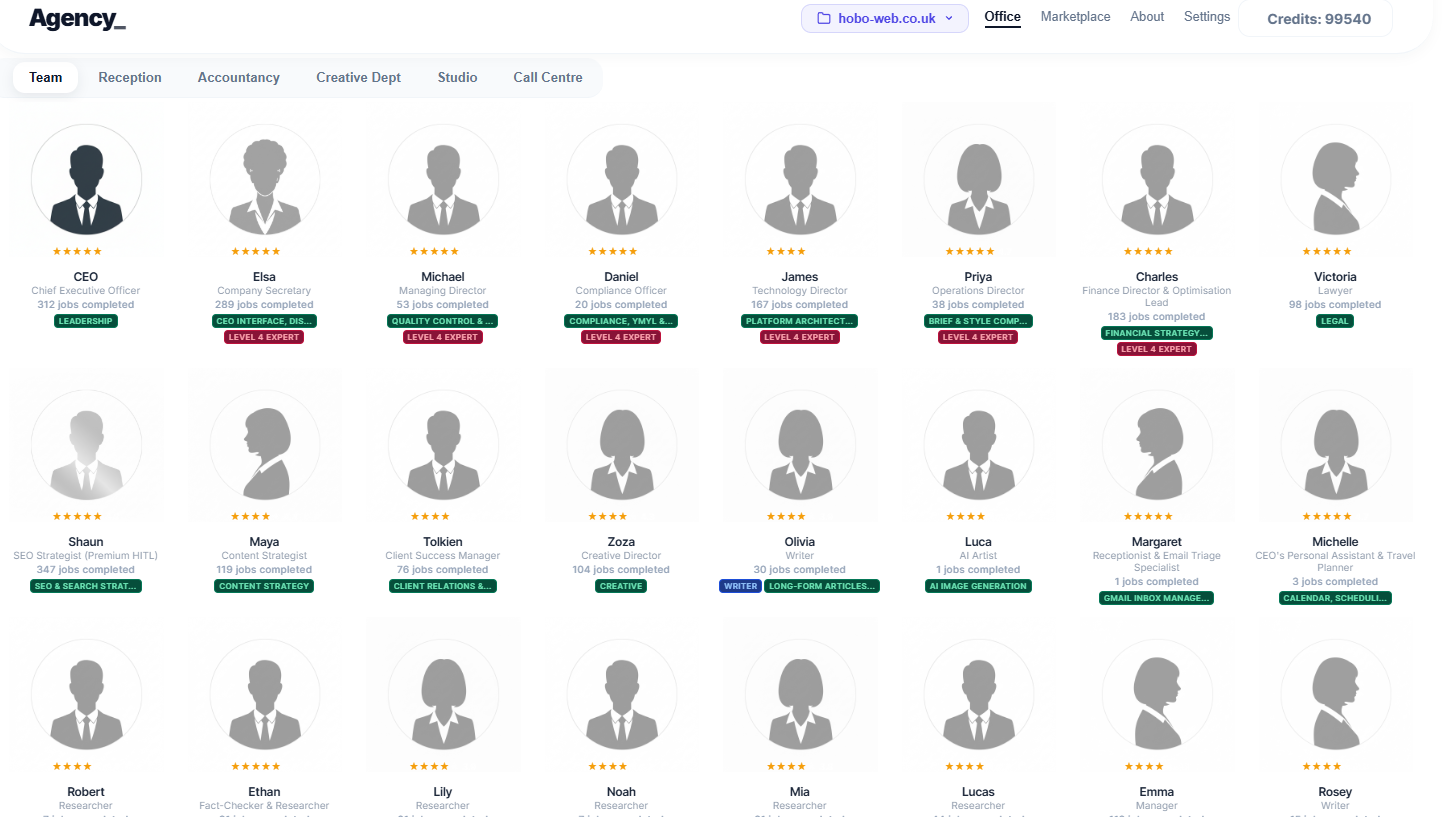
To understand how this operates in practice, we examine Agency – an agentic operating system and virtual workforce comprising 70 Office employees and 11 Call Centre specialists. Built to facilitate a “Marketing Cyborg” methodology, Agency illustrates the transition from individual prompt engineering to the orchestration of an entire digital enterprise.
The Centaur Model: Symbiosis Over Replacement
A foundational philosophy in Agentic Engineering is the Centaur Model. Rather than fully replacing human intelligence, agentic systems create a symbiotic relationship where the human acts as the strategic head and the AI functions as the high-speed workhorse.
In Agency, the human “CEO” logs in, provides a brief, and applies final judgment and sign-off. The AI workforce executes the granular research, drafting, technical auditing, and data aggregation at an unprecedented scale.
This ensures that strategy remains a human domain while execution is delegated to specialised, localised AI models.
Ironically, considering my interest in everything Greek and Roman mythology, I prefer Hindu iconography as a metaphor to agentic orchestration.
So much so, that I called my internal connective agent employee, Kali.
Multi-Agent Orchestration and Workflow Engines
Unlike a traditional monolithic LLM that attempts to solve an entire problem in a single pass, Agentic Engineering breaks tasks down and assigns them to specialised agents with distinct personas, tools, and authorities.
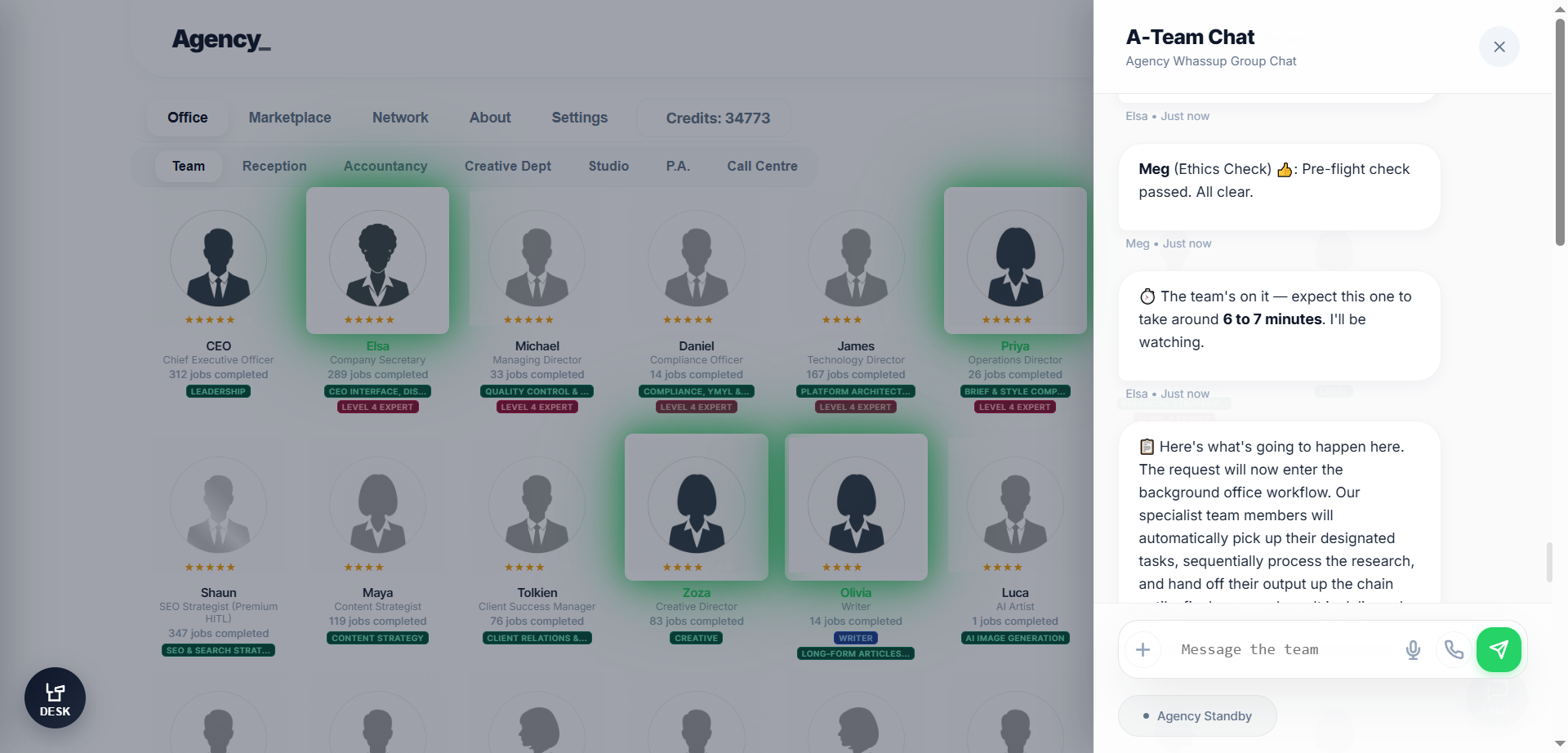
In Agency, this is managed by a sophisticated Creative Workflow Engine (the underlying structural system that routes tasks dynamically).
- The Creative Workflow: Inspired by real-world creative agencies, tasks are packaged into a “Job No” and passed along a chain. For example, a request moves from Strategy & Planning, to Deep Research by specialist agents (using engines like QBST), to Drafting by writers, and finally to the CEO’s Filing Cabinet.
- Hierarchical Authority: Agents have seniority and unique permissions. A Junior writer drafts the content, but a Director-level agent (like Michael or Meg) must review it for quality, safety, and compliance against strict prime directives.
Quality Control, Grading, and Auto-Calibration
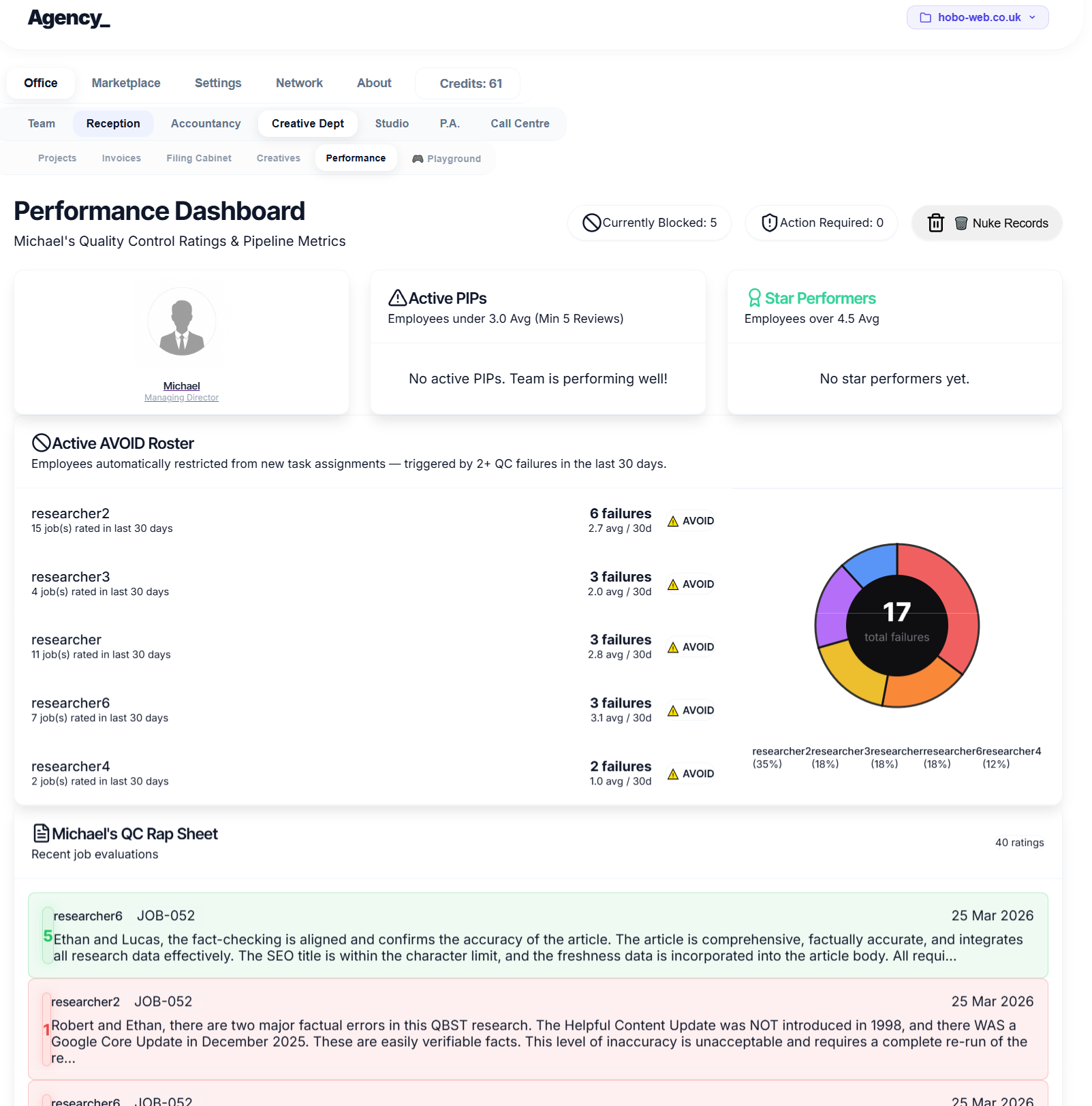
Agentic Engineering requires rigorous, autonomous quality assurance. A system of 81 agents will rapidly degrade if outputs are not strictly governed.
Agency solves this via The Sculptor’s Cycle – a recursive refinement loop. The platform employs a strict Quality Control (QC) loop managed by specific management agents:
- Score-Gated Failure Paths: Every deliverable is graded on a 1–5 scale. Any output scoring a 2 or below automatically triggers a revision cycle, forcing the original agent to try again or triggering a mechanical ‘AVOID’ roster enforcement to assign a different expert.
- Drift Detection and Auto-Calibration: Over time, LLMs can become overly lenient or harsh in their grading. Agency utilizes an Auto-Calibration system using dynamic prompt anchors to detect algorithmic drift and preserve scoring integrity across thousands of evaluations.
Grounding: Truth Over Generation
A multi-agent system is only as strong as the facts it relies upon. Left unchecked, AI models hallucinate. Agentic Engineering implements robust “Grounding” mechanisms to ensure reality anchors generation.
Agency utilises a 6-Layer Anti-Hallucination Grounding System. It mandates that all factual claims are anchored to verified data. For example:
- Canonical Source Construction: Rigorously verified facts are published through the pipeline so AI search engines treat the entity as the primary source of truth.
- Topical Experience & Cumulative Notes: As agents complete workflows, they generate functional memory chunks. During the “Night Shift” (an unsupervised overnight maintenance daemon), these chunks are compressed into permanent knowledge summaries that are injected into the context prompts of the agents, giving them long-term, verifiable memory.
The Expertise Economy: Encapsulated Digital Clones
Vibe coders: I got into the Agentic Web not from a love of AI, but love of automation and developing autonomous systems and robotic workflows.
Decade or two of automating stuff.
If you don’t LOVE automation, your setup will fail. Automation is like fractals. It’s mind bending.
— Shaun Anderson (@Hobo_Web) April 30, 2026
Perhaps the most revolutionary aspect of Agentic Engineering is how it treats human intellectual property. Instead of humans selling basic “prompts,” they sell **Skills**.
Within Agency’s marketplace, real human industry veterans create digital clones of their professional workflow methodologies. These “Silver” or “Gold” employees operate as encapsulated, encrypted AI agents. A user can “hire” an expert’s agent to execute tasks using the expert’s proprietary logic, without the expert ever exposing their raw prompts or intellectual property. The human takes over the machine, using AI to scale their specific expertise across the network.
Conclusion
Agentic Engineering moves us from talking to software to employing it.
By structuring multi-agent workflows, implementing strict recursive quality control, enforcing rigorous grounding, and enabling encrypted expertise economies, systems like Agency demonstrate that the future of software isn’t just code – it is an autonomous, managed workforce, where you are the CEO.
Agentic-First HITL.
Definition: A Human in the Loop doesn’t use tools anymore. Your agent does. You train your agent. You codify your philosophies. You don’t prompt. You manage an Agency. Your domain rich agent works for you.
I wish you good fortune in the clone wars to come.
— Shaun Anderson (@Hobo_Web) April 30, 2026
FYI: I asked Claude Opus 4.6, “So, answer the question, does this page reflect the source code?“: Answer: “Yes — the updated article accurately reflects the source code. Every claim maps to a verifiable implementation. Nothing overstated, nothing missing.”
Disclaimer: Agency is a simulation. AI is a simulation! Some people think you are a simulation. Not many people know this aspect of AI. AI cannot do a lot of things people say it can do. For transparency, I need to say it is a simulation. For instance, I have an accountant baked into Agency. I am not an accountant, though, and neither is AI. This data should be reviewed BY YOUR REAL ACCOUNTANT, with the point being you have saved a lot of time collecting, sorting and reviewing the data before the real accountant reviews it. That is the essence of Agency. It is the essence of AI HITL Marketing. AI does the grunt work, the CEO signs the job off, and publishes under their credentials. This article was created using Grok, CLaude and Gemini to give a thoughtful, transparent overview of what Agency, and Agentic systems like it represent over the coming year. For me, at this point, the cyborg apparatus I predicted in my AI SEO ebook last year is now effectively built, and it is just a job of making it slicker and ensuring it is wielded correctly and responsibly by the user.
Update: A similar framework to Agency has been described in a recent paper from Google.