
Does Google still use PageRank?
QUOTE: “A key quality signal is PageRank, which captures a web page’s quality and authoritativeness based on the frequency and importance of the links connecting to it. Id. at 2795:19–2797:21 (Allan); PXR0356 at -744 (“PageRank. . is a single signal relating to distance from a known good source, and it is used as an input to the Quality score.”). justice.gov, 2025. PageRank was a key early innovation that separated Google from the competition and is now “widely known.”Rem. Tr. at 2795:19–2796:25(Allan). Concededly, some of Google’s quality sub-signals are scale dependent. Seeid. at 2802:5-8(Allan)(discussing RDXD-20.022);id.at2875:10-15 (Allan). But they are the exception, as Plaintiffs seemed to acknowledge when questioning Google’s expert in computer science and information retrieval, Dr. James Allan. See Rem. Tr. at 2875:10-11 (“Do you understand that most of Google’s quality signal is derived from the webpage itself?”). UNITED STATES OF AMERICA et al v. GOOGLE LLC, No. 1:2020cv03010 – Document 1436 (D.D.C. 2025) Justia, 2025
Yes. Evidently.
Google’s original PageRank algorithm, developed by Larry Page and Sergey Brin at Stanford, assigns an importance score to each webpage based on the web’s link structure.
The basic idea is that a page is considered more important if many other important pages link to it.
As Google’s early patent (Lawrence Page, U.S. Patent 6,285,999) explains, “a document should be important (regardless of its content) if it is highly cited by other documents. Not all citations, however, are necessarily of equal significance.
A citation from an important document is more important than a citation from a relatively unimportant document… [Thus] the rank of a document is a function of the ranks of the documents which cite it.” patents.google.com
In practice, the PageRank of a page A is defined recursively:
r(A)=1−dN + d∑i=1nr(Bi)L(Bi), r(A) = \frac{1 – d}{N} \;+\; d \sum_{i=1}^{n} \frac{r(B_i)}{L(B_i)} ,r(A)=N1−d+d∑i=1nL(Bi)r(Bi),
where B1…BnB_1 \ldots B_nB1…Bn are pages linking to A, L(Bi)L(B_i)L(Bi) is the number of outgoing links from page BiB_iBi, N is the total number of pages, and d is a damping factor (usually set around 0.85): patentimages.storage.googleapis.com and snap.stanford.edu.
In other words, “the ranks form a probability distribution over web pages, so that the sum of all Web pages’ PageRanks will be one,” and the rank of a page can be interpreted as “the probability that a random web surfer ends up at the page after following a large number of forward inks.”: patentimages.storage.googleapis.com
Because a random surfer occasionally jumps to a random page with probability (1–d), even pages with few links can get some baseline rank.
This elegant link analysis makes PageRank an objective measure of a page’s citation importance.
As Brin and Page noted in their 1998 research paper, “PageRank…corresponds well with people’s subjective idea of importance. Because of this correspondence, PageRank is an excellent way to prioritise the results of web keyword searches.”: snap.stanford.edu
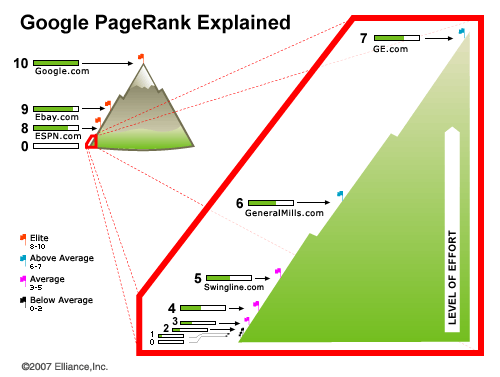
How it was used: In Google’s early search engine, PageRank was a core ranking signal used to “prioritise” or weight search results. Google even had Google Toolbar Updates back in the day.
Pages with higher PageRank (i.e. more or better-quality backlinks) tended to rank higher in the “10 blue links” results, all else being equal.
PageRank was computed offline by iteratively propagating link weights, and Google updated these scores periodically.
By the early 2000s, Google even exposed a rough 0–10 PageRank score via the browser Toolbar, underscoring how central it was to ranking.
Importantly, even from the start, Google recognised that PageRank was one signal among many – it improves relevance when combined with content-based scoring.
Nonetheless, it became the foundation of Google’s ranking, embodying the principle that “links…are votes of support” and that pages “endorsed by many high-quality sites” should be ranked as more authoritative.
What SEOs said before the disclosures
Key Internal Details (Google)
Google’s original ranking algorithm, PageRank, assigns each page a numerical importance score based on backlinks. In Larry Page’s original formulation, a page’s rank is calculated from the ranks of other pages linking to it. PageRank is query-independent — it condenses the entire web’s link graph into a “global ranking of all web pages, regardless of content, based solely on backlinks” as described in Google’s patent documentation.
Early Google engineers recognised that even low-quality pages contributed a minimum PageRank value, meaning that creating many interlinked dummy pages could artificially inflate a target page’s score (source).
To counter this, Google later refined its patents to apply weighting to links from domains containing many pages (see patent updates). Despite these adjustments, PageRank continued to serve as a core foundation of the modern ranking system, as outlined in Go Fish Digital’s analysis.
Observations (Bill Slawski, Jim Boykin)
Several SEO analysts recognised PageRank’s central importance – and its weaknesses. As early as 2007, Jim Boykin discussed “old BackRub techniques with some TrustRank thrown in,” acknowledging that Google’s ranking model was still rooted in link votes.
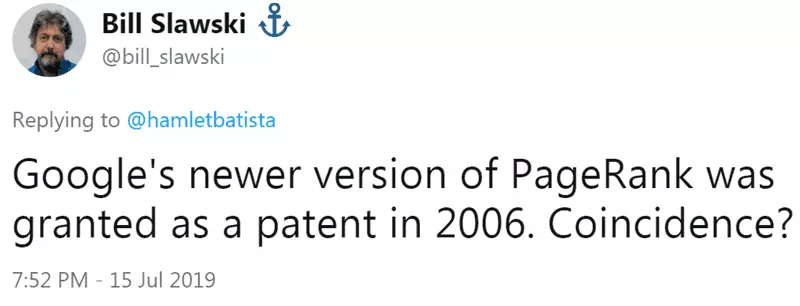
The late Bill Slawski extensively analysed Google’s link algorithms and noted the vulnerability of PageRank to spam farms and reciprocal “endorsement” loops.
He highlighted that many low-value links could still elevate a page’s rank because “every linking page is guaranteed to have a minimum PageRank… links from many such low-quality pages can still inflate the PageRank score” (Google patent reference).
Slawski also drew attention to Google’s efforts to combat manipulation – such as the “reasonable surfer” model, which gives different weights to links depending on how likely users are to click them (technical details here). Around that time, we described PageRank as a measure of link-derived authority – “the rank assigned to a document is calculated from the ranks of documents citing it” – a principle that Google itself defined in its own materials.
Notable Quotes and Metaphors
Bill often compared backlinks to votes or peer reviews, echoing Google’s own explanation that PageRank uses “information external to webpages — their backlinks — which provide a kind of peer review. Backlinks from ‘important’ pages are considered more significant… by recursive definition” (Google patent reference).
This idea of “link votes” mirrored Google’s internal philosophy. In my own practical guides, I stressed that “Google has long worked by displaying organic results based on keywords and links” – reinforcing that link authority, or PageRank, still underpins modern ranking outcomes.
Accuracy in Hindsight
Looking back, those early interpretations were remarkably accurate. PageRank truly became the foundational ranking factor within Google’s system, and the advice to acquire high-quality backlinks was prescient.
Bill Slawski’s early warnings about link spam predicted the very manipulative tactics Google would later fight internally (documented in its patents). Although many additional signals have since been integrated into Google’s algorithm, evidence presented during the 2023 DOJ trial confirmed that PageRank – or evolved derivatives of it – remains an active component of search ranking today.
The Evolution of TrustRank: From PageRank to Link Trust
As the web expanded, link spam – artificial link networks or “link farms” – began undermining the reliability of Google’s original PageRank system.
In response, researchers (including some who later joined Google) developed TrustRank, an evolution of PageRank that emphasizes trustworthiness over raw link popularity.
A Google patent on link-spam detection defines TrustRank as “a link analysis technique related to PageRank” and “a method for separating reputable, good pages on the Web from web spam.” It works on the principle that good websites seldom link to spam sites.
TrustRank operates in two steps: first, human experts identify a small seed set of highly trustworthy pages; second, a propagation algorithm spreads a trust score outward through the web graph. As the patent notes, “TrustRank involves two steps, one of seed selection and another of score propagation. [Thus] the TrustRank of a document is a measure of the likelihood that the document is a reputable (i.e., non-spam) document.”
Google implemented this concept internally to downweight webspam and elevate authoritative content. Rather than counting all backlinks equally, links from trusted seed pages carry greater value — effectively running a biased PageRank that starts from verified, reputable nodes.
A later Google patent describes “select[ing] a few ‘trusted’ pages (also referred to as seed pages) and [finding] other pages likely to be good by following the links from the trusted pages.” By crawling outward from this set of high-quality seed pages and measuring link distance (the number of hops or weighted path length), Google can calculate a trust score for each page based on its proximity to trusted sources.
Pages closely linked to the trusted seeds earn higher trust scores, while those further away — or connected mainly through untrusted links — are considered less reliable.
This distance ranking approach, patented by Google, reduces the influence of spam farms: “good documents on the Web seldom link to spam,” and therefore spam pages naturally end up many link-hops away from the reputable core.
In practice, Google can use TrustRank to demote or filter pages with high PageRank but low trust. One Google filing even notes that the system may compute a discrepancy between link-based popularity (PageRank) and trustworthiness (TrustRank) to identify artificially boosted pages.
In essence, a page with many backlinks may still rank poorly if those links come from low-trust sources.
By the late 2000s, Google’s ranking algorithms had begun to incorporate such link quality assessments alongside link quantity, reinforcing the enduring principle that not all links are equal.
Usage: TrustRank (and related “link distance” signals) are believed to operate internally as part of Google’s ranking and anti-spam frameworks. While Google has never publicly branded the system “TrustRank,” several Google patents and research papers describe the method of using a seed set of reputable documents whose trust values are propagated through the link graph to influence overall ranking.
In summary, TrustRank evolved PageRank by introducing a crucial layer of link reliability, ensuring that a page’s ranking reflects not only the number of its backlinks but also the trustworthiness and quality of those linking sources.
Observations (Bill Slawski)
Bill Slawski closely followed Google’s developments around trust. He noted that “Google TrustRank is very different from Yahoo’s TrustRank… Yahoo’s TrustRank identifies spam, whereas Google developed a system for reordering rankings of web pages based on trust signals” (source).
Years before Google’s trial revelations, Slawski discussed patents describing how trusted seed sites could influence rank. In one such patent, “the system assigns lengths to links, computes the shortest distances from seed pages to each page, and determines a ranking score based on those computed shortest distances.” In simpler terms, Bill explained that pages closer – in link hops – to authoritative or trusted sites would rank higher, encapsulating the essence of TrustRank as a measure of “distance from authority sites.”
Distance and Trust Metrics
Slawski explicitly connected Google’s trust metrics to what he described as the “distance between documents.” He highlighted that Yahoo’s TrustRank “diminishes with increased distance between documents” and depends on carefully selected seed sets (further reading). Google appeared to mirror this approach, as evidenced by a 2019 analysis by Slawski showing a patent for ranking pages based on how “close or distant” they are to trusted seed sites.
This “seed set distance” metaphor became Slawski’s shorthand for translating Google’s internal ranking logic into SEO-friendly terms. I often discussed “authority” in similar language — echoing both Slawski and Jim Boykin – and recommended acquiring backlinks from .gov, .edu, or established community hubs to convey trust, a strategy fully aligned with Google’s evolving TrustRank principles.
Reverse-Engineering Google’s Trust Logic
Bill Slawski (RIP) effectively reverse-engineered Google’s thinking through meticulous patent analysis. He identified that Google aimed to compute a “trust score” to combat low-quality or spammy results. This intuition was confirmed when Pandu Nayak revealed that Google added an explicit quality/trust metric around 2011 to counter the surge of content farms.
My own emphasis on site credibility, authoritative backlinks, and user trust anticipated what Google would later formalise as its E-A-T principles (Expertise, Authoritativeness, Trustworthiness). In hindsight, the guidance many of us shared — to “stay close to trusted authorities,” both literally within link graphs and figuratively in reputation — proved remarkably accurate.
Our early predictions, along with those of contemporaries such as Rand Fishkin, correctly foresaw that Google would integrate trust evaluations directly into its ranking systems – a fact since validated by DOJ trial exhibits and Google’s own patents.
PageRank’s Role Today
Even as Google’s algorithm has become vastly more complex, it still uses PageRank internally in 2025 – and as my friend David at Primary Position correctly argues, it is certainly still in use.
Pagerank is one factor – a very important foundational factor – among hundreds, now usually mediated through higher-level scores like Q*.
QUOTE: “A key quality signal is PageRank, which captures a web page’s quality and authoritativeness based on the frequency and importance of the links connecting to it.”UNITED STATES OF AMERICA et al v. GOOGLE LLC, No. 1:2020cv03010 – Document 1436 (D.D.C. 2025) Justia, 2025
From my own personal research delving into the Google Content Warehouse api leak from 2024, I have counted twelve (perhaps 13) variants of Pagerank (but note that this is first-hand research and logical inference by myself – no one outside of Google knows the very latest configuration of the Google algorithm, naturally):
| PageRank Attribute | Function / Description (inferred from leak analysis) | Status (Inferred) |
PageRank-NearestSeeds (or pagerank_ns) |
The “modern evolution of PageRank.” A “seed-based” score influenced by proximity to trusted “seed” sites. | Active |
PageRankPerDocData |
The core, foundational PageRank score is calculated and stored for every single document (URL). | Active |
homepagePagerankNs |
The PageRank score is specifically for the site’s homepage. This score is stored as a distinct signal. | Active |
sitePr |
A signal for a site’s PageRank, used as a proxy for authoritativeness. | Active |
csePagerankCutoff |
A threshold, not a score. A document’s PageRank must be above this cutoff value to be included in a Google Custom Search Engine (CSE). | Active |
toolbarPagerank |
A copy of the historical, public-facing PageRank score (0-10). | Deprecated |
scaledIndyRank |
Another form of link-based ranking score, “possibly derived from an earlier version of Google’s index, codenamed ‘Indy'”. | Legacy |
PageRank |
An experimental PageRank value, noted in PerDocData.proto as “not used in serving”. |
Deprecated / Experimental |
Pagerank0 |
A variant PageRank value, purpose unclear. | Experimental |
Pagerank1 |
A variant PageRank value, purpose unclear. | Experimental |
Pagerank2 |
A variant PageRank value, purpose unclear. | Experimental |
crawlPagerank |
Used by the docjoiner (the system that processes documents) to forward PageRank between canonical URLs. |
TBC |
Google’s own public documents affirm some of this.
In a 2019 white paper on combating disinformation, Google noted that “the best known of these signals is PageRank, which uses links on the web to understand authoritativeness.” searchengineland.com
In other words, link-based authority (PageRank) remains a fundamental signal for evaluating a page’s trust and expertise.
Google’s search engineers continue to value the “distance from a known good source” that PageRank-style algorithms provide.
“QUOTE: PageRank. This is a single signal relating to distance from a known good source, and it is used as an input to the Quality score”. justice.gov, 2025
However, they no longer rely on raw PageRank alone. As Google’s John Mueller explained, modern ranking is “not just PageRank of course…there are lots of different topics in there and PageRank is more or less a side comment.” searchengineland.com
PageRank has effectively been subsumed into composite metrics like quality score and into specific applications (e.g. identifying authoritative seed sites, boosting trusted domains, etc.).
In summary, PageRank’s evolution over two decades reflects Google’s shifting focus from quantity of links to quality of content and trust.
The original PageRank algorithm (circa 1998) introduced the paradigm of ranking by link popularity (with a damping factor ~0.85 to model random surfing) snap.stanford.edu.
TrustRank and related link-distance algorithms (mid-2000s) built on this by prioritising links from vetted “trusted” pages and demoting spam, under the principle that “good pages seldom link to bad ones.”patents.google.com
And in the 2010s, “QRank” or page quality scores further blended PageRank with numerous other signals to measure a page’s true authority and reliability, addressing content quality issues beyond links.
Today, Google’s ranking uses a sophisticated mix of these factors:
PageRank is still there under the hood, informing the algorithm about the link-based authority of pages justice.gov, but it operates in concert with semantic relevance models, machine learning systems (like RankBrain and BERT-based RankEmbed stradiji.com), user feedback metrics, and domain-level quality evaluations.
As a result, Google Search can surface results that are not only popular in the link graph, but also trusted, expert, and satisfying – fulfilling the original goal of PageRank (“bringing order to the web” by leveraging links snap.stanford.edu) while adapting to the modern web’s challenges.
Does Google Tell Us Our PageRank Score?
QUOTE: “Retiring the PageRank display from Toolbar helps avoid confusing users and webmasters about the significance of the metric.” John Mueller, Google, 2016
No.
What Was Toolbar Pagerank?
“The PageRank display from Toolbar” was known as Toolbar PR, a simplification of REAL PageRank that was published for webmasters. In the latter years, a Toolbar PageRank score was unrelated to where you actually ranked (because of the quality metric Google added).
Toolbar PageRank, the public version of PageRank shown in browser toolbar plugins, has been completely phased out by Google and is deprecated at least for public use (although it is still annotated within the api leak as the attribute toolbarPagerank). In fact, this encapsulates the usefulness of the leak when attributing ranking considerations. There’s no argument that Google has an attribute called toolbarPagerank and that it refers to Toolbar Pagerank. We don’t actually know what PageRank is these days, but we see descriptive names where we can infer something of what they measure.
How To Check Your Website’s Google PageRank
You can’t check your real Google PageRank (unless you work at Google).
QUOTE: “We’ve been telling people for a long time that they shouldn’t focus on PageRank so much; many site owners seem to think it’s the most important metric for them to track, which is simply not true. We removed it because we felt it was silly to tell people not to think about it, but then to show them the data, implying that they should look at it. :-),” Susan Moskwa, Google, 2014
Will A Higher Google PageRank increase My Rankings?
Yes, but not necessarily.
Google has other quality algorithms that look at user experience, ad placement and website content quality scoring. All of these together determine where a page ranks, not just PageRank, although it was admitted in the DOJ trial that PR is still used.
Should I Nofollow External Links To Keep Google Pagerank?
QUOTE: “I’d recommend not using nofollow for kind of PageRank sculpting within a website because it probably doesn’t do what you think it does” John Mueller, Google 2017
No.
In any case, there’s a much better reward, in most cases, in linking out and building relationships with like-minded authors on other sites than to hoard Google PageRank.
Do not fear linking to trustworthy sites.
Your site is more valuable to Google and other search engines if you link out sensibly and editorially.
More importantly, it’s more valuable to other webmasters and ultimately to users.
When was the Last Google Toolbar PageRank update?
The Last Toolbar PageRank update was on 5/6 December 2013.
When will the next Google Toolbar PageRank Update happen?
It won’t.
The Last Toolbar Pagerank Update was 5/6 December 2013, and Google declared thereafter:
QUOTE: “PageRank is something that we haven’t updated for over a year now, and we’re probably not going to be updating it again gong forward, at least the Toolbar version.” John Mueller, Google 2014
True to their word, Google hasn’t updated Toolbar PageRank publicly since.
Key Take-aways
PageRank & Link-Based Authority: One of the oldest authority signals is Google’s famous PageRank algorithm, which treats links as “votes” of confidence.
Kim described PageRank as “a single signal relating to distance from a known good source” – essentially measuring how far removed a webpage is from trusted, reputable sites on the web justice.gov.
In the trial, he confirmed that Google “uses [PageRank] as an input to the Quality score.” justice.gov In practice, a page linked by many high-authority sites will inherit some authority itself.
This link-based authority is one component of the overall page quality/Q★ score. (For example, a university or government site linking to a page conveys a level of trustworthiness to that page.)
By feeding PageRank into the quality metric, Google combines traditional link popularity with other quality assessments to rank authoritative content higher.
 This is a preview from my new ebook – Strategic SEO 2025 – a PDF which is available to download for free here.
Disclosure: Hobo Web uses generative AI when specifically writing about our own experiences, ideas, stories, concepts, tools, tool documentation or research. Our tool of choice is in this process is Google Gemini Pro 2.5 Deep Research. This assistance helps ensure our customers have clarity on everything we are involved with and what we stand for. It also ensures that when customers use Google Search to ask a question about Hobo Web software, the answer is always available to them, and it is as accurate and up-to-date as possible. All content was verified as correct by Shaun Anderson. See our AI policy.